
Primary Science Topics by Level: P3 to P6 MOE Guide for Parents
Use this Primary Science topics by level guide to see what P3 to P6 children learn, what gets harder before PSLE, and how to support revision.
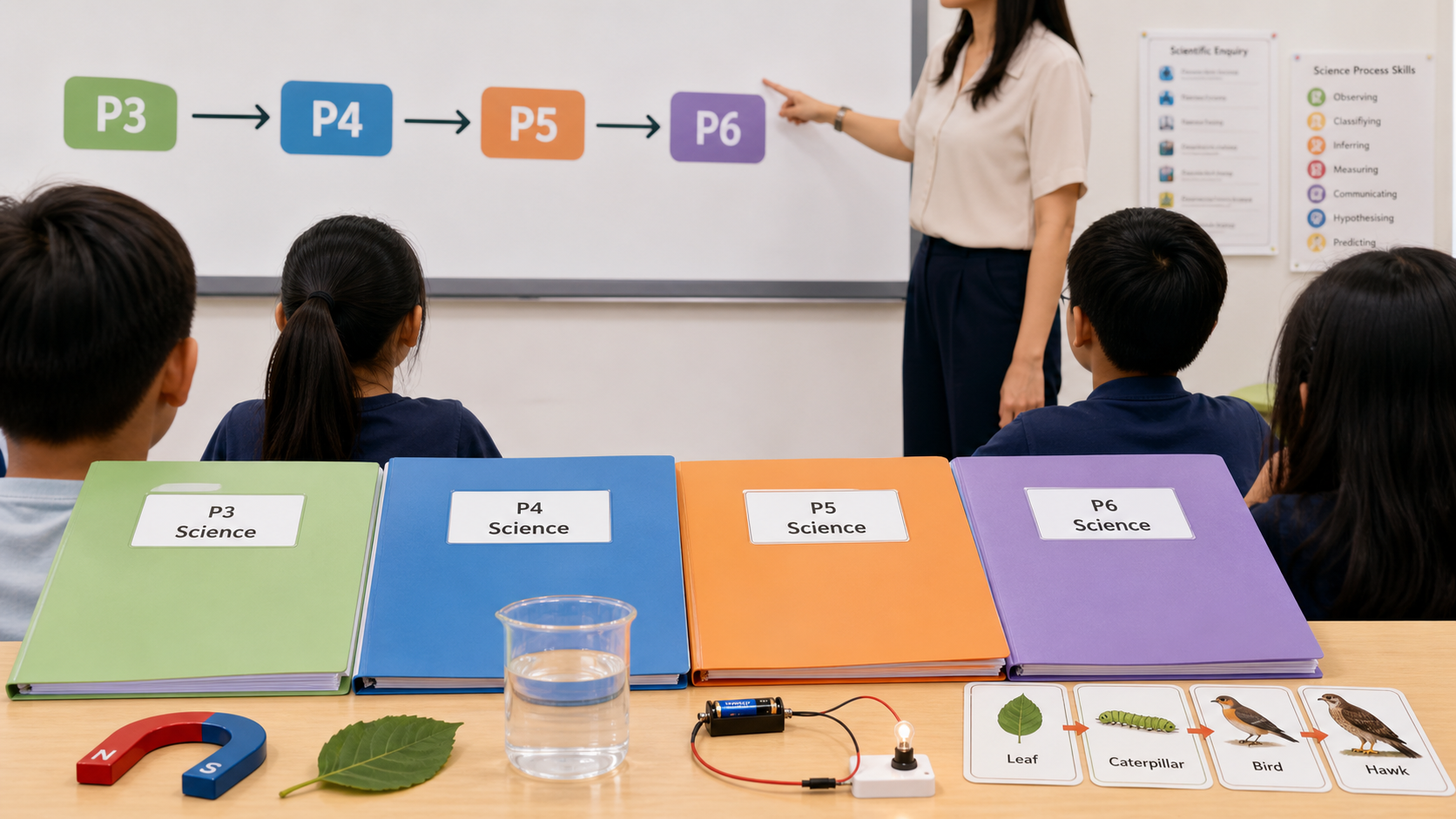
Singapore Primary Science starts formally in P3. From P3 to P6, children move from observing and classifying living things to explaining systems, cycles, energy, forces, environments, and open-ended questions.
If you are trying to work out what your child should revise, the level matters. A P3 child needs careful observation and correct terms. A P5 or P6 child needs to connect concepts, diagrams, experiments, and written explanations. This guide gives you a parent-friendly map of Primary Science topics by level in Singapore, plus the next pages to read when your child needs more focused help.
Key Takeaways
- Formal MOE Science starts at P3 in Singapore primary school.
- P3 and P4 build the foundation: P3 covers diversity of living and non-living things, materials, life cycles, and magnets; P4 moves into plant and human systems, cycles in matter and water, light, and heat.
- P5 becomes more demanding because children learn reproduction, water cycle, plant transport, respiratory and circulatory systems, and electrical systems.
- P6 is PSLE-focused, with photosynthesis, energy conversion, frictional force, gravitational force, elastic spring force, and interactions within the environment.
- Content knowledge is not enough. In upper primary, children also need to explain answers clearly in Science open-ended questions.
Quick Answer
See the Primary Science topic map by level, then choose focused guides for revision.
Recommended Next Guides and Practice
Primary Science Topics By Level
Use this as the quick map.
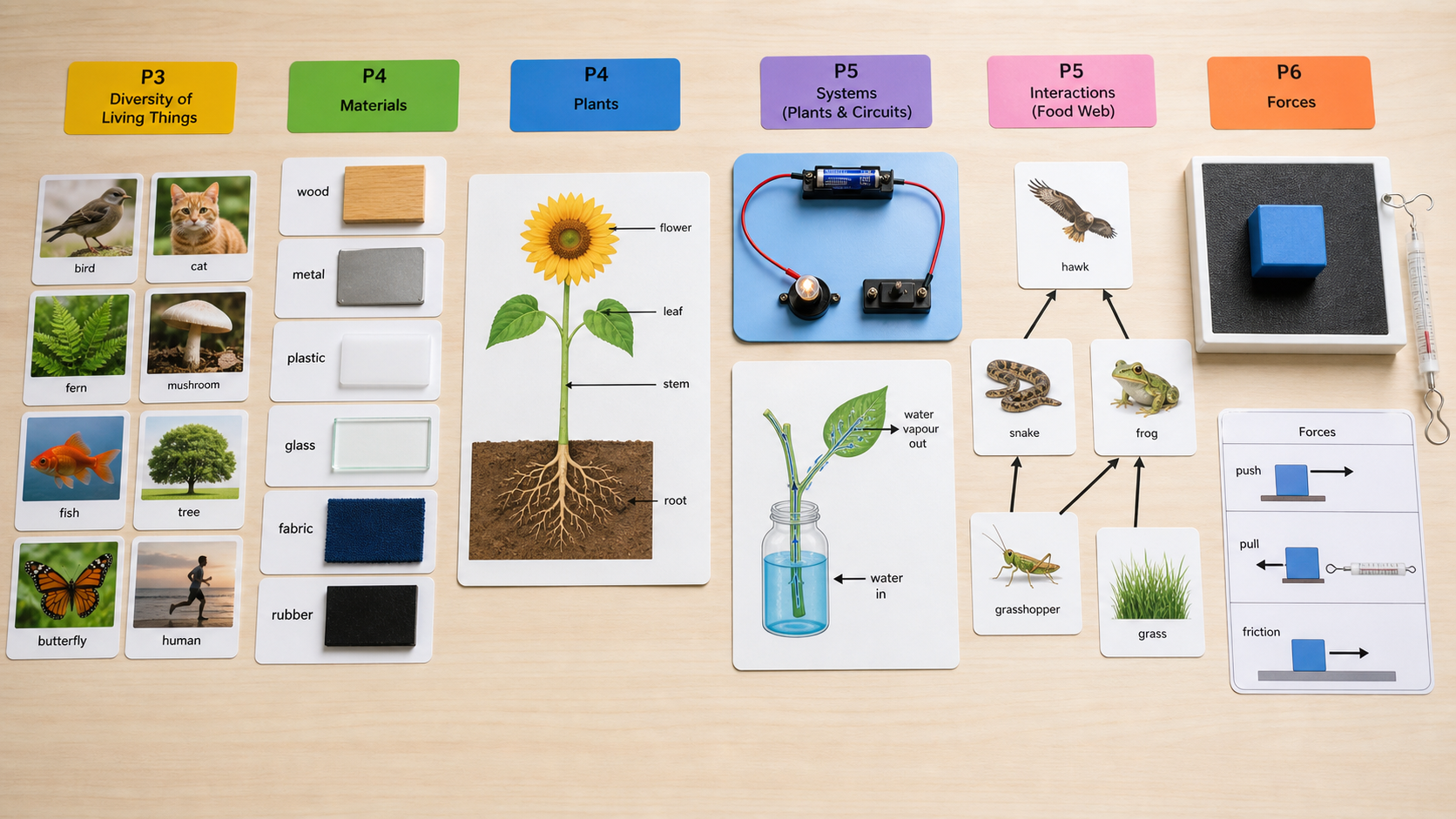
Level | Main Science topics | Parent watch-out |
P3 | Diversity of living and non-living things, diversity of materials, life cycles in plants and animals, magnets | Your child must observe carefully and classify accurately |
P4 | Plant system, digestive system, cycles in matter and water, light, heat | Your child must explain changes, effects, and functions |
P5 | Reproduction, water cycle, plant transport, respiratory and circulatory systems, electrical system | Your child must connect systems and explain experiments |
P6 | Photosynthesis, energy conversion, frictional force, gravitational force, elastic spring force, interactions within the environment | Your child must combine concepts in PSLE-style open-ended questions |
From P5, Science can be taken at Standard or Foundation level, so the exact scope may differ. The 2026 PSLE Science paper 0009 is the Standard paper, and SEAB's 2026 Science format assesses knowledge, application, scientific inquiry, explanations, and reasoning.
Think of the syllabus as a staircase. P3 and P4 build the language of Science. P5 and P6 test whether your child can use that language when the question is unfamiliar.
P3 Science Topics Singapore
P3 is the first formal year of Primary Science. The focus is on noticing features, sorting things into groups, and describing what makes something similar or different.
Common P3 Science topics include:
diversity of living and non-living things
diversity of materials and their properties
life cycles of plants and animals
magnets and their properties
At this level, the hard part is usually not long written answers. It is careful observation. A child may know that an animal is a fish, but still struggle to explain which features show that it belongs to that group.
At home, the useful move is not to push PSLE-style revision too early. Help your child speak clearly about what they observe. Ask, "What feature tells you that?" or "What property makes this material suitable?"
For the detailed level guide, read Primary 3 Science in Singapore: Your Child's First Year of Scientific Thinking.
P4 Science Topics Singapore
P4 Science starts to move from "what is this?" to "how does this work?"
Common P4 Science topics include:
states and changes of matter
measuring mass and volume
plant system, including roots, stems, leaves, and their functions
human digestive system
light and shadows
heat and temperature
This is where children begin to explain functions and effects. They are no longer only naming parts of a plant. They need to say what the roots, stem, and leaves do. They are no longer only recognising that a shadow forms. They need to explain what blocked the light and how the shadow was formed.
It is tempting to treat P4 Science as memorisation. Keywords help, but children also need to complete the cause-and-effect sentence. If your child says "because of heat", ask, "Because of heat, what changed?"
For the full level guide, read Primary 4 Science in Singapore: Systems, Energy, and How Things Change.
P5 Science Topics Singapore
P5 is where Science starts to feel like upper primary Science. The topics are heavier, the systems are more connected, and children need to write clearer explanations.
Common P5 Science topics include:
reproduction in plants and animals
water cycle and factors affecting evaporation
plant transport system
human respiratory system
human circulatory system
electrical systems
This is also the level where many parents notice the gap between "my child understands when I ask aloud" and "my child loses marks in written answers".
Take plant transport as an example. It is not enough for a child to say, "The plant cannot get water." A stronger answer explains that the water-carrying tubes were removed, so water could not be transported from the roots to the leaves.
For body systems, the same pattern appears. Children need to explain how the respiratory and circulatory systems work together. They do not need secondary-school-level details like alveoli, heart chambers, or named blood vessels. They do need to understand that air enters the lungs, oxygen passes into the blood, and blood transports oxygen to different parts of the body.
For electrical systems, terminology matters too. Use "closed circuit", not "complete circuit". Children should know the basic components: battery, wire, bulb, and switch. They should also recognise the symbols for these components because the P5 syllabus includes constructing simple circuits from circuit diagrams.
P5 is not the PSLE year, but it is when PSLE-style habits begin to matter. If your child is struggling here, check whether they can explain the concept in a complete sentence and use evidence from the diagram, setup, table, or observation.
For the detailed level guide, read Primary 5 Science in Singapore: Reproduction, Body Systems, and Electrical Circuits. If the issue is answer writing, start with P5 Science Open-Ended Questions: How To Improve.
P6 Science Topics For PSLE
P6 Science pulls the earlier years together. Your child learns new topics while applying older concepts in unfamiliar setups.
Common P6 Science topics include:
photosynthesis
energy conversion for Standard stream
forces, including friction, gravity, and elastic spring force for Standard stream
food chains and food webs
habitats, communities, populations, and adaptations
interactions within the environment
P6 questions often require several thinking steps. A food web question may ask what happens to one organism when another decreases. A forces question may ask why a block moves a shorter distance on a rough surface. An adaptations question may ask whether an organism can survive in a new habitat based on its features.
The child has to identify the Science concept, use the evidence in the question, and explain the cause-and-effect link clearly.
For P6 Standard Science, be careful with syllabus boundaries. Energy conversion is a Standard topic. Elastic spring force is also Standard. Magnets are introduced earlier at P3, and air resistance or water resistance should not be treated as standalone required Primary Science terms.
For the full level guide, read Primary 6 Science in Singapore: PSLE Topics and Revision Guide. If your child is losing marks in written answers, read P6 Science Section B: How To Improve Before PSLE and Primary Science Open-Ended Questions: Parent Guide.
Why Science Gets Harder In Upper Primary
Upper primary Science feels harder because the question format changes the demand.
In P3 and P4, many questions check whether the child can name, observe, classify, and describe. In P5 and P6, the child must often explain relationships:
how one system affects another
how a variable changes an outcome
why a setup is or is not a fair test
how a feature helps an organism survive
why an observation happened
what will happen next based on a food chain, circuit, or experiment
This is where Science open-ended questions become important. A weak answer says, "The object stopped because of friction." A stronger answer explains that friction acts between the object and the surface, opposes the motion, and causes the object to slow down.
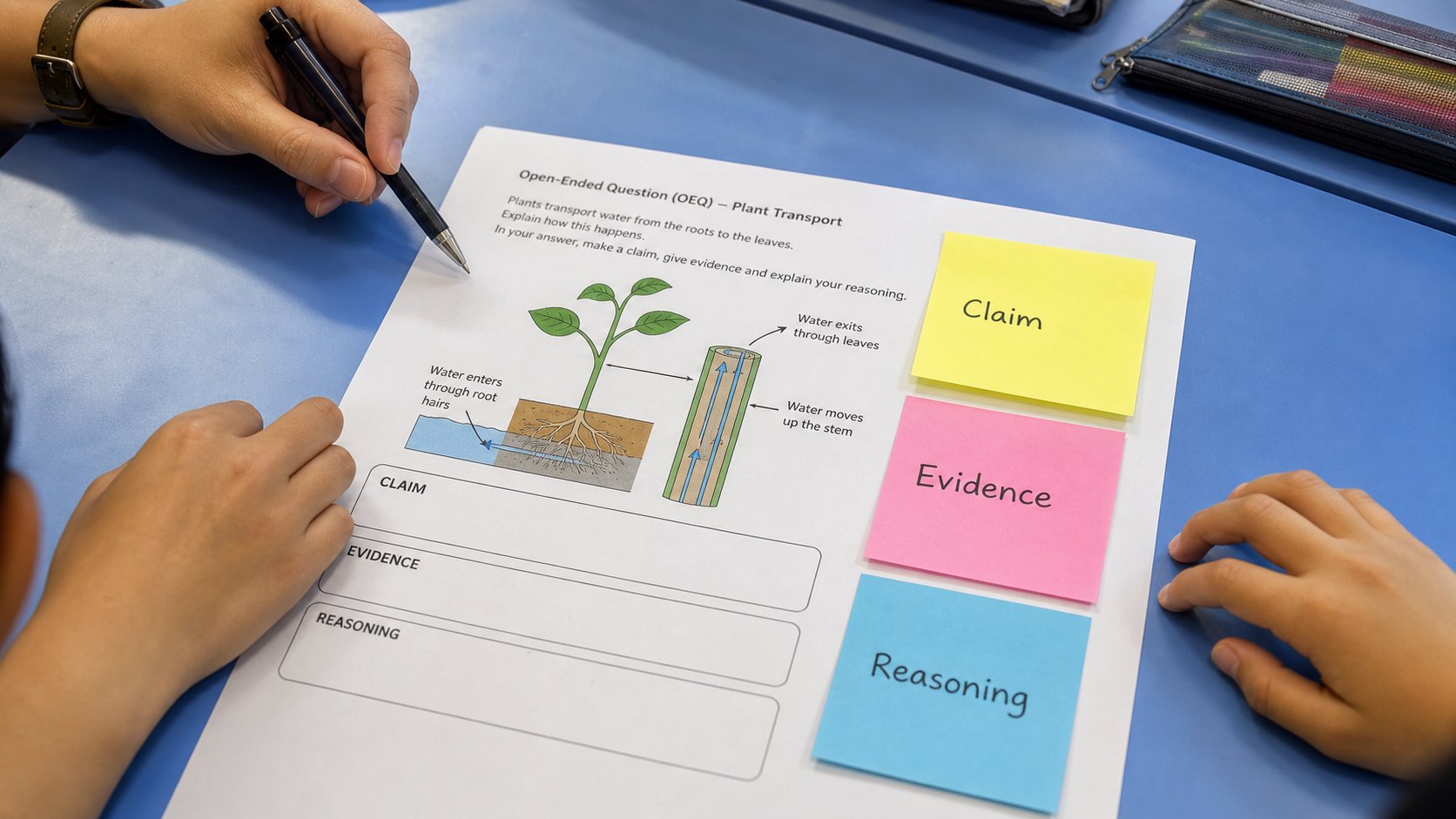
If your child can do MCQ but loses marks in OEQs, read Science MCQ vs Open-Ended Questions: Why Children May Struggle With OEQs. If they need a structure for written explanations, use Claim, Evidence, Reasoning For Primary Science Answers.
How Parents Can Use This Topic Map
Do not try to revise every topic at once. Use the level map to decide the next step.
1. Start With Your Child's Current Level
If your child is in P3 or P4, build foundation habits: observe carefully, compare features, classify accurately, and explain functions in simple sentences.
If your child is in P5 or P6, add application habits: read the command word, identify the concept, use evidence from the question, explain the cause-and-effect link, and check whether the answer matches the mark value.
2. Separate Content Gaps From Answering Gaps
A content gap means your child does not understand the Science idea yet. An answering gap means your child understands the idea, but cannot express it clearly enough for marks.
These need different fixes. A content gap needs reteaching. An answering gap needs worked examples, sentence practice, and feedback.
3. Use Broad Guides First, Then Topic Spokes
Use the level guides when you need the big picture. Use topic-specific articles when one area keeps causing trouble, such as P5 plant transport, P5 respiratory and circulatory systems, P6 forces, or P6 energy conversion.
That is how this Science topic cluster will grow: one hub, refreshed level guides, and deeper topic spokes.
4. Add OEQ Practice When Marks Are Being Lost In Writing
If your child says, "I know it but I don't know how to write it," more notes may not solve the issue. Use a routine like Claim, Evidence, Reasoning:
Part | What your child writes |
Claim | The direct answer |
Evidence | The clue from the question |
Reasoning | Why the evidence supports the answer |
How Ottodot Supports Primary Science
Ottodot teaches MOE-aligned Primary Science through live teacher-led online classes, guided practice, homework, and Roblox-based application after the concept has been taught.
For lower primary Science, the focus is on observation, classification, and basic explanations. For upper primary Science, the focus shifts toward PSLE-ready topic understanding, OEQ reasoning, precise keywords, and written-answer feedback.
The game-based practice is not the whole lesson. The teacher teaches the concept first. Students then apply the idea in structured practice so the topic becomes more concrete and memorable.
Check my child's fit to see whether Ottodot's Science classes match your child's level, learning concerns, and current revision needs.
For class details, you can also explore Lower Primary Science or Upper Primary Science.
Frequently Asked Questions
When does Science start in Singapore primary school?
Formal MOE Science starts at P3 in Singapore primary school. P1 and P2 may have enrichment or exposure activities, but they are not formal Primary Science examination levels.
What are the main P5 Science topics?
The main P5 Science topics include reproduction in plants and animals, water cycle, plant transport system, human respiratory and circulatory systems, and electrical systems.
What are the main P6 Science topics for PSLE?
The main P6 Science topics include photosynthesis, energy conversion, forces, food chains, food webs, habitats, communities, populations, adaptations, and interactions within the environment.
Is P5 Science already PSLE preparation?
P5 is not the PSLE year, but it is an important preparation year. Many major upper-primary Science topics are introduced in P5, and children begin to need stronger open-ended explanation skills.
Why can my child know the Science concept but still lose OEQ marks?
Usually, the missing piece is evidence or reasoning. The child may know the topic, but the written answer may not use the diagram, table, setup, observation, or cause-and-effect explanation required by the question.
New P5 And P6 Topic Guides
For more focused revision, use these topic guides next: P5 Plant Transport System, P5 Respiratory And Circulatory Systems, P6 Forces, P6 Energy Conversion And Photosynthesis, and P6 Food Chains And Food Webs.