
P6 Energy Conversion And Photosynthesis: PSLE Science Guide For Parents
Use this P6 energy conversion photosynthesis guide to explain how plants make food, energy changes, experiments, and PSLE Science OEQs clearly.
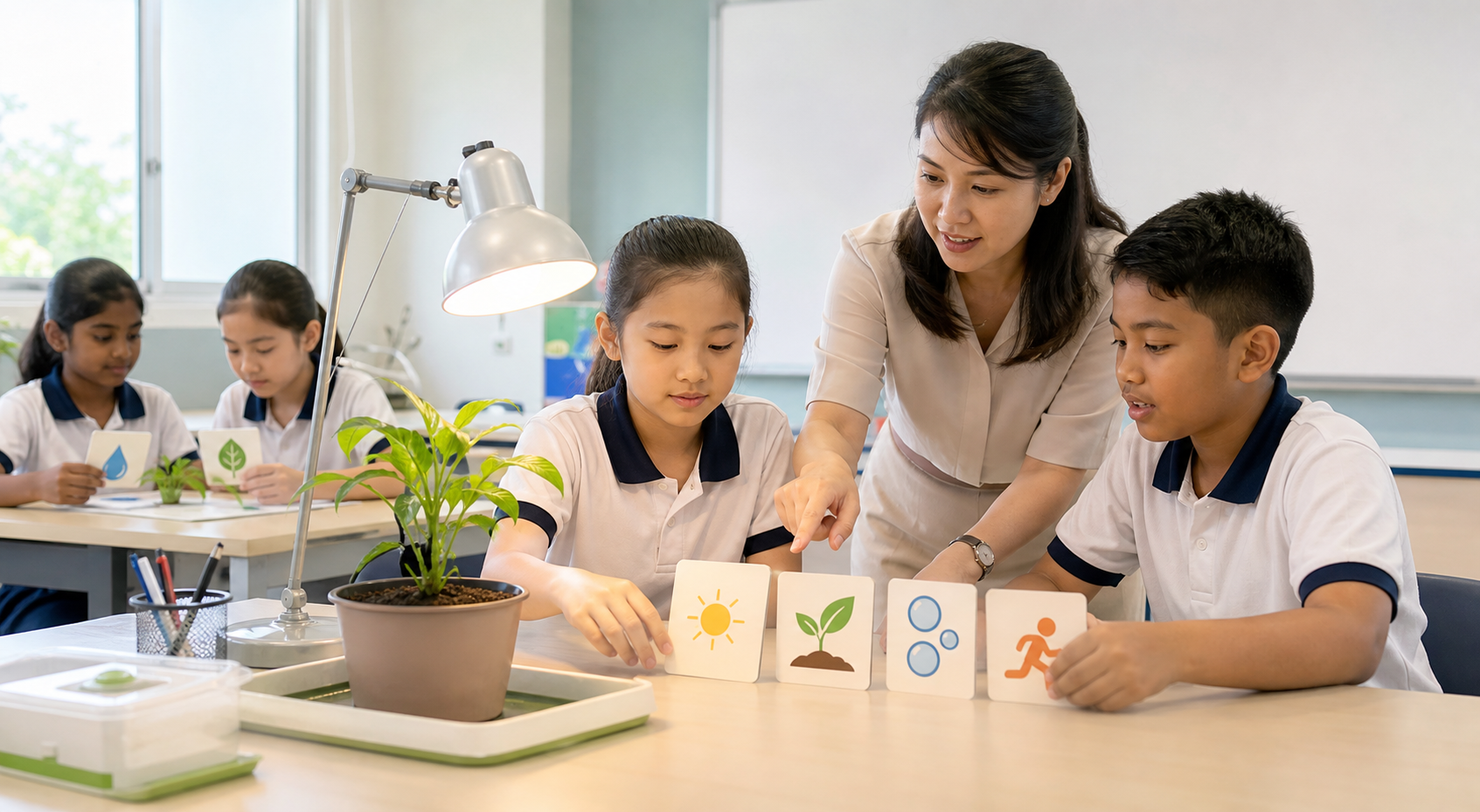
This P6 energy conversion photosynthesis guide explains how energy is used, changed, and passed on in living things and everyday setups. In P6 Science, photosynthesis explains how plants use light, water, and carbon dioxide to make food. Energy conversion explains how energy changes from one form to another.
For PSLE Science, the challenge is not memorising a list of energy forms. It is knowing which energy form is involved, what changes in the setup, and how to explain the observation clearly.
This guide follows the MOE primary syllabus overview and the SEAB PSLE Science format for 2026.
Key Takeaways
- Photosynthesis is a P6 Science topic.
- Energy conversion is P6 Standard Science only.
- Plants use light, water, and carbon dioxide to make food, and oxygen is produced.
- Energy conversion questions require children to identify starting and ending energy forms.
- Strong OEQ answers use the experiment variable and the observation.
Quick Answer
Link photosynthesis, producers, and energy conversion to clear OEQ explanations.
Recommended Next Guides and Practice
What P6 Photosynthesis Covers
Photosynthesis is the process where plants make food.
At primary level, your child should know that plants need:
light
water
carbon dioxide
During photosynthesis, plants make food and produce oxygen. The Sun is the primary source of energy for this process.
A clear P6 explanation sounds like this:
The plant uses light, water, and carbon dioxide to make food during photosynthesis. Oxygen is produced.
That is enough. Your child does not need to overcomplicate the answer with secondary-school details. If the question asks about a plant growing better in light, the explanation should connect light to photosynthesis and food-making.
What P6 Energy Conversion Covers
Energy conversion means energy changes from one form to another.
For P6 Standard Science, common energy forms include:
Energy form | Simple example |
Light energy | Light from the Sun or a lamp |
Heat energy | Heat from a stove or heated object |
Sound energy | Sound from a ringing bell |
Electrical energy | Energy from a battery or mains supply |
Kinetic energy | Energy of a moving object |
Potential energy | Stored energy |
Use "potential energy" as the primary-level term. Some resources split it into more detailed subtypes such as gravitational, elastic, and chemical, but these specific wordings or labels are not required for PSLE 2026 Science.
The habit your child needs is to ask:
What energy is present at the start?
What energy is present at the end?
What observation shows the conversion?
For example, in a torch, electrical energy from the battery is converted to light energy and heat energy. In a moving toy car, stored energy may be converted to kinetic energy.
How Photosynthesis And Energy Are Connected
These topics are often taught separately, but they are linked.
The Sun provides light energy. Plants use light energy during photosynthesis to make food. The food made by plants stores energy that living things can use. Animals obtain energy by eating plants or other animals.
This connection matters because it prepares children for later P6 topics such as food chains and food webs. A food chain is not only about "who eats what". It also shows how energy is passed from one organism to another.
So when your child studies photosynthesis, do not treat it as an isolated plant topic. It is part of a bigger P6 idea: energy starts from the Sun, plants make food, and living things depend on that food for energy.
Worked Example: Photosynthesis Equation
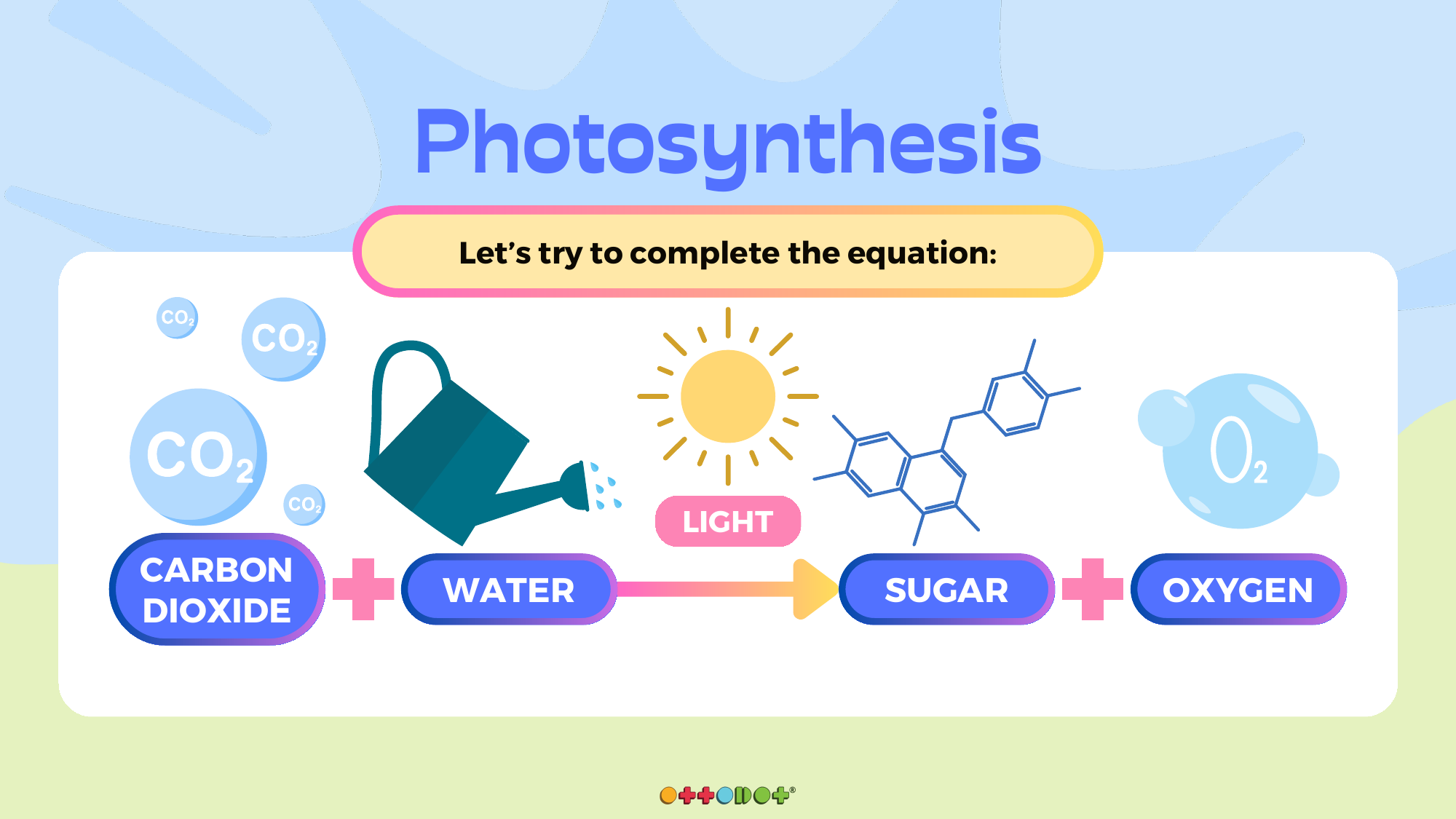
In the 16:9 lesson slide, students complete the photosynthesis equation using the materials and products shown.
A weak answer might be:
Plants need sunlight to make food.
That is true, but the slide is asking for the full process, not only one condition.
A stronger answer would be:
Plants use carbon dioxide and water in the presence of light to make sugar and oxygen during photosynthesis.
This answer matches the slide because it names both materials, the light condition, and both products.
Worked Example: Energy Conversion In A Moving Object
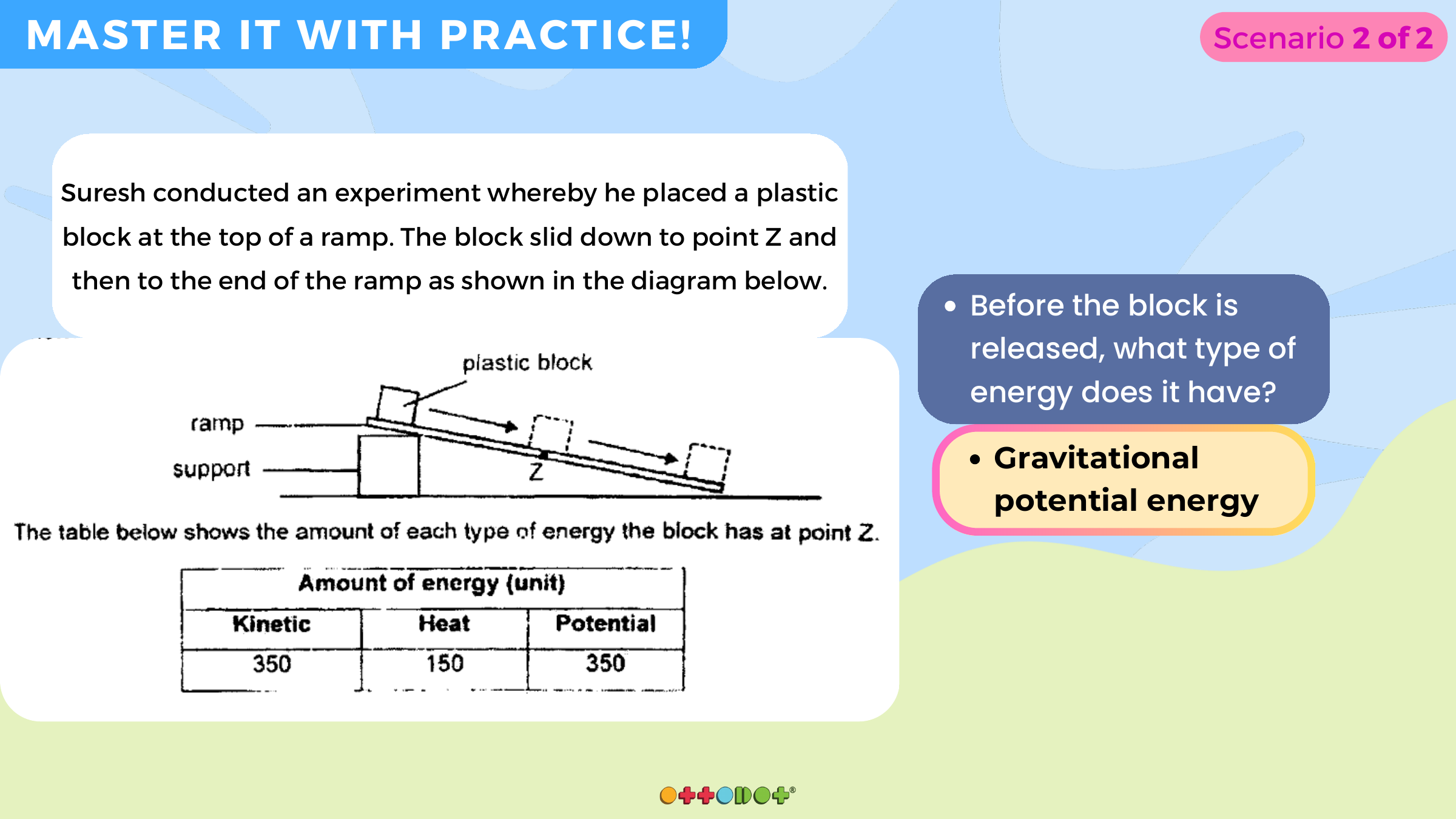
In the lesson slide, a plastic block is placed at the top of a ramp and then slides down to point 2. The question asks for the type of energy the block has at point 2 before it is released.
A weak answer:
The block has energy because it can move down the ramp.
That does not name the energy form tested in the slide.
A stronger answer:
The block has potential energy at point 2 because it is raised above the ground. When it is released and slides down the ramp, that stored energy can be converted to kinetic energy.
This keeps the wording aligned with the lesson slide while still helping children see the conversion that happens after release. Ottodot may teach the types of potential energy for understanding, but the required PSLE wording can stay at "potential energy" unless the question or school asks for more detail.
Common OEQ Patterns
For photosynthesis, your child may see questions about:
plants placed in light and darkness
plants receiving different amounts of water
carbon dioxide being changed in an experiment
oxygen bubbles from an aquatic plant
why animals depend on plants for energy
For energy conversion, your child may see questions about:
a battery-powered device
a moving object
a lamp or buzzer
an object moving down a ramp
a setup that produces heat, sound, or light
The answer routine is similar:
Identify the changed condition or starting energy.
Name the relevant concept.
Explain what changes.
Link it to the observation.
For more help with Science explanations, read our Primary Science open-ended questions guide and P6 Science Section B guide.
Common Mistakes
Mistake 1: Saying photosynthesis is P5
Photosynthesis is a P6 topic. P5 students learn plant transport, not photosynthesis as a main topic.
Mistake 2: Saying plants stop all processes at night
It is better to say that plants need light to carry out photosynthesis. Avoid broad statements that go beyond the question.
Mistake 3: Using energy subtypes as required wording
For PSLE 2026 Science, use "potential energy" rather than requiring detailed subtype labels. The subtypes can support understanding, but children should not treat gravitational, elastic, or chemical potential energy as required answer wording unless taught that way by their school.
Mistake 4: Naming energy forms without explaining conversion
"Potential energy and kinetic energy" is not enough. The child should say which form is converted to which form.
Mistake 5: Ignoring the experiment variable
In photosynthesis experiments, the changed variable often carries the answer. Was light changed? Was water changed? Was carbon dioxide changed? The explanation should match that variable.
How Parents Can Help
Ask your child:
"What does the plant need to make food?"
"Which condition changed in this setup?"
"What energy form is at the start?"
"What energy form is produced?"
"What observation proves your answer?"
If your child gives a memorised sentence, point back to the diagram. Science OEQs are usually not asking for the whole topic. They are asking for the part of the topic that explains the setup.
How This Fits Into P6 Science
P6 energy links to several other topics. Photosynthesis connects to food chains because plants are the starting point for food and energy in many feeding relationships. Energy conversion connects to forces and experimental setups because children often need to describe what changes as an object moves.
For connected P6 revision, read P6 Forces and P6 Food Chains And Food Webs.
For the bigger P6 map, read Primary 6 Science in Singapore: Adaptations, Forces and the Road to PSLE and the Primary Science topics by level guide. For related environmental interactions, read our P6 Adaptations guide.
FAQ
Is photosynthesis taught in P5 or P6?
Photosynthesis is a P6 Science topic. P5 plant topics focus on plant transport, not photosynthesis as a main topic.
Is energy conversion for all P6 students?
Energy conversion is part of P6 Standard Science. Foundation Science has a narrower scope.
What is the safest wording for potential energy?
Use "potential energy" at primary level. Some resources split it into gravitational, elastic, or chemical potential energy for understanding, but those specific labels are not required for PSLE 2026 Science unless the school teaches them as enrichment.
How Ottodot Helps With P6 Energy OEQs
At Ottodot, students learn P6 Science through live teacher-led classes, guided examples, teacher-marked homework, and structured Roblox-based practice after the concept is taught. Teachers model how to read the setup, identify the changed variable or energy form, and decide what the answer must prove.
For energy and photosynthesis, students practise CER: make the claim, use evidence from the experiment or diagram, and explain the reasoning with precise Science keywords. The practice layer then helps students apply the same idea so it does not stay as a memorised sentence.
Ottodot's verified Energy in Food - Photosynthesis and Conversion of Energy OEQ games give students simulation-based practice after teaching. Students answer with scaffolding first, then try similar open-ended questions with less help. Weekly homework and class attempts give teachers a feedback loop to catch repeated gaps.
If your child can recite energy forms but struggles to apply them in PSLE-style questions, you can Check my child’s fit for Ottodot's Upper Primary Science classes.