
Primary Science Open-Ended Questions: Parent Guide
Help your child answer primary science open-ended questions with CER, worked examples, common mistakes, parent tips, and OEQ practice guidance for PSLE.

To answer Primary Science open ended questions well, your child needs to state the answer, use evidence from the question, and explain the reasoning with the correct Science concept. That is why a child can understand a topic when you ask them aloud, but still lose marks once they have to write the answer.
This guide explains how Primary Science open-ended questions work, where marks usually disappear, how Claim, Evidence, Reasoning helps, and what you can practise at home without turning revision into a fight.
Key Takeaways
- PSLE Science Booklet B has 10 to 11 structured questions worth 40 marks in the 2026 format.
- Most lost open-ended question marks come from four gaps: concept, evidence, expression, or transfer.
- CER means Claim, Evidence, Reasoning. It helps children turn a vague answer into a mark-worthy explanation.
- A good Science OEQ answer uses details from the question instead of relying on memorised keywords.
- Short weak-to-strong answer rewrites are often more useful than doing another full paper.
If your child keeps losing marks in Science open-ended questions (OEQs), start by finding the gap. Ottodot's P3 to P6 Science classes teach students to read the question, use evidence, and improve written answers across topics.
Use this page as the main guide for the Science OEQ cluster. If you already know your child's specific gap, go deeper with our guides to P5 Science open-ended questions, P6 Science Section B, Claim, Evidence, Reasoning for Primary Science, Science MCQ vs open-ended questions, and why children lose marks in Science open-ended questions.
What Are Primary Science Open Ended Questions?
Primary Science open-ended questions are written-response questions. Instead of choosing from four options, students have to explain, compare, predict, conclude, or justify an answer in their own words.
In the official 2026 PSLE Science format from SEAB, the Science paper has two booklets. Booklet A has 30 multiple-choice questions worth 60 marks. Booklet B has 10 to 11 structured questions worth 40 marks. These structured questions are what parents often call OEQs or Section B questions.
Science begins from Primary 3 in Singapore. The PSLE stakes arrive in Primary 6, but OEQ habits are built much earlier. A Primary 3 child may not write long explanations yet, but they are already learning to use accurate terms, observe diagrams, and answer the question asked.
Think of OEQ skill as a writing habit for Science. The content changes from magnets to heat, systems, water cycle, electrical systems, adaptations, and forces. The answering habit stays the same: read carefully, use evidence, explain clearly.
Why Children Lose Marks In Primary Science Open Ended Questions
Many parents say the same thing: "My child knows the concept, but still loses marks." Usually, one of the problems below is showing up.
They Answer The Topic, Not The Question
A child sees a question on plants and writes everything they remember about plants. The question, though, may be asking for the role of water-carrying tubes, the variable in an experiment, or why one leaf wilted while another did not.
Science OEQs are specific. The marker is not awarding marks for general knowledge. The answer has to match the command word and the evidence given.
They Describe What They See But Miss The Reasoning
This is one of the most common mistakes.
A child writes, "Plant A grew taller because it had more water." That may sound reasonable, but it may not be complete enough. A stronger answer explains why water matters: the plant received more water, so it could make more food and grow better.
The difference is not length. It is reasoning.
They Leave Out Evidence From The Question
Primary Science open ended questions often include a diagram, table, graph, setup, observation, or variable. If your child skips over that evidence, the answer becomes too general.
For example, a fair test question may show that two variables changed. A child who writes "the test is fair" without noticing the changed variables loses the mark because the evidence was missed.
They Use Vague Words Instead Of Precise Science Terms
Vague answers often sound like this:
"It is stronger."
"It can survive better."
"It helps the plant grow."
"The object is hot."
Better Science answers name the concept and the mechanism:
"The electromagnet has a stronger magnetic force."
"The adaptation reduces water loss, helping the plant survive in a dry environment."
"The plant receives light and can photosynthesise to make food."
"The object gains heat from the hotter surroundings."
Precision matters. It gives the marker something clear to award.
How To Answer Primary Science Open Ended Questions With CER
CER stands for Claim, Evidence, Reasoning. It helps children build complete Science answers without writing long, rambling paragraphs.
CER Part | What It Means | Parent Prompt |
Claim | State the answer clearly | "What is your answer?" |
Evidence | Use details from the question | "Which part of the diagram, table, setup, or observation tells you that?" |
Reasoning | Explain using the Science concept | "Why does that evidence support your answer?" |
CER should not become a box-filling template. It is a thinking routine. Your child still needs to understand the concept, choose relevant evidence, and connect that evidence to the answer.
Try this quick check: cover the question and read only your child's answer. Can you tell what happened, what evidence was used, and why the answer is scientifically correct? If not, one part of CER is probably missing.
When Sarah's P5 son practised OEQs, he kept writing answers like "Leaf W wilted because it had no water." The idea was partly right, but the reasoning was incomplete. The playbook's model answer is: "Leaf W did not receive water because its water-carrying tubes were cut. Leaf Z continued to receive water because its water-carrying tubes were still intact." It is the same concept, but the answer gives the marker much more to award.
Command Words: How To Know What The Answer Needs
The command word tells your child what kind of answer to write. If they miss it, they may answer a different question from the one being marked.
Command Word | What It Asks For | Answer Shape | Common Mistake |
State / identify / name | Give the answer directly | Short phrase or sentence | Writing a long explanation when keywords are enough |
Describe | Say what is observed | What happened or what can be seen | Explaining a reason when only observation is asked |
Compare | Use both items in the answer | A is more / less than B because... | Mentioning only one side |
Predict | Say what will happen | Outcome plus reason | Guessing without evidence |
Explain | Give the reason | Claim plus reasoning | Stating the observation without the concept |
Conclude | State the relationship shown by data | As X increases, Y increases / decreases | Repeating one data point instead of the relationship |
Suggest | Give a logical answer using evidence | Possible answer plus reason | Giving a random guess |
Before your child writes, ask: "What is this question asking you to do?" That one pause can prevent a lot of avoidable lost marks.
Worked Examples From Ottodot Science PDFs
The worked examples below are taken from Ottodot Science PDF lesson materials. Each one shows the same CER habit: make a claim, use evidence from the diagram or setup, then explain the Science reasoning.
Example 1: Comparing Animal Life Cycles
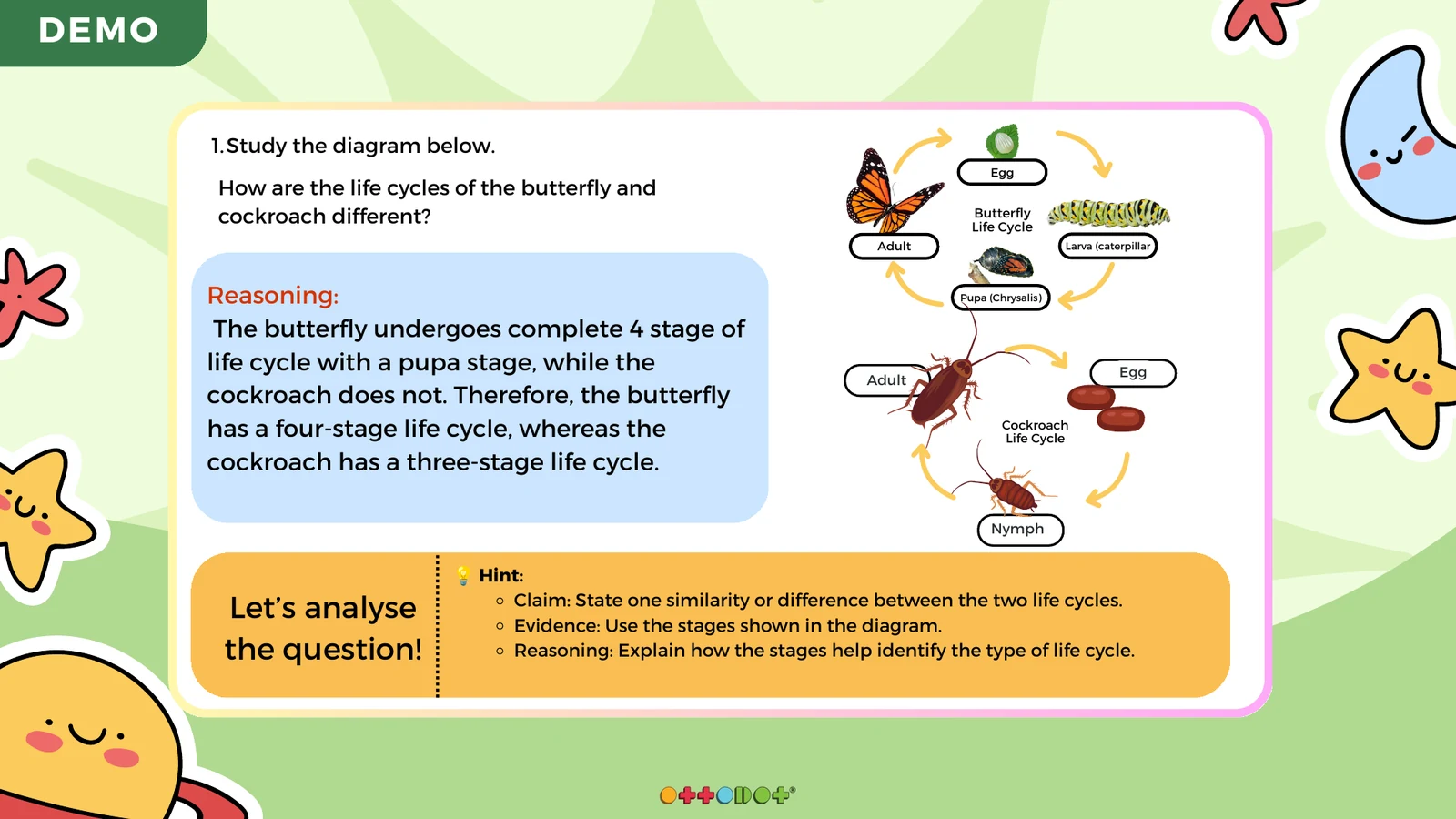
Question: How are the life cycles of the butterfly and cockroach different?
Weak answer: "The butterfly has more stages."
Strong answer: "The butterfly undergoes a complete four-stage life cycle with a pupa stage, while the cockroach does not. Therefore, the butterfly has a four-stage life cycle, whereas the cockroach has a three-stage life cycle."
CER breakdown:
Claim: The butterfly and cockroach have different numbers of life cycle stages.
Evidence: The butterfly has egg, larva, pupa, and adult stages, while the cockroach has egg, nymph, and adult stages.
Reasoning: The stages shown in the diagram help identify the type of life cycle. A butterfly has a complete four-stage life cycle, while a cockroach has a three-stage life cycle.
This example works because the answer does not only say that the butterfly and cockroach are different. It uses the stages shown in the diagram, then explains that the butterfly has a four-stage life cycle while the cockroach has a three-stage life cycle.
Example 2: Explaining Shadow Length
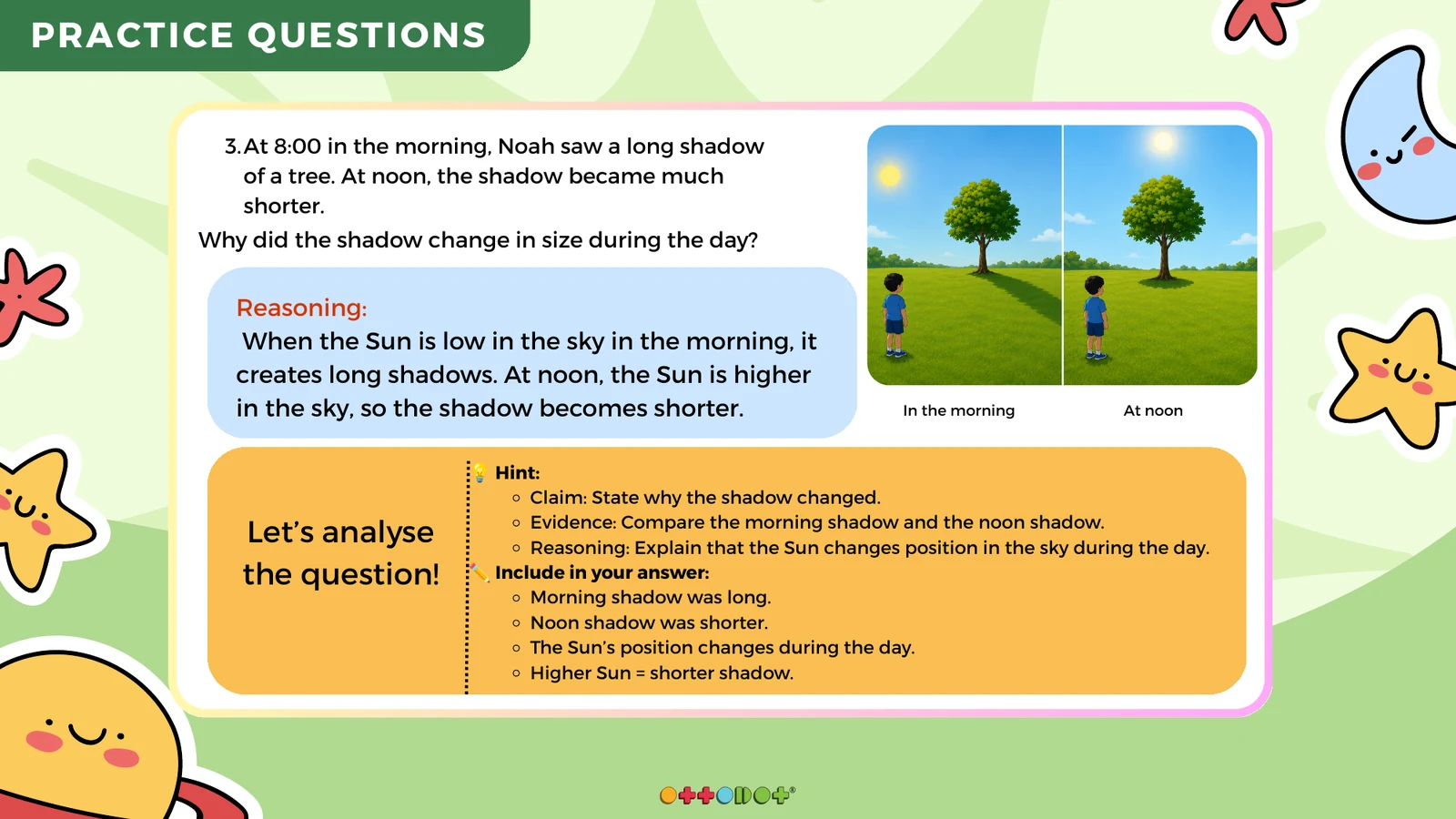
Question: At 8:00 in the morning, Noah saw a long shadow of a tree. At noon, the shadow became much shorter. Why did the shadow change in size during the day?
Weak answer: "The Sun moved."
Strong answer: "When the Sun is low in the sky in the morning, it creates long shadows. At noon, the Sun is higher in the sky, so the shadow becomes shorter."
CER breakdown:
Claim: The shadow changed in size because the position of the Sun changed during the day.
Evidence: The tree's shadow was long in the morning but became shorter at noon.
Reasoning: A lower Sun creates a longer shadow, while a higher Sun creates a shorter shadow.
This example works because the answer uses the observation in the question: the shadow was long in the morning and shorter at noon. The reasoning then connects that evidence to the Sun's changing position in the sky.
Example 3: Explaining Dark And Faint Shadows
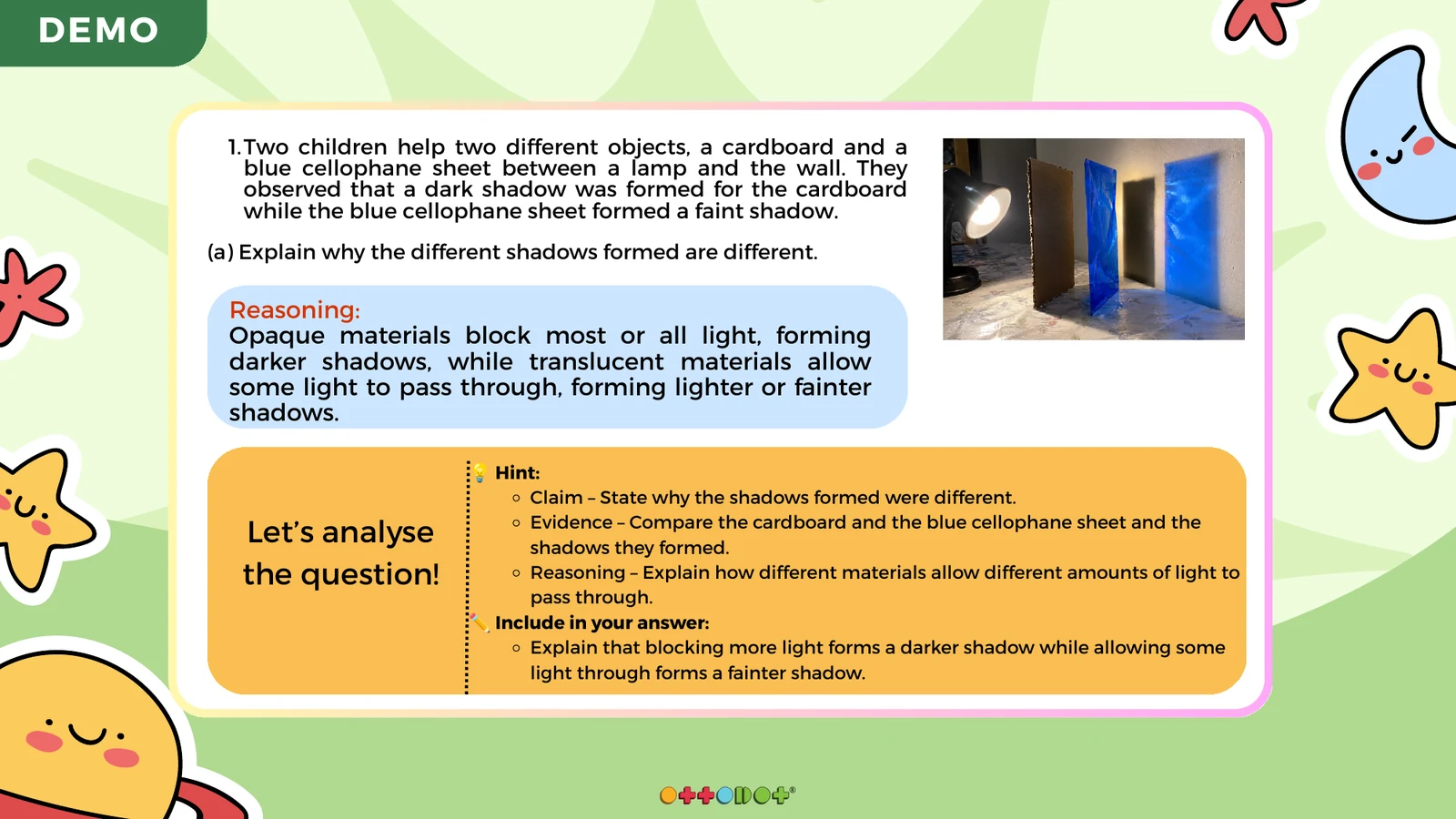
Question: Two children placed a cardboard and a blue cellophane sheet between a lamp and a wall. A dark shadow was formed for the cardboard while the blue cellophane sheet formed a faint shadow. Explain why the different shadows formed are different.
Weak answer: "The cardboard blocks light better."
Strong answer: "Opaque materials block most or all light, forming darker shadows, while translucent materials allow some light to pass through, forming lighter or fainter shadows."
CER breakdown:
Claim: The different shadows formed because the two materials allowed different amounts of light to pass through.
Evidence: The cardboard formed a dark shadow, while the blue cellophane sheet formed a faint shadow.
Reasoning: Opaque materials block most or all light, while translucent materials allow some light through. Blocking more light forms a darker shadow.
This example works because the answer compares both materials and both shadows. It then explains the concept: opaque materials block most or all light and form darker shadows, while translucent materials allow some light through and form fainter shadows.
If your child often writes answers that are partly correct but too vague, one careful rewrite can teach more than five rushed questions. For topic-specific practice, see our materials OEQ guide, electromagnets open-ended questions, P5 Electrical Systems guide, and P6 adaptations guide with OEQ examples.
Want a teacher to spot these gaps with your child? Check my child's fit to try guided Science OEQ practice.
Is It A Concept, Evidence, Expression, Or Transfer Gap?
"My child needs more practice" is often true, but it is not specific enough. Different gaps need different fixes.
Concept Gap
A concept gap means the Science idea is wrong or incomplete.
Example: a child writes, "A shadow forms because the object gives off darkness." The child needs the concept retaught. A shadow forms when an object blocks light.
Fix: use a model, diagram, contrast example, or short explanation before more OEQ practice.
Evidence Gap
An evidence gap means the child ignores or misreads the diagram, data, setup, variables, or observation.
Example: a child concludes that a plant grew better because it received more water, but misses that it also received more light. The evidence shows more than one variable changed, so the conclusion may not be valid.
Fix: ask your child to point to the evidence before writing. "Which part of the question tells you that?"
Expression Gap
An expression gap means the child partly understands the idea but cannot explain it clearly enough for marks.
Example: "The plant grew better because it had sunlight" may be improved to "The plant received light, so it could photosynthesise and make food for growth."
Fix: practise weak-to-strong answer rewrites using CER. This helps children who can explain verbally but write incomplete answers.
Transfer Gap
A transfer gap means the child can answer familiar questions but struggles when the context changes.
Example: a child can answer a textbook evaporation question, but cannot apply the same concept when the question is about drying clothes, puddles, or containers with different exposed surface areas.
Fix: use changed-context questions. Ask the same concept in a new setting.
Game-based and interactive practice can help here because the child sees the same concept in different situations instead of memorising one model answer.
How Parents Can Help At Home
You do not need to become a Science tutor. You can help by improving the practice routine.
Ask Your Child To Underline The Command Word
Before writing, your child should identify whether the question says state, compare, predict, explain, conclude, or suggest.
This helps them avoid overwriting for short questions and under-answering for explanation questions.
Get Them To Point To The Evidence
Before your child writes, ask them to point to the diagram, table, variable, setup, or observation they are using.
This helps children who rush. It slows them down just enough to notice what the question is testing.
Correct One Thing At A Time
Do not correct everything in one answer. Choose the biggest gap.
If the concept is wrong, fix the concept first. If the concept is right but the wording is weak, practise rewriting. If the evidence was missed, go back to the diagram or table.
Practise Short Rewrites, Not Only Full Papers
Full papers have a place, especially nearer exams. For OEQ improvement, though, short answer rewrites often work better.
Take one weak answer and ask:
What is the claim?
What evidence did the question give?
What Science concept explains it?
Which word is too vague?
How can we rewrite it in one clearer sentence?
Five minutes of focused rewriting can build the exact habit your child needs in Booklet B.
Use Practice Tools Between Lessons
If your child needs topic-based practice, try Ottodot's free Science and Math worksheet generator to create extra revision questions. For children who need feedback on written Science answers, the AI Science OEQ tutor can help them practise answer structure outside class.
How Ottodot Helps With Science OEQ Practice
Ottodot's Science lessons are designed around concept accuracy, evidence reasoning, transfer, and answer quality. Students learn the Science content, then practise using it in questions.
In class, students work with:
teacher modelling on how to read the question and identify the tested concept
CER answer writing, so students connect the claim, evidence, and reasoning
precise Science keywords instead of vague phrases
weak-answer analysis and CER answer rewriting
changed-context questions that test transfer, not memorisation
OEQ games where students watch Science simulations or scenarios, then answer open-ended questions with scaffolding first and less help later
teacher-marked homework and feedback on written explanations
For example, if many students get the MCQ right but cannot explain why, that is an expression gap. The answer is not to reteach the whole topic. The lighter fix is to model a strong CER answer, show what was missing, and ask students to rewrite their own answer.
Science performance improves when children repeatedly practise the same thinking required in exams: recall the concept, use evidence, apply it to a changed situation, and explain the reasoning clearly.
If your child is in P3 to P6 and struggles with Primary Science open-ended questions, explore Ottodot Science classes or check my child's fit.
FAQ
What Is A Science OEQ?
A Science OEQ is an open-ended question where students write their own answer instead of choosing from multiple-choice options. In parent language, OEQs usually refer to the structured written questions in Science assessments and PSLE Science Booklet B.
How Many Marks Is PSLE Science Booklet B Worth In 2026?
In the 2026 PSLE Science format, Booklet B has 10 to 11 structured questions worth 40 marks in total, according to the SEAB Science format PDF.
Why Does My Child Know The Concept But Lose OEQ Marks?
Your child may have an expression gap or evidence gap. They may understand the idea, but leave out the evidence, use vague wording, miss the command word, or fail to explain why the answer is correct.
Should My Child Memorise Model Answers?
Model answers can help children see what a good answer looks like, but memorising full answers is risky. It is better to practise identifying the command word, finding evidence, choosing the concept, and writing the reasoning clearly.
Is CER Useful For Primary Science OEQs?
Yes. Claim, Evidence, Reasoning helps students state the answer, use relevant details from the question, and explain the answer with the correct Science concept. It is useful when children know the topic but write vague or incomplete explanations.
Conclusion
Primary Science open ended questions become less intimidating when your child has a repeatable way to think. Start with the command word. Find the evidence. State the claim. Explain the reasoning with the correct Science concept.
If your child is losing marks, name the gap first. Is it a concept gap, evidence gap, expression gap, or transfer gap? Once you know that, practice becomes much more focused.
You do not need to fix every answer at once. Take one weak answer, rewrite it clearly, and build from there. Over time, that habit helps your child approach Science OEQs with more confidence.
For guided support, Ottodot's P3 to P6 Science classes teach CER reasoning, changed-context practice, and answer improvement through live online lessons and game-based practice. Check my child's fit when you are ready to see how your child responds.