
P6 Science Section B: How To Improve Before PSLE
Learn how to improve P6 Science Section B before PSLE with CER answer techniques, worked examples, timing tips, and common PSLE mistakes to avoid at home.

To improve P6 Science Section B before PSLE, your child needs to practise answer quality, not simply memorise another stack of Science notes. The fastest gains usually come from reading the command word, using evidence from the question, completing the reasoning step, and writing precise Science keywords in context.
If your child has been doing practice papers but still loses marks in written answers, it can feel worrying. It is also common. Section B rewards what your child can explain clearly on paper, not what they understood silently in their head.
This guide explains what P6 Science Section B tests, why marks are lost, and how to use worked examples to help your child improve before PSLE.
Key Takeaways
- In the 2026 PSLE Science format, Booklet B has 10-11 structured questions worth 40 marks.
- Section B marks are often lost through missing evidence, weak reasoning, vague wording, or poor timing.
- Before doing more full papers, review one weak answer and identify the missing mark part.
- Use Claim, Evidence, Reasoning for explanation, prediction, comparison, conclusion, and evaluation questions.
- Visual clues matter. Diagrams, organism features, food webs, tables, and experiment setups should appear in the answer.
What is P6 Science Section B in the PSLE?
Parents often call it "Section B" or "open-ended questions". In the official 2026 PSLE Science format, SEAB calls it Booklet B structured questions.
The SEAB 2026 PSLE formats page links to the official Science format PDF, which states that the paper is 1 hour 45 minutes and has two booklets:
Booklet | Item type | Number of questions | Marks |
A | Multiple-choice | 30 | 60 |
B | Structured | 10-11 | 40 |
Booklet B questions carry 2, 3, 4, or 5 marks each. Students must answer all questions.
This matters because Section B is not a pure memory test. SEAB's assessment objectives include applying knowledge, interpreting information, evaluating observations and methods, and communicating explanations and reasoning. In parent language, your child must show the Science idea, the evidence, and the "why".
Want to understand the broader answer habits first? Read our Primary Science open-ended questions guide. If your child needs the exam-focused version, use the PSLE Science open-ended questions guide.
Why P6 students lose marks in Science Section B
A child can do well for MCQ and still struggle with P6 Science Section B. MCQ gives options. Section B asks the child to build the answer from scratch.
These are the usual reasons marks disappear.
They answer the topic, not the exact question
A child may write everything they know about food chains, adaptations, or photosynthesis. But if the question asks for a population change, habitat suitability, or comparison between two organisms, the answer must address that exact demand.
The quick fix: ask your child to underline the command word before writing. Words like explain, predict, compare, conclude, and suggest tell them what kind of answer is needed.
They miss the evidence from the question
Section B questions often include a diagram, table, food web, organism feature, experiment setup, or observation. Those details are not decoration. They are clues.
For example, if a diagram shows an animal with webbed feet and gills, the answer should use those features. A vague answer like "it cannot live there" is usually too weak.
They stop one reasoning step too early
This is the familiar "I knew it" problem. Your child may know the concept, but the written answer stops before the marker can award the full marks.
A weak answer says, "Y decreases because X died." A stronger answer explains the chain: when X dies, Z increases, more Z eat Y, so Y decreases.
They use everyday words instead of precise Science wording
Primary Science rewards clear terms. "The animal cannot survive well because the grassland is dry" may be partly right, but a stronger answer links the animal's moist skin, webbed feet, or gills to a watery habitat.
Do not force complicated vocabulary. Use the right Primary Science term, then explain it simply.
They spend too long writing answers that do not earn more marks
Some P6 students overwrite 2-mark questions and run out of time later. Others write one short sentence for a 4-mark explanation.
The quick fix: teach your child to match the answer to the mark value. Each mark usually needs a distinct idea, evidence point, or reasoning link.
The fastest way to improve P6 Science Section B: find the missing mark part
Before PSLE, it is tempting to give your child another full paper. Sometimes that helps. But if the same mistakes keep repeating, full papers can become a tiring way to practise the wrong habit.
Start with one weak answer and ask: what is missing?
Gap | What it looks like | What to practise |
Concept gap | The Science idea is wrong or incomplete | Reteach the topic with a diagram or simple example |
Evidence gap | The answer ignores the diagram, table, setup, or observation | Evidence-spotting before writing |
Reasoning gap | The answer gives the result but not the cause-effect link | Claim, Evidence, Reasoning rewrite |
Expression gap | The child understands but writes too vaguely | Science keywords and sentence frames |
Transfer gap | The child can answer familiar questions but not changed examples | Changed-context OEQ drills |
Timing gap | The answer is unfinished, too long, or too short | Timed sets of 2-5 mark questions |
A 4-step Section B answer routine for P6 students
Teach your child one routine they can use even when the clock is running.
1. Circle the command word
If the question says "state" or "identify", a short answer may be enough.
If the question says "explain", "predict", "compare", "conclude", or "evaluate", your child likely needs evidence and reasoning.
2. Point to the evidence before writing
Ask: "Which clue from the question must appear in your answer?"
This could be a population change, body feature, graph result, variable, material, or observation.
3. Use Claim, Evidence, Reasoning when explanation is needed
CER is not a box-filling exercise. It is a thinking structure.
CER part | What your child writes |
Claim | The direct answer |
Evidence | The clue from the question |
Reasoning | Why the evidence supports the answer using the Science concept |
4. Check whether each mark has a distinct point
For higher-mark questions, your child should check that each part of the answer is doing real work. Repeating the same idea in different words does not usually earn extra marks.
Worked examples: weak answer vs improved answer
The examples below are adapted from Ottodot P6 lesson materials on living together, food chains, food webs, and adaptations. Each example works best with a simple diagram, because students need to practise using the visual clue before writing.
Example 1: Food chain population prediction
Question: A food chain in a forest shows that organism X controls the population of organism Z, and organism Z eats organism Y. A disease wipes out organism X. Explain the change in the population of organism Y.
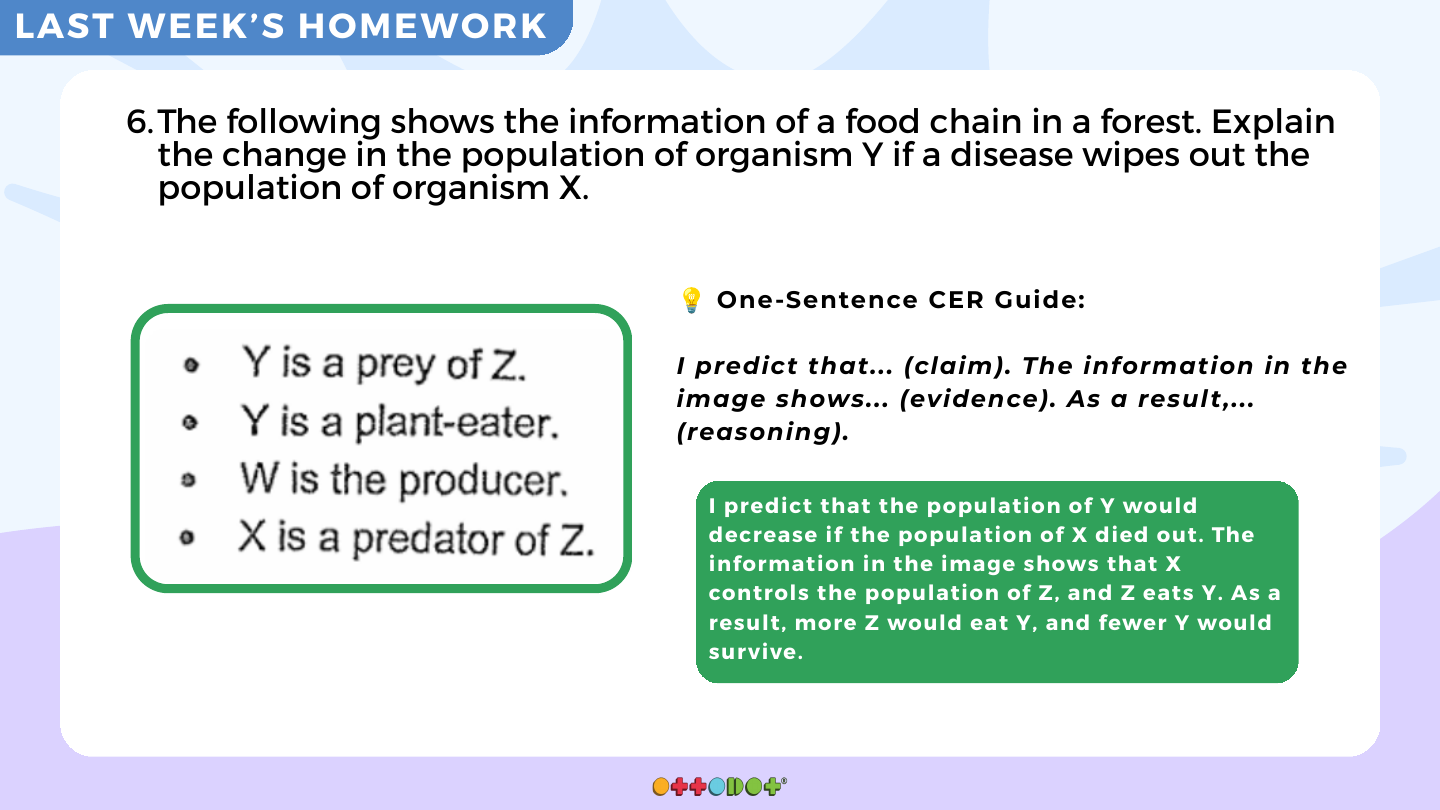
Weak answer: The population of Y will decrease because X died.
Main gap: Reasoning gap. The answer gives the change, but does not explain the intermediate organism.
Improved CER answer: The population of Y would decrease. The food-chain information shows that X controls the population of Z, and Z eats Y. When X dies out, the population of Z increases, so more Z will eat Y and fewer Y will survive.
Claim: The population of Y would decrease.
Evidence: The food-chain information shows that X controls the population of Z, and Z eats Y.
Reasoning: When X dies out, the population of Z increases, so more Z will eat Y and fewer Y will survive.
Why this earns more marks:
The claim answers the population-change question.
The evidence uses the relationship shown in the food chain.
The reasoning explains the knock-on effect through organism Z.
Parent prompt: "Which organism is in the middle of the reasoning chain?"
Example 2: Adaptation and prey inference
Question: Peili sees Animal K in a garden full of twigs and leaves. Animal K has a stick-like body, blends in with the plants, and lacks features commonly used for catching other animals. Peili says Animal K is a herbivore and is prey to other animals. Do you agree? Why?
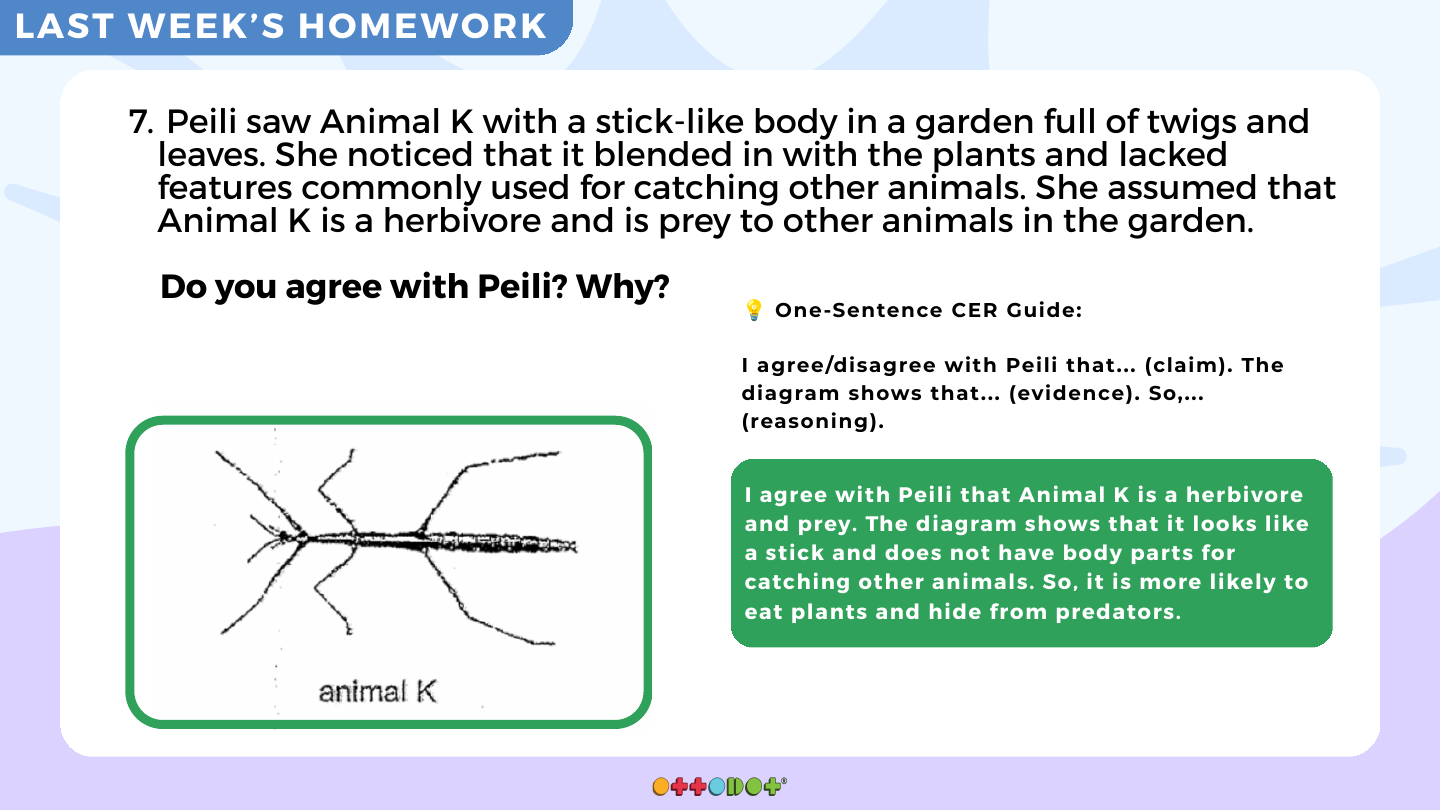
Weak answer: I agree because it looks like a stick.
Main gap: Evidence and reasoning gap. The child noticed one feature, but did not connect the features to feeding role and survival.
Improved CER answer: I agree that Animal K is likely to be a herbivore and prey. The diagram shows that Animal K looks like a stick and does not have body parts for catching other animals. This suggests that it is more likely to eat plants and use camouflage to hide from predators.
Claim: I agree that Animal K is likely to be a herbivore and prey.
Evidence: The diagram shows that Animal K looks like a stick and does not have body parts for catching other animals.
Reasoning: This suggests that it is more likely to eat plants and use camouflage to hide from predators.
Why this earns more marks:
It uses two pieces of evidence, appearance and lack of catching features.
It links structure to function, which is central to adaptation questions.
Parent prompt: "What body feature proves your answer?"
Example 3: Habitat suitability and population decline
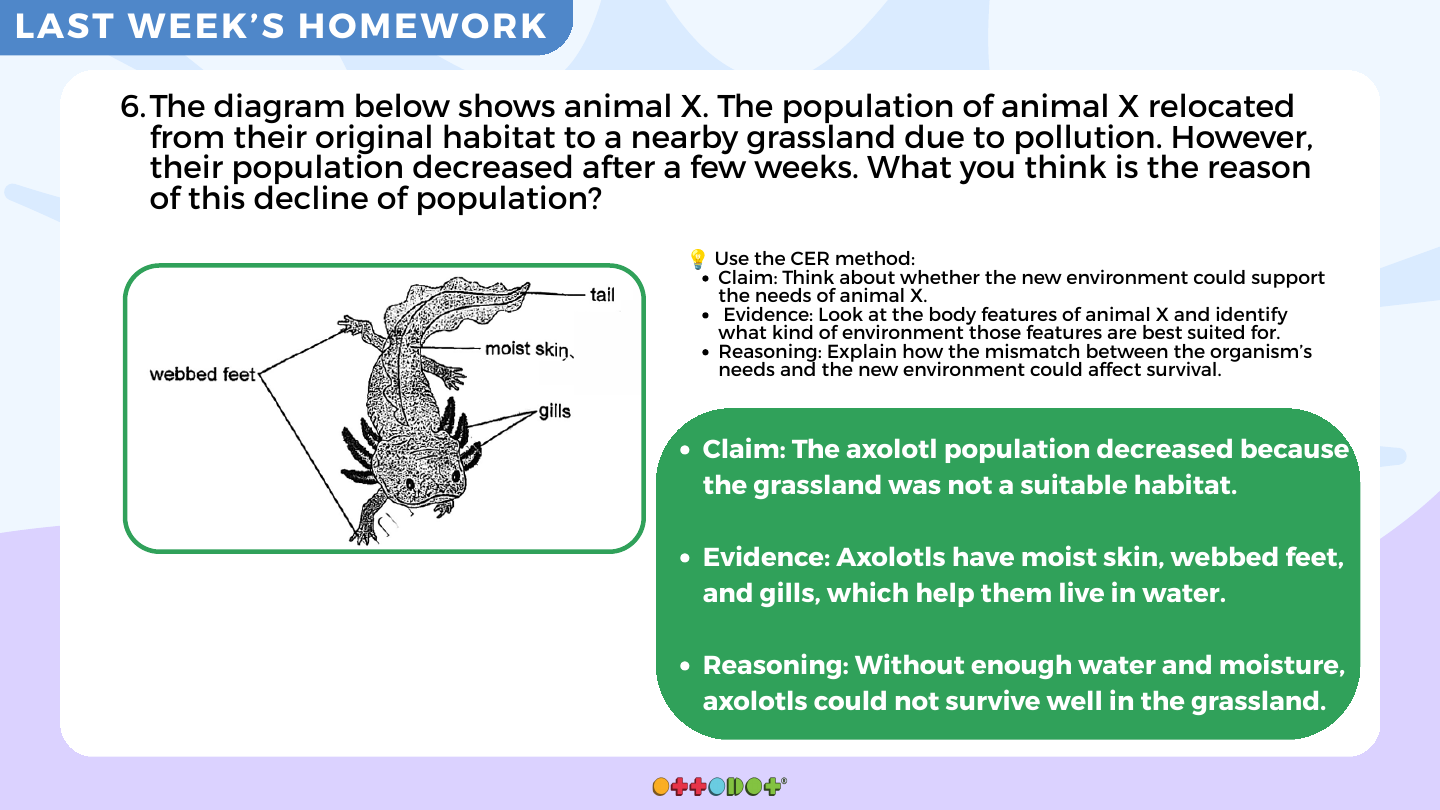
Question: Animal X relocates from its original habitat to a nearby grassland because of pollution. Its population decreases after a few weeks. What could be the reason for this decline?
Weak answer: The grassland is not suitable.
Main gap: Expression gap. The answer may be correct, but it does not explain why the habitat is unsuitable.
Improved CER answer: The population of animal X decreased because the grassland was not a suitable habitat. Animal X has moist skin, webbed feet, and gills, which help it live in water. Without enough water and moisture in the grassland, animal X could not survive well, so its population decreased.
Claim: The population of animal X decreased because the grassland was not a suitable habitat.
Evidence: Animal X has moist skin, webbed feet, and gills, which help it live in water.
Reasoning: Without enough water and moisture in the grassland, animal X could not survive well, so its population decreased.
Why this earns more marks:
The evidence comes from the animal's body features.
The reasoning explains the mismatch between the animal and the new habitat.
Parent prompt: "Which feature tells you what habitat the animal needs?"
Example 4: Earthworms and community health
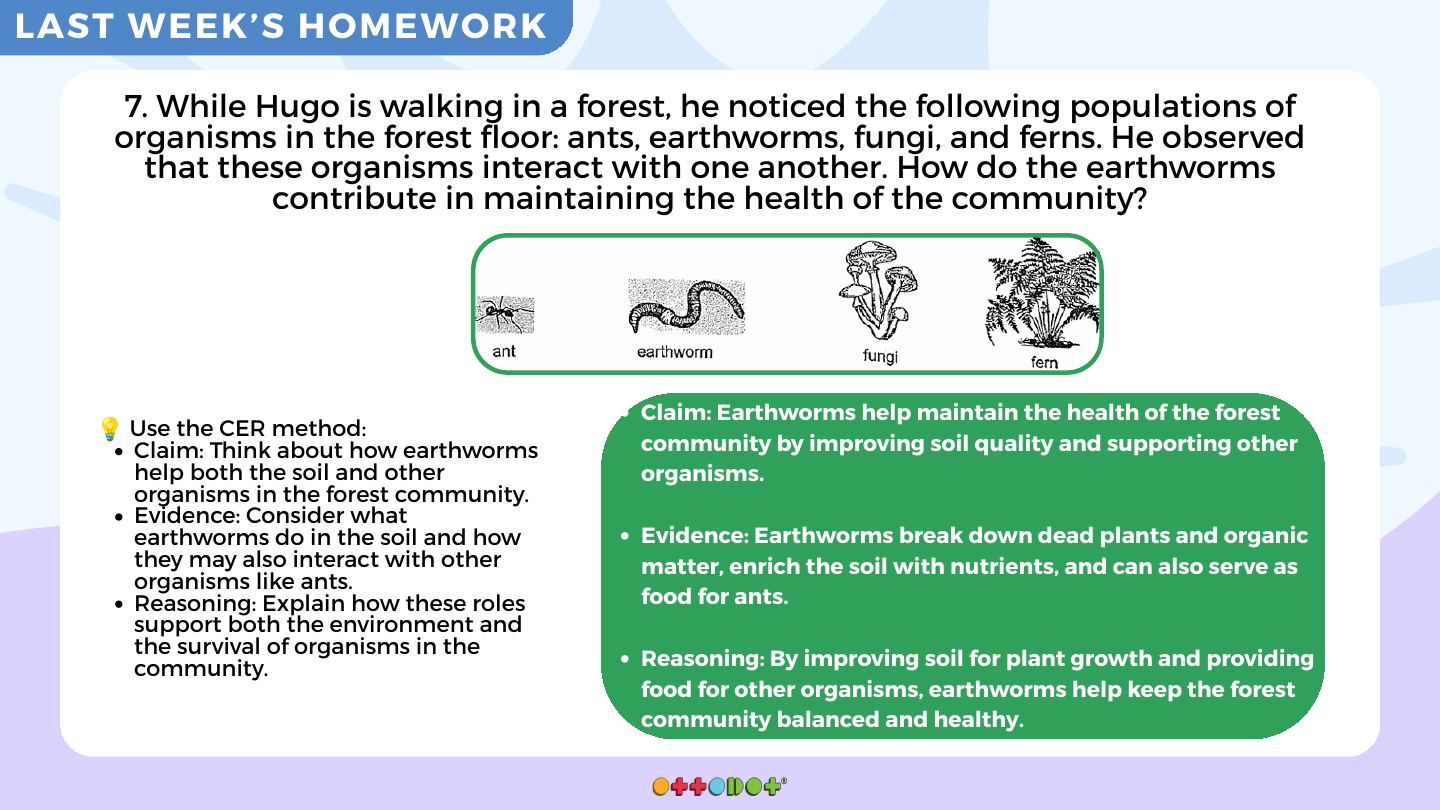
Question: Hugo observes ants, earthworms, fungi, and ferns on the forest floor. How do earthworms contribute to maintaining the health of the community?
Weak answer: Earthworms help the soil.
Main gap: Expression gap. The answer is true but too broad for a Section B explanation.
Improved CER answer: Earthworms help maintain the health of the forest community by improving soil quality and supporting other organisms. They break down dead plants and organic matter, enrich the soil with nutrients, and can serve as food for ants. This helps plants grow better and supports the survival of organisms in the community.
Claim: Earthworms help maintain the health of the forest community by improving soil quality and supporting other organisms.
Evidence: They break down dead plants and organic matter, enrich the soil with nutrients, and can serve as food for ants.
Reasoning: This helps plants grow better and supports the survival of organisms in the community.
Why this earns more marks:
It explains more than one role of the organism.
It connects the earthworm's role to both plants and other organisms.
Parent prompt: "Does the question ask for one role, or how the whole community is helped?"
If your child often gives answers that are partly right but not mark-worthy, try an OEQ-focused Science class to see how they respond to guided answer feedback.
What to practise in the last few weeks before PSLE
If PSLE is approaching, practise based on the gap, not based on panic.
If concepts are weak: revise high-priority P5 and P6 topics first. For P6 Standard Science, this includes interactions within the environment, forces, photosynthesis, and energy conversion. Use a short recap, then try one changed-context question.
If evidence is missing: give your child a diagram or food web and ask them to point to the clue before writing. No writing yet. The aim is to train noticing.
If reasoning is incomplete: take one weak answer and rewrite it using CER. A careful rewrite matters more than five new questions done badly.
If expression is vague: build a small bank of precise Science phrases. For example, "eats plants" is clearer than "gets food", and "population decreases" is clearer than "there will be less".
If timing is weak: practise short timed sets. Give 6-8 minutes for two structured questions, then review the answer quality.
You can also generate extra topic practice using Ottodot's free Science and Math worksheet generator. If the issue is not timing but answer shape, compare this page with our guide on why children lose marks in Science open-ended questions.
How Ottodot helps with Science OEQs
Ottodot teaches students to answer Science OEQs through teacher-led reasoning practice, not answer memorisation.
In class, the teacher models how to read the question, identify the tested concept, choose the evidence, and decide what the answer must prove. Students then practise using CER:
Claim: What is the answer?
Evidence: What clue from the question supports it?
Reasoning: Why does the evidence support the answer?
Students also practise using precise Science keywords. The goal is not a longer answer. It is a clearer answer that shows the concept and the reasoning.
For OEQ games, Ottodot uses simulations and scenarios where students observe what happens, answer with scaffolding first, then try similar questions with less help. For this P6 topic, relevant game entries include Food Chains and Food Webs, Adaptations, and Energy in Food - Photosynthesis. The teacher still teaches the concept and checks misconceptions. The game is the practice environment.
Weekly homework and class attempts give teachers evidence of whether the child has a concept gap, evidence gap, expression gap, or transfer gap. That helps the teacher choose the next move: reteach, practise CER, assign an evidence-spotting drill, or use a changed-context OEQ.
How parents can help at home without becoming the Science tutor
You don't need to reteach the whole topic every time an answer loses marks. Use three questions:
What is the question asking?
What clue from the diagram, table, or setup must be used?
What Science idea explains that clue?
Then ask your child to rewrite one answer. One careful rewrite is often more useful than another rushed page of practice.
One more example may help.
Daniel's father used to mark Science practice by counting ticks and crosses. Daniel would correct the final answer, but the same mistake returned the next week.
When they changed the routine, Daniel had to label the missing part before rewriting. Was it the concept, evidence, reasoning, or wording? After a few sessions, Daniel started catching missing evidence before his father pointed it out.
That is what you want before PSLE: a child who can check the answer, instead of waiting for corrections.
FAQ
Is PSLE Science Section B the same as open-ended questions?
In official 2026 SEAB wording, Booklet B contains structured questions. Many parents and tuition materials still call this Section B or Science open-ended questions because students must write their own answers.
How many marks is Science Section B in the 2026 PSLE?
Booklet B has 10-11 structured questions worth 40 marks in total. Booklet A has 30 multiple-choice questions worth 60 marks.
Can my child improve P6 Science Section B in a few weeks?
Yes, especially if the main issue is evidence use, reasoning, expression, or timing. If the Science concept itself is weak, your child will also need targeted topic revision.
Should my child memorise model answers for Science Section B?
Model answers can help with wording, but memorising is not enough. Your child must learn how to adapt the answer to the exact evidence in the question.
What is the best way to practise P6 Science OEQ at home?
Start with one weak answer. Identify the missing part, rewrite it using Claim, Evidence, Reasoning, then try a similar question in a changed context.
Conclusion
P6 Science Section B is not won by writing more words. It improves when your child can read the question carefully, use the evidence, and explain the Science link clearly.
If your child keeps losing marks even after revision, look for the pattern. Is it concept, evidence, reasoning, expression, transfer, or timing? Once you know the gap, practice becomes much more focused.
For parents who want guided support before PSLE, Ottodot's Science classes teach students how to structure OEQ answers with CER, practise with scaffolded examples, and get teacher feedback on written explanations. You can check my child's fit or explore our Upper Primary Science classes.