
Why Your Child Loses Marks in Science Open-Ended Questions
Find out why your child loses marks in Science open-ended questions, then improve evidence, reasoning, keywords, and OEQ answer structure at home.

Your child may know the Science concept and still lose marks in science open-ended questions (OEQs). That usually happens because OEQs test more than recall. They test whether your child can use evidence from the question, explain the reasoning, and write the answer in a way the marker can award.
Some children do fine in multiple-choice questions (MCQs), then struggle when they have to write the answer themselves. It does not always mean their Science foundation is weak. Sometimes the gap is in evidence, expression, or transfer.
If this sounds like your child, the companion guide on Science MCQ vs open-ended questions explains why recognition and written explanation can look so different.
This guide explains why a child loses marks in Science open-ended questions even when the concept is familiar. For the main cluster guide, start with our Primary Science open-ended questions guide. For answer structure, use the Claim, Evidence, Reasoning guide.
Why Science open-ended questions are different from MCQs
In a multiple-choice question, the answer is already on the page. A child can often spot the correct option, eliminate weaker choices, or use clues from the options.
In an open-ended question, your child has to build the answer from scratch. They need to understand the question, choose the Science concept, use the evidence, explain the reasoning, and use precise Science words.
From 2026, the PSLE Science paper has 30 MCQs in Booklet A, worth 60 marks, and 10 to 11 structured questions in Booklet B, worth 40 marks. See the SEAB PSLE formats page.
So the next step is not always to reteach the whole topic. The better question is: what kind of gap is showing up?
The four gaps that cost Science open-ended marks
At Ottodot, we look for four common gap types.
Gap type | What it looks like | What helps |
Concept gap | The Science idea is wrong or incomplete | Reteach the concept with diagrams, examples, and contrast cases |
Evidence gap | The child ignores or misreads the diagram, table, variable, or observation | Train the child to point to evidence before writing |
Expression gap | The child has the idea but writes it too vaguely for marks | Use answer frames, keywords, and weak-to-strong answer rewriting |
Transfer gap | The child knows the concept in one context but cannot apply it to a changed question | Practise changed-context OEQs instead of repeated recall questions |
If the concept is already there, your child may need practice in evidence, expression, or transfer.
4 reasons children lose Science OEQ marks even when they understand
1. They answer the topic, not the question
A child may see a question about flowers and write everything they remember about reproduction in plants. But if the question asks whether pollination can still occur when the stigma is coated in wax, the answer has to deal with that exact setup.
This happens when children revise by memorising notes. They recognise the topic, then pour out everything they remember. In OEQs, the marks go to the answer to the question.
2. They give the answer but not the evidence
Many OEQs include a diagram, table, graph, or experiment setup. If the answer ignores that evidence, it can still lose marks.
For example, "Plant A grew better because it had more water" only helps if the question evidence shows water was the tested variable. If more than one condition changed, the answer has not used the evidence well enough.
3. They stop one reasoning step too early
This is the classic "almost there" answer.
The child may write, "Pollination cannot happen because the stigma is covered." A stronger answer explains that the stigma receives pollen grains, and wax prevents pollen from sticking or growing a pollen tube.
That missing step often carries the mark.
4. They use everyday words instead of precise Science language
Science answers often need specific terms. "The water disappeared" is weaker than "The water evaporated." "The bulb worked" is weaker than "The bulb lit up because the circuit was closed."
The point is not to sound complicated. The point is to make answers clear.
A simple check: Claim, Evidence, Reasoning
One parent-friendly way to review a Science OEQ is Claim, Evidence, Reasoning, or CER.
Claim: What is the answer?
Evidence: What detail from the question supports it?
Reasoning: Why does that evidence support the answer, using the correct Science concept?
CER is a quick check for the parts needed for marks. Before your child writes, ask: What is the question asking? What evidence should I use? What Science concept explains the evidence?
If one of these is missing, the answer may be incomplete. This is common in P5 Science topics.
Worked examples: Weak answer vs stronger answer
Example 1: Reproduction in plants
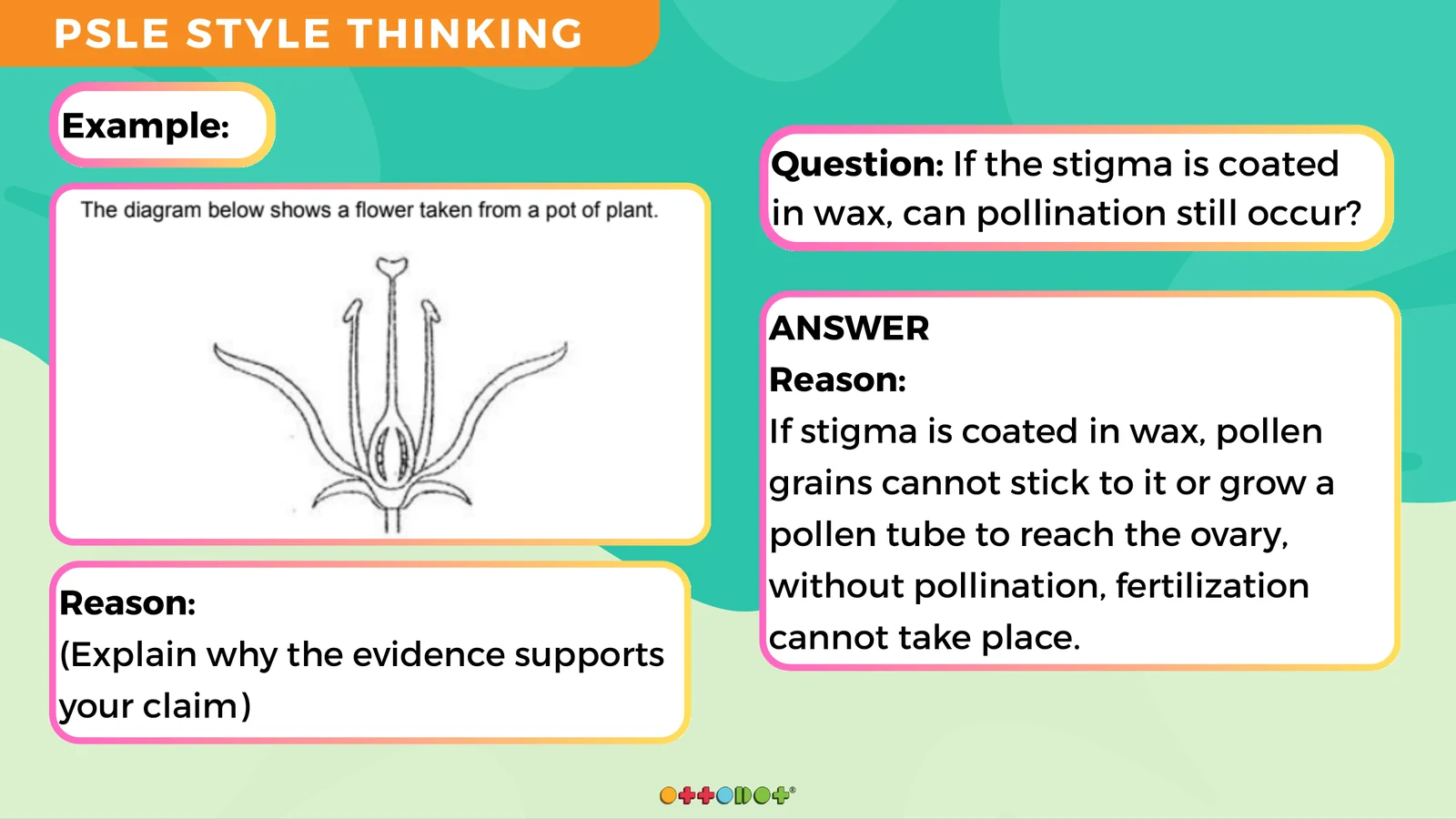
Question shown above: If the stigma is coated in wax, can pollination still occur?
Weak answer: No, pollination cannot occur because the stigma is blocked.
Stronger answer using CER:
Claim: No, pollination cannot occur.
Evidence: The stigma is the part of the flower that receives pollen grains.
Reasoning: If the stigma is coated in wax, pollen grains cannot stick to it or grow a pollen tube to reach the ovary. Without pollination, fertilisation cannot take place.
Why the stronger answer earns marks: The weak answer has the right claim, but it stops too early. The stronger answer names the flower part, explains its function, and links wax to pollination and fertilisation.
Example 2: Magnetic force
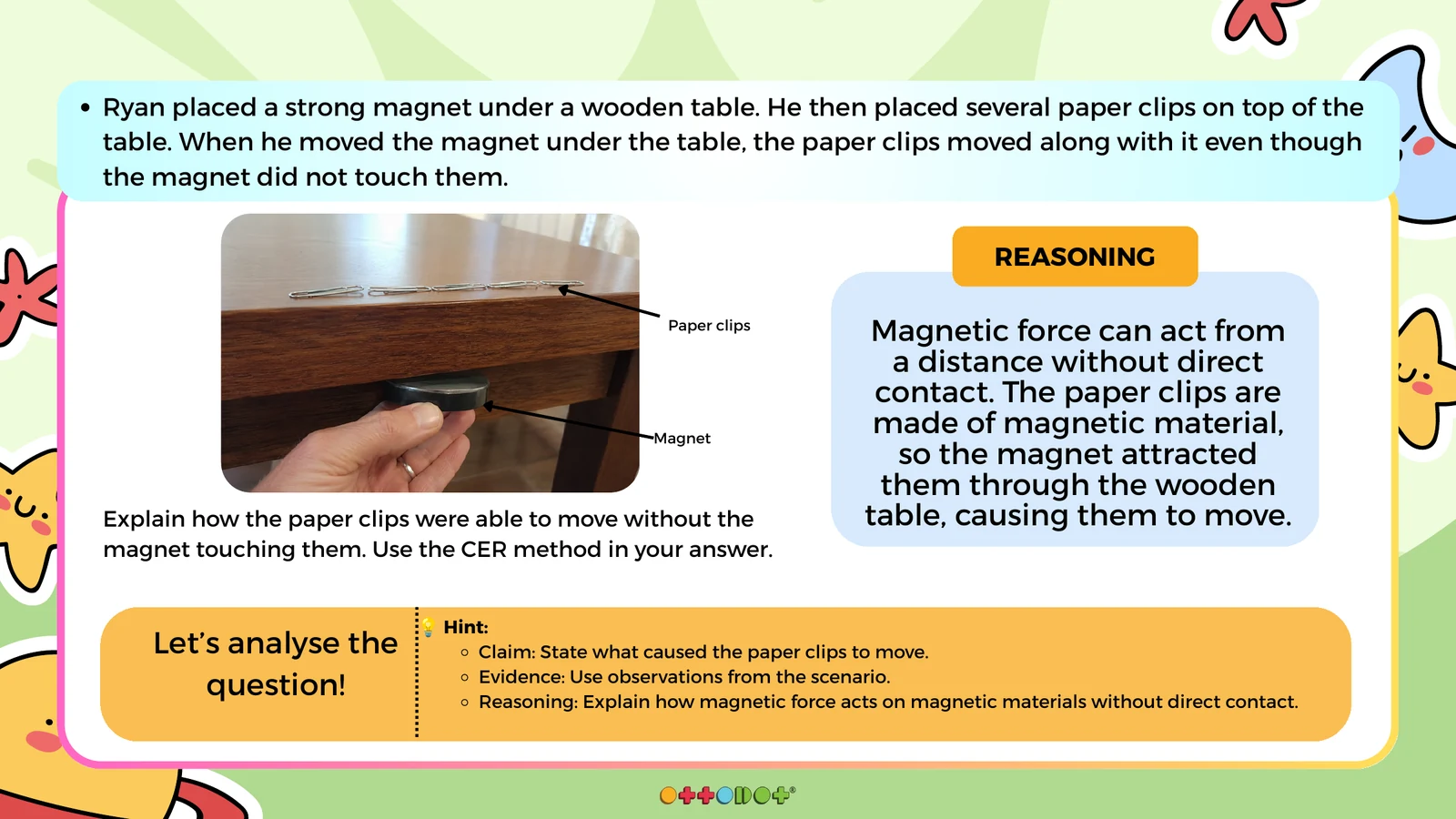
Question shown above: A magnet under a wooden table moves paper clips on top without touching them. Explain why.
Weak answer: The paper clips moved because the magnet was strong.
Stronger answer using CER:
Claim: The paper clips moved because the magnet exerted a magnetic force on them.
Evidence: The paper clips moved across the table even though the magnet was underneath the wooden table and did not touch them.
Reasoning: Magnetic force can act from a distance without direct contact. The paper clips are made of magnetic material, so the magnet attracted them through the wooden table, causing them to move.
Why the stronger answer earns marks: The weak answer gives a vague cause. The stronger answer uses the observation in the question and explains how magnetic force can act without direct contact.
How parents can help at home
Rewrite one weak answer instead of doing ten more questions
If your child keeps losing marks in OEQs, more practice is not always the first fix. Sometimes more practice just repeats the same mistake.
Choose one weak answer and ask: What was the claim? What evidence did you use? What reasoning was missing? Which words were too vague? Then get your child to rewrite the answer.
Ask your child to point to the evidence before writing
Before your child writes, ask them to point to the diagram, table, variable, or observation they are going to use.
Do not treat every weak OEQ as a full topic gap
If your child's concept is wrong, reteach the concept. If the concept is correct but the wording is weak, focus on expression. If the answer ignores the table or diagram, focus on evidence. If your child can answer a familiar example but gets stuck when the question changes, focus on transfer.
How Ottodot teaches Science OEQ answer quality
Ottodot's Primary Science classes and games help children work on concept accuracy, evidence-based reasoning, transfer, and answer quality. Teachers model how to read the question, choose the tested concept, use precise Science keywords, and connect the claim, evidence, and reasoning.
In OEQ games, students watch a Science scenario or simulation, then answer open-ended questions with prompts before trying similar questions with less help. Weekly homework and teacher feedback help spot repeated gaps.
For children who are "okay with MCQ but weak in OEQ", the problem is often not effort. It is the missing bridge between understanding and written explanation, especially as they move towards P6 Science and PSLE preparation.
If you want to see how your child handles Science OEQs with teacher feedback, you can check my child's fit.
Frequently asked questions
Why does my child know the Science concept but lose marks in OEQ?
Your child may know the concept but still lose marks because the written answer is missing evidence, reasoning, precise Science words, or a clear answer structure.
Why does my child score better for MCQ than open-ended questions?
MCQ tests recognition and selection. Open-ended questions require your child to build the answer, choose evidence from the question, and explain the reasoning.
Should my child memorise Science keywords?
Science keywords help, but memorising keywords is not enough. The keyword has to sit inside a complete explanation that fits the question. For example, writing "photosynthesis" may not earn full marks unless the answer explains how photosynthesis connects to the observation.
How many marks is PSLE Science Booklet B from 2026?
From 2026, PSLE Science Booklet B has 10 to 11 structured questions worth 40 marks in total. The full paper is 100 marks and lasts 1 hour 45 minutes.
Where to start
Open-ended Science questions are trainable. Start by finding out which gap is costing marks: concept, evidence, expression, or transfer.
If your child knows the topic but still loses OEQ marks, do not begin with more memorisation. Begin with one weak answer. Improve the claim, add the evidence, complete the reasoning, and make the Science language precise.
That small routine is often the start of better Science answers.