
Math Word Problems: Why Children Struggle and How to Help
Learn why primary school children struggle with Math word problems, how bar models and heuristics help, and what parents can practise at home.
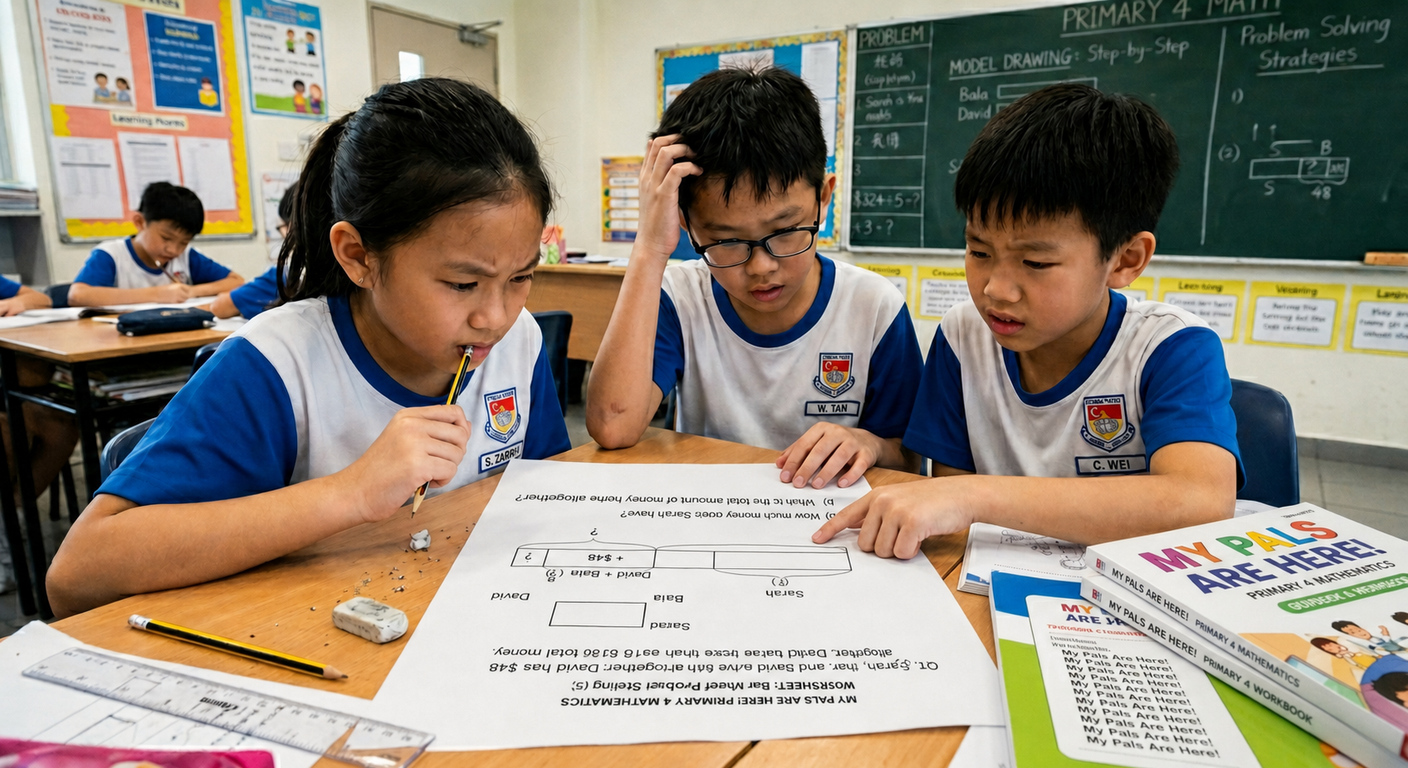
Your child can add fractions. They sail through a page of sums without trouble. But the moment a word problem appears, something breaks down. They stare at the question, write a number or two, then look up at you asking, "What do I do?"
This is one of the most consistent patterns seen in primary school mathematics in Singapore. And it is not a maths problem. It is a translation problem.
This guide explains exactly why word problems are harder than computation, what breakdown stages to look for, and the strategies that make a real difference at every primary school level from P3 to P6.
Why Word Problems Feel Different to Children
A bare computation question, such as 3/4 + 1/2, tests whether a child knows the method. A word problem tests three separate skills at the same time: reading comprehension, identifying what the question is actually asking, and choosing the correct mathematical operation.
For many children, the reading load alone is enough to cause difficulty. They misread a key word, skip over a detail, or lose track of the numbers while trying to understand the context.
What the Research Says
A review published in Frontiers in Psychology found that linguistic complexity plays a significant role in word problem difficulty that is separate from a child's arithmetic ability. Children who struggle with word problems are often not weak at maths. They are struggling with the verbal reasoning demands of the problem text itself (Daroczy et al., 2015, Word problems: a review of linguistic and numerical factors contributing to their difficulty).Daroczy, G., Wolska, M., Meurers, D. W., & Nuerk, H. (2015). Frontiers in Psychology, 6, 516.
A separate study published in Frontiers in Psychology (Hickendorff, 2021) found that reading comprehension becomes significantly more important as problems move from one-step to two-step calculations. This aligns directly with what parents in Singapore notice when their child moves from P4 to P5: the problems do not just get harder numerically. They require a different kind of reading.
The Three Stages Where Children Get Stuck

Understanding exactly where the breakdown happens makes it easier to help.
Stage 1: Reading Without Understanding
Many children read word problems the same way they read a storybook, scanning for familiar words and skipping the unfamiliar ones. But maths word problems require careful, word-by-word reading. Missing the word "not" or "fewer" changes the entire operation.
Research by Boonen et al. (2016, Frontiers in Psychology) found that even students who were classified as successful word problem solvers had noticeably lower performance on problems with greater semantic complexity, despite performing well when the language was simpler. The implication: reading strategy, not just maths skill, determines outcomes.
Stage 2: Failing to Identify the Unknown
Before attempting any calculation, a child needs to know what they are solving for. "How many more" requires subtraction. "How many altogether" requires addition or multiplication. "What fraction of" requires a division or ratio approach.
Children who skip this step often solve for the wrong quantity and do not notice. They produce a number, check that the arithmetic is correct, and submit a wrong answer with confidence.
Stage 3: Choosing the Wrong Heuristic
Once the problem is understood, the child needs to select the right approach. In Singapore Maths, this means choosing from methods such as the bar model, the branching method, or working backwards. Each method is suited to different problem structures.
Children who have only been exposed to one or two heuristics will try to force every problem into the same method, even when it does not fit.
What the Research Says
A 2024 systematic review and meta-analysis in Educational Psychology Review (Springer) confirmed that both linguistic task features and numerical complexity independently affect primary school children's word problem performance. The authors note that students in Grades 1 to 6 are still developing executive function and reading comprehension simultaneously, which compounds the difficulty of multi-step problems.Systematic review, Educational Psychology Review (2024). DOI: 10.1007/s10648-024-09954-2.
The Bar Model: The Most Useful Tool Most Children Under-Use
The bar model is the single most useful tool in Singapore Maths for tackling word problems, and it is consistently under-used by children who struggle.
A bar model turns abstract relationships into a visual picture. Instead of trying to hold multiple quantities in working memory, the child draws them out. This reduces the cognitive load and makes the relationships between numbers visible.
Here is how to use it for a straightforward example.
Worked Example: Bar Model for Fractions
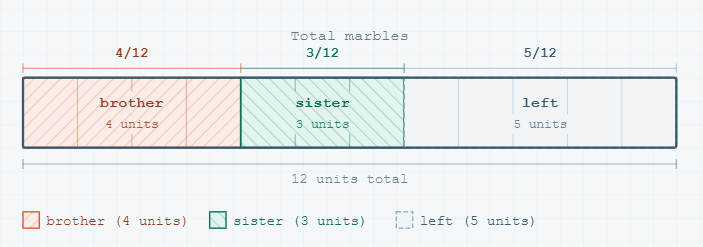
Question: Meilin had 48 stickers. She gave 1/3 of them to her brother and 1/4 of them to her sister. How many stickers did she have left?
Step 1: Draw a bar representing 48 stickers. Divide it into 12 equal parts (the LCM of 3 and 4).
Step 2: Shade 4 parts for the brother (1/3 = 4/12) and 3 parts for the sister (1/4 = 3/12).
Step 3: The remaining 5 parts represent what is left. 5/12 of 48 = 20 stickers.
The calculation is straightforward once the bar model makes the relationships clear. Children who skip this step try to do all of that reasoning in their head, which is where errors enter.
Common Mistakes to Watch For
Reading the question only once
Word problems often contain multiple conditions. Reading once is rarely enough to hold all the relevant information. Teach your child to read the question at least twice: once to understand the situation, once to identify exactly what they are solving for.
Writing working without a plan
Children who jump straight to calculations often get halfway through and realise they do not know what to do next. Encourage them to decide on the method before writing any numbers.
Confusing "more than" and "less than"
Research consistently shows that children find it harder to convert relational terms like "less than" into the correct operation than they do for "more than" (Lewis and Mayer, 1987; Verschaffel et al., 1992). "Ahmad has 12 more marbles than Bala" means Ahmad's amount is the larger one. A significant number of children draw this bar model the wrong way around, which flips the subtraction and produces an incorrect answer. This is a specific reading error, not a maths error.
Not checking whether the answer makes sense
After calculating, ask: "Does this answer make sense in the story?" If a question says Priya ate some cookies and had 5 left, and your child's answer says she started with 2, something has gone wrong. Teaching children to do a basic sense-check catches many avoidable errors.
A Worked Example: Before and After Problems
Before and after problems are one of the most common word problem types in P5 and P6, and one of the most frequently answered incorrectly.
Worked Example: Before and After
Question: Ahmad had 3 times as many stamps as Bala. After Ahmad gave Bala 20 stamps, they had the same number. How many stamps did Ahmad have at first?
Step 1: Draw the "before" situation. Ahmad = 3 units. Bala = 1 unit.
Step 2: After Ahmad gives 20 stamps, they are equal. The gap between them is 2 units, which equals 40 stamps (20 given + 20 received). So 1 unit = 20. Ahmad at first = 3 units = 60 stamps.
Step 3: Check. Ahmad had 60, gave away 20 = 40. Bala had 20, received 20 = 40. Equal. Correct.
The bar model makes the relationship between the before and after states visible, which is exactly what makes this type of problem easier to solve systematically.
Tips for Parents
Read word problems aloud together
When a child reads silently, they skip. When they read aloud to you, they slow down. You can also ask questions as they read: "What does that tell us? What are we looking for?" This models the internal questioning a strong reader applies automatically.
Ask "what do we know, and what do we need to find?"
These two questions, asked before any calculation, organise a child's thinking. If they cannot answer both questions from reading the problem once, they need to read it again. This habit transfers across all primary school levels and all question types.
Separate the reading step from the calculation step
Many children treat a word problem as one big task. Help them see it as two tasks: understand the problem first, then solve it. Rushing past the comprehension step is the single most common reason for avoidable errors on Paper 2.
Frequently Asked Questions
My child understands the concept but still gets word problems wrong. Why? Understanding the concept and applying it inside a word problem are two separate skills. The word problem requires comprehension, identification of the relevant operation, and execution, all at once. A child who gets isolated computation right but word problems wrong usually needs more practice with the reading and identification steps, not the calculation itself.
Should I teach my child to look for keywords like "altogether" or "left"? Keywords help as a starting point, but relying on them too heavily causes errors. The word "more" can indicate addition or subtraction depending on context. Teach your child to understand the situation first, then identify the operation. Keywords are a hint, not a rule.
What is the difference between heuristics and methods? In Singapore Math, heuristics are problem-solving strategies, such as drawing a bar model, making a systematic list, or working backwards. Methods refer to the specific arithmetic operations used within a heuristic. A child who knows which heuristic to apply can approach unfamiliar problems more reliably than a child who only knows procedures.
At what level do word problems become significantly harder? Most children find word problems manageable at Primary 3 and Primary 4, then notice a significant jump in difficulty at Primary 5, when multi-step problems involving fractions, ratios, and percentages become the standard. Building bar model habits in Primary 3 and Primary 4 pays off significantly at this stage.
Where to Go From Here
Math word problems reward children who practise the reading and translation steps, not just the calculation. The strategies above, reading carefully, drawing a bar model, checking the answer against the story, apply at every primary school level and for every problem type.
For older students, this connects closely to P5 and P6 Math tuition support, where problem sums, heuristics, and exam-ready working habits need to develop together.
If your child is struggling with fraction word problems, ratio problems, or before-and-after questions, Ottodot's live Math classes work through these systematically using MOE heuristics and the STAR routine: slow down, think through the structure, apply the right method, and review the answer. Each 75-minute Google Meet class is teacher-led, with game-based practice to reinforce the method in a way that keeps children active rather than passive.
Check my child’s fit to see whether Ottodot's word-problem approach matches your child's current level and learning needs.