
P5 Science Open-Ended Questions: How To Improve
Learn how P5 Science open-ended questions improve with command words, evidence, reasoning, worked examples, and parent practice tips for Section B.

P5 Science open-ended questions improve when your child learns to answer the exact question, use evidence from the diagram or data, and explain the reasoning with clear P5 Science terms. The goal is not to write longer answers. It is to make the thinking visible.
Many Primary 5 children can explain a Science idea aloud, then lose marks when they write it down. Often, the gap is answer shape: knowing what the question is asking, choosing the right concept, and connecting the evidence to the answer.
This guide gives you a simple routine, two worked examples, and a way to check your child's answers at home.
Key Takeaways
- P5 Science OEQ marks depend on answer shape, evidence, and reasoning, not content knowledge alone.
- The command word tells your child whether to state, compare, predict, conclude, or explain.
- Strong answers use details from the question, such as diagrams, observations, variables, or data.
- P5 human-system answers should use clear terms like lungs, heart, blood, oxygen, nutrients, and muscles.
- If your child is stronger in MCQ than OEQ, the gap may be evidence use, reasoning, or written expression.
Why P5 Science Open-Ended Questions Feel Harder
Primary 5 is where Science starts to feel more demanding. Topics such as electrical systems, the water cycle, plant transport, human respiratory and circulatory systems, and reproduction require more than remembering facts.
Your child now has to explain processes, interpret diagrams, read data, and write clear cause-and-effect sentences. That is why a child can know the topic and still lose marks.
In MCQ, the correct answer is already on the page. In an open-ended question, your child has to build the answer from scratch. They need to decide what the question wants, choose the right Science concept, and match the mark scheme.
For P5 school assessments, Section B open-ended questions carry a meaningful portion of the paper. P5 students do not sit the PSLE yet, but P5 is when written-answer habits become important. For context, the current SEAB 2026 PSLE Science format has 30 MCQ questions for 60 marks and 10 to 11 structured questions for 40 marks.
Read more in Ottodot's guide to what your child learns in Primary 5 Science.
The 5-Step Routine For P5 Science OEQs
Before your child writes, train them to pause for five short checks.
Step | What your child should ask | Why it matters |
1. What to do? | What is the command word? | It tells them the answer shape. |
2. What concept to use? | Which P5 Science topic is being tested? | It prevents random fact dumping. |
3. What evidence is given? | What diagram, data, observation, or variable must I use? | It keeps the answer tied to the question. |
4. What is the answer? | What is my direct answer? | It stops vague openings. |
5. Why is this the answer? | What reasoning links the evidence to the answer? | It completes the explanation. |
This connects closely to claim, evidence, and reasoning. The claim answers the question. The evidence uses a clue from the question. The reasoning explains why the evidence supports the claim.
Use this as a quick parent check. If the answer has a claim but no evidence, ask, "Which detail in the question proves this?" If it has evidence but no reasoning, ask, "Why does that detail matter?"
P5 Science OEQ Command Words And Answer Shapes
Command words tell your child how much to write and what kind of answer earns marks.
Command word | What it asks for | Answer shape | Common mistake |
State, list, name, identify | A short direct answer | One clear point per mark | Writing a long explanation and missing the keyword |
Compare | A difference or similarity between two things | Mention both items and the basis of comparison | Describing only one side |
Predict | What will happen next | State the outcome, then give the reason | Saying "it will change" without direction |
Explain, give a reason | Why or how something happens | Cause, evidence, effect | Naming a concept without linking it to the question |
Conclude | The relationship shown by results | As one variable changes, the other changes | Repeating observations without stating the relationship |
If your child writes too much, start with the command word. If they write too little, ask what evidence or reasoning is missing.
Worked Examples For P5 Science Open-Ended Questions
These examples use the circulatory system topic. In the published article, the questions should appear as images, followed by the answer breakdown below.
Example 1: Heart Rate And Activity Intensity
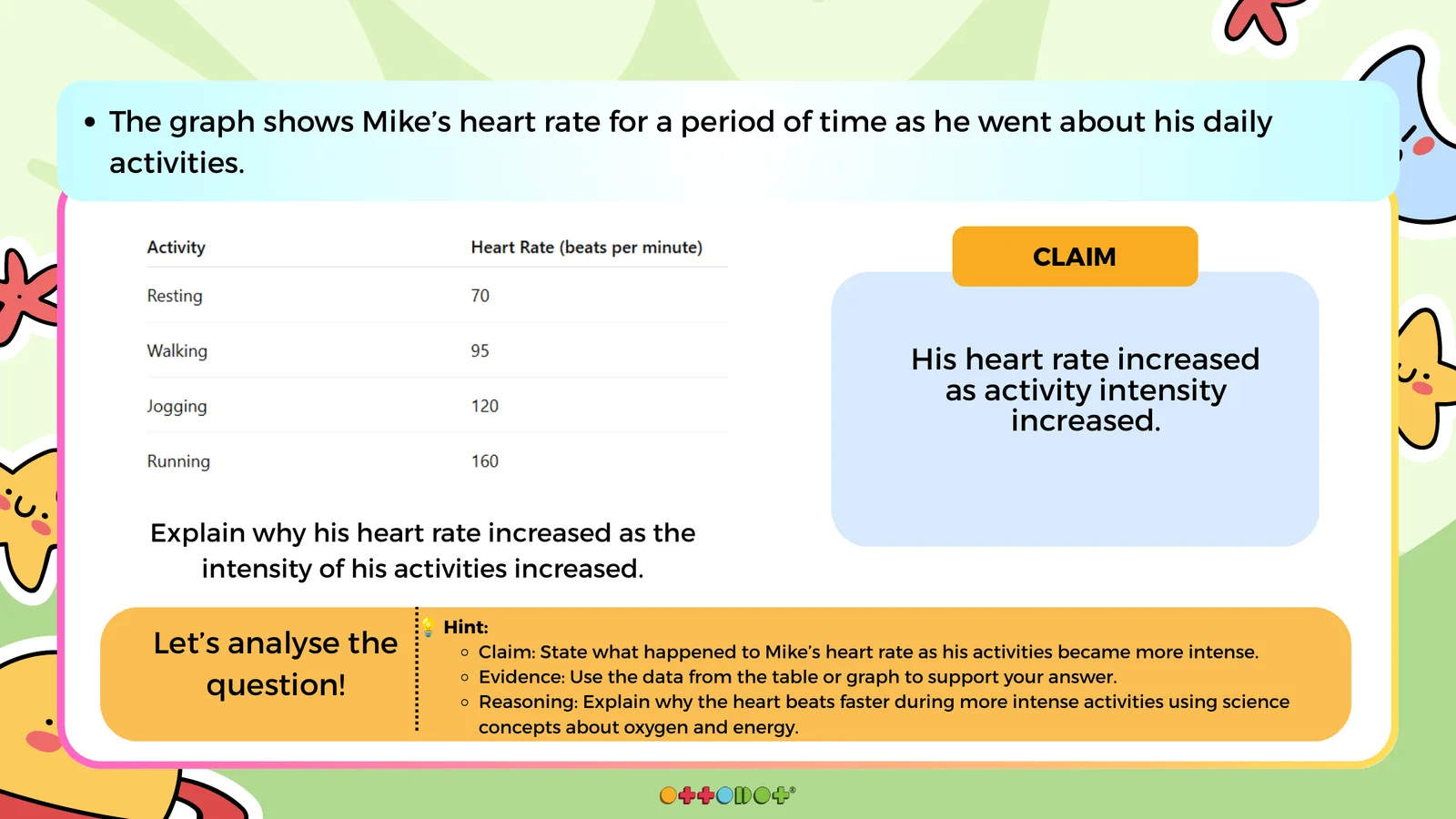
Question image: Mike's heart rate increases from 70 beats per minute when resting to 160 beats per minute when running.
Weak answer: His heart rate increased because he was exercising more.
Stronger answer: Mike's heart rate increased as the intensity of his activities increased. The table shows that his heart rate rose from 70 beats per minute when resting to 160 beats per minute when running. During more intense activities, his muscles need more oxygen and nutrients to release energy. His heart pumps faster to deliver more oxygen-rich blood to his muscles.
Claim: Mike's heart rate increased as the intensity of his activities increased.
Evidence: The table shows that his heart rate rose from 70 beats per minute when resting to 160 beats per minute when running.
Reasoning: During more intense activities, his muscles need more oxygen and nutrients to release energy. His heart pumps faster to deliver more oxygen-rich blood to his muscles.
Why this earns marks: The strong answer follows the claim, evidence, reasoning framework taught earlier. It answers the question, uses a number from the table, and explains why the heart had to pump faster.
Parent check: Ask, "Did your answer use a number from the table, and did it explain why the heart had to pump faster?"
Example 2: Respiratory And Circulatory Systems Working Together
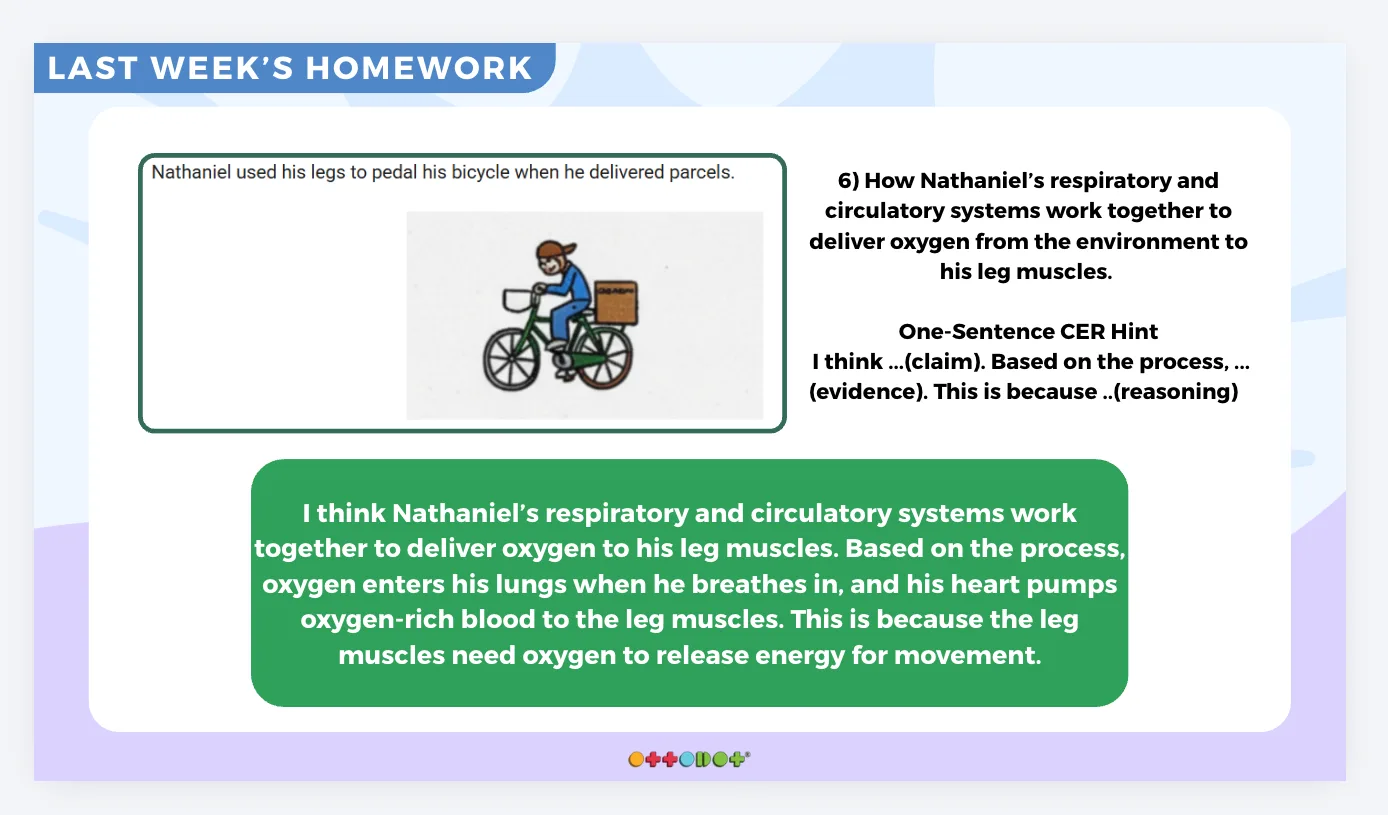
Question image: Nathaniel pedals a bicycle and explains how oxygen reaches his leg muscles.
Weak answer: He breathes in oxygen and his blood carries it to his legs.
Stronger answer: Nathaniel's respiratory and circulatory systems work together to deliver oxygen to his leg muscles. Oxygen enters his lungs when he breathes in, and his heart pumps oxygen-rich blood to the leg muscles. The leg muscles need oxygen to release energy for movement.
Claim: Nathaniel's respiratory and circulatory systems work together to deliver oxygen to his leg muscles.
Evidence: Oxygen enters his lungs when he breathes in, and his heart pumps oxygen-rich blood to the leg muscles.
Reasoning: The leg muscles need oxygen to release energy for movement.
Why this earns marks: The strong answer uses the same claim, evidence, reasoning framework. It mentions both systems, gives the path of oxygen, and explains why the leg muscles need oxygen.
Parent check: Ask, "Did your answer mention both systems, the path of oxygen, and why the leg muscles need oxygen?"
If your child understands these examples but struggles to apply the same answer shape independently, it may help to start the quiz.
Common P5 Science OEQ Mistakes And Parent Practice
They answer the topic, not the question. A question about why Mike's heart rate increased is asking for the link between activity intensity, oxygen demand, and the heart pumping faster.
They skip the evidence. Many children write the right concept but ignore the diagram, table, or setup. The answer may sound correct, but not specific enough.
They use vague words. Replace words such as "better", "stronger", "more", and "it works" with precise Science language.
They confuse evidence and reasoning. "Mike's heart rate rose from 70 to 160 beats per minute" is evidence. "His muscles needed more oxygen and nutrients to release energy" is reasoning.
They use vague system language. For human systems, keep to broad P5 terms such as nose, windpipe, lungs, heart, blood, blood vessels, oxygen, nutrients, and muscles.
How Ottodot Helps Students Improve OEQ Answers
Ottodot teaches Science OEQs through teacher-led reasoning practice, not answer memorisation.
In class, teachers use a clear I Do, We Do, You Do approach when teaching Science OEQs.
For P5 Science, teachers also pay close attention to keywords. Students learn to write "oxygen-rich blood", "lungs", "heart", "blood vessels", "muscles", and "release energy" instead of vague phrases.
I Do: The teacher first models how to read the question, identify the tested concept, and decide what the answer needs to prove. The teacher then demonstrates how to write the answer using claim, evidence, and reasoning.
We Do: The teacher and students practise the CER structure together. With guidance, students learn to write a clear claim that answers the question, use evidence from the question's clue, and add reasoning that explains the cause-and-effect link.
You Do: Students then answer OEQs independently, applying the claim-evidence-reasoning framework on their own.
Ottodot's OEQ games give students Science scenarios or simulations, then ask open-ended questions with prompts first and without prompts later. For this topic, the Circulatory System OEQ game lets P5 students practise after watching a Science scenario. The teacher still teaches the concept, checks the reasoning, and uses post-test and homework attempts to spot repeated gaps.
How Parents Can Practise P5 Science OEQs At Home
You do not need to reteach the whole Science topic. Practise one answer at a time.
First, ask your child to underline the command word. Then ask them to highlight the evidence. Only after that should they write the answer.
Self-check before marking:
Did I answer the question? (claim)
Did I use the clue in the question or diagram? (evidence)
Did I explain the Science reason? (reasoning)
Did I use proper Science keywords?
After marking, ask which part was missing:
Concept gap: "I did not know the Science idea."
Evidence gap: "I did not use the diagram or data."
Reasoning gap: "I wrote the answer but did not explain why."
Expression gap: "I knew it but wrote it vaguely."
If the same gap appears three times, you know what to practise next.
For broader question-type guidance, read Ottodot's Primary Science open-ended questions guide. If your child needs help with answer structure, use the Claim, Evidence, Reasoning guide. For the next exam step, see P6 Science Section B and Primary 6 Science and the road to PSLE.
When To Consider A P5 Science Diagnostic Assessment
Consider extra support if your child is doing reasonably well in MCQ but repeatedly loses marks in OEQ. That pattern usually means they recognise the concept but cannot yet communicate the reasoning clearly.
Ottodot's Science classes are built around MOE-aligned concepts, written reasoning, scaffolded practice, and teacher feedback. The aim is to identify whether the gap is content, evidence, reasoning, or expression, then practise that answer habit.
Frequently Asked Questions About P5 Science Open-Ended Questions
How can my P5 child improve Science open-ended questions?
Start with command words, evidence, and reasoning. Ask your child to identify what the question wants, point to the evidence in the setup, then explain why that evidence supports the answer.
Why does my child do better in Science MCQ than OEQ?
MCQ tests whether your child can select the correct answer from the given options, while OEQ tests written explanation. Your child may know the concept but still lose marks if they do not use evidence, complete the reasoning, or write with precise Science terms.
Should P5 students memorise model Science answers?
Model answers can help children see good answer shape, but memorising them is not enough. P5 questions often change the context, so your child needs to adapt the structure.
How many P5 Science OEQ questions should my child practise each week?
Two to four well-reviewed OEQs can be more useful than a full stack of rushed questions. The important part is correction: identify the missing concept, evidence, reasoning, or expression.
The Next Step
P5 Science open-ended questions are learnable. Once your child can read the command word, use the evidence, and complete the reasoning, their answers become clearer and easier to mark.
If your child keeps saying "I know it, but I don't know how to write it", that is a useful clue. The next step is guided practice with answer shape.
Check my child's fit to see how we teach OEQ reasoning through teacher modelling, practice, and feedback.