
Claim-Evidence-Reasoning Strategy for Primary Science Open-Ended Questions
Learn how claim evidence reasoning helps Primary Science answers, with two respiratory-system examples, common mistakes, and parent practice tips for home.
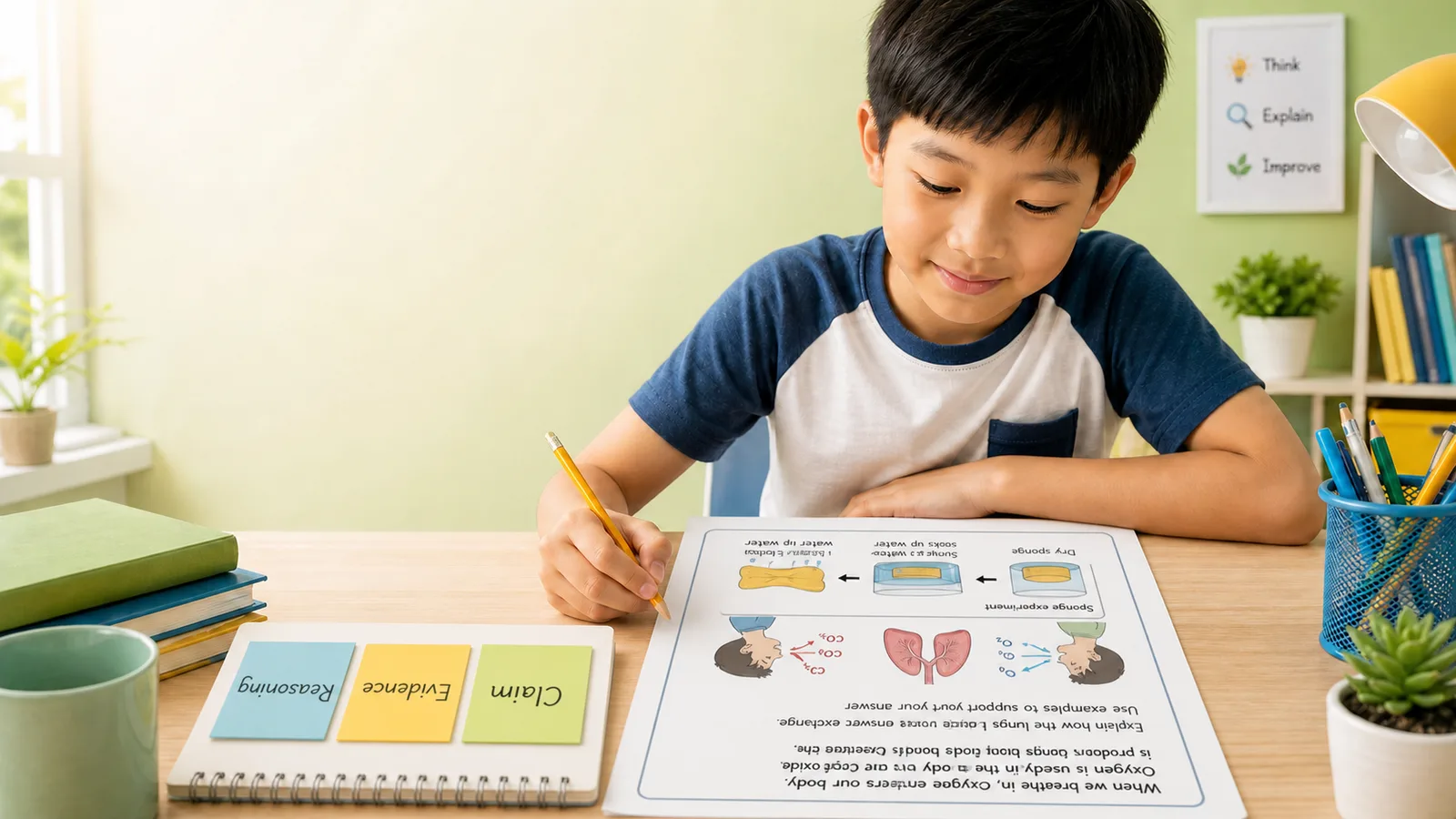
In Primary Science, Claim, Evidence, Reasoning is a simple way to help children write clearer open-ended answers. The claim answers the question. The evidence points to a clue in the question. The reasoning explains the Science link.
If your child often says, "I knew that," after losing marks, CER can help you spot what was missing. Sometimes the concept is there, but the evidence or reasoning is not written clearly enough.
Use this guide when you are checking a Science open-ended answer and cannot quite tell why it lost marks.
Key Takeaways
- CER means Claim, Evidence, Reasoning: answer the question, use the question's clue, then explain the Science link.
- It helps most when a child has an evidence gap or expression gap, not when the Science concept itself is wrong.
- Strong answers are not always longer. They are usually easier for a marker to follow.
What is claim, evidence, reasoning in Primary Science?
Claim, Evidence, Reasoning, often shortened to CER, is an answer structure that helps children slow down and show their thinking.
CER part | What your child asks | What to write | Common mistake |
Claim | What is my answer? | The direct answer to the question | Writing a vague answer like "it is better" |
Evidence | What clue must I use? | Data, observation, diagram detail, or setup detail from the question | Ignoring the table, diagram, or variable |
Reasoning | Why does the evidence prove my answer? | The Science concept that links the evidence to the claim | Using a keyword without explaining the link |
The labels are not the main point. CER is useful when it helps your child make a clear claim, choose relevant evidence, and explain the link.
That is why CER fits Primary Science open-ended questions. The 2026 PSLE Science format includes Booklet B structured questions, and the SEAB Science format PDF includes interpreting information and communicating explanations and reasoning.
Why CER helps with Science open-ended answers
In multiple-choice questions, the answer options are already on the page. In an open-ended question, your child has to build the answer from scratch. The marker can only award what is written.
When a Primary Science answer loses marks, it is often because one of these four parts is weak:
Concept gap: the Science idea is wrong or incomplete.
Evidence gap: the child does not use the clue in the question.
Expression gap: the child partly understands, but writes too vaguely for marks.
Transfer gap: the child can answer a familiar version, but struggles when the context changes.
CER helps most with evidence and expression gaps. If the Science concept is wrong, reteach the concept first. If your child understands the familiar version but gets stuck when the setup changes, practise the same idea in a new context.
For more examples, start with our Primary Science open-ended questions guide. You can also compare how CER shows up in P5 Science open-ended questions, P6 Science Section B, and Science MCQ vs open-ended questions.
How to use claim, evidence, reasoning in Primary Science answers
Before your child writes, ask three quick questions:
What is the question asking me to answer?
What evidence in the question must I use?
Which Science concept explains that evidence?
Then write the answer in this order: claim, evidence, reasoning. It does not need to be labelled every time, but the thinking should be there.
Many children mix up evidence and reasoning, especially when they already know the topic.
"The sponge turns dark and sticky" is evidence. "Blocked air spaces make gaseous exchange harder" is reasoning.
Worked examples of claim, evidence, reasoning in Primary Science
The two examples below come from respiratory-system questions. For each one, we look at the question, a weak answer, the gap, and a stronger CER rewrite.
Example 1: Smoking and gaseous exchange
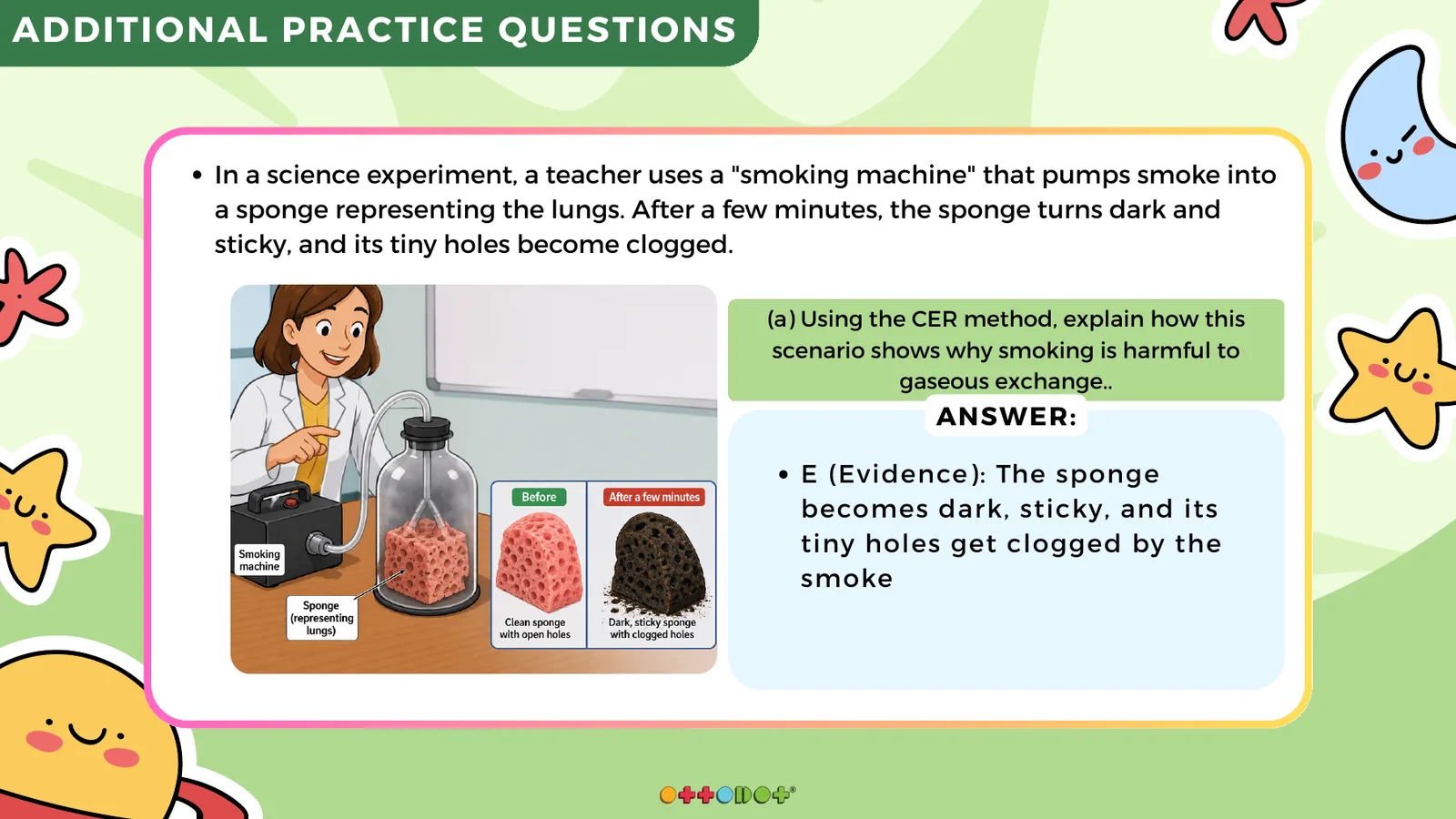
Question: A teacher uses a "smoking machine" that pumps smoke into a sponge representing the lungs. After a few minutes, the sponge turns dark and sticky, and its tiny holes become clogged. Using CER, explain why smoking is harmful to gaseous exchange.
Weak answer: Smoking is bad because the sponge becomes dirty.
Main gap: Evidence and expression gap. The child noticed the dirty sponge, but did not explain what that means for gaseous exchange.
CER rewrite:
Claim: Smoking is harmful to gaseous exchange.
Evidence: The sponge becomes dark and sticky, and its tiny holes become clogged by the smoke.
Reasoning: When the tiny holes in the sponge are blocked, it represents air spaces in the lungs being blocked. Less oxygen can enter the blood, and carbon dioxide cannot be removed easily.
Why this is stronger: It uses the experiment evidence and connects it to the movement of oxygen and carbon dioxide.
Example 2: Breathing rate at high altitude
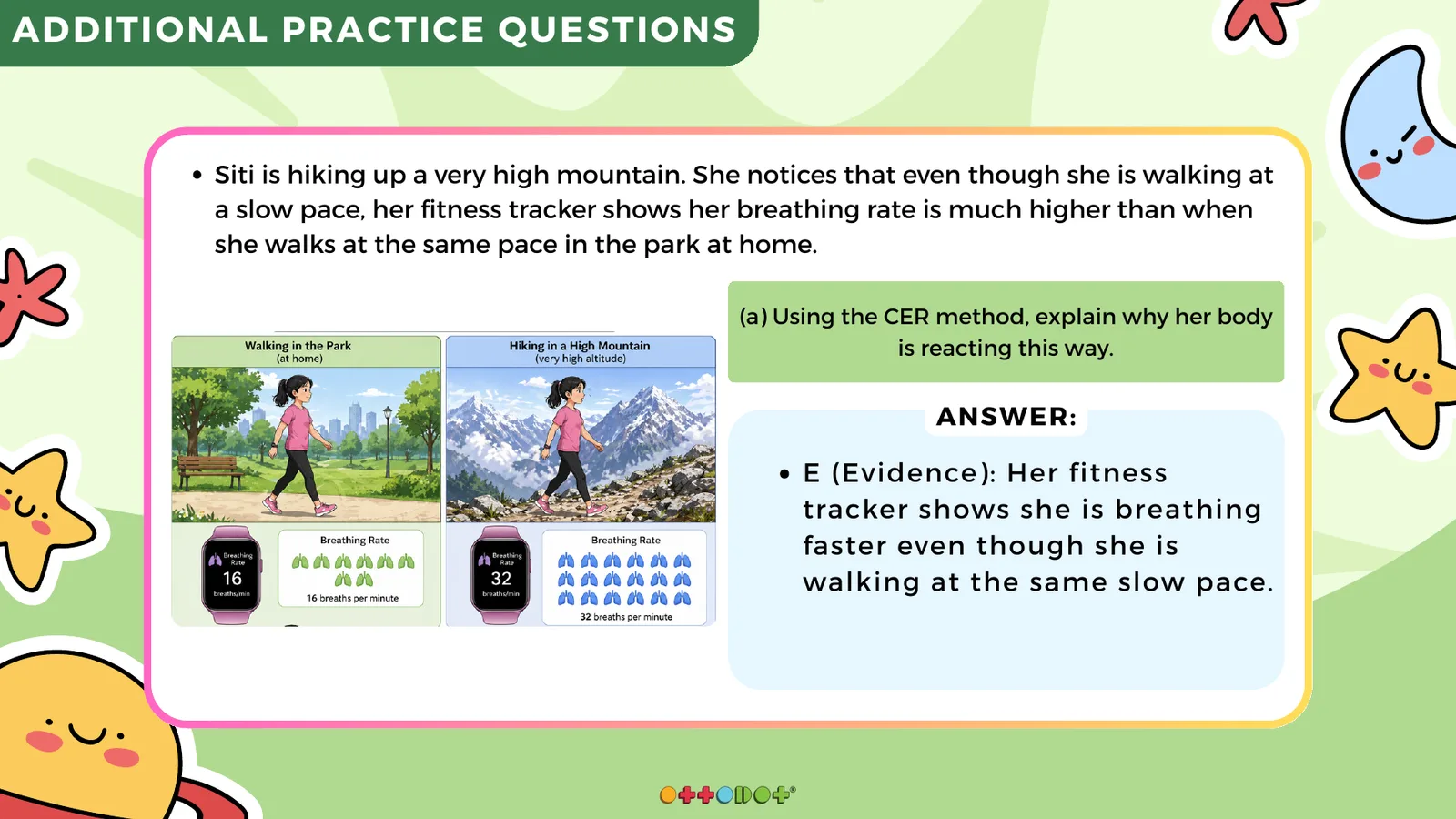
Question: Siti is hiking up a very high mountain. Even though she is walking slowly, her fitness tracker shows her breathing rate is much higher than when she walks at the same pace in the park at home. Using CER, explain why.
Weak answer: She is breathing faster because she is climbing a mountain.
Main gap: Evidence and reasoning gap. The answer names the mountain, but does not use the breathing-rate evidence or explain the role of oxygen.
CER rewrite:
Claim: Siti's breathing rate increases because there is less oxygen available at high altitude.
Evidence: Her fitness tracker shows that she is breathing faster even though she is walking at the same slow pace.
Reasoning: Her body needs oxygen. When less oxygen is available, she breathes faster to take in enough oxygen for her body.
Why this is stronger: It compares the two situations, uses the fitness tracker evidence, and explains why the body responds.
Changed-context check: What if Siti jogs in the park and her breathing rate increases? This time, the reasoning should link faster breathing to physical activity, not altitude.
If your child often misses the evidence or reasoning part in Science answers, check my child's fit to see how they respond to guided OEQ feedback.
Common CER mistakes and parent practice tips
They give a claim without evidence. "Smoking is harmful" may be correct, but it does not show which clue from the experiment supports the answer.
They copy evidence without explaining it. "The sponge is clogged" is useful evidence, but the mark often comes from explaining why that affects oxygen and carbon dioxide movement.
They use the right keyword but the wrong link. A child may write "gaseous exchange" but still lose marks if they do not explain oxygen entering the blood and carbon dioxide leaving the blood.
They memorise model answers. Model answers help only when children understand the thinking behind them. After one correction, change the setup slightly and ask your child to try again.
They use CER when a short answer is enough. Not every question needs a full CER response. "State" or "identify" questions may only need a direct answer. "Explain", "predict", "compare", "conclude", and "evaluate" questions are more likely to need evidence and reasoning.
How parents can practise CER at home
Start with one question, not a whole stack of worksheets. You are trying to find the gap, not finish ten questions at speed.
Ask your child to highlight the claim, underline the evidence, and circle the Science concept. If one part is missing, rewrite that part first.
After the rewrite, ask one changed-context question:
"What if Siti jogs in the park instead of walking on the mountain?"
"What if the sponge turns dark but its holes are not clogged?"
This matters because Primary Science tests application. Remembering the idea is only the first step.
If your child keeps losing marks after corrections, look for the pattern. Is it a concept gap, evidence gap, expression gap, or transfer gap? The fix depends on the gap.
For more support with this topic range, see our guide to Primary 5 Science topics.
How Ottodot helps children improve Science reasoning
In Ottodot's upper-primary Science classes, students practise MOE-aligned Science concepts through live online lessons, teacher-guided OEQ practice, and game-based activities.
For Science open-ended answers, the goal is not to memorise model responses. Teachers model how to read the question, choose the tested concept, use precise Science keywords, and explain the cause-and-effect link. Students then practise moving from scaffolded prompts to more independent answers.
Ottodot's OEQ games use Science scenarios and simulations as the practice environment. For respiratory-system practice, games such as Rate of Respiration and Air and Respiratory System help students practise open-ended questions after watching simulations. The teacher still teaches the concept and gives feedback, while the game gives students another way to practise observing carefully and explaining clearly.
That guided feedback loop is what helps a child move from "I knew that" to an answer that actually shows the thinking.
Frequently asked questions
What does Claim, Evidence, Reasoning mean in Primary Science? Claim is the answer, evidence is the clue from the question, and reasoning is the Science explanation that links the clue to the answer.
What is the difference between evidence and reasoning? Evidence comes from the question, such as a diagram, data table, observation, or setup. Reasoning comes from Science. It explains why that evidence supports the claim.
Why does my child still lose marks after using Science keywords? Keywords help, but they are not enough. An answer can still lose marks if your child does not answer the exact question, use evidence from the context, or complete the cause-and-effect explanation.
How can I help my child practise CER at home? Ask your child to label one answer in three parts: claim, evidence, and reasoning. Then rewrite the missing part before moving on.