
Science MCQ vs Open-Ended Questions: Why Children May Struggle With OEQs
Science MCQ vs open ended questions: see why children choose MCQ answers but lose OEQ marks, with CER examples, PDF visuals, and parent practice tips.

A child may do well in Science MCQ but struggle with open-ended questions because MCQ and OEQ ask for different skills. MCQ lets your child recognise the right idea from a set of options. OEQ asks them to choose the concept, use evidence, and explain the cause-and-effect link.
So if your child can pick the correct option but loses marks when writing, it does not automatically mean they do not know Science. They may need help with evidence, expression, transfer, or answer quality.
Key Takeaways
- Science MCQ often shows what a child can recognise, while Science OEQ shows what a child can explain.
- Correct MCQ but weak OEQ is often an evidence or expression gap, not always a full concept gap.
- Strong OEQ answers need Claim, Evidence, and Reasoning, not memorised keywords alone.
- Parents can help by asking children to point to the evidence before writing.
- Changed-context questions are useful when a child can answer familiar questions but struggles with new setups.
Science MCQ vs Open Ended Questions: What Is Being Tested?
In the 2026 PSLE Science format from SEAB, Booklet A has 30 multiple-choice questions worth 60 marks. Booklet B has 10 to 11 structured questions worth 40 marks. Parents often call these structured questions open-ended questions, OEQs, or Section B.
This matters because the MOE primary curriculum syllabus page points families back to subject syllabuses, and the Primary Science syllabus 2023 topic progression shows topics such as Properties of Magnets building towards evidence-heavy reasoning. Children need to observe, use evidence, and explain Science ideas clearly.
Both parts matter. MCQ is not "easy Science", and OEQ is not "hard Science". They test different parts of the same subject, which is why a child can look steady in one and shaky in the other.
Question type | What the child has to do | What can go wrong |
Science MCQ | Recognise the concept, compare options, eliminate distractors, choose the best answer | The options may cue the answer even if the child cannot explain it |
Science OEQ | Identify the concept, use evidence, explain reasoning, write a precise answer | The child may know the idea but leave out evidence or cause and effect |
MCQ shows what your child can recognise. OEQ shows what your child can explain.
Why Science MCQ Can Look Strong When OEQ Is Weak
MCQ gives support that open-ended questions do not.
In MCQ, your child can look at four options and eliminate choices. In OEQ, they have to build the answer themselves. No options remind them of the Science term, the evidence, or the reasoning chain.
That is why a child may choose the correct MCQ option about magnets, then write a vague OEQ answer about the same concept. The issue is often not the whole topic. It is the answer they put on paper.
The Four Gaps Behind "MCQ Okay, OEQ Weak"
When parents say, "My child needs more practice," they are usually right. The important question is what kind of practice.
Concept gap
A concept gap means the Science idea is wrong or incomplete. If your child gets both MCQ and OEQ wrong, revise the concept before doing more exam-style questions.
What helps: revise the concept with a diagram, model, or contrast example.
Evidence gap
An evidence gap means your child ignores or misreads the diagram, table, variable, setup, or observation. They may know the topic, but miss the clue that the question is built around.
What helps: ask, "Which part of the question tells you that?"
Expression gap
An expression gap means your child partly understands the idea but cannot write it clearly enough for marks.
A weak answer may say, "The plant grows better because it has sunlight." A stronger answer says, "The plant received light, so it could photosynthesise and make food for growth."
What helps: practise weak-to-strong answer rewrites using CER.
Transfer gap
A transfer gap means your child can answer familiar questions but struggles when the same concept appears in a new situation.
What helps: use changed-context questions instead of repeating the same question type.
How CER Helps With Science OEQ Answers
CER stands for Claim, Evidence, Reasoning. It is a thinking routine for Science OEQs, not a set of boxes to fill blindly.
CER part | What it means | Parent prompt |
Claim | State the answer | "What is your answer?" |
Evidence | Use a clue from the question | "What in the diagram, table, setup, or observation supports this?" |
Reasoning | Explain with the Science concept | "Why does that evidence support your answer?" |
Keywords help, but they are not enough. The answer still has to explain why the evidence supports the claim.
Use this with Ottodot's Primary Science open-ended questions guide and the Claim, Evidence, Reasoning guide.
After one OEQ, try this:
Underline the command word.
Point to the evidence before writing.
Say the Science concept in one sentence.
Write the answer.
Rewrite vague answers before rushing to the next question.
If the issue is expression, answer rewriting may help more than reteaching the whole topic.
If your child keeps saying they understand the Science but still loses marks, read why children lose marks in Science open-ended questions next.
Worked Example: Same Concept, Different Skill
Example 1: Properties of a magnet
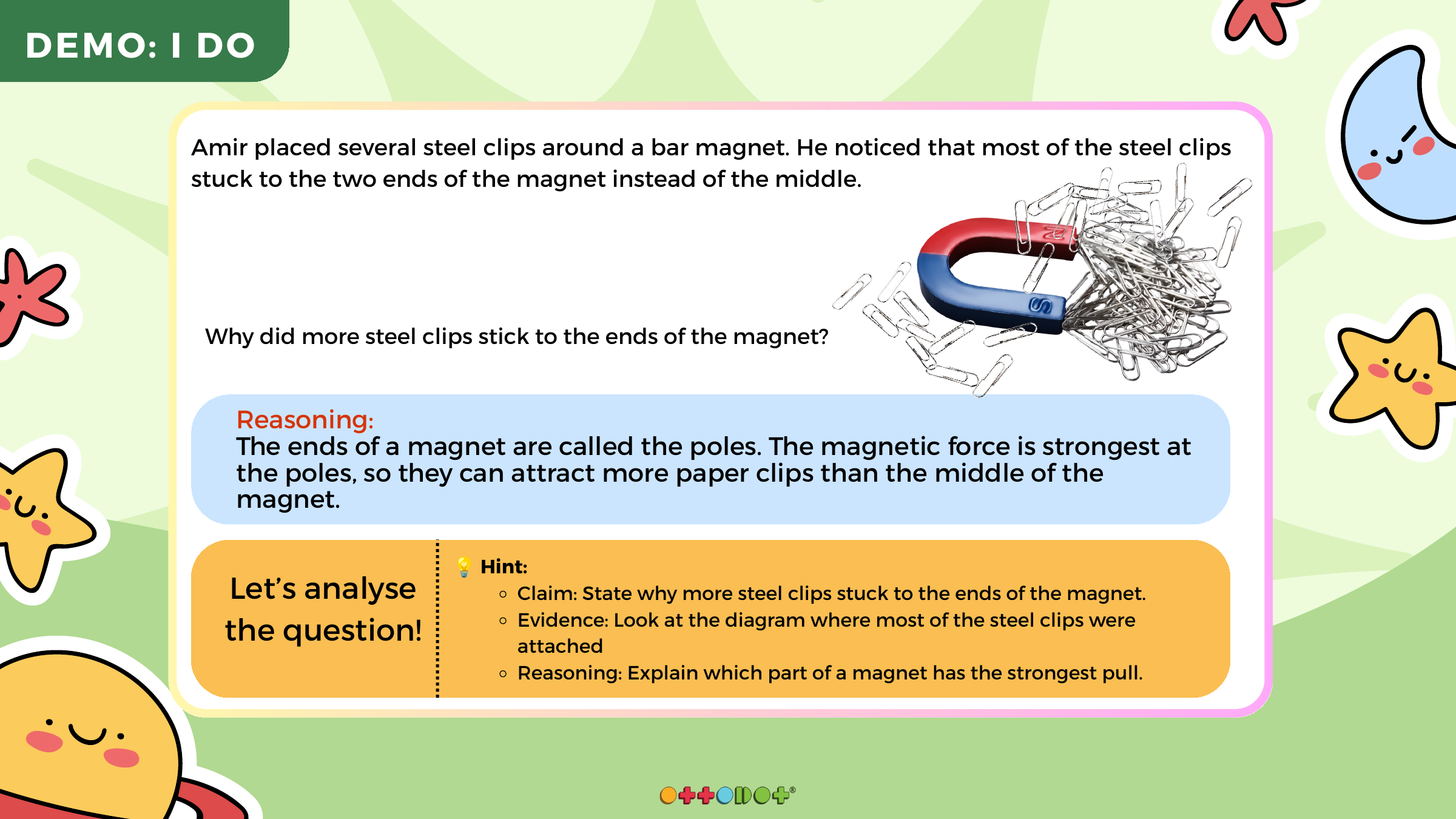
Question: Amir placed steel clips around a bar magnet. Most clips stuck to the two ends instead of the middle. Why did more steel clips stick to the ends?
Weak answer:
"The ends are stronger."
Main gap: expression gap. The idea is partly correct, but the answer is too loose for marks.
Stronger CER answer:
"More steel clips stuck to the ends of the magnet because the ends are the poles. Most of the steel clips were attached to the two ends of the bar magnet. The magnetic force is strongest at the poles, so the poles can attract more steel clips than the middle of the magnet."
Claim: More steel clips stuck to the ends of the magnet because the ends are the poles.
Evidence: Most of the steel clips were attached to the two ends of the bar magnet.
Reasoning: The magnetic force is strongest at the poles, so the poles can attract more steel clips than the middle of the magnet.
Why this is stronger: the answer gives the claim, uses the diagram as evidence, and explains that magnetic force is strongest at the poles.
Parent practice move: ask your child to add one evidence sentence before they write the reasoning.
Example 2: Unlike poles attract
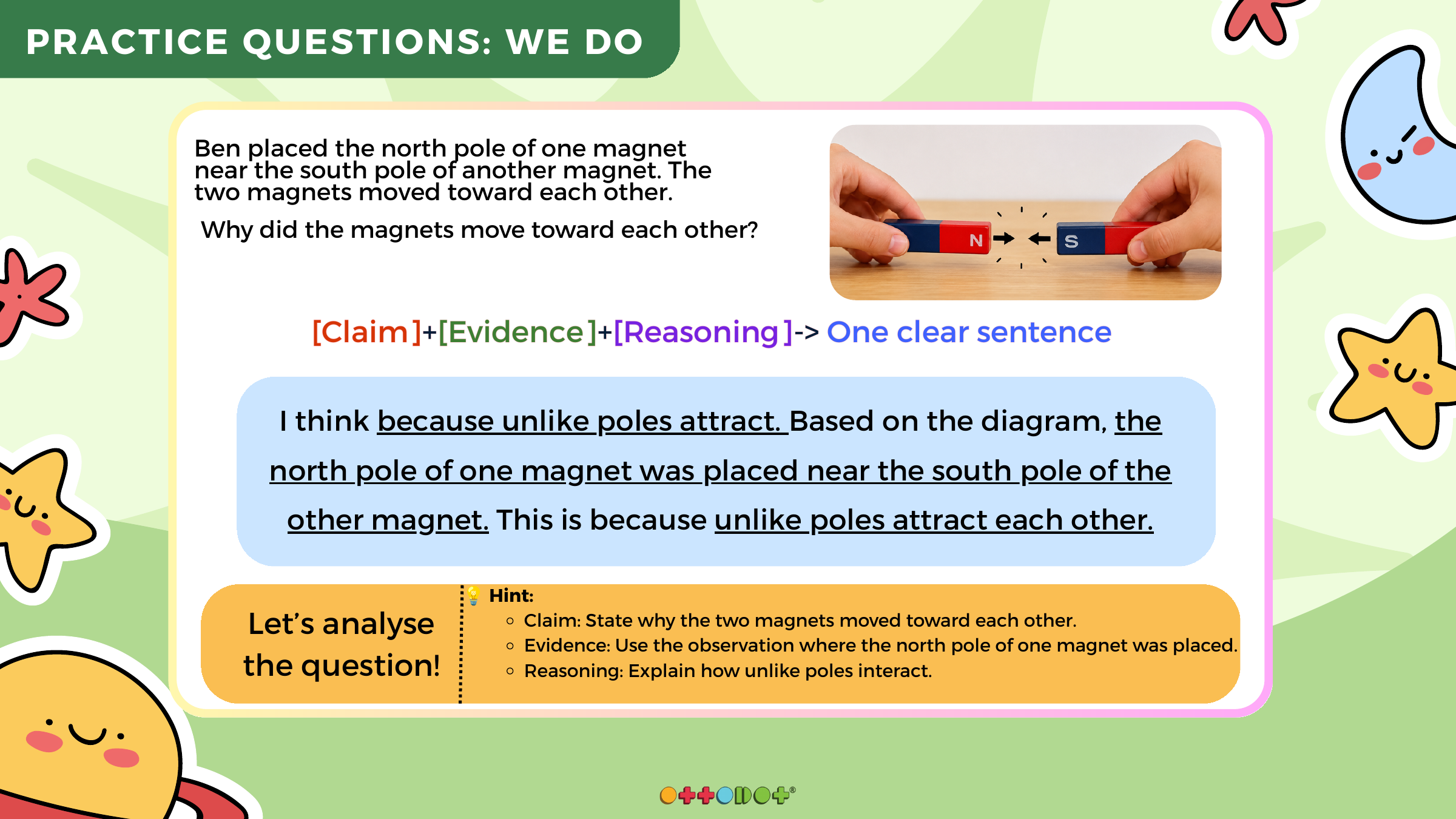
Question: Ben placed the north pole of one magnet near the south pole of another magnet. The two magnets moved toward each other. Why did the magnets move toward each other?
Weak answer:
"They moved because they attract."
Main gap: evidence gap. The answer gives the idea, but skips the key observation: the north pole was near the south pole.
Stronger CER answer:
"The magnets moved toward each other because unlike poles attract. Based on the diagram, the north pole of one magnet was placed near the south pole of the other magnet. Unlike poles attract each other, so the magnets pulled toward one another."
Claim: The magnets moved toward each other because unlike poles attract.
Evidence: Based on the diagram, the north pole of one magnet was placed near the south pole of the other magnet.
Reasoning: Unlike poles attract each other, so the magnets pulled toward one another.
Why this is stronger: the answer names the concept, uses the pole arrangement as evidence, and explains how unlike poles interact.
Parent practice move: before your child explains the movement, ask them to name the pole arrangement.
Example 3: Mosquito larvae and oil layer
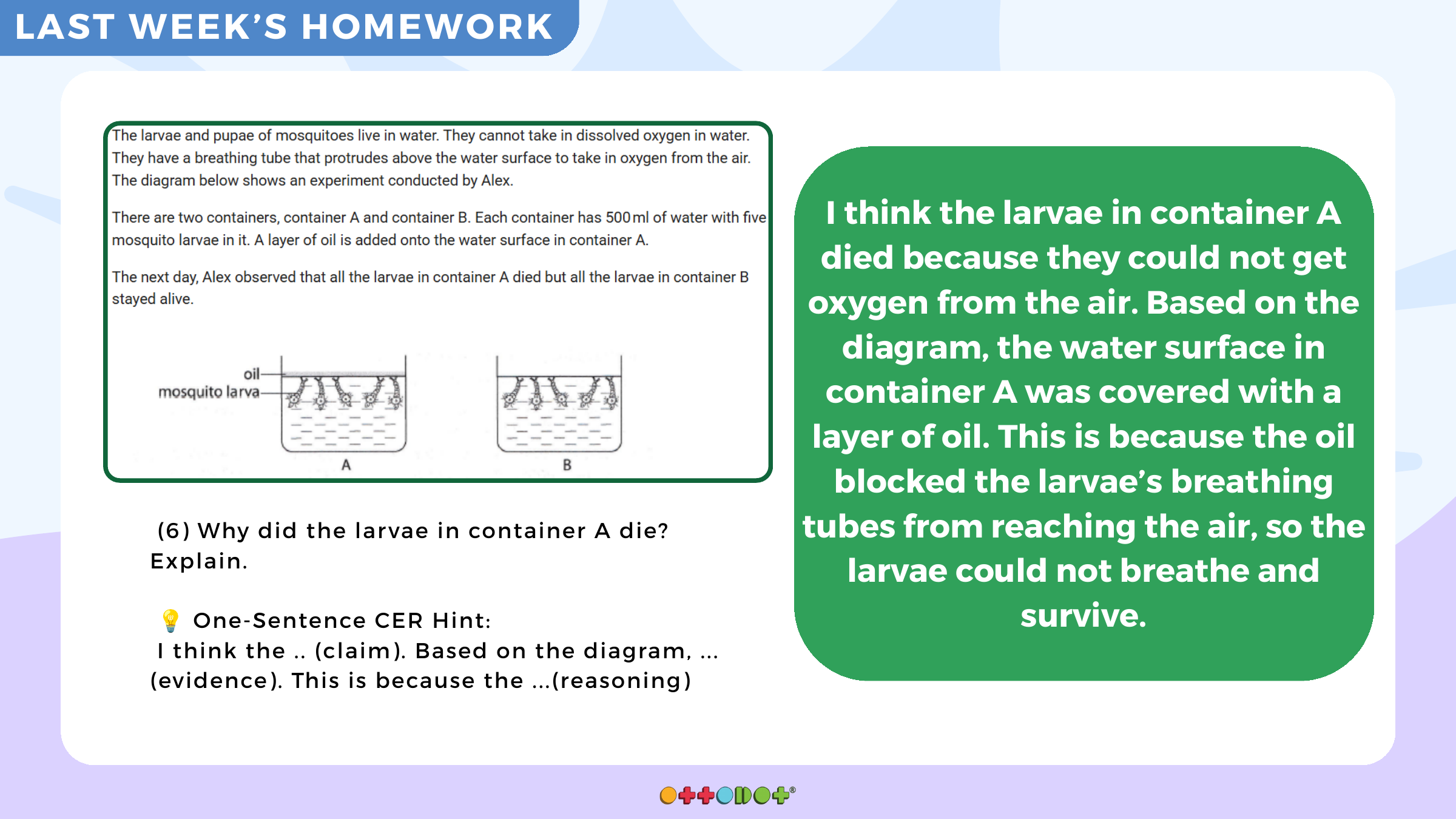
Question: Mosquito larvae use breathing tubes to take in oxygen from the air. A layer of oil was added onto the water surface in container A. The next day, all the larvae in container A died. Why did the larvae die?
Weak answer:
"The larvae died because there was oil."
Main gap: evidence and reasoning gap. The answer mentions oil, but does not explain what the oil did to the larvae.
Stronger CER answer:
"The larvae in container A died because they could not get oxygen from the air. Based on the diagram, the water surface in container A was covered with a layer of oil. The oil blocked the larvae's breathing tubes from reaching the air, so the larvae could not breathe and survive."
Claim: The larvae in container A died because they could not get oxygen from the air.
Evidence: Based on the diagram, the water surface in container A was covered with a layer of oil.
Reasoning: The oil blocked the larvae's breathing tubes from reaching the air, so the larvae could not breathe and survive.
Why this is stronger: the answer states the claim, uses the oil layer as evidence, and explains the cause-and-effect link.
Parent practice move: use this sentence frame: "I think the ... Based on the diagram, ... This is because ..."
What Parents Can Practise At Home
Use these after school worksheets:
Cover the MCQ options first. Ask your child to predict the answer or explain the concept aloud before looking at the choices.
Ask for the evidence. After any open-ended answer, ask, "What clue in the question supports your answer?"
Turn one MCQ into an OEQ sentence. Take one correct MCQ and ask, "Why is this option correct?"
For extra practice, use Ottodot's free Science and Math worksheet generator.
How Ottodot Helps With Science OEQ Practice
Ottodot teaches Science OEQs through teacher-led reasoning practice, not answer memorisation. Teachers model how to read the question, identify the concept, choose evidence, and decide what the answer has to prove.
Students practise using CER: Claim answers the question, Evidence uses the diagram or setup, and Reasoning explains the cause-and-effect link with accurate Science keywords.
Students start with scaffolded prompts, then move towards independent answers. Weekly homework and class attempts help teachers spot repeated gaps.
Ottodot's OEQ games also support this process. Games such as Making Magnets, Evaporation and Condensation, and Adaptations show Science scenarios or simulations, then ask students to answer open-ended questions with scaffolding first and less help later. The teacher still teaches the concept.
If your child is okay with Science MCQ but weak in open-ended questions, explore Ottodot's Upper Primary Science classes or check my child's fit.
FAQ
Does doing well in Science MCQ mean my child understands Science?
It can show that your child recognises some concepts, but not always whether they can explain them clearly in their own words.
Why is my child weak in Science open-ended questions but okay with MCQ?
MCQ gives answer options, so the child can recognise or eliminate choices. Open-ended questions require the child to choose the concept, use clues, and explain.
Should my child memorise model answers for Science OEQ?
Model answers help if your child studies how the answer is built. Memorising whole answers is risky because questions often change the context, diagram, variable, or observation.
How can parents help with Science OEQ at home?
Ask three questions: "What Science concept are you using?", "What evidence supports this?", and "Have you explained why?"
Conclusion
Science MCQ and open-ended questions are connected, but they do not test the exact same skill. If your child is okay with MCQ but weak in OEQ, find the gap first: concept, evidence, expression, or transfer. Then practise one small correction at a time.