
P6 Food Chains and Food Webs: PSLE Examples
Learn P6 food chains and food webs with arrow direction, energy flow, population-change examples, common mistakes, and OEQ answer patterns.
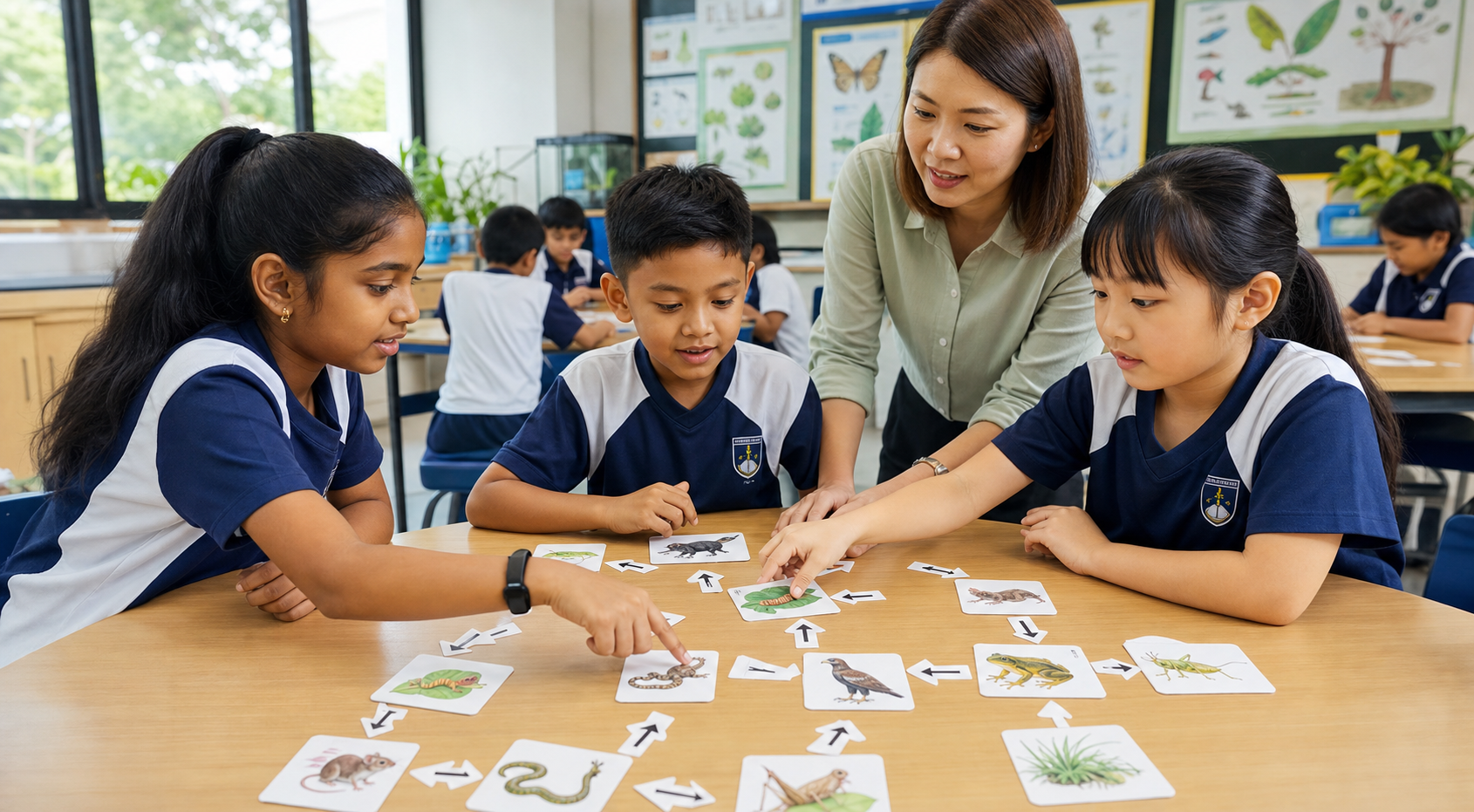
P6 food chains and food webs show feeding relationships in an environment. Children need to read the arrows correctly, trace how energy flows, and explain how a change in one population affects other organisms.
This topic belongs under P6 interactions within the environment. It connects to habitats and adaptations, but it deserves its own revision because food web questions have a very specific skill: follow the arrows step by step and explain the population change.
This guide follows the MOE primary syllabus overview and the SEAB PSLE Science format for 2026.
Key Takeaways
- Food chains and food webs are part of P6 Science.
- Arrows show the direction of energy flow, from food to eater.
- A food chain shows one feeding pathway.
- A food web shows many connected food chains.
- Population-change OEQs require step-by-step reasoning.
Quick Answer
Practise arrow direction, energy flow, and population-change explanations.
Recommended Next Guides and Practice
What Is A Food Chain?
A food chain shows one feeding relationship pathway.
For example:
grass -> grasshopper -> frog -> snake
This means the grasshopper eats the grass, the frog eats the grasshopper, and the snake eats the frog. The arrow points from the food to the eater because it shows the direction of energy flow.
In many food chains, the plant is the producer. It makes its own food through photosynthesis. Animals are consumers because they obtain energy by eating plants or other animals.
The key habit is to read the arrow correctly. If your child reads the arrow backwards, the whole explanation can become wrong.
What Is A Food Web?
A food web shows many connected food chains in the same environment.
Food webs are more realistic than single food chains because an organism may have more than one food source or more than one predator.
For example, a grasshopper may be eaten by a frog and a bird. A bird may eat grasshoppers and seeds. A snake may eat frogs and birds. These connected feeding relationships form a food web.
This is why food web questions feel harder. A change in one organism can affect several other organisms. Your child has to trace the direct effect first before explaining the next effect.
How To Read Arrows Correctly
This is the most important skill in the topic.
In a food chain or food web, the arrow points from the food to the eater. It also shows the direction of energy flow.
So if the diagram shows:
plant -> caterpillar -> bird
It means:
the caterpillar eats the plant
the bird eats the caterpillar
energy flows from the plant to the caterpillar to the bird
It does not mean the plant eats the caterpillar. This sounds obvious when written out, but under exam pressure many children read arrows in the direction of "eats" instead of energy flow.
A useful parent prompt is:
"Who is getting energy from whom?"
That one question helps the child slow down.
Population Change Questions
Population-change questions ask what happens when one organism increases, decreases, is removed, or is affected by disease.
Use this routine:
Identify the organism that changed.
Identify what that organism eats.
Identify what eats that organism.
Trace the direct effect first.
Then explain the next effect if the question asks for it.
Do not jump across the whole web at once. Food web reasoning works best one link at a time.
Worked Example: A Disease Reduces One Organism
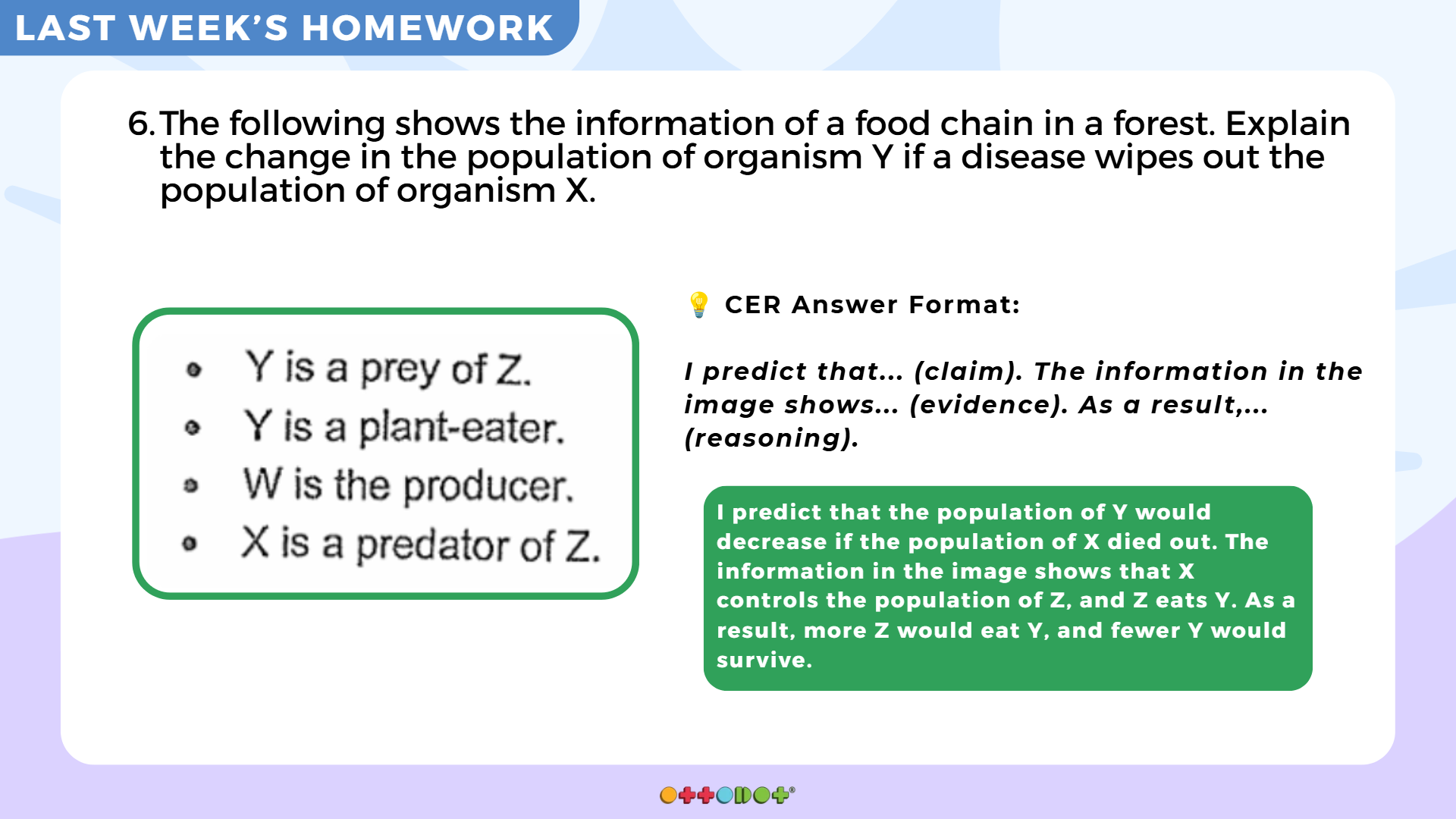
The slide describes a food chain where Y is a plant-eater, Y is prey of Z, and X is a predator of Z. The question asks what happens to the population of organism Y if a disease wipes out organism X.
A weak answer:
The population of Y will decrease.
This gives the final change, but it does not explain the feeding links.
A stronger answer:
The population of Y would decrease if the population of X died out. The information in the image shows that X controls the population of Z, and Z eats Y. As a result, more Z would eat Y, and fewer Y would survive.
This answer uses the CER structure: it makes a claim, uses evidence from the food chain, and explains the reasoning link by link.
Worked Example: Producer Decreases
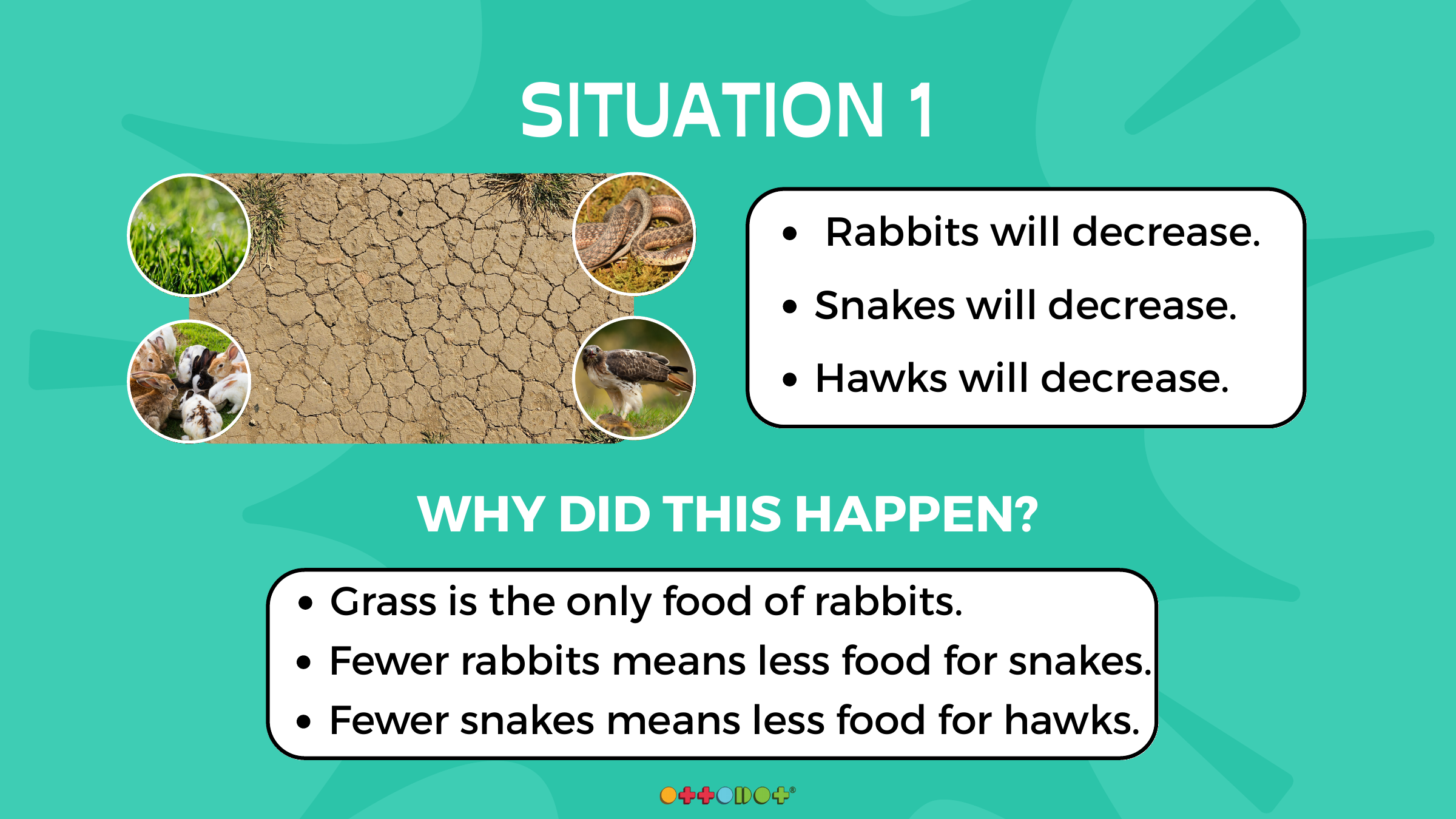
In this slide, grass is the only food of rabbits. If the grass decreases, the rabbit population will decrease because there is less food for the rabbits.
If the rabbit population decreases, the snake population will also decrease because there are fewer rabbits for the snakes to eat. If the snake population decreases, the hawk population will decrease because there are fewer snakes for the hawks to eat.
This is a common two-step explanation:
Less grass -> less food for rabbits -> fewer rabbits -> less food for snakes -> fewer snakes -> less food for hawks -> fewer hawks.
In OEQs, your child should not write only "the food web is affected". They should name the organisms and explain each link.
Common OEQ Patterns
P6 food chains and food webs questions often ask about:
an organism being removed
a new predator being introduced
a disease reducing one population
a producer decreasing
a food source becoming scarce
habitat changes
population graphs linked to a food web
The question may ask for one population only. In that case, your child should focus on that organism and the direct feeding links around it.
For more Section B practice, read our P6 Science Section B guide and Primary Science open-ended questions guide.
Common Mistakes
Mistake 1: Reading arrows backwards
The arrow points from food to eater. It shows energy flow.
Mistake 2: Saying "more food" without naming the food
"The animal has more food" is weaker than "the fox has more rabbits to eat".
Mistake 3: Jumping to the final effect
Food web answers need steps. If the child skips the organism in between, the explanation may not earn full marks.
Mistake 4: Confusing food webs with adaptations
Adaptations explain how organisms survive in their habitat. Food chains and food webs explain feeding relationships and energy flow.
Mistake 5: Giving a general ecosystem answer
The question usually asks about a specific organism. Name that organism in the answer.
How Food Webs Link To P6 Adaptations
Food chains, food webs, habitats, and adaptations all sit under P6 interactions within the environment.
They are related, but they answer different questions.
Food chains and food webs answer:
"Who eats whom, and how does energy flow?"
Adaptations answer:
"How does this organism survive in its habitat?"
For example, a bird may have a beak shape that helps it eat a certain food. The adaptation explains why the bird can feed successfully. The food web shows where the bird sits in the feeding relationship.
For the related topic, read our P6 Adaptations guide.
How Parents Can Help
Ask your child:
"What does this organism eat?"
"What eats this organism?"
"If this organism decreases, who gets less food?"
"Who gets more food because there are fewer animals eating it?"
"Which arrow proves that?"
These questions help your child turn a messy diagram into a sequence of links.
How This Fits Into P6 Science
Food chains and food webs are part of P6 interactions within the environment. They connect to photosynthesis because plants are often the starting point of food and energy in a food chain. They also connect to adaptations because organisms have features that help them survive and obtain food.
For connected P6 revision, read P6 Energy Conversion And Photosynthesis and P6 Forces.
For the bigger P6 map, read Primary 6 Science in Singapore: Adaptations, Forces and the Road to PSLE and the Primary Science topics by level guide.
FAQ
Are food chains and food webs P6 Science topics?
Yes. They are part of P6 interactions within the environment.
What do arrows mean in a food chain?
Arrows show the direction of energy flow, from the food to the eater.
Why do children lose marks in food web OEQs?
They often read arrows backwards, skip a feeding link, or write a general answer without naming the organisms involved.
How Ottodot Helps With Food Web OEQs
At Ottodot, students learn food chains and food webs through live teacher-led explanation, diagram reading, guided OEQ practice, and teacher feedback. Teachers model how to read the arrows, identify the organism being asked about, and decide what the answer must prove.
Students practise CER: make the claim, use evidence from the food web, and explain the reasoning with precise organism names and feeding links. Ottodot's verified Food Chains and Food Webs OEQ game gives students simulation-based practice after teaching. Students answer with scaffolding first, then try similar open-ended questions with less help.
Weekly homework and class attempts give teachers a feedback loop to catch repeated gaps, such as reading arrows backwards or skipping a feeding link.
If your child can read the food web but struggles to explain population changes in writing, you can Check my child’s fit for Ottodot's Upper Primary Science classes.