
P6 Forces PSLE Science: Examples and OEQ Guide
Use this P6 forces guide to explain friction, gravity, elastic spring force, effects on motion, common mistakes, and PSLE Science OEQs.

P6 forces PSLE Science questions test whether children can explain how forces affect motion, direction, shape, and observations in experiments. Standard Science students learn frictional force, gravitational force, and elastic spring force. Foundation Science students focus on friction and gravity.
The hard part is rarely the definition of force. Most children can say that a force is a push or pull. The marks are lost when they name the force but do not explain what the force does in that specific setup.
This guide follows the MOE primary syllabus overview and the SEAB PSLE Science format for 2026.
Key Takeaways
- A force is a push or pull.
- Forces can start, stop, slow down, speed up, change direction, or change shape.
- Frictional force opposes motion between surfaces in contact.
- Gravitational force pulls objects towards Earth.
- Elastic spring force acts when an elastic object is stretched or compressed. This is for P6 Standard Science.
- OEQ answers must link the force to the observation.
Quick Answer
Name the force, explain what it does, and link it to the observation.
Recommended Next Guides and Practice
What Does P6 Forces Cover?
In P6, children meet forces under the Interactions theme.
For P6 Standard Science, the key forces are:
Force | What students should know |
Frictional force | Acts between surfaces in contact and opposes motion |
Gravitational force | Pulls objects towards Earth |
Elastic spring force | Acts when an elastic object is stretched or compressed |
For P6 Foundation Science, elastic spring force is not part of the required scope. This matters if your child is in Foundation Science, because revision should match the paper they are sitting for.
Magnetic force may still appear as earlier knowledge because magnets are introduced in P3, but it should not become the main focus of a P6 forces revision plan.
What Can Forces Do?
Forces can:
start an object moving
stop a moving object
slow an object down
speed an object up
change the direction of motion
change the shape of an object
When your child sees a force question, ask them to identify the effect first. Is the object slowing down? Is it falling? Is a spring being stretched? Is a surface making movement harder?
That one observation usually tells the child which concept to use.
Frictional Force
Frictional force acts between surfaces in contact. It opposes motion.
In simple P6 questions, a rougher surface usually produces greater friction than a smoother surface. Greater friction can cause a moving object to slow down more quickly or travel a shorter distance.
For example, imagine two identical blocks pushed with the same force. One block moves across a smooth surface. The other moves across a rough surface.
The block on the rough surface usually travels a shorter distance because there is greater frictional force opposing its motion. The block on the smooth surface usually travels further because there is less friction opposing its motion.
That is the relationship your child must write clearly:
Rougher surface -> greater frictional force -> motion opposed more strongly -> shorter distance travelled.
Avoid adding terms like air resistance or water resistance as required concepts. For P6 Primary Science, the safe term here is frictional force.
Worked Example: Rough Vs Smooth Surface
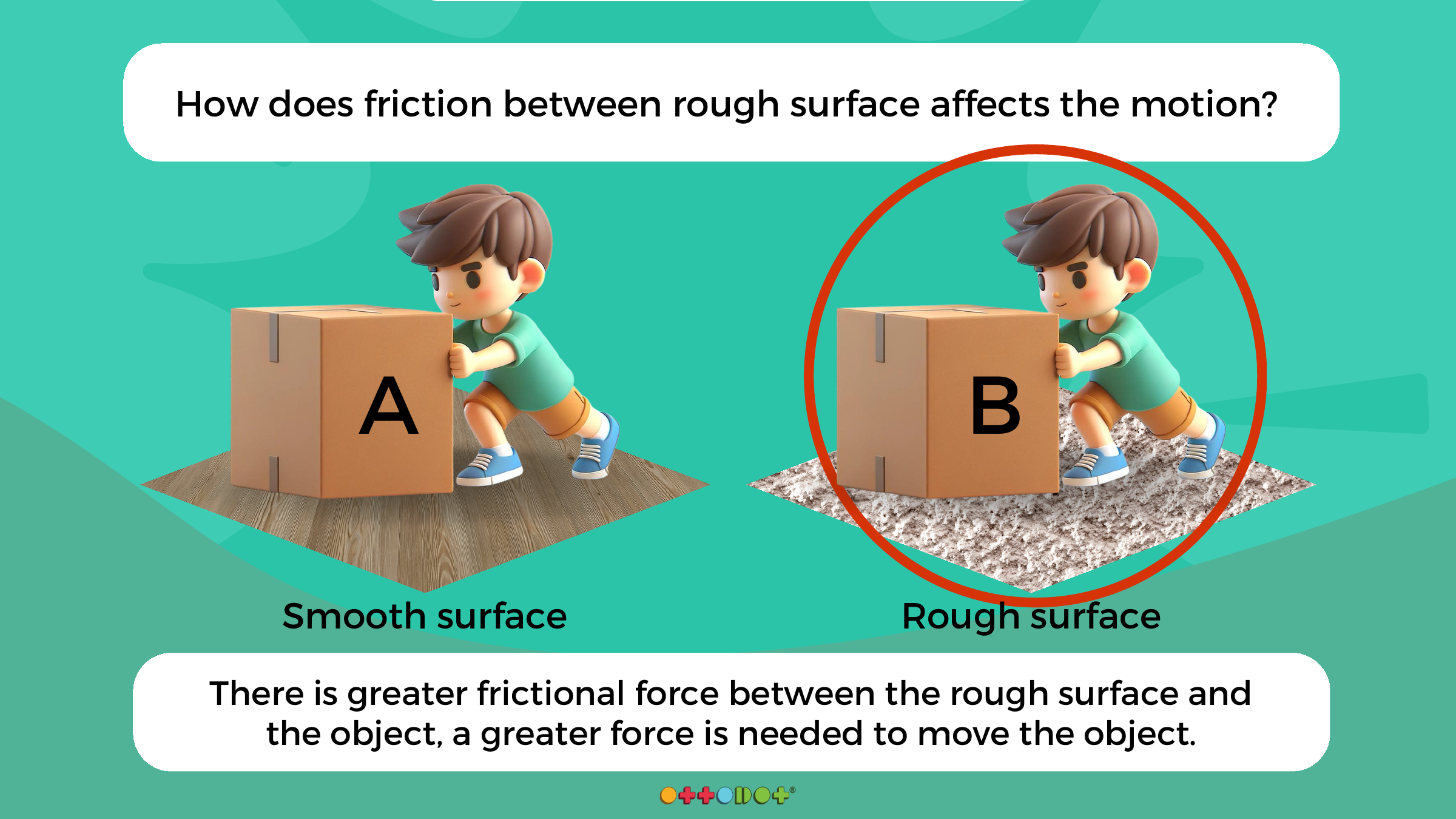
A block is pushed across two surfaces with the same starting force.
Surface A is smooth. Surface B is rough. The block travels further on Surface A.
The question asks why the block travels a shorter distance on Surface B.
A weak answer:
Surface B has more friction, so the block stops.
This has the right idea, but it can be clearer.
A stronger answer:
Surface B is rougher, so there is greater frictional force between the block and the surface. The greater frictional force opposes the motion of the block more strongly, so the block slows down faster and travels a shorter distance.
This answer works because it connects surface texture, frictional force, effect on motion, and final observation.
Gravitational Force
Gravitational force pulls objects towards Earth.
In P6 questions, gravity often appears in falling-object setups, hanging objects, or explanations of why an object moves downwards. The answer should not stop at "because of gravity". It should say what gravity does.
For example:
The ball falls because gravitational force pulls it towards Earth.
If the question asks for a comparison, your child should use the observation given in the question and avoid overexplaining beyond the mark value.
Elastic Spring Force
Elastic spring force applies to P6 Standard Science.
It acts when an elastic object is stretched or compressed. Examples include springs and rubber bands. The elastic object tends to return to its original shape when released.
A simple explanation:
When the spring is compressed, elastic spring force acts to return the spring to its original length.
For P6, keep this explanation at primary level. The child does not need secondary physics formulas. They need to explain the relationship between stretching or compressing the object and the force acting.
Worked Example: Compressed Spring
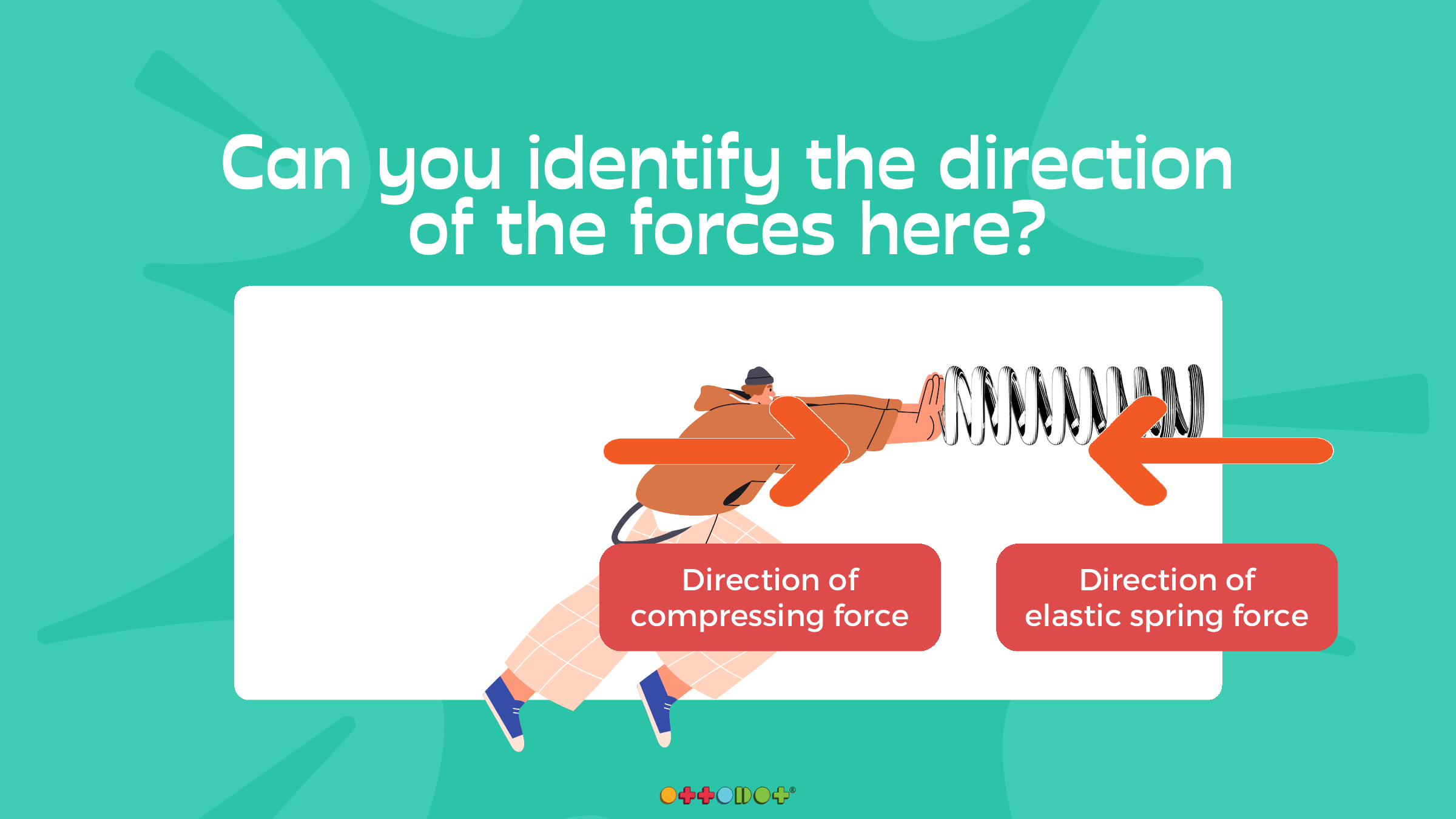
In the lesson slide, a spring is being compressed by a hand. The question asks students to identify the direction of the forces.
A weak answer:
The force is to the left.
That answer names only one direction and misses the pair of forces shown in the setup.
A clear answer:
The hand exerts a compressing force on the spring towards the left. The compressed spring exerts an elastic spring force in the opposite direction, towards the right.
This matches the slide because elastic spring force acts in the opposite direction to the force compressing the spring.
Common Forces OEQ Patterns
Your child may see questions about:
an object travelling different distances on different surfaces
ways to increase or reduce friction
why a falling object moves towards Earth
what happens when a spring or rubber band is stretched or compressed
how a force changes the shape or motion of an object
The answering habit is the same each time:
Name the force.
Say what the force does.
Link it to the observation.
For more Section B answering support, read our P6 Science Section B guide and Primary Science open-ended questions guide.
Common Mistakes
Mistake 1: Naming the force only
"Friction" is not a full explanation. Your child should say that frictional force opposes motion.
Mistake 2: Saying friction always stops things
Friction can slow an object down, prevent slipping, or help movement in some situations. The answer should match the setup.
Mistake 3: Reading beyond the syllabus
Some online notes include broader physics terms. For P6, keep to the MOE scope and the wording used in school.
Mistake 4: Forgetting Foundation vs Standard scope
If your child is taking Foundation Science, do not spend unnecessary time drilling elastic spring force as a required topic.
Mistake 5: Ignoring the observation
If the question says "shorter distance", "slower", "falls", or "returns to original shape", that phrase should guide the answer.
How Parents Can Help
Ask your child:
"Which force is acting here?"
"What is the force doing?"
"Is the object speeding up, slowing down, falling, or changing shape?"
"Which observation proves your answer?"
If the answer feels too short, ask, "What happened because of that force?" That usually pushes the child from keyword recall into explanation.
How This Fits Into P6 Science
Forces is one of the major P6 topics that can appear in PSLE Science open-ended questions. It sits beside other P6 topics such as photosynthesis, energy conversion, food chains, food webs, and adaptations.
Next, revise related P6 topics: P6 Energy Conversion And Photosynthesis and P6 Food Chains And Food Webs.
For the bigger map, read Primary 6 Science in Singapore: Adaptations, Forces and the Road to PSLE and the Primary Science topics by level guide.
FAQ
What forces are tested in P6 Science?
P6 Standard Science covers frictional force, gravitational force, and elastic spring force. P6 Foundation Science covers friction and gravity.
Is magnetic force a P6 forces topic?
Magnets are introduced earlier in P3. They may appear as prior knowledge, but the main P6 forces focus is friction, gravity, and elastic spring force for Standard Science.
How should my child answer a forces OEQ?
Name the force, explain what the force does, and link it to the observation in the question.
How Ottodot Helps With P6 Forces
At Ottodot, students learn forces through live teacher-led explanation, guided examples, and Science OEQ practice. Teachers model how to read the setup, identify the force being tested, and decide what the answer must prove.
Students practise CER: make the claim, use evidence from the setup, and explain the reasoning with precise Science keywords. For forces, that usually means linking the force to motion, distance travelled, falling, or a change in shape.
Ottodot's verified Effects of Forces OEQ game gives students simulation-based practice after teaching. Students answer with scaffolding first, then try similar open-ended questions with less help. Weekly homework and class attempts give teachers a feedback loop to catch repeated gaps.
If your child understands the definitions but loses marks in PSLE-style explanations, you can Check my child’s fit for Ottodot's Upper Primary Science classes.