
P5 Plant Transport System: OEQ Examples Guide
Learn the P5 plant transport system with water-carrying tubes, food-carrying tubes, diagrams, OEQ examples, and common mistakes to avoid.

The P5 plant transport system teaches children how water moves from the roots to the rest of the plant, and how food made in the leaves is transported to other plant parts. For Primary 5 Science, your child does not need secondary-school plant biology. They need to know what each transport tube carries and how to explain the observation in an open-ended question.
This topic looks simple at first. Then the exam question shows a cut stem, coloured water, a ring of bark removed, or a plant that starts to wilt. That is where many children lose marks. They know the word "transport", but they do not connect the affected tube to the substance being moved and the visible result.
This guide follows the MOE primary syllabus overview and keeps the terminology suitable for Singapore Primary Science.
Key Takeaways
- P5 students should use "water-carrying tubes" and "food-carrying tubes".
- Water is transported from the roots to other parts of the plant.
- Food made in the leaves is transported to other plant parts.
- Tube-removal questions test cause and effect, not memorised labels.
- A strong Science OEQ answer names the affected tube, what it carries, where the substance cannot go, and the observation.
Quick Answer
Focus on tube differences, diagrams, and OEQ phrasing for P5 plant transport.
Recommended Next Guides and Practice
What Is The P5 Plant Transport System?
Plants need water and food to survive. They do not move around to look for these substances, so different plant parts have different jobs.
The roots absorb water from the soil. The leaves make food. The stem supports the plant and contains tubes that transport substances between plant parts.
At P5, the two important terms are:
Tube | What it transports | Main idea | Common question clue |
Water-carrying tubes | Water and mineral salts | Water moves from the roots to the rest of the plant | Coloured water, cut stem, wilting |
Food-carrying tubes | Food made by leaves | Food moves from the leaves to other plant parts | Ring of bark removed, swelling, parts below the cut receiving less food |
Some resources may mention the secondary terms for these tubes. Your child can recognise them if a teacher has introduced them, but they are not required terms for Primary Science. In Ottodot articles and student explanations, we keep to the MOE-safe wording: water-carrying tubes and food-carrying tubes.
Why This Topic Becomes Tricky
The concept is not hard because the plant has many parts. It becomes hard because the question usually changes one part of the setup and asks your child to predict or explain the result.
For example, a question may show a plant stem placed in coloured water. After some time, the colour appears in the stem or leaves. A child who only writes "the plant absorbed water" may be partly right, but the answer is not specific enough.
A stronger answer would say that the coloured water was transported through the water-carrying tubes from the roots or cut end of the stem to the other parts of the plant. The colour acts as evidence that water was transported.
Another question may show a ring removed from the outside of a stem. The plant part above the removed ring may swell because food made by the leaves cannot be transported past the damaged part. The important link is not "the stem is cut". The important link is that the food-carrying tubes are affected, so food cannot be transported normally.
Common Plant Transport OEQ Patterns
Most P5 plant transport system questions fall into a few patterns.
Coloured water questions
The question uses coloured water to show the path taken by water in the plant. Your child should mention the water-carrying tubes and where the water travels.
Wilting questions
A plant wilts when it does not receive enough water. If the water-carrying tubes are damaged or removed, water cannot be transported properly to the leaves and other parts.
Food accumulation questions
If food-carrying tubes are affected, food made in the leaves may not be transported past the affected part. Questions may show swelling or ask why a certain part receives less food.
Comparison questions
The question may compare two similar plants with different tubes removed. Your child must identify what changed between the setups before explaining the result.
Observation-based questions
The question may ask, "What can you conclude?" or "Explain the observation." These require the child to use the evidence in the diagram or table, not give a general textbook statement.
Worked Example: Food-Carrying Tube Removed
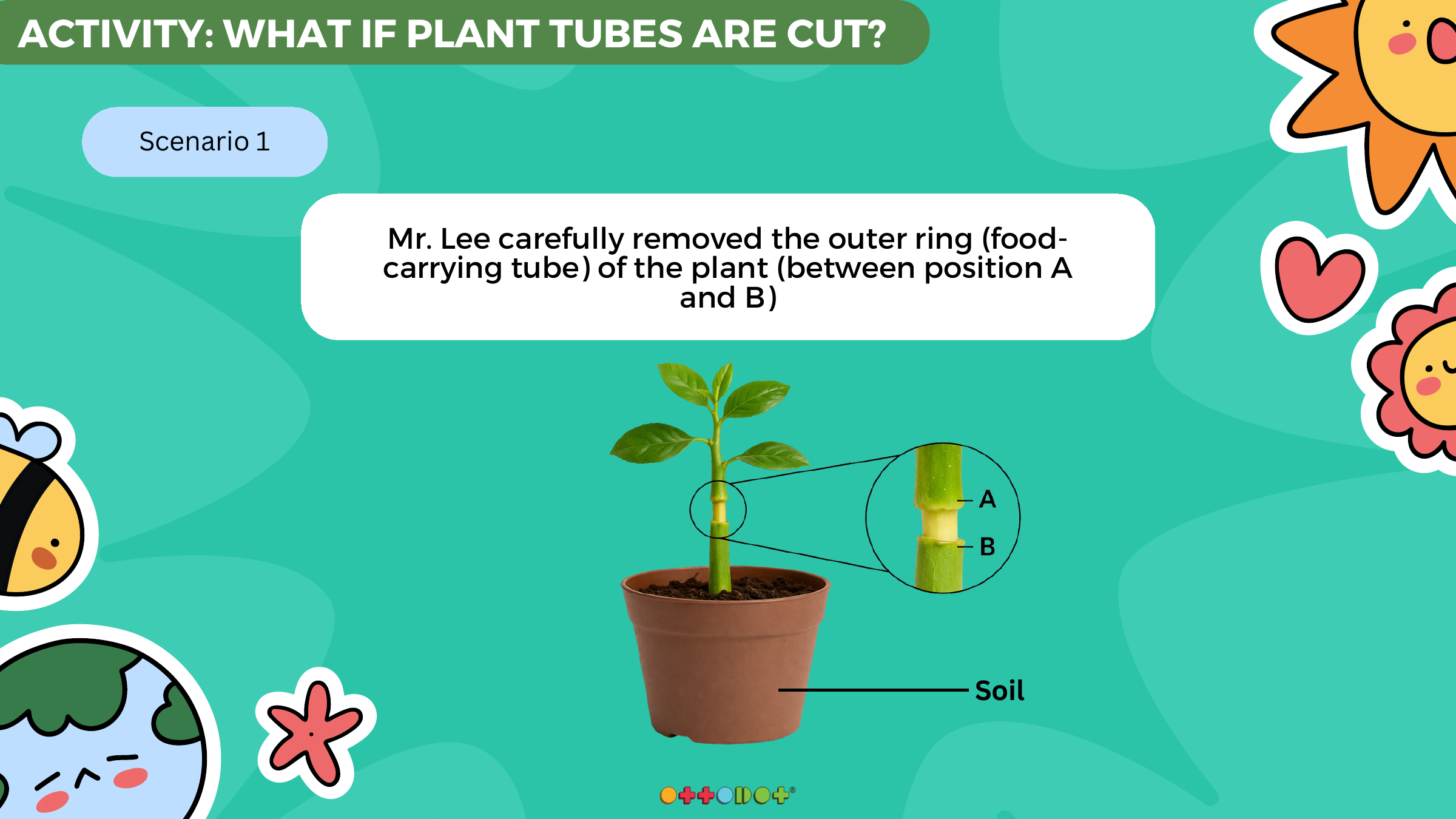
In the lesson slide, Mr Lee removes the outer ring containing the food-carrying tubes from a plant stem at position A. After a few weeks, position A becomes swollen.
The question is not asking children to say that the stem was simply cut. It is asking them to connect the removed tube to the movement of food made by the leaves.
A weak answer might be:
The plant cannot get nutrients, so the stem swells.
This is too vague. It does not name the food-carrying tube or explain where the food is unable to go.
A better answer would be:
The food-carrying tubes at position A were removed. Food made by the leaves could not be transported past position A to the lower parts of the plant, so food accumulated above the removed part and caused the stem at position A to swell.
Notice the answer pattern: name the tube, state what it transports, then link that to the swelling shown in the slide.
Worked Example: Coloured Water In A Stem
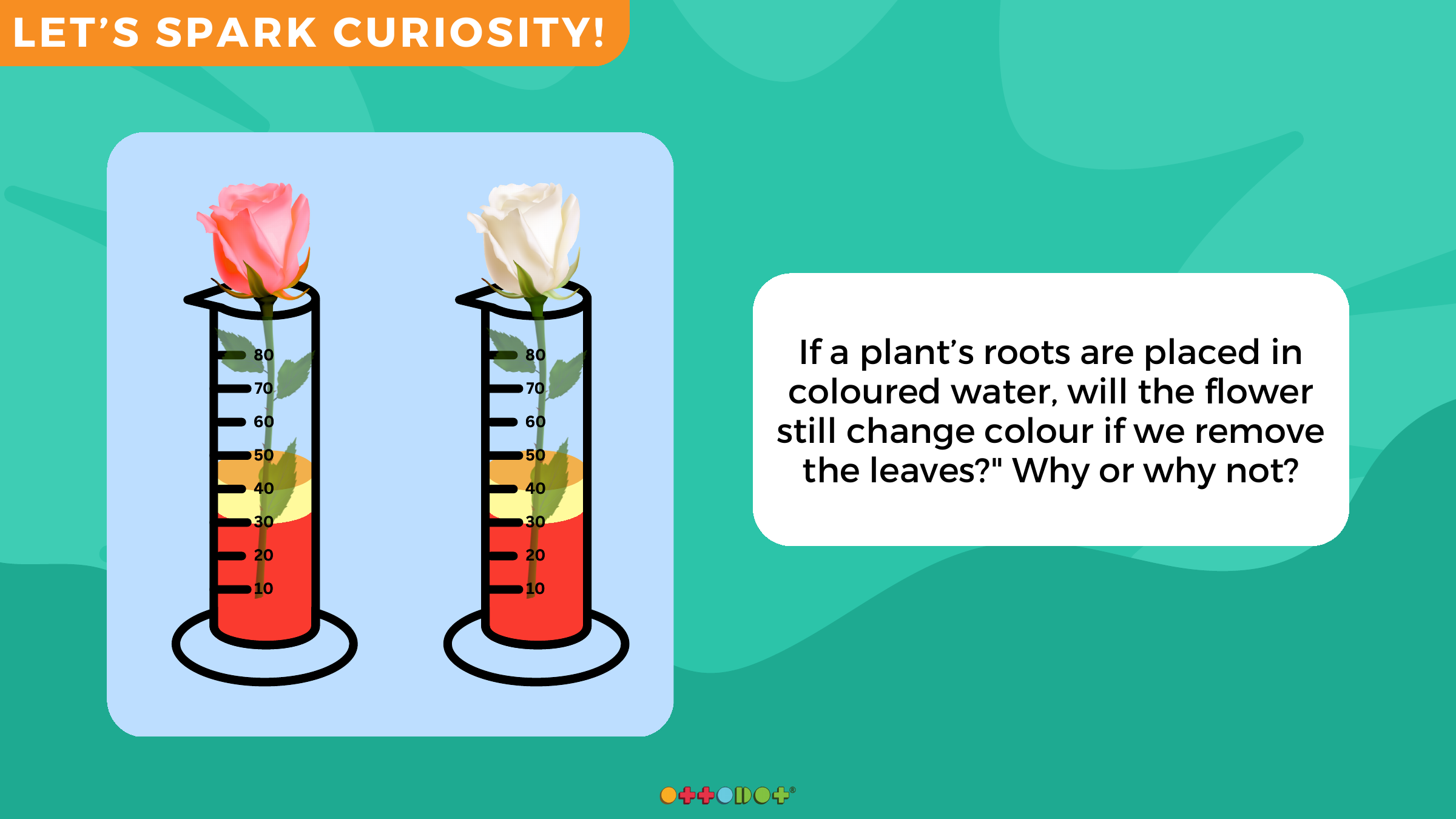
In the lesson slide, two rose stalks are placed in coloured water. The question asks whether the flower will change colour, and why.
A weak answer might be:
Yes, because the flower drinks the coloured water.
That sounds natural, but it is not precise enough for a P5 Science answer.
A better answer would be:
Yes. The coloured water is absorbed by the plant and transported upwards through the water-carrying tubes in the stem to the flower. The coloured water reaches the petals, causing the flower to change colour.
This answer matches the slide because it explains the path of the coloured water, not only the final colour change.
Common Mistakes In P5 Plant Transport
Mistake 1: Saying "nutrients" for everything
Many children use "nutrients" when they are unsure whether the question is about food or water. This can cost marks because plant transport questions are often testing that exact distinction.
Mistake 2: Naming the tube but not the effect
"The food-carrying tube is removed" is a start, not a full answer. Your child must explain what cannot be transported and what happens as a result.
Mistake 3: Using secondary terms as if they are required
The child may have seen terms like xylem or phloem elsewhere. For Primary Science, the safer habit is to use water-carrying tubes and food-carrying tubes unless the school specifically asks otherwise.
Mistake 4: Forgetting that leaves make food
Food transport questions often depend on this idea. If the leaves are removed, less food is made. If the leaves remain but the food-carrying tubes are affected, food may not move to the parts that need it.
Mistake 5: Ignoring the observation
If the question says a part swelled, wilted, changed colour, or grew poorly, that observation must appear in the answer.
How Parents Can Help With This Topic
You do not need to reteach the entire topic at home. A few good questions can help your child slow down and think.
Ask:
"Is this question about water or food?"
"Which tube is affected?"
"What does that tube transport?"
"Where can the substance no longer go?"
"What observation proves your answer?"
If your child can answer these five questions, the final written answer becomes much easier.
For more help with answer structure, read our guide to P5 Science open-ended questions and our broader Primary Science open-ended questions guide.
How This Fits Into P5 Science
Plant transport is one part of the P5 Systems theme. Your child will also meet body systems, reproduction, water cycle, and electrical systems. These topics all require the same shift: instead of naming facts, children must explain how parts work together.
For the related human body systems topic, read P5 Respiratory And Circulatory Systems.
If you want the bigger P5 map, read Primary 5 Science in Singapore: Reproduction, Body Systems and Electrical Circuits. You can also use the Primary Science topics by level guide to see how P5 connects to P6.
FAQ
Is the plant transport system a P5 topic?
Yes. Plant transport is taught in P5 Science under the Systems theme.
Does my child need to use xylem and phloem?
No. For Primary Science, use water-carrying tubes and food-carrying tubes.
Why do plant transport OEQs feel harder than the notes?
The questions usually change part of the plant setup. Your child must explain how the affected tube changes what is transported and what is observed.
How Ottodot Helps With Plant Transport OEQs
At Ottodot, upper-primary Science is taught through live teacher-led classes first. The teacher models how to read the question, identify the tested concept, and decide what the answer must prove.
For plant transport, that means your child is not simply memorising "water-carrying tubes" and "food-carrying tubes". They learn to use CER: make the claim, point to evidence from the diagram or observation, and explain the reasoning with precise Science keywords.
Ottodot's verified Plant Transport System OEQ game gives students simulation-based practice after the concept has been taught. Students answer with scaffolding first, then try similar open-ended questions with less help. Weekly homework and class attempts give teachers a feedback loop to spot repeated gaps.
If your child often knows the topic but loses marks in open-ended questions, you can Check my child’s fit for Ottodot's Upper Primary Science classes.