
P5 Respiratory And Circulatory Systems: Parent Guide For Primary Science
Use this P5 respiratory and circulatory systems guide to explain oxygen, carbon dioxide, blood transport, breathing rate, and common OEQs clearly.
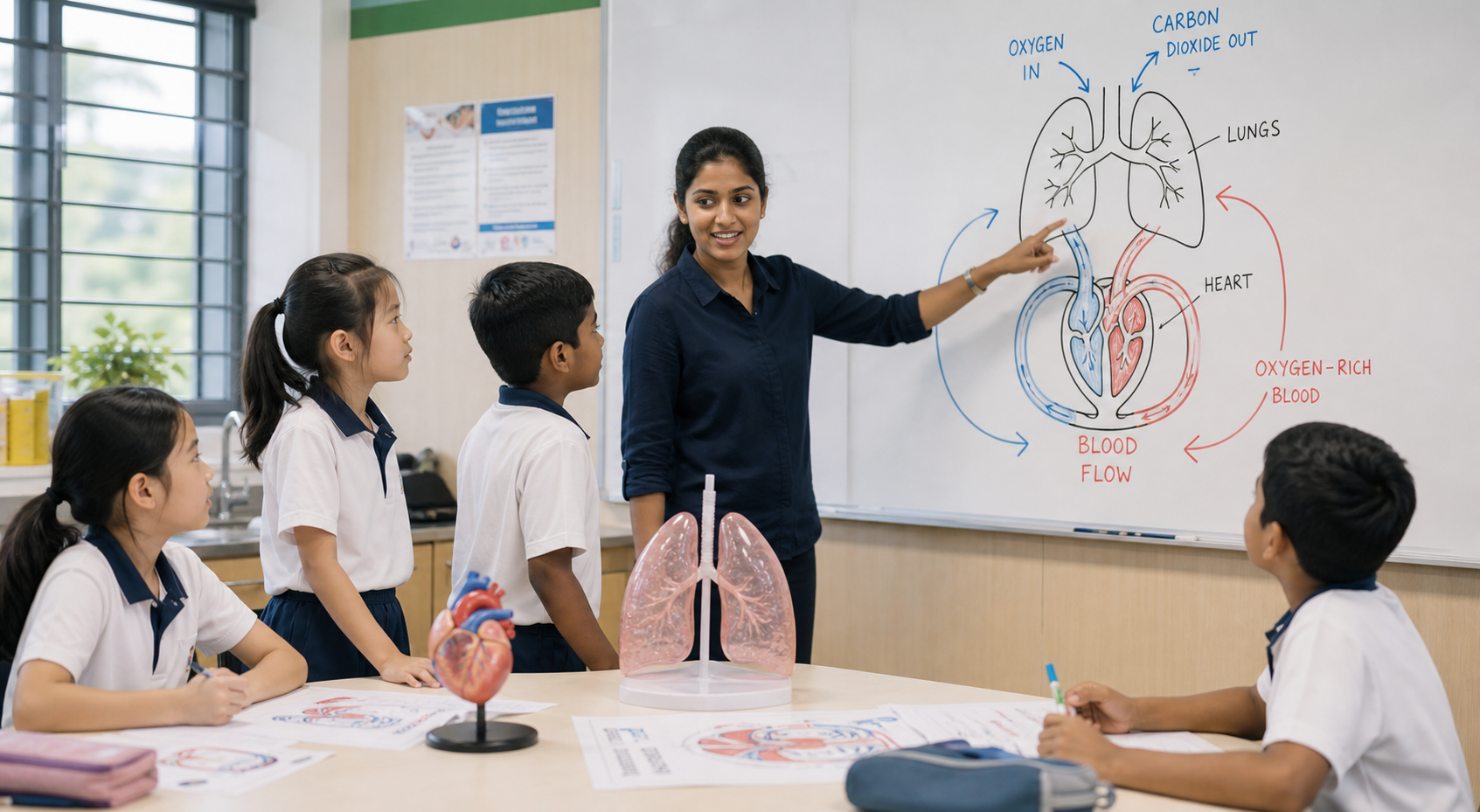
P5 respiratory and circulatory systems teach children how oxygen enters the body, how carbon dioxide leaves the body, and how blood transports substances around the body. The tricky part is not naming the nose, windpipe, lungs, heart, blood, and blood vessels. The tricky part is explaining how these parts work together in a Science open-ended question.
For Primary 5 Science, your child does not need secondary biology terms. They need a clear process: air enters the lungs, oxygen enters the blood, the heart pumps blood around the body, and carbon dioxide is removed from the body.
This guide follows the MOE primary syllabus overview and keeps the body-system terms at Primary Science level.
Key Takeaways
- P5 students need nose, windpipe, lungs, heart, blood, and blood vessels.
- The respiratory system takes in oxygen and removes carbon dioxide.
- The circulatory system transports oxygen and other substances around the body.
- The two systems work together, especially during exercise.
- OEQ answers should explain the process, not only name body parts.
Quick Answer
Connect oxygen, carbon dioxide, breathing rate, and blood transport in P5 Science OEQs.
Recommended Next Guides and Practice
What The P5 Respiratory System Covers
The respiratory system helps the body take in oxygen and remove carbon dioxide.
At P5, the key parts are:
Part | What it does |
Nose | Allows air to enter and leave the body |
Windpipe | Carries air between the nose and lungs |
Lungs | Where oxygen enters the blood and carbon dioxide leaves the blood |
When a child breathes in, air enters through the nose, passes through the windpipe, and reaches the lungs. In the lungs, oxygen from the air enters the blood. Carbon dioxide from the blood leaves the body when the child breathes out.
That is enough for Primary Science. Your child does not need to explain tiny air sacs or detailed lung structures to answer P5 questions well.
What The P5 Circulatory System Covers
The circulatory system transports substances around the body.
At P5, the key parts are:
Part | What it does |
Heart | Pumps blood around the body |
Blood | Transports oxygen and other substances |
Blood vessels | Carry blood to different parts of the body |
The heart is often described as a pump. Blood moves through blood vessels to different body parts. Oxygen is transported in the blood to the parts of the body that need it.
For a P5 child, the important point is the link: oxygen enters the blood in the lungs, then blood carries oxygen around the body.
How The Respiratory And Circulatory Systems Work Together
Many children learn the two systems separately. Then they get stuck when a question asks how both systems work together.
Use this simple flow:
Air enters the body through the nose.
Air passes through the windpipe into the lungs.
Oxygen enters the blood in the lungs.
The heart pumps blood around the body.
Blood transports oxygen to different body parts.
Carbon dioxide is transported back to the lungs and breathed out.
This sequence is useful because it turns a vague answer into a complete explanation.
A vague answer sounds like this:
The lungs and heart help us breathe.
A better answer sounds like this:
The lungs allow oxygen to enter the blood. The heart pumps blood around the body, so oxygen is transported to different body parts. Carbon dioxide is transported back to the lungs and removed when the person breathes out.
The second answer names the system parts and explains what happens.
Worked Example: Candle Under A Glass Container
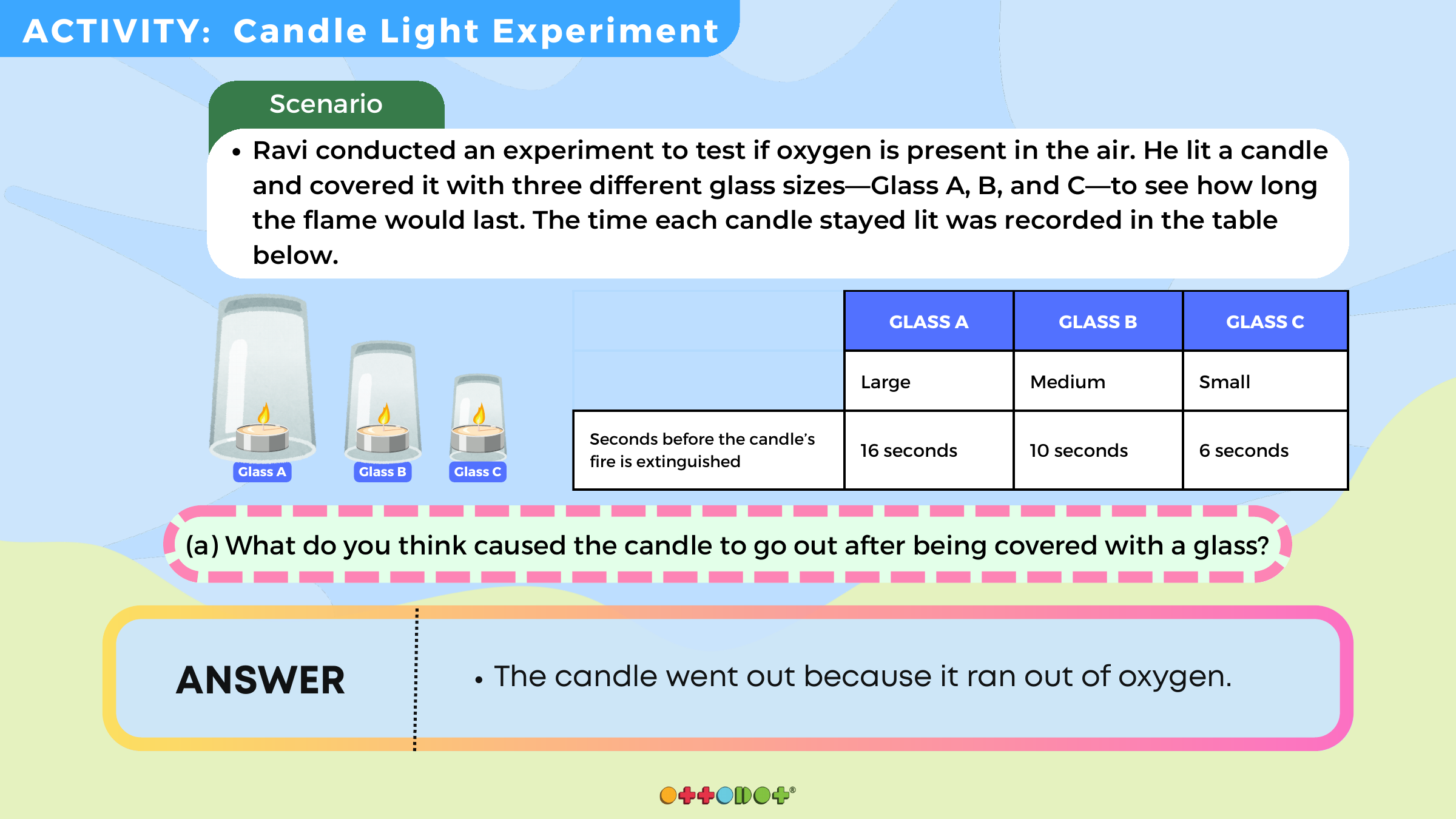
In the lesson slide, Ravi covers burning candles with glass containers. The question asks what caused a candle to go out after it was covered.
A weak answer might say:
The candle went out because there was no air.
That is close, but the Science idea being tested is more specific: burning needs oxygen.
A stronger answer would be:
The candle went out because the oxygen in the glass container was used up. Without enough oxygen, the candle could no longer continue burning.
This links directly to the slide: the candle is covered, oxygen is used up, and the flame goes out.
Worked Example: Breathing Rate After Exercise
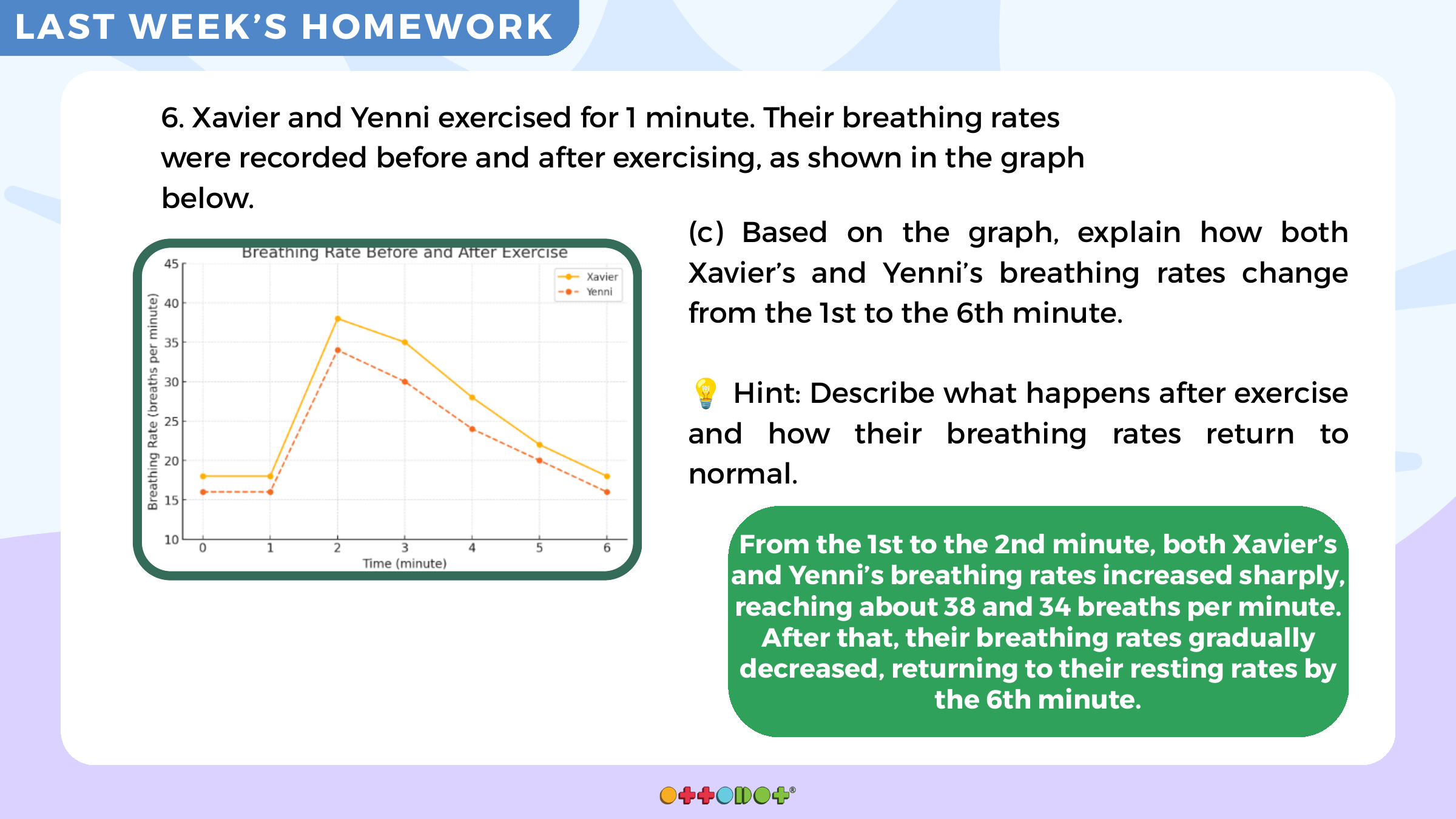
In the lesson slide, Xavier and Yenni exercise for one minute. Their breathing rates are recorded before and after exercise, and the graph is used to explain how their breathing rates change over time.
A weak answer might be:
Their breathing rates increased after exercise and then decreased.
That answer sees the trend, but it does not use enough detail from the graph.
A stronger answer would be:
From the 1st to the 2nd minute, both breathing rates increased greatly. From the 2nd to the 5th minute, both breathing rates decreased gradually but were still higher than before exercise. By the 6th minute, the breathing rates returned to normal.
This is the habit children need for graph questions: describe the pattern in stages, then connect it to the body needing more oxygen during and just after exercise.
Common OEQ Patterns
P5 respiratory and circulatory systems questions often test:
inhaled air compared with exhaled air
oxygen and carbon dioxide changes
burning candle experiments
breathing rate before and after activity
oxygen being transported by blood
how lungs and heart work together
why body parts need oxygen
For each pattern, your child should ask:
What changed in the setup?
What evidence does the question give?
Which system is involved?
What substance is being transported or removed?
This slows the child down enough to write a proper cause-and-effect answer.
Common Mistakes
Mistake 1: Saying "lungs help us breathe"
This is too general. The answer should mention oxygen entering the body and carbon dioxide leaving the body.
Mistake 2: Treating both systems as separate
If a question asks how the systems work together, the answer must connect lungs, blood, and heart.
Mistake 3: Using terms beyond P5
Some resources introduce secondary-level terms such as oxygenated and deoxygenated blood. For P5, keep to nose, windpipe, lungs, heart, blood, and blood vessels, and describe blood as rich in oxygen or rich in carbon dioxide.
Mistake 4: Forgetting the role of blood
Blood is not only "inside the body". In this topic, blood transports oxygen and other substances.
Mistake 5: Ignoring exercise
Exercise questions are about increased oxygen need. The child should explain why the body needs more oxygen, not only state that breathing becomes faster.
How Parents Can Help
You can help your child practise with short verbal prompts.
Ask:
"Where does oxygen go after it enters the lungs?"
"What does blood transport?"
"What does the heart do?"
"How do the lungs and heart work together?"
"What evidence from the question shows the body needs more oxygen?"
If your child gives a one-line answer, ask for the missing link. For example, if they say "the person breathes faster", ask, "So what does faster breathing help the body get more of?"
For answer-writing support, read our Claim Evidence Reasoning guide for Primary Science and Primary Science open-ended questions guide.
How This Fits Into P5 Science
Respiratory and circulatory systems sit under the P5 Systems theme. They connect well with plant transport because both topics ask children to explain how substances move through living things.
For the matching plant systems topic, read P5 Plant Transport System.
For the bigger P5 map, read Primary 5 Science in Singapore: Reproduction, Body Systems and Electrical Circuits. You can also use the Primary Science topics by level guide to see how P5 prepares children for P6 Science.
FAQ
Are respiratory and circulatory systems P5 topics?
Yes. The human respiratory system and circulatory system are taught in P5 Science.
Does my child need to learn detailed heart or lung structures?
No. At P5, keep to nose, windpipe, lungs, heart, blood, and blood vessels.
Why does breathing rate increase after exercise?
The body parts need more oxygen during exercise, so breathing rate increases to take in more oxygen and remove more carbon dioxide.
How Ottodot Helps With P5 Body Systems
At Ottodot, students learn P5 Science through live teacher-led online classes. The teacher models how to read the question, identify whether the respiratory system, circulatory system, or both systems are being tested, and decide what the answer must prove.
For OEQs, students practise CER: make the claim, use evidence from the setup or data, and explain the reasoning with precise Science keywords such as oxygen, carbon dioxide, blood, heart, and lungs.
Ottodot's verified Rate of Respiration and Circulatory System OEQ games give students simulation-based practice after teaching. Students answer open-ended questions with scaffolding first, then with less help. Weekly homework and class attempts help teachers spot repeated gaps.
If your child can memorise body parts but struggles to explain how systems work together, you can Check my child’s fit for Ottodot's Upper Primary Science classes.