
PSLE Maths Problem Sums: How To Solve Paper 2 Questions
Learn how to solve PSLE maths problem sums with a Paper 2 routine, worked examples, common mistakes, parent prompts, and smarter revision tips for home.

PSLE maths problem sums feel harder because the method is hidden inside the story. Your child has to read carefully, spot the question type, choose a heuristic, and show enough working for method marks.
Many parents see the same pattern at home. A child can do fractions, ratio, percentage, or rate questions on a topic worksheet. But when those ideas appear in a long Paper 2 question, they freeze.
That does not always mean the child is weak in Math. Often, they need a clearer routine for turning a word problem into visible working.
This guide explains how to approach PSLE maths problem sums, with worked examples, common mistakes, and parent prompts you can use during revision.
Key Takeaways
- PSLE problem sums test application, not only calculation.
- A useful way to understand Math practice is AO1, AO2, and AO3: recall, application, and complex reasoning.
- The first step is to find what the question is asking, before choosing an operation.
- Bar models, before-and-after tables, working backwards, and volume/rate setups solve different problem structures.
- Your child's written working matters because method marks can be awarded even when the final answer is wrong.
- Mixed practice is important because PSLE questions are not labelled by topic or heuristic.
Quick Answer
Build a repeatable setup routine for PSLE Math Paper 2 problem sums.
Recommended Next Guides and Practice
The AO1, AO2, AO3 framework most parents never see
In the 2026 PSLE format, Paper 2 carries 50 marks, so it is a major part of the exam. If you want the broader paper breakdown first, start with our complete guide to PSLE Math question types.
One useful way to understand PSLE maths problem sums is through three assessment levels teachers commonly use when planning Math practice: recall, application, and complex reasoning.
Parents do not need to memorise the labels. The framework is useful because it explains why good revision should not be made only of easy sums, and also why it should not chase only the hardest viral questions.
Level | Type of question | Approximate exam role |
AO1 | Basic recall and direct calculation | About 40%, foundational marks |
AO2 | Interpret, apply, and solve word problems | About 50%, the biggest portion, and where many students lose marks |
AO3 | Reason, analyse, and strategically solve complex word problems | About 10%, high-ability stretch |
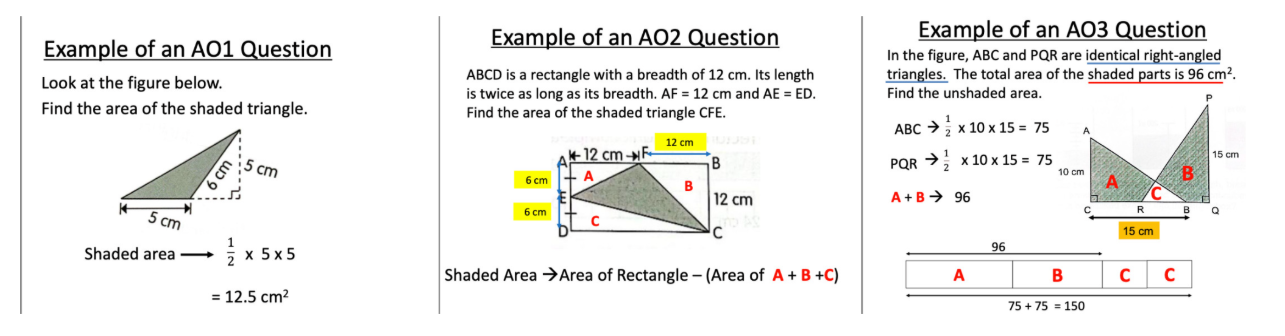
AO1 checks whether the child knows the concept. A direct area question, for example, may ask the child to use the formula for the area of a triangle.
AO2 checks whether the child can apply the concept when the question is less direct. For example, a shaded-area question may require the child to find the area of a rectangle, identify smaller shapes inside it, then subtract the unshaded parts.
AO3 checks whether the child can reason through a more complex structure. The question may combine geometry, comparison, hidden relationships, and multi-step working.
Many students underperform not because they do not understand the concept, but because they cannot apply it independently. AO2 word problems are where many marks slip away.
That is why AO2 matters so much. Word problems make up a large part of PSLE and weighted-assessment practice. A child may answer correctly during a guided lesson when the teacher gives prompts, but struggle to produce written working alone.
That gap between guided performance and independent performance is the real problem to solve.
Parents often worry about AO3 "viral" hard questions they see on social media. Those questions can be useful for stretch, but they are not the whole paper. If AO3 is roughly 10% of the assessment, spending all revision time on the hardest questions can backfire.
The better priority is this:
Secure AO1 so basic marks are not lost.
Build AO2 independence because word problems form the biggest portion.
Use AO3 as stretch once the child can explain and show working for AO2 questions.
This also explains why Ottodot lessons include a mix of question levels. Students first secure AO1 questions so they do not lose foundation marks. Then they spend more time on AO2 word problems, where independent application matters most. AO3 questions are used as targeted stretch once the basics are secure.
The progression is intentional. Lessons should not be made up only of easy questions, or dominated by the hardest ones. Students need time with the question types that carry the greatest weight.
Why children struggle with PSLE maths problem sums
They start calculating too early
Some children treat every number in the question as a clue to an operation. They see 3/5, 48, and 12, then start multiplying or dividing before they understand the story.
When that happens, the working can look busy but directionless.
Take Sarah, a P6 student revising ratio. She could solve direct ratio questions quickly, but lost marks on a problem where one person gave away marbles and both children ended with the same number.
Her first line of working was correct arithmetic. It simply answered the wrong situation. Once her teacher asked, "What changed, and what stayed the same?", she realised it was a before-and-after question, not a direct ratio question.
They know methods only when the worksheet labels them
A worksheet titled "Assumption Method" gives the child a big hint. The PSLE does not.
In the exam, the child has to recognise whether the question needs a bar model, working backwards, a table, a comparison equation, or a volume/rate setup. This recognition skill needs mixed practice.
For a deeper look at this pattern, read our guide on why children struggle with Math word problems.
They do not show enough working
For longer questions, answer-only practice is risky. Examiners can award method marks when the working shows the right idea. If the child writes only a final number, there is nothing to mark except the answer.
At home, parents should ask to see the model, equation, steps, and final answer. This is not about making homework longer. It is about making the child's thinking visible.
In Ottodot, students use an interactive whiteboard to show their complete step-by-step work. Teachers can view these submissions in real time, allowing them to instantly assess understanding and provide immediate feedback.
A 5-step routine for PSLE maths problem sums
Use this routine before any long calculation.
Read the whole problem, then re-read the last sentence. That's usually where the actual question hides.
Highlight key words. Underline what you need to find, circle the given numbers, and label what each one means.
Decide what tool or strategy to use. This is where you choose the appropriate model, formula, and step-by-step approach needed for the problem.
Solve, showing each step.
Check: does the answer make sense and does it actually answer the question asked?
Ottodot teachers often use a STAR-style routine for word problems: Study the problem, Think of a plan, Act and answer by showing workings clearly, and Review the answer. The exact wording matters less than the habit. The child should not jump from reading straight into calculation.
Soft practice prompt: If your child often says, "I don't know how to start," the issue may be application rather than effort. You can Check my child's fit to see whether they need foundation rebuilding, application practice, exam-skill support, or a different kind of guidance.
Worked examples for PSLE problem sums
Example 1 (AO1): Internal-transfer before-and-after problem
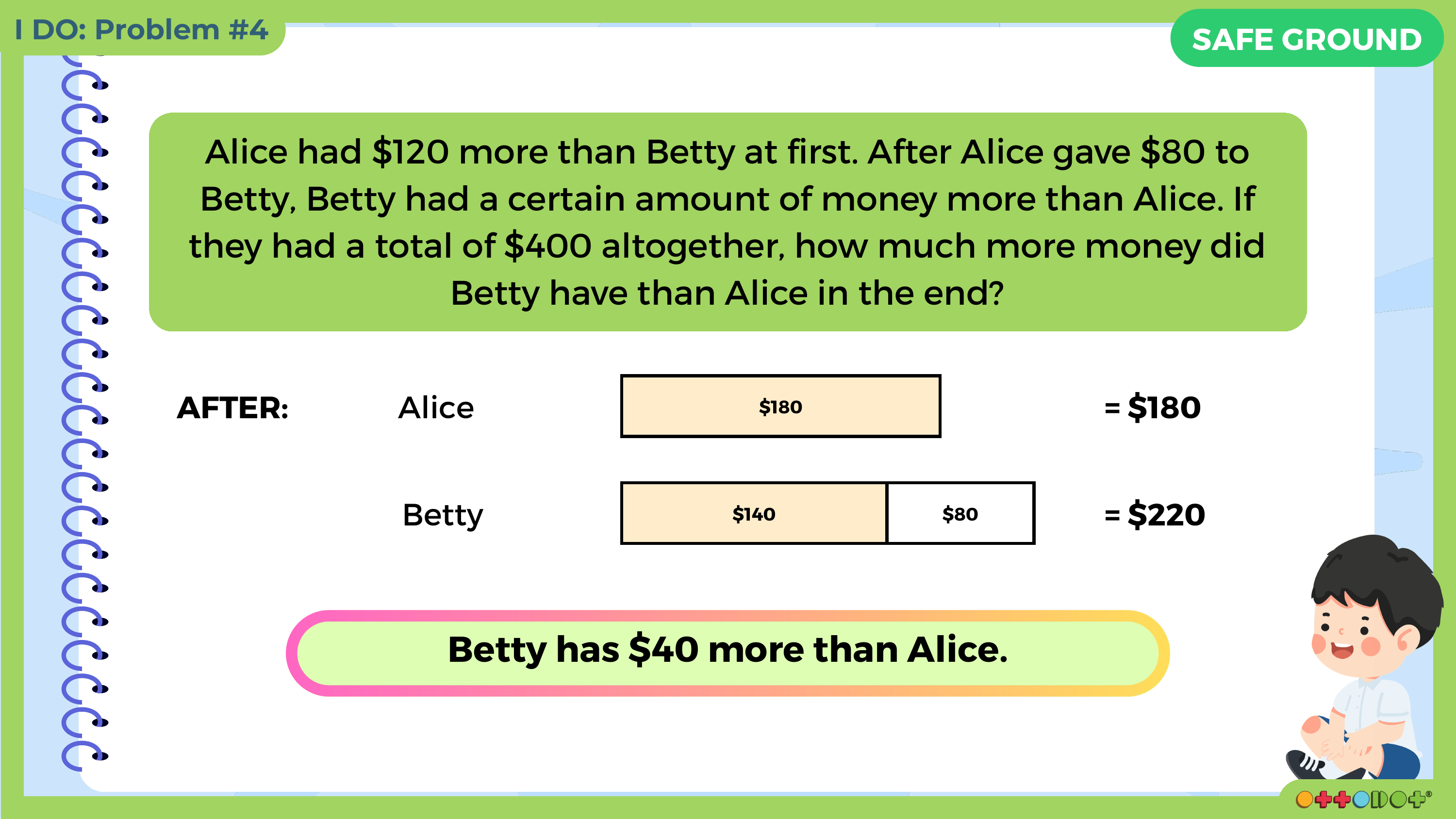
Question: Alice had $120 more than Betty at first. After Alice gave $80 to Betty, Betty had more money than Alice. If they had $400 altogether, how much more money did Betty have than Alice in the end?
This is a classic internal-transfer question: the total amount stays the same, but the difference changes because money moves from one person to the other.
Step 1: Find their starting amounts.
Alice had $120 more than Betty.
Alice + Betty = $400
Betty's amount + Betty's amount + $120 = $400
2 units = $400 - $120 = $280
1 unit = $140
So Betty had $140 at first, and Alice had $260 at first.
Step 2: Apply the transfer.
Alice gave $80 to Betty.
Alice after transfer = $260 - $80 = $180
Betty after transfer = $140 + $80 = $220
Step 3: Compare the final amounts.
$220 - $180 = $40
Betty had $40 more than Alice in the end.
Check: The total is still $400. Alice has $180 and Betty has $220. The transfer changed the difference, not the total.
Example 2 (AO2): Volume and rate problem
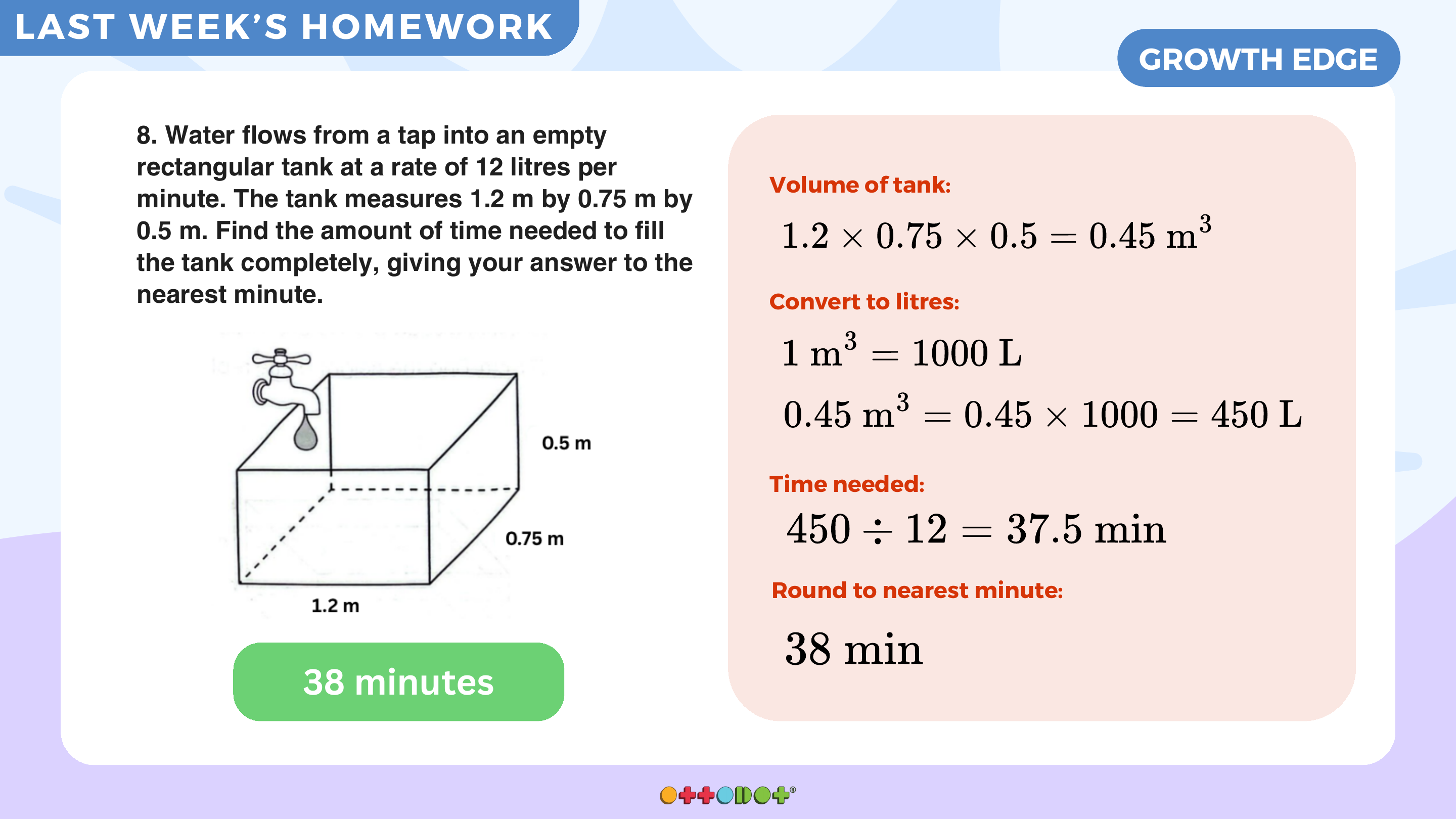
Question: Water flows from a tap into an empty rectangular tank at a rate of 12 litres per minute. The tank measures 1.2 m by 0.75 m by 0.5 m. Find the amount of time needed to fill the tank completely, giving your answer to the nearest minute.
This combines volume conversion with rate, so the key is to keep the units consistent.
Step 1: Find the volume of the tank.
1.2 x 0.75 x 0.5 = 0.45 m³
Step 2: Convert cubic metres to litres.
1 m³ = 1000 litres
0.45 m³ = 0.45 x 1000 = 450 litres
Step 3: Divide by the rate.
450 divided by 12 = 37.5 minutes
Rounded to the nearest minute, the time needed is 38 minutes.
Check: 12 litres per minute for 37.5 minutes gives 450 litres, which fills the tank.
Example 3 (AO3): MP6 W19 perimeter challenge
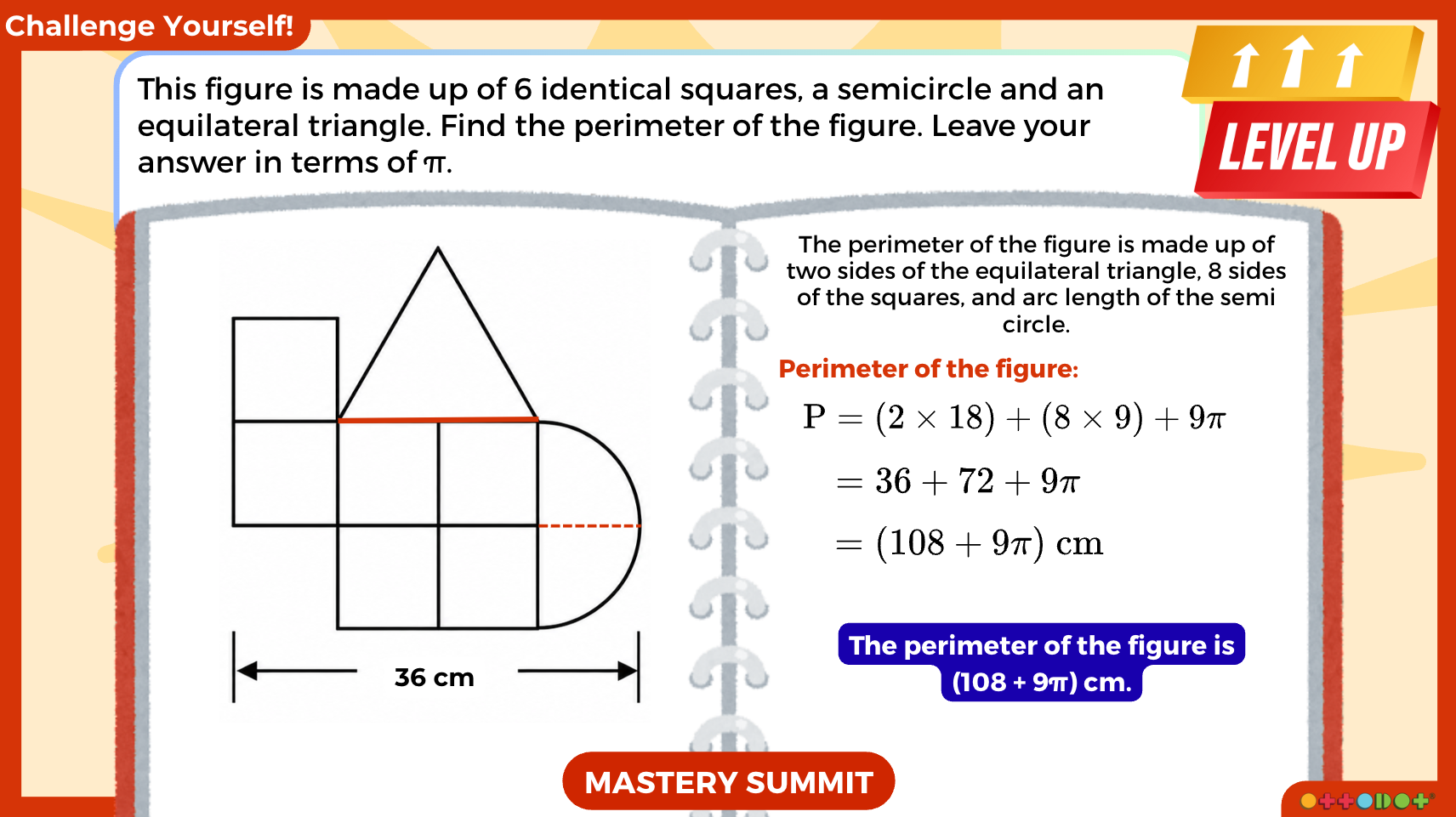
Question: This figure is made up of 6 identical squares, a semicircle and an equilateral triangle. Find the perimeter of the figure. Leave your answer in terms of π.
This is an AO3-style geometry problem because the child has to identify which outer edges form the perimeter instead of adding every visible line.
The perimeter is made up of two sides of the equilateral triangle, 8 sides of the squares, and the arc length of the semicircle.
One side of one square = 36 ÷ 4 = 9 cm
One side of the equilateral triangle = 9 + 9 = 18 cm
Arc length of the semicircle = 1/2 x π x 18 = 9π cm
Perimeter of the figure = 2 x 18 + 8 x 9 + 9π
The perimeter of the figure is (108 + 9π) cm.
The key PSLE habit is to mark only the outside boundary. Interior square lines and the base of the triangle help you reason, but they are not part of the final perimeter.
Common mistakes in PSLE maths problem sums
Mistake | Why it happens | What to do instead |
Starting with calculation | The child wants to rush | Name the question type first |
Drawing no model | The child thinks models are slow | Draw for unfamiliar questions during revision |
Applying a fraction to the wrong total | Remainder language is missed | Label "original", "remaining", and "left" |
Treating the transfer amount as disappeared | Internal-transfer structure is missed | Remember that one side loses it and the other side gains it |
No answer check | Time pressure | Substitute the answer back into the story |
One useful home habit is to ask, "What does this number represent?" If the child cannot explain a number in words, they may be manipulating symbols without understanding the story.
How parents can practise problem sums at home
Start with short, mixed sets. For example, give your child one fraction problem, one internal-transfer problem, one volume/rate problem, and one ratio or percentage problem. Ask them to identify the type before solving.
You can also use these prompts:
What is the question asking you to find?
Which number is the whole?
Which numbers are parts?
What changed in the story?
Can you show me your working step by step?
Avoid helping too early. If you give the first step every time, your child may become a dependent solver. A better prompt is, "Draw what you know first."
For corrections, ask your child to redo only the thinking step first. They can mark the question type, draw the model, and explain why that method fits before recalculating.
This keeps correction work focused on the part that actually broke down. It also stops every wrong answer from turning into another full worksheet.
Closer to PSLE, keep a small "problem-sum log". For each mistake, write the question type, the missed clue, and the fix.
After two weeks, patterns usually appear. Some children keep missing remainder language. Others rush comparison questions. The log helps revision become sharper.
How Ottodot helps with PSLE maths problem sums
Ottodot's upper-primary Math classes focus on teacher-led explanation first, then guided practice, then independent application. In lesson terms, that means I DO, WE DO, YOU DO.
For problem sums, the teacher models how to read the question, mark out the important information, choose a heuristic, and write complete working. Students then practise similar but not identical questions so they learn recognition, not memorisation.
Game-based practice is used after teaching to reinforce the same skill in a more active format. The point is not that games replace working. The teacher teaches the method, and the game gives students another way to practise applying it.
If this sounds like the support your child needs, Check my child's fit.
Frequently asked questions
Are PSLE maths problem sums mostly in Paper 2?
Yes, the longer structured problem sums are mainly associated with Paper 2. Paper 2 carries a large part of the PSLE Math marks, so students need to practise both calculation and written problem-solving.
Should my child always draw a bar model?
No. A bar model is most useful when the relationship between quantities is hard to hold in the head. For direct calculation questions, it may not be needed. For unfamiliar word problems, drawing a clear model often prevents mistakes.
How many problem sums should my child practise each week?
Quality matters more than quantity. A useful routine is 6 to 10 mixed problem sums each week, with full working and corrections. During PSLE revision, increase the mix across fractions, ratio, percentage, geometry, rate, and heuristics.
What if my child understands the solution but cannot start independently?
That usually means the child needs practice with question recognition. Ask them to identify the problem type, known values, unknown value, and possible model before solving. Independence comes from practising the starting routine, not only reviewing finished solutions.
For method-specific practice, pair this guide with the bar model method for visual comparison questions and the assumption method for two-type quantity-and-value questions.