
Careless Mistakes in Primary Math: Parent Guide
Learn why primary school children make careless Math mistakes, how to spot the pattern, and what checking routines help reduce lost marks.
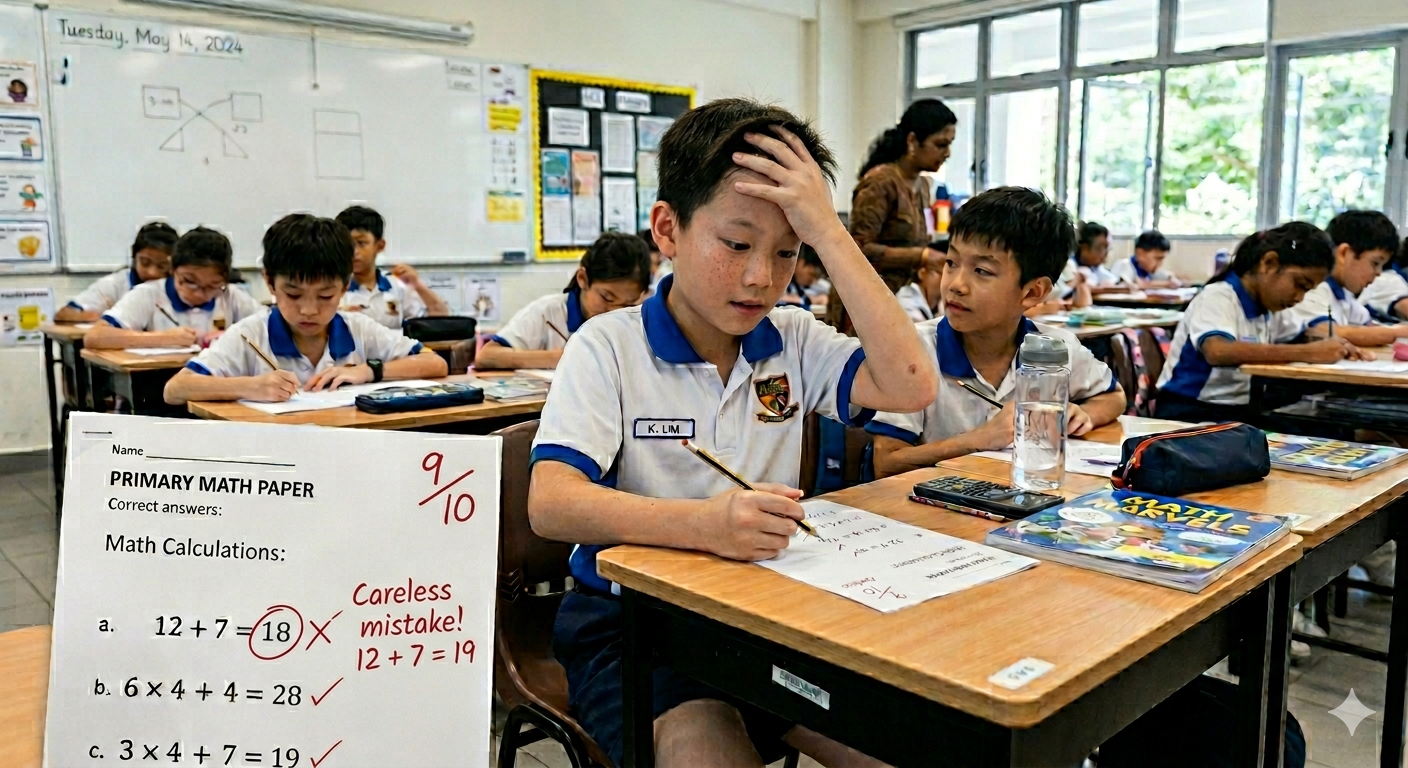
Your child gets the method right. The working looks correct. But somewhere in the calculation, a sign flips, a number is copied wrong, or the decimal lands in the wrong place, and the mark is gone.
You ask them about it afterwards and they get the answer right immediately. "I know how to do it," they say. "I just made a careless mistake."
This explanation sounds reasonable. It is also incomplete. Careless mistakes in primary school math are not random. They follow patterns. And those patterns point to specific causes that have specific fixes.
In this guide, we will explain what actually causes careless mistakes, why some children make them consistently even when they understand the content, and what you can do at home to reduce them.
Quick Answer
Spot whether mistakes come from rushing, method choice, checking habits, or confidence.
Recommended Next Guides and Practice
"Careless" Is Not a Cause. It Is a Label.
When a child calls something a careless mistake, they are describing what happened, not why. The mark was lost. Something went wrong that the child could have avoided. But the reason it keeps happening is almost always one of three things.
1. The skill is not yet automatic. When a child has to think about each individual step of a calculation, their working memory fills up. There is no spare capacity left to notice when something has gone wrong. The error happens because the child is concentrating on the wrong thing.
2. The child is rushing. Rushing is often a symptom of anxiety or poor time management, not laziness. A child who feels they are running out of time will skip checking steps, misread numbers, and copy answers incorrectly.
3. The child has a consistent gap they are not aware of. Some mistakes that look careless are actually systematic errors. A child who consistently adds when they should subtract in a particular type of problem is not being careless. They have an incomplete understanding of one specific rule.
The Automaticity Problem
Research on working memory consistently shows that when children have to think consciously about each step of a calculation, they are much more likely to make errors. A review published in the British Journal of Educational Psychology (2025) found that children with higher working memory capacity performed better on multi-step math problems, and that offloading foundational steps to long-term memory freed up cognitive resources for more complex thinking.
Put simply: working memory is limited. Cognitive science research from Dr. Helen Abadzi at the University of Texas estimates that we can only hold around seven items in working memory for approximately 12 seconds at a time. When a child is working through a multi-step problem in a PSLE-style paper, holding intermediate results while processing the next step is already pushing that limit. Any foundational operation that is not yet automatic, such as times tables or fraction arithmetic, consumes even more of that limited space. At full capacity, small errors slip through undetected.
The implication is clear: children who have not automated their foundational math facts will make more arithmetic errors inside complex problems, not because they are careless, but because they are working at the limit of their capacity.
The fix is targeted practice on the specific skills that are not yet automatic, done in short, regular sessions. This is where timed fluency practice matters most.
Why Anxiety Makes It Worse
Beyond cognitive load, exam conditions introduce another layer: anxiety.
A study published in Scientific Reports found that math anxiety directly increases cognitive load on working memory, reducing the resources available for actual calculation. In other words, a child who is already stretched cognitively by exam time pressure has even less capacity left to catch their own errors.
Research published in Frontiers in Psychology similarly found a consistent negative link between math anxiety and math performance, particularly for problems with higher cognitive demands, which are exactly the type of multi-step word problems that appear at Primary 5 and Primary 6 level.
This is why a child can answer a question correctly at home but lose the mark in an exam. It is not that they did not study. It is that anxiety under timed conditions consumes cognitive resources that would otherwise catch the error.
The practical solution is to introduce timed practice conditions at home regularly, so the exam environment is familiar and less anxiety-inducing. Familiarity with time pressure significantly reduces its cognitive cost.
The Most Common Careless Mistake Patterns
Misreading the question Children who read quickly often misread numbers (6 and 9, 17 and 71), miss negative signs, or skip a condition in a word problem. This produces answers that are mathematically correct but answer a different question from the one asked.
Fix: Train the habit of underlining what the question is asking before starting. Reading the question twice before writing anything catches most misreading errors.
Copying errors between steps A child calculates correctly and writes the right answer in one line of working, then copies it incorrectly in the next. The method is right. The execution loses the mark.
Fix: Encourage your child to point to each number as they copy it, rather than reading a line of working and reproducing it from memory. This one habit eliminates most copying errors.
Sign errors in subtraction Subtracting a larger number from a smaller one, or forgetting the negative in an answer, is one of the most common arithmetic errors at Primary 5 and Primary 6 level, particularly in algebra and ratio problems.
Fix: Teach your child to check whether the answer is positive or negative before writing it down. A quick "does the sign make sense?" takes two seconds and catches the majority of sign errors.
Decimal point placement In questions involving money, mass, or length, the decimal point is frequently placed one position to the left or right of the correct position. A child who calculates 3.6 and writes 36, or vice versa, has the right answer in the wrong form.
Fix: After any decimal calculation, ask: "Is this a reasonable number?" $360 for a bag of rice is unreasonable. $3.60 is not. Sense-checking the magnitude of the answer is a habit that prevents this class of error entirely.
What "Checking Your Work" Actually Means
Most children, when told to check their work, re-read their answers and look for nothing specific. This type of checking rarely catches errors.
Effective checking is targeted. It means:
Re-reading the question and confirming the answer addresses what was asked.
Checking one step that is high-risk for errors, such as a decimal calculation, a sign change, or a copied number.
Asking whether the answer is a reasonable magnitude.
Without a specific error type to look for, children read their own work with the same expectation of correctness they had when they first wrote it. They see what they expect to see, not what is actually there. Teaching three specific things to check in a set order, such as sign, decimal, and whether the answer matches the question, turns a passive re-read into productive checking.
How to Reduce Careless Mistakes at Home
Build automaticity in foundational skills Research on distributed practice published in PMC (2024) found that spaced practice produces significantly better retention than massed practice, with a moderate-to-strong effect size. Five minutes a day of fluency practice on times tables and arithmetic operations is more effective than one long session per week. Short, frequent sessions build the automatic recall that frees up working memory during complex problems.
Slow down at the copying step The transition from one line of working to the next is where most copying errors happen. Teach your child to pause at each line and confirm the number before continuing. This feels slow at first and becomes natural quickly.
Practise under timed conditions Children who only practise math at their own pace often struggle when time pressure is introduced in an exam. Regular timed practice at home builds the ability to maintain accuracy under pressure. The more familiar the conditions, the less anxiety they produce, and the more cognitive capacity remains available for catching errors.
Use the sense-check as a habit After every calculation, one question: "Is this a reasonable answer?" If the question is about the price of a pencil and the answer is $45, something has gone wrong. This habit catches decimal and sign errors that formal checking sometimes misses.
For Parents: How to Respond to Careless Mistakes

Treat every careless mistake as data, not character. When you see a pattern across multiple papers, such as sign errors always appearing in the same type of problem, that is useful information. It tells you exactly where to focus practice. Keep a simple note of the error types you see most often.
Do not add more problems. Add more targeted practice. More homework rarely reduces careless mistakes. More targeted practice on the specific sub-skill that is not yet automatic does. If the issue is times tables, practise times tables specifically. If it is decimal placement, practise that.
Avoid scolding. Scolding for careless mistakes rarely produces improvement and often increases anxiety, which research shows will worsen error rates further. A more effective response is to sit with the child, identify the specific mistake type together, and practise the specific skill that failed. Make the feedback concrete, not personal.
Frequently Asked Questions
My child makes careless mistakes on tests but not on homework. Why? Test conditions introduce time pressure and performance anxiety that homework does not. Both consume cognitive resources, reducing the spare capacity available to catch errors. The solution is regular timed practice at home so that the test environment is familiar, and the automatic skills are reliable enough to perform under pressure.
How do I know whether a mistake is careless or a genuine gap in understanding? Ask your child to redo the question aloud, explaining each step. If they get it right and can explain why, the mistake was likely an execution error at the original attempt. If they make the same error again or cannot explain a step, there is a genuine gap in understanding that needs to be addressed.
At what level do careless mistakes matter most? Careless mistakes cost marks at every level, but they become significantly more consequential at Primary 5 and Primary 6, when each mark carries more weight and the questions have more steps where errors can enter. Building the habits above at Primary 3 or Primary 4 means they are already established by the time they matter most.
The Key Takeaway
Careless mistakes are not random and they are not a personality trait. They are predictable, patterned errors that point to specific gaps, most often in working memory load, foundational automaticity, or a checking process that lacks focus.
The research is consistent: children who build foundational math skills to the point of automaticity, and who are taught a specific, consistent checking process, make significantly fewer execution errors under exam conditions.
If your child's marks are being consistently affected by careless mistakes, Ottodot's Math classes address both sides: game-based fluency practice to build automaticity in core skills, and teacher-led routines for reading carefully, showing working, and checking answers under pressure. The goal is not more worksheets for the sake of it, but a steadier solving process your child can repeat in tests.
If these mistakes become more frequent in upper primary, it may be time to look at structured P5 and P6 Math support rather than adding more random worksheets.
Check my child’s fit to see whether Ottodot's Math fluency and accuracy approach matches your child's current needs.