
Assumption Method for PSLE Math: Worked Examples
Learn when to use the assumption method in PSLE Math, with worked examples, signal phrases, common mistakes, and answer-checking tips.

The assumption method for PSLE Math helps students solve word problems with two item types, one total quantity, and one total value. The child assumes all items are one type first, compares that assumed total with the actual total, then adjusts using the difference per item.
It sounds like guessing, but it is not random guessing. It is a structured heuristic. Once students understand why the assumption works, ticket, coin, marks, and animal-leg questions feel much less mysterious.
This guide explains how to recognise assumption method questions, how to solve them step by step, and what parents should look for in a child's working.
Key Takeaways
- Use assumption method when a question gives two item types, a total number, and a total value.
- The key is separating quantity from value: how many items there are versus what each item is worth.
- A common approach is to assume all items are the smaller-value type first, then find how much the actual total differs.
- Each swap from the smaller-value type to the larger-value type increases the total by a fixed amount.
- The final answer should be checked against both original conditions: total quantity and total value.
Quick Answer
Learn when assumption is faster than trial-and-error or a bar model.
Recommended Next Guides and Practice
What is the assumption method in PSLE Math?
The assumption method is a Math heuristic for two-type word problems. It sits within the wider group of upper-primary heuristics covered in our PSLE Math question types guide.
It is often used when the question gives:
a total number of items
two possible item types
a different value for each item type
the actual total value
For example:
adult and child tickets with different prices
20-cent and 50-cent coins
correct and wrong answers with different marks
chickens and rabbits with different numbers of legs
$1 and $2 coins in a box
The method works because every item is counted once, but each item may have a different value. If we pretend all items are the cheaper type first, we can see how far the assumed total is from the actual total. That gap tells us how many items must be the higher-value type.
In some schools and tuition centres, this is also called the supposition method. The idea is the same.
First, separate quantity from value
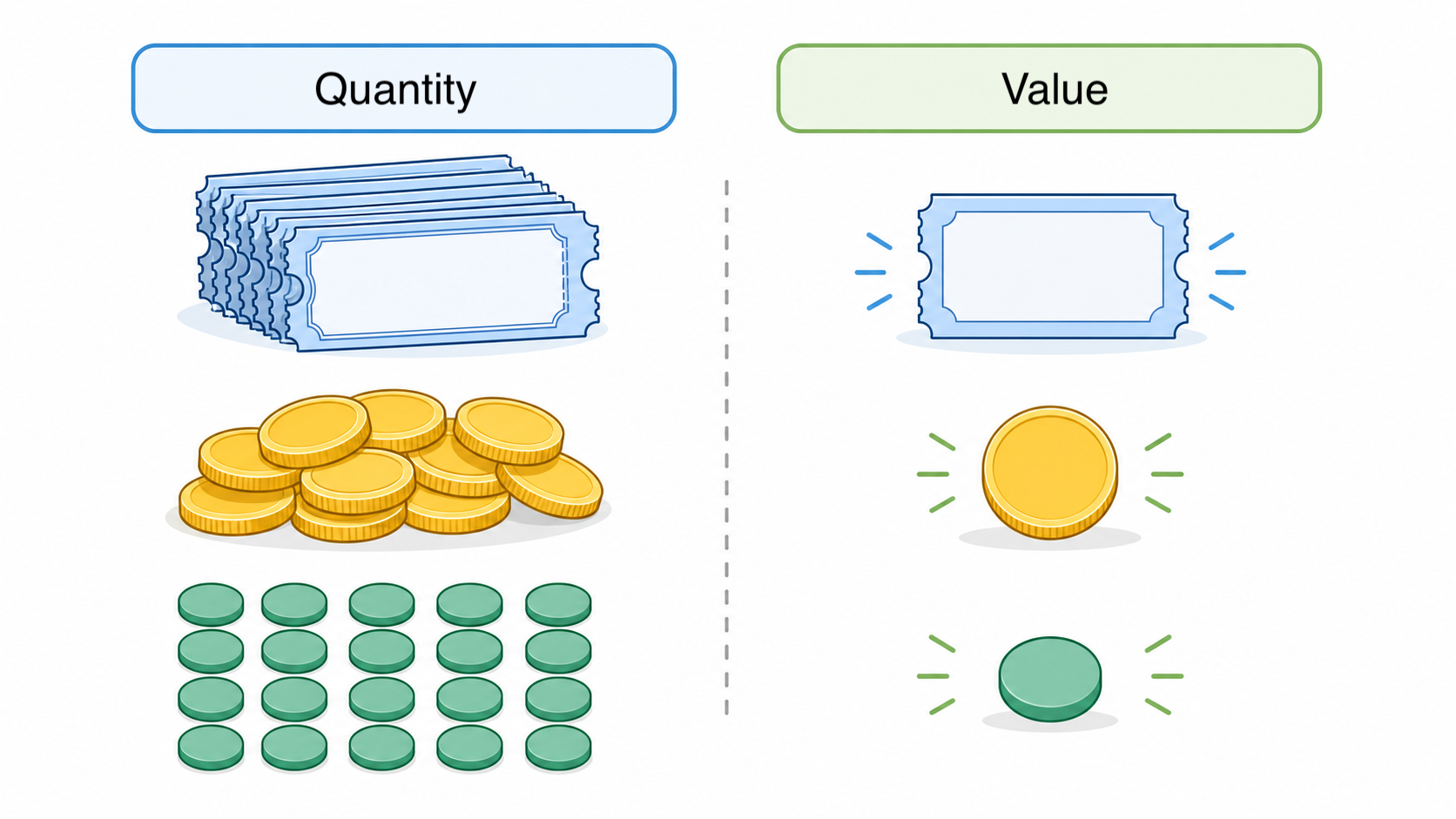
Before teaching the assumption method, make sure your child understands the difference between quantity and value.
Term | What it means | Example |
Quantity | How many items there are | 50 tickets |
Unit value | How much each item is worth | $2 per child ticket |
Total value | The amount altogether | $130 collected |
This is where many children make mistakes. They see "$2" and "50 tickets" in the question, but they do not pause to ask what each number represents.
Try this prompt:
"What am I counting, and what is each one worth?"
For example, "50 tickets at $2 each" means:
50 x $2 = $100
The 50 is the quantity. The $2 is the value of one item.
If a child mixes these up, the assumption method becomes a memorised layout instead of a meaningful method.
When should your child use the assumption method?
Use this checklist:
Are there two item types?
Is the total number of items known?
Is the total value known?
Does each type have a different value, price, mark, or number of legs?
If the answer is yes to all four, assumption method may work.
Here is a simple recognition rule:
Use assumption method when the question gives a total count and a total value, and there are two item types with different values.
For example, a question about 50 tickets sold for $130, with adult tickets at $3 and child tickets at $2, fits. There are two ticket types, a total number of tickets, and a total amount collected.
If your child knows the method during topic practice but cannot choose it in mixed revision, Check my child's fit. That can help identify whether the issue is foundation, application, exam confidence, or independent problem-solving.
The 5-step assumption method routine
A clean assumption-method solution usually follows this sequence:
Assume all items are the smaller-value type.
Work out the assumed total value.
Compare the assumed total with the actual total.
Find the fixed increase for each swap.
Divide the total difference by the fixed increase.
After that, find the other item type and check both conditions.
In class, teachers often model it as a think-aloud: "If everything were the cheaper item, what would the total be? How far is that from the real total? What does each swap add?"
Worked examples for assumption method PSLE Math
Example 1: School concert tickets
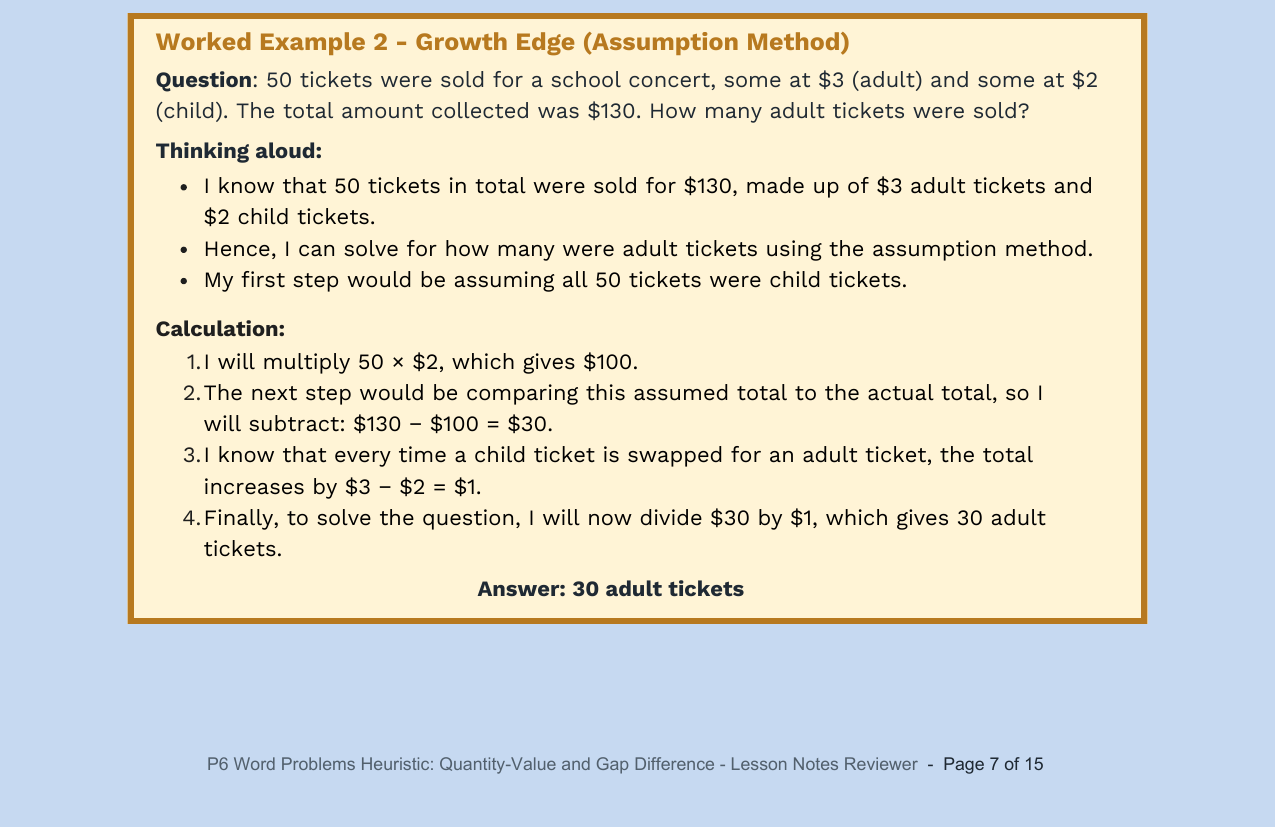
Question: 50 tickets were sold for a school concert. Some tickets were adult tickets at $3 each, and some were child tickets at $2 each. The total amount collected was $130. How many adult tickets were sold?
This is an assumption method question because there are:
two item types: adult tickets and child tickets
total quantity: 50 tickets
total value: $130
different unit values: $3 and $2
Step 1: Assume all tickets were the smaller-value type.
Assume all 50 tickets were child tickets.
50 x $2 = $100
Step 2: Compare with the actual total.
Actual total = $130
Assumed total = $100
Difference = $130 - $100 = $30
Step 3: Find the fixed increase per swap.
Each adult ticket costs $3.
Each child ticket costs $2.
Each swap from child to adult adds:
$3 - $2 = $1
Step 4: Divide to find the number of adult tickets.
$30 divided by $1 = 30
There were 30 adult tickets.
Check: 30 adult tickets cost 30 x $3 = $90. The remaining 20 child tickets cost 20 x $2 = $40. Total = $130. Correct.
Example 2: 20-cent and 50-cent coins
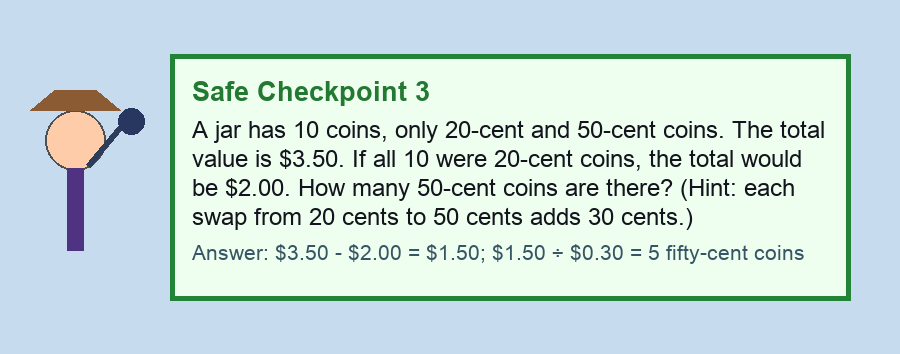
Question: A jar has 10 coins. They are only 20-cent coins and 50-cent coins. The total value is $3.50. How many 50-cent coins are there?
This example is useful because the "swap" is easy to see. A 50-cent coin is 30 cents more than a 20-cent coin.
Step 1: Assume all coins were 20-cent coins.
10 x 20 cents = 200 cents
200 cents = $2.00
Step 2: Compare with the actual total.
Actual total = $3.50
Assumed total = $2.00
Difference = $1.50
Step 3: Find the fixed increase per swap.
50 cents - 20 cents = 30 cents
Each 20-cent coin changed to a 50-cent coin adds 30 cents.
Step 4: Divide the total difference by the increase per swap.
$1.50 divided by $0.30 = 5
There are 5 fifty-cent coins.
Check: 5 x 50 cents = $2.50. 5 x 20 cents = $1.00. Total = $3.50.
Example 3: Correct and wrong answers
Question: A quiz has 20 questions. A student gets 4 marks for each correct answer and loses 1 mark for each wrong answer. The student scores 55 marks altogether. How many questions did the student answer correctly?
This fits the assumption method because there are two answer types, a total number of questions, and a total score.
Step 1: Assume all answers were wrong.
20 x -1 = -20
Step 2: Compare with the actual score.
Actual score = 55. Assumed score = -20. Difference = 55 - (-20) = 75 marks.
Step 3: Find the fixed increase per swap.
Changing one wrong answer to one correct answer adds 5 marks: 4 - (-1) = 5.
Step 4: Divide to find the number of correct answers.
75 divided by 5 = 15
The student answered 15 questions correctly.
Check: 15 correct answers give 15 x 4 = 60 marks. The remaining 5 wrong answers give 5 x -1 = -5 marks. Total = 55 marks. Correct.
Example 4: Chickens and rabbits
Question: A farm has 18 animals. Some are chickens and some are rabbits. Altogether, the animals have 50 legs. How many rabbits are there?
This is an assumption method question because there are two animal types, a total number of animals, and a total number of legs.
Step 1: Assume all animals were chickens.
18 x 2 = 36 legs
Step 2: Compare with the actual total.
Actual total = 50 legs. Assumed total = 36 legs. Difference = 14 legs.
Step 3: Find the fixed increase per swap.
Each rabbit has 4 legs and each chicken has 2 legs, so each swap from chicken to rabbit adds 2 legs.
Step 4: Divide to find the number of rabbits.
14 divided by 2 = 7
There are 7 rabbits.
Check: 7 rabbits have 28 legs. The remaining 11 chickens have 22 legs. Total = 50 legs. Correct.
Common mistakes in assumption method questions
Mistake | Why it happens | What to do instead |
Mixing up quantity and value | The child does not separate count from unit value | Ask: "What am I counting, and what is each one worth?" |
Dividing by the wrong difference | The child subtracts totals but not item values | Find the fixed increase per swap |
Forgetting negative marks | The child treats wrong answers as 0 instead of -1 | Compare the full change from correct to wrong |
Stopping after finding one type | The question asks for the other type | Reread the final sentence before answering |
Skipping the check | The child trusts the first result | Substitute both quantities into the original conditions |
The most important line of working is often the swap line. This is where the method either makes sense or becomes a template.
For tickets, the swap line is:
$3 - $2 = $1
For coins, it is:
50 cents - 20 cents = 30 cents
For correct and wrong answers, explain the drop like this:
Losing a correct answer removes 4 marks and adds a 1-mark penalty, so each swap changes the score by 5 marks.
If your child cannot explain this line in words, they may be copying the method without understanding it.
How parents can practise the assumption method at home
Start with recognition, not calculation.
Before your child solves, ask:
What are the two item types?
What is the total number?
What is the total value?
Which type has the smaller value?
If everything were the smaller-value type, would the assumed total be too low or too high?
What does each swap add?
Then ask your child to write the full method:
Assumption
Assumed total
Actual total
Difference
Fixed increase per swap
Number of larger-value items
Other item type
Check
If the method still feels abstract, use physical objects. Coins, counters, or small slips of paper labelled "$2" and "$3" work well.
Let your child build the assumed total first. Then swap one item type for the other and watch the total change.
That small visual step often makes the written method click.
For PSLE-style revision, mix assumption method with bar model, working backwards, P6 ratio, and internal-transfer questions. If every question in the set is labelled "assumption method", the child is practising calculation, not recognition.
How Ottodot helps with PSLE Math heuristics
Ottodot teaches heuristics as part of broader problem-solving, not as isolated tricks. In upper-primary Math classes, the teacher first models the thinking aloud, then students try guided examples, then they practise independently.
For assumption method, that means students learn to spot quantity-value structures, explain the assumption, write the swap line, and check the final answer.
Game-based practice can then reinforce the same reasoning through structured tasks, but the teacher-led explanation comes first.
If your child keeps learning methods in isolation but cannot choose them in mixed practice, Check my child's fit.
Frequently asked questions
Is assumption method the same as supposition method?
Yes. Some schools and tuition centres call it supposition method. Both terms refer to assuming all items are one type first, then adjusting based on the difference.
Is assumption method tested in PSLE Math?
The PSLE does not usually label questions by method, but assumption method is a useful heuristic for upper-primary two-type word problems. Students may meet the structure in ticket, coin, marks, animal, or item-value questions.
Should my child always assume the smaller-value type?
Not always. Either direction can work if the child handles the difference correctly. For primary students, assuming the smaller-value type is often easier because each swap increases the total.
Should my child use algebra instead?
For primary school, assumption method is often more concrete. P6 algebra can work, but some students make equation mistakes before they fully understand the relationship. The assumption method helps them see what is changing.
What is the easiest way to check an assumption method answer?
Check both original conditions. The total number of items must match, and the total value must match. If either one fails, the answer needs to be corrected.
For a broader Paper 2 routine, start with our PSLE maths problem sums guide. For questions where relationships are better seen visually, practise the bar model method too.