
Bar Model Method for Primary Math: Examples Guide
Learn the bar model method for primary Math with Singapore Math word problem examples, part-whole models, comparison models, and parent prompts.
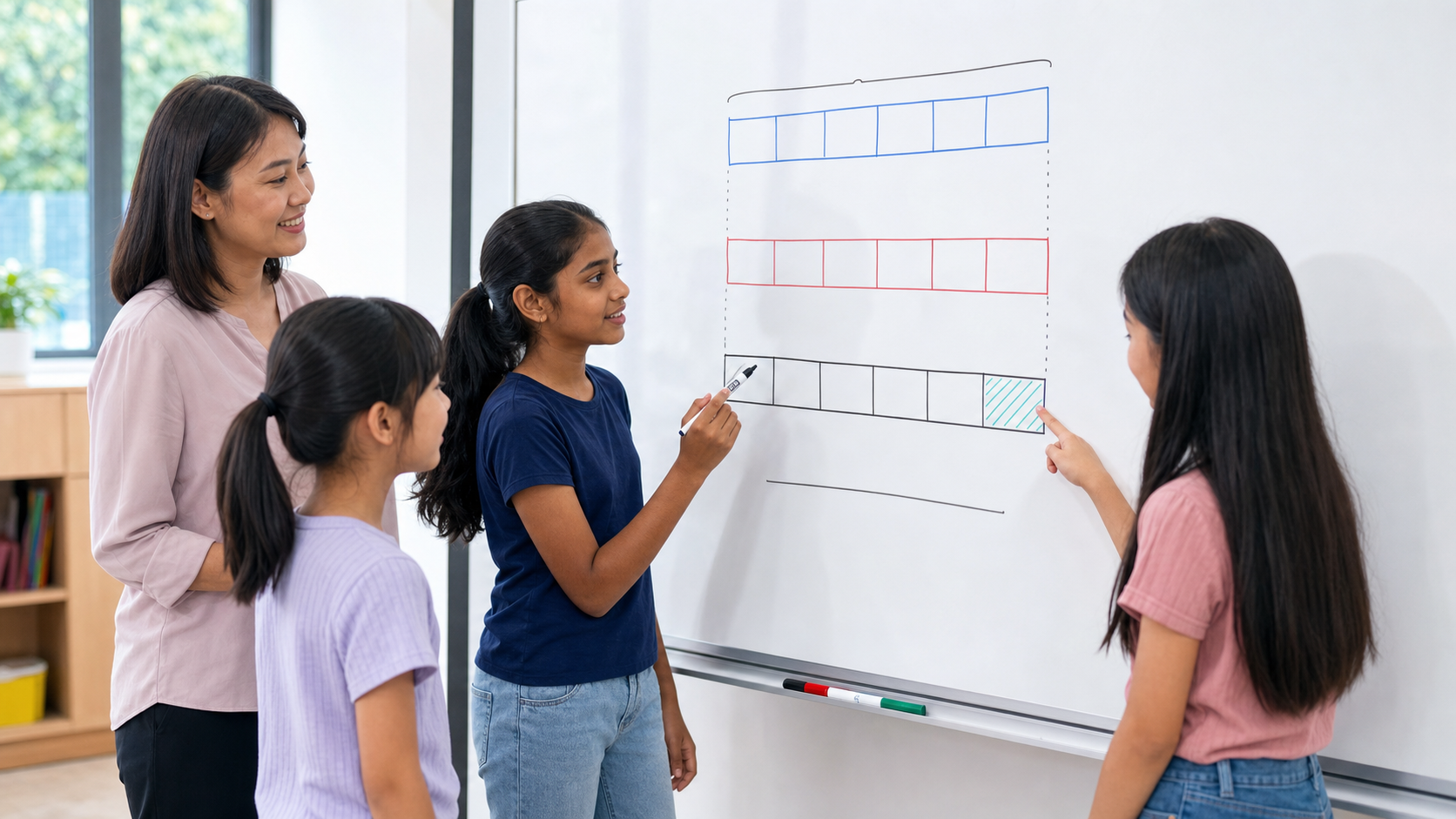
The bar model method for primary math helps children turn word problems into a clear picture before they calculate. It shows what is known, what is unknown, and how the quantities relate.
If your child can do sums on a worksheet but gets stuck when the question becomes a story, the bar model is often the missing thinking step. It helps children move from concrete quantities to visual reasoning, and later, to algebraic thinking.
This guide explains what the bar model is, when to use it, and how parents can help children draw models that actually support problem-solving.
Key Takeaways
- The bar model is a visual method for representing quantities in word problems.
- It is most useful for part-whole, comparison, fraction, and before-and-after questions. In P6, it can also support ratio questions.
- A useful bar model is labelled clearly. It does not need to be beautiful.
- Children should explain what each bar means before they calculate.
- For P5 and P6, bar models help make working visible for method marks.
Quick Answer
Use bar models to make part-whole and comparison word problems visible before calculating.
Recommended Next Guides and Practice
Quick answer: how does the bar model method work?
The bar model method for primary math works by turning a word problem into labelled rectangular bars. The bars show the whole, the parts, the difference, or the before-and-after change.
Once the child can see the relationship, the calculation becomes clearer. A good model answers three questions before any arithmetic starts:
What is known?
What is unknown?
How are the quantities connected?
What is the bar model method in primary math?
The bar model method uses rectangular bars to show quantities and relationships in a word problem. The bars can show a whole split into parts, two quantities being compared, or a before-and-after change.
In Singapore Math, parents may also hear this called model drawing. It gives children a way to "see" the problem before deciding on the calculation.
For example, if a question says Aisha has 24 stickers and Ben has 8 fewer, a child can draw Aisha's bar as the longer one, then draw Ben's bar shorter by 8. The model helps the child understand that Ben's number is 24 - 8, not 24 + 8.
That sounds simple, but this is where many word problem mistakes happen.
Why the bar model method helps with word problems
A word problem asks a child to hold several pieces of information in their head at once. There may be a total, two parts, a difference, a fraction, or a final unknown.
The bar model reduces that load.
This matters because primary Math is no longer about memorising procedures only. MOE has explained that primary students are expected to apply mathematical concepts and skills to real-world problems, not only recall operations.
Instead of asking, "Which operation should I use?", the child first asks:
Which is the whole?
Which are the parts?
Who has more?
What does this number represent?
What am I trying to find?
This is how Ottodot teachers guide students during problem-solving. The teacher makes the thinking visible first. Then students practise filling in and drawing models independently.
If your child gets stuck before choosing a method, this often connects to a wider word-problem issue. We explain that pattern in why children struggle with Math word problems.
Need help figuring out whether your child's issue is concepts, application, or exam habits? Check my child's fit.
The two basic bar model types
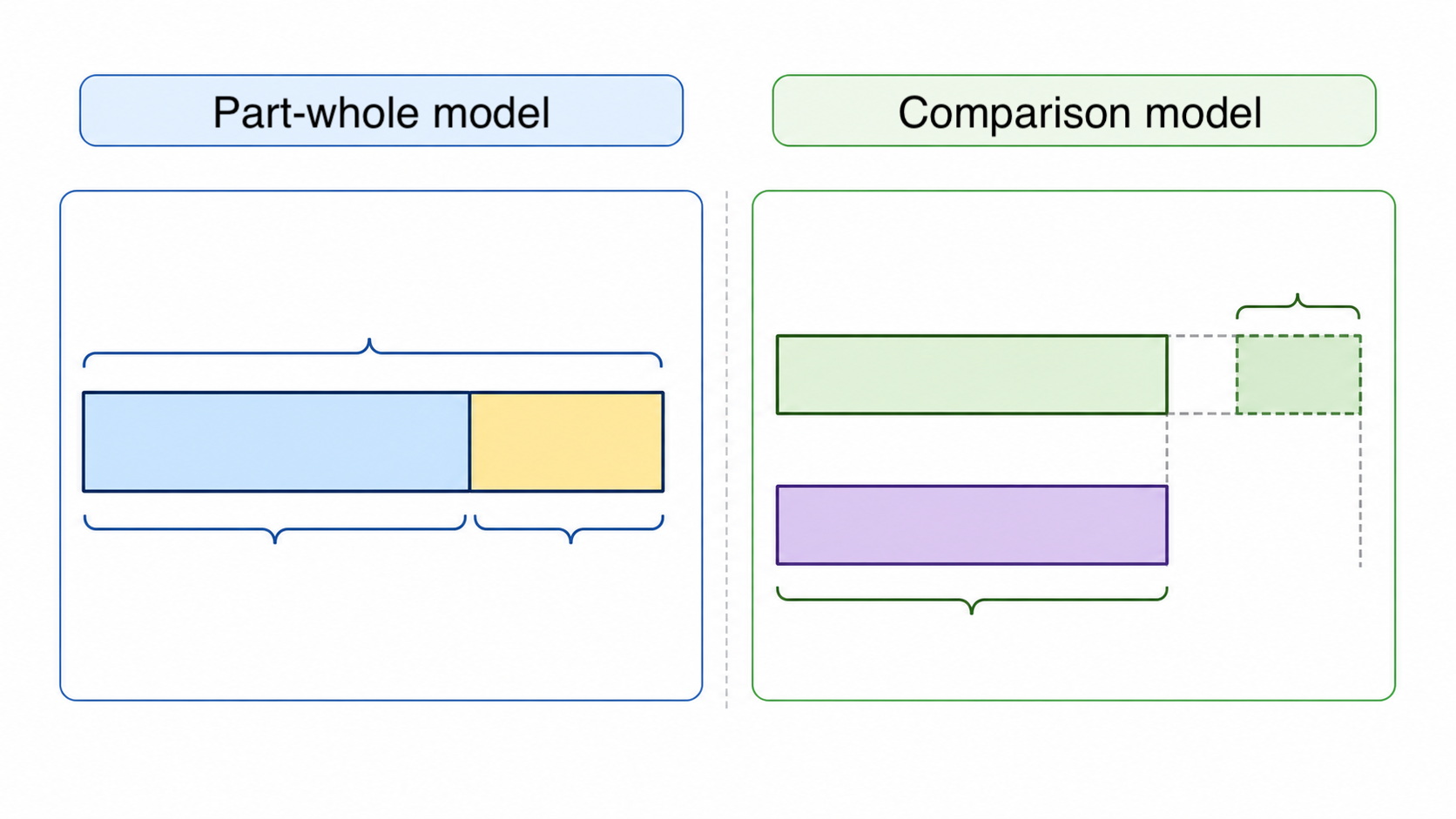
The two models can be introduced in a practical way: first decide whether the question is asking about a whole split into parts, or whether it is comparing two quantities.
For multi-step word problems, the model is not just a drawing. It helps the child decide which operation each step needs.
Part-whole model
A part-whole model shows a total split into smaller parts. The key idea is to think of the total as the "whole", then treat each step as a "part" that may need to be added, multiplied, subtracted, or divided.
Use it when the question includes words such as:
altogether
in all
remaining
total
left
Example 1: Part-whole model with shirts
Question: William had 450 shirts. He gave the same number of shirts to each of 6 boys and also gave 21 shirts each to 8 girls. How many shirts did each boy receive?
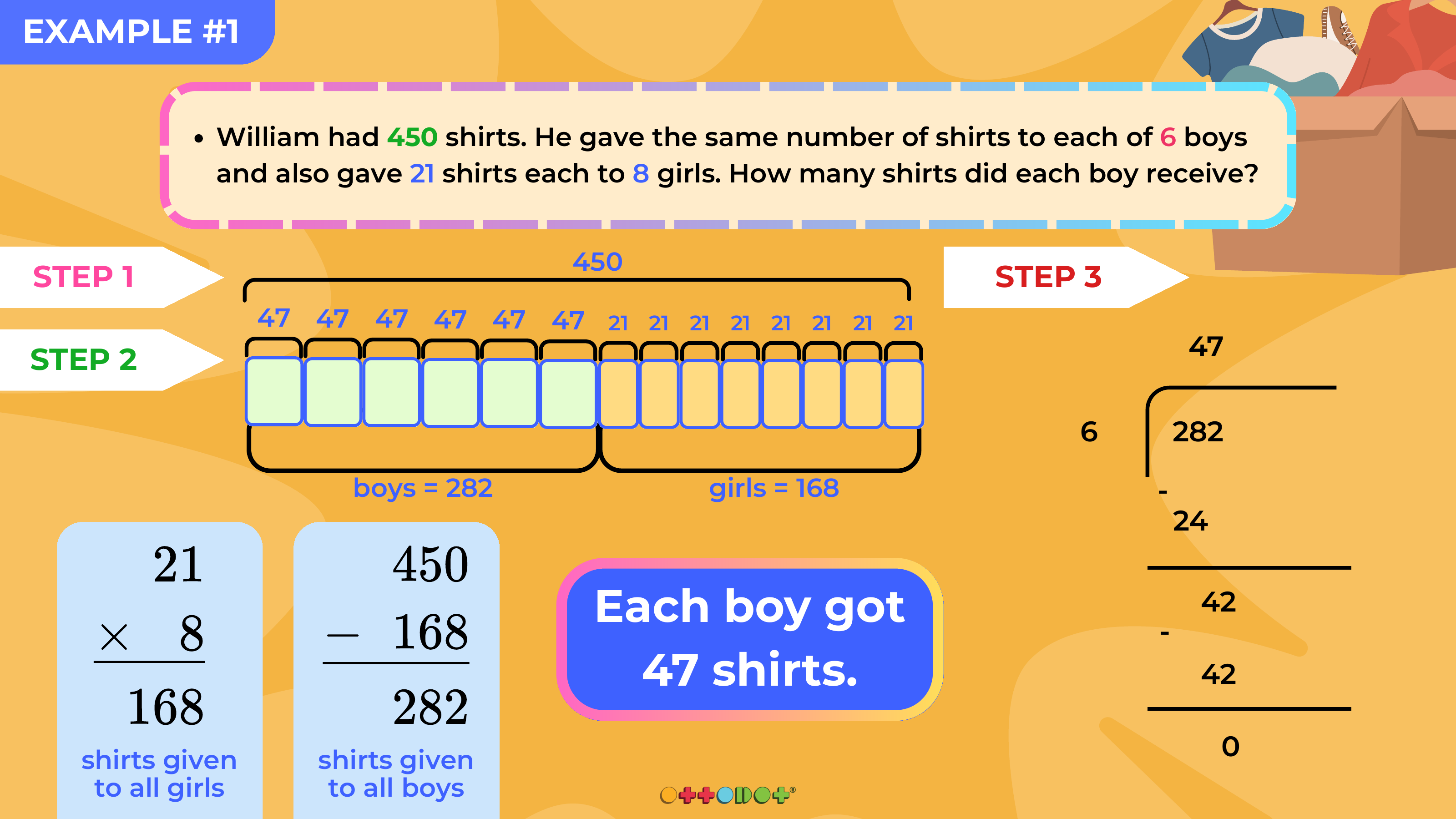
This is a part-whole question because the 450 shirts are the whole. The parts are:
the shirts given to 6 boys
the shirts given to 8 girls
The model keeps the child from jumping straight into division. They first account for the known part.
Step 1: Find the shirts given to all girls.
21 x 8 = 168
The girls received 168 shirts in total.
Step 2: Find the shirts left for the boys.
450 - 168 = 282
The boys received 282 shirts in total.
Step 3: Divide the boys' share equally.
282 divided by 6 = 47
Each boy got 47 shirts.
Parent note: This is why part-whole models are useful even when the calculation is not hard. The model shows what must be removed from the whole before dividing the remaining part.
Comparison model
A comparison model shows how two quantities relate to each other. The key is to identify which amount is bigger or smaller than the other, then sketch the bar model to represent that relationship.
Use it when the question includes words such as:
more than
fewer than
less than
twice as many
thrice as many
difference
Example 2: Comparison model with candies
Question: Tim and Sue had 720 candies at first. Tim had thrice as many candies as Sue. Sue gave away 50 candies to her friend.
a. How many candies did Tim have?
b. How many candies did Sue have left?
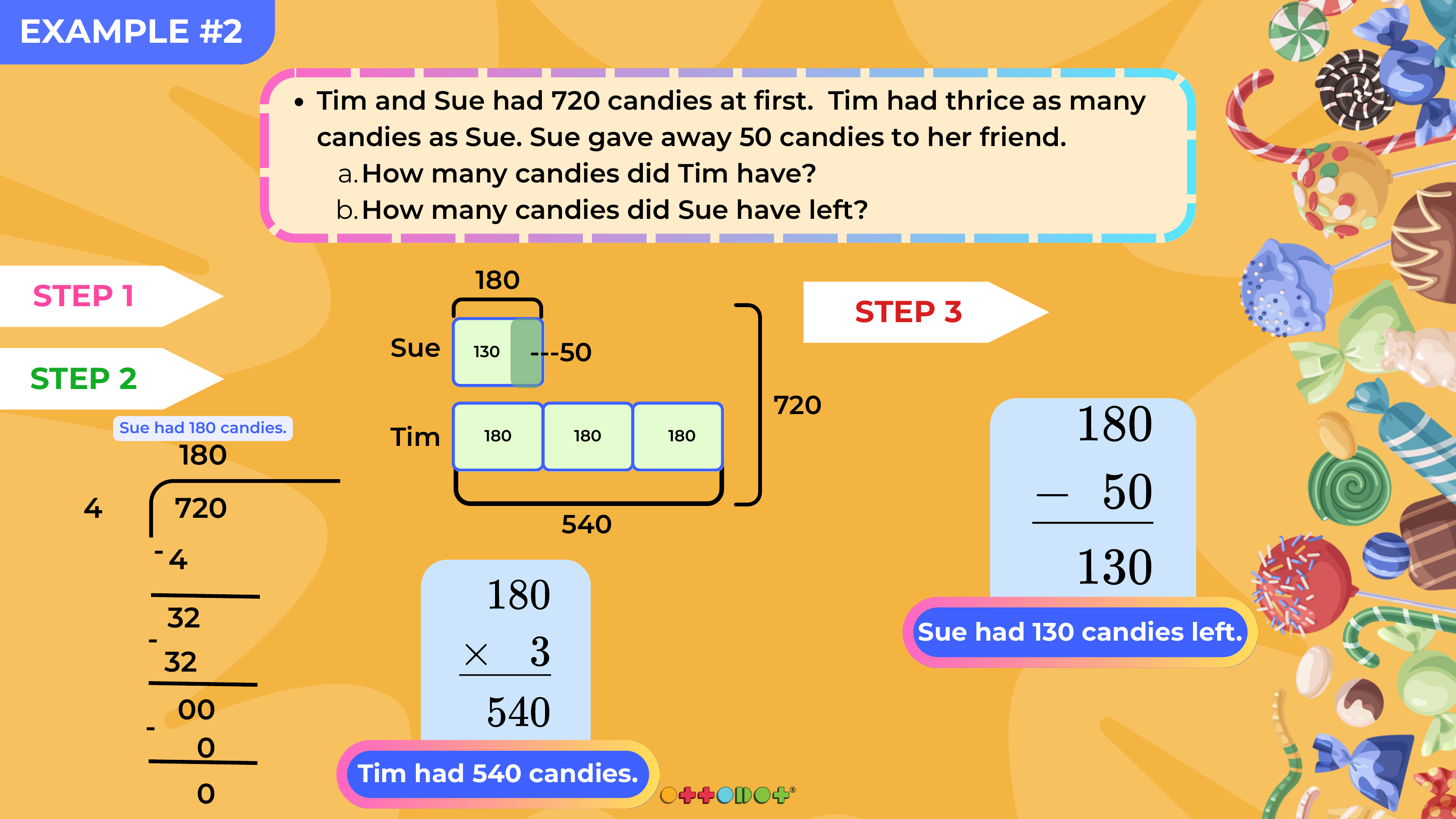
This is a comparison question because Tim's amount is described in relation to Sue's amount. Tim has thrice as many candies as Sue, so the model shows:
Sue = 1 unit
Tim = 3 units
Total = 4 units
Step 1: Find 1 unit.
720 divided by 4 = 180
Sue had 180 candies at first.
Step 2: Find Tim's amount.
180 x 3 = 540
Tim had 540 candies.
Step 3: Account for the change in Sue's amount.
180 - 50 = 130
Sue had 130 candies left.
Parent note: A comparison model is not only for simple "how many more" questions. It also helps when the question uses multiplicative comparison, such as "twice as many", "thrice as many", or "4 times as many". The bars tell the child how many units make up the total.
Bar models for harder upper-primary questions
By upper primary, bar models are often used together with fractions and before-and-after changes. In P6, they can also support ratio questions. The drawing becomes less decorative and more strategic. For the wider PSLE context, see our PSLE Math question types guide.
Example 3: Before-and-after ratio model
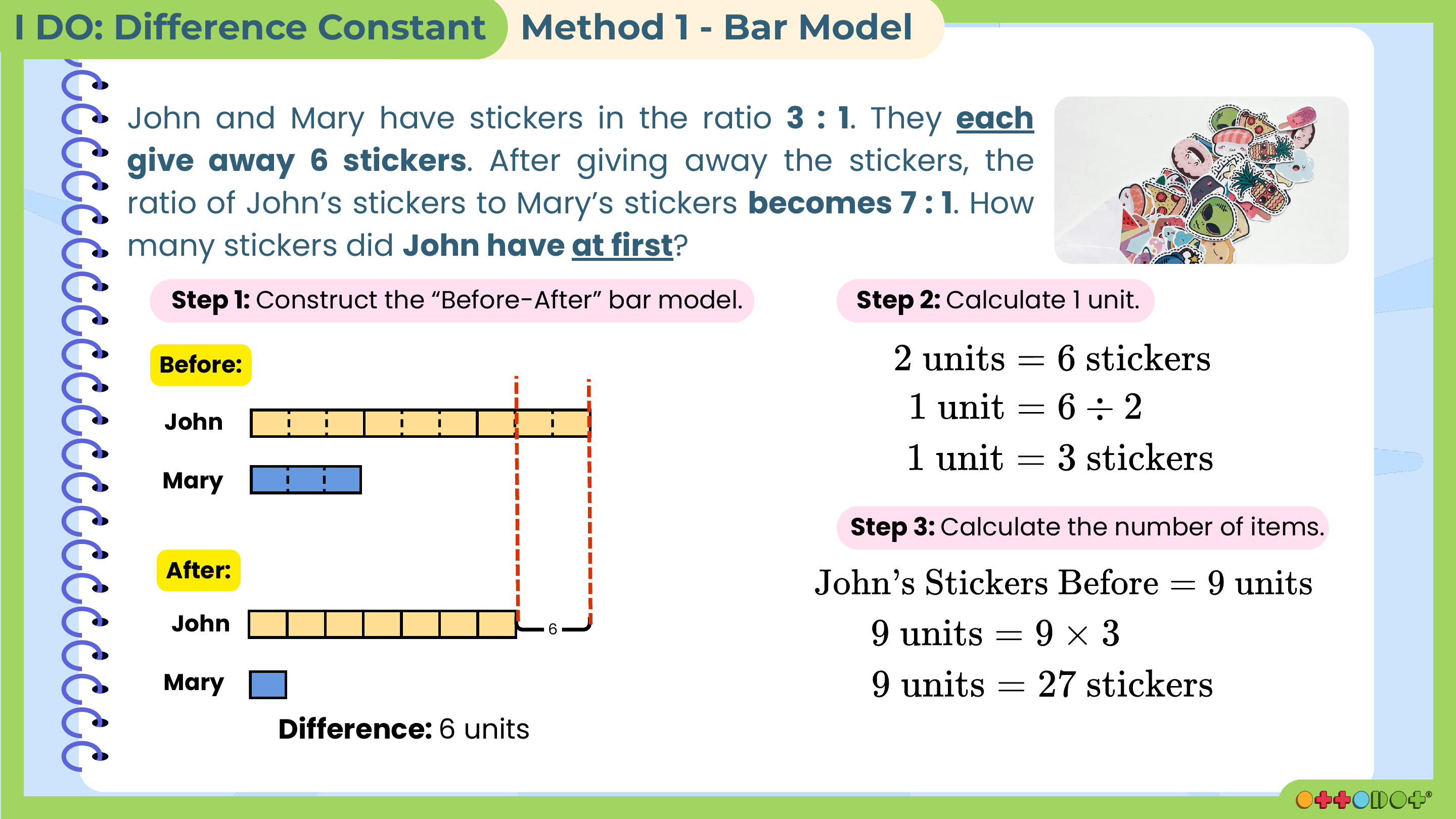
Question: John and Mary have stickers in the ratio 3 : 1. They each give away 6 stickers. After giving away the stickers, the ratio of John's stickers to Mary's stickers becomes 7 : 1. How many stickers did John have at first?
The bar model is useful because both children give away the same number of stickers, so the difference between them stays constant.
Before:
John : Mary = 3 : 1
After:
John : Mary = 7 : 1
The difference is constant.
Before difference = 2 before-units
After difference = 6 after-units
These two differences represent the same number of stickers, so:
2 before-units = 6 after-units
1 before-unit = 3 after-units
Mary had 1 before-unit at first. After giving away 6 stickers, she had 1 after-unit left.
So the amount she gave away is:
3 after-units - 1 after-unit = 2 after-units
2 after-units = 6 stickers
1 after-unit = 3 stickers
John's stickers at first = 3 before-units
3 before-units = 9 after-units
9 x 3 = 27 stickers
John had 27 stickers at first.
Example 4: Before-and-after internal transfer model
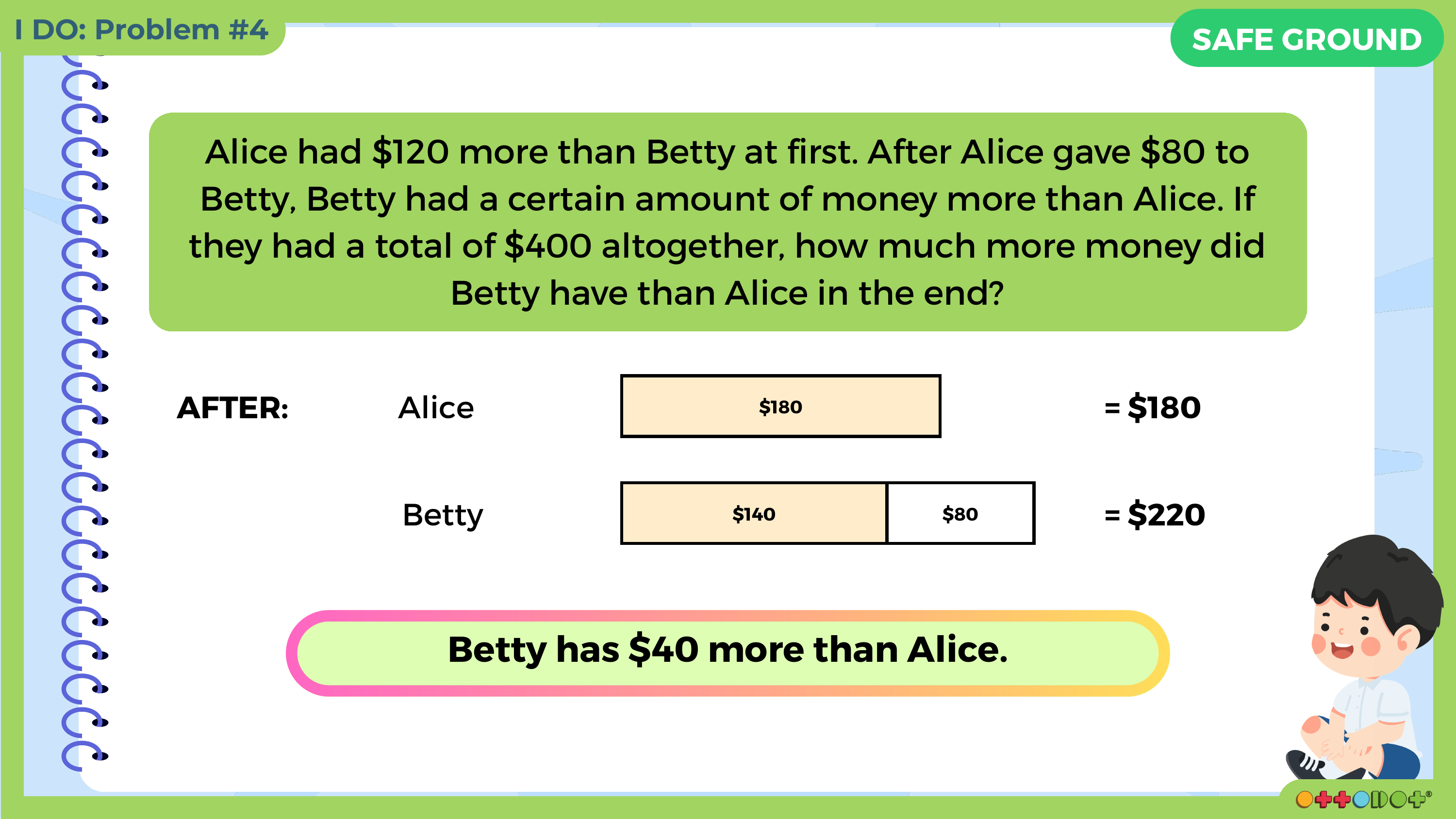
Question: Alice had $120 more than Betty at first. After Alice gave $80 to Betty, Betty had more money than Alice. If they had $400 altogether, how much more money did Betty have than Alice in the end?
This shows why internal-transfer questions are useful for teaching bar models. The total stays constant, but the bars change because one person gives to the other.
Before the transfer:
Betty = 1 unit
Alice = 1 unit + $120
Total = $400
So:
2 units + $120 = $400
2 units = $280
1 unit = $140
Betty had $140 at first.
Alice had $140 + $120 = $260 at first.
After Alice gave $80 to Betty:
Alice = $260 - $80 = $180
Betty = $140 + $80 = $220
Final difference:
$220 - $180 = $40
Betty had $40 more than Alice in the end.
Check: $180 + $220 = $400, so the total did not change.
This is where a bar model earns its keep. Without the picture, many children treat the $80 as if it only affects Alice. They miss that it also increases Betty's amount.
In this example, the common wrong answer is to subtract $80 from $120 and say the difference is $40 in Alice's favour. That misses the transfer. Alice loses $80 while Betty gains $80, so the difference changes by $160.
The model should make one idea obvious: internal transfer has a double effect on the difference.
Error analysis: why transfer questions confuse children
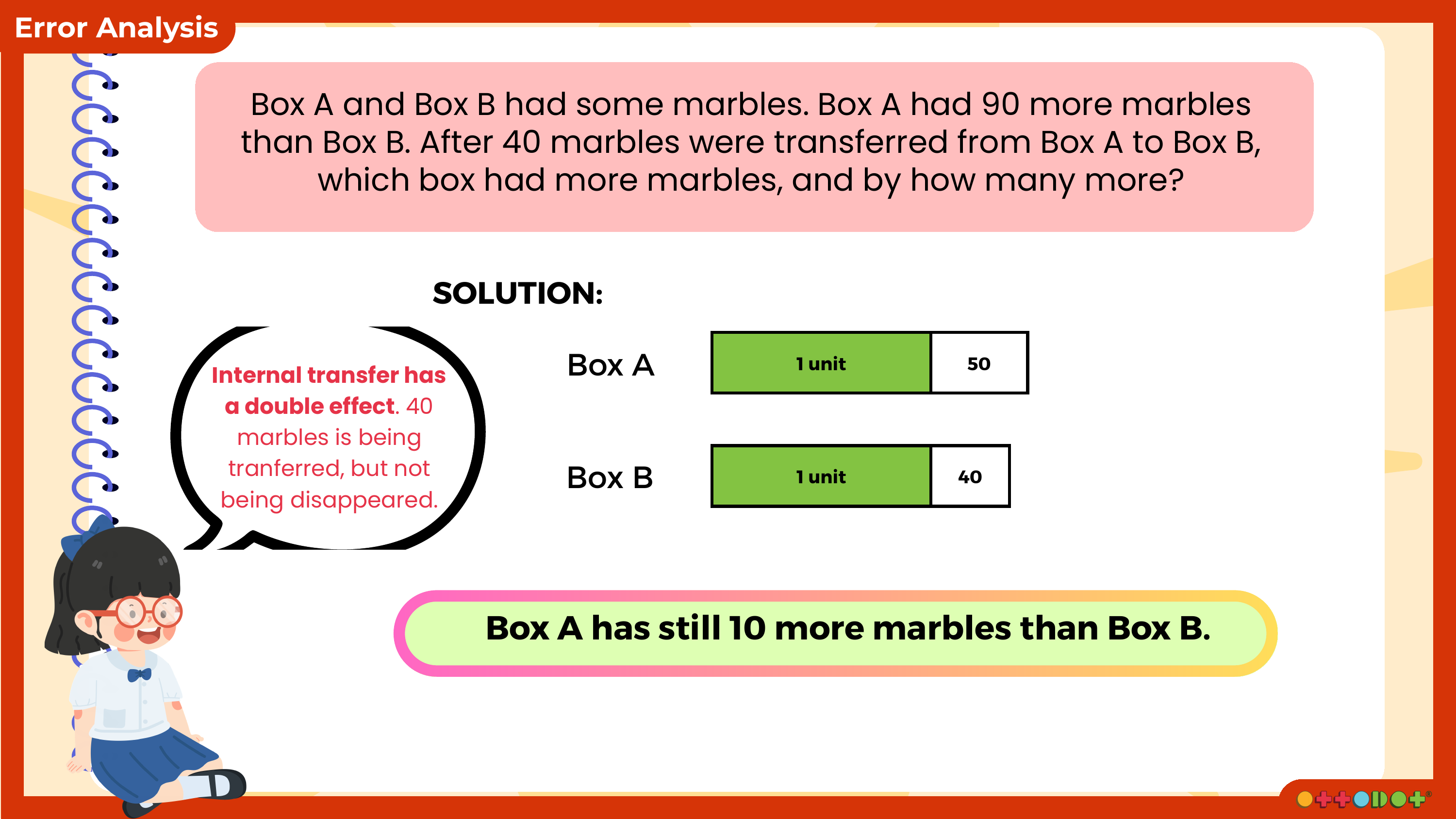
Question: Box A had 90 more marbles than Box B. Then 40 marbles were transferred from Box A to Box B. Which box had more marbles in the end, and by how many?
A common wrong solution is:
90 - 40 = 50
So Box A had 50 more marbles.
The mistake is that the 40 marbles did not vanish. Box A lost 40, and Box B gained 40. The difference changed by 80.
Final difference = 90 - 80 = 10
Box A still had 10 more marbles than Box B.
The mistake is easier to see when the child marks both movements: 40 leaves Box A, and the same 40 enters Box B.
Common bar model mistakes
Mistake | Why it happens | Fix |
Bars are not labelled | The child draws shapes without meaning | Label every known and unknown quantity |
Equal units are drawn unevenly | The child draws by feel | Keep unit lengths consistent within the same model |
Wrong model type | The child uses part-whole for every question | Ask whether the question compares quantities |
Calculating before drawing | The child wants to rush | Draw first for unfamiliar questions |
Spending too long making the model neat | The child treats it like art | Rough but clear is enough |
If your child says, "I know how to do it without drawing," ask them to explain what each number represents. If the explanation is clear, the model may not be needed. If the explanation is vague, the model is still doing important work.
How parents can practise bar models at home
Start with model interpretation before full model drawing.
You can use this progression:
Give a word problem with a pre-drawn model and ask your child to fill in the numbers.
Give a completed model and ask what story it could represent.
Give a word problem and ask your child to choose between part-whole and comparison.
Ask your child to draw the full model, number sentence, and answer.
This follows the same teaching logic Ottodot uses in Math lessons: support first, then guided attempt, then independent practice.
Try quick prompts during homework:
Which is the whole?
Which are the parts?
Who has more?
What model would help here?
Can you show me the unknown on the bar?
When your child gets a model wrong, avoid erasing it immediately. Ask them to point to each bar and say what it stands for. Many mistakes become obvious once the child has to explain the drawing aloud.
You can also separate model practice from calculation practice. Give your child three word problems and ask only for the model, not the final answer.
This lowers the pressure and trains the skill many children skip: turning the story into a structure.
For upper primary, add one more check. Ask, "Would this model still make sense if the numbers changed?" A strong model shows the relationship, not only the arithmetic for one set of numbers. That is the habit to build.
If your child is very slow, set a small target. For the first week, ask for one clear model per revision session, not a model for every question. Once the habit feels less painful, increase the number.
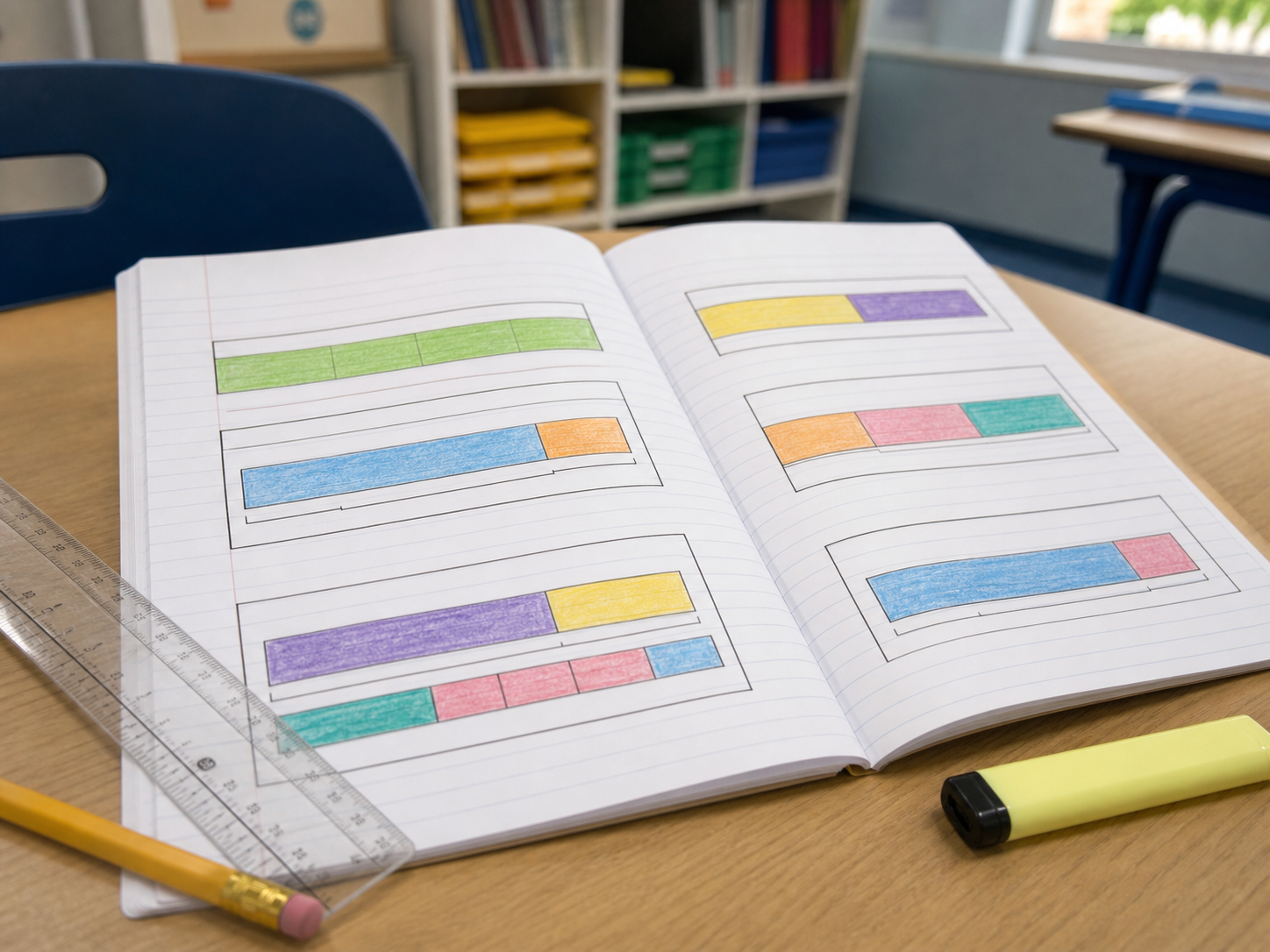
You can also keep a "model bank" in a notebook. Each page can show one common structure: part-whole, comparison, fraction remainder, before-and-after, and P6 ratio.
Before solving a new question, your child can point to the closest model type. This helps them see that many difficult questions are variations of a few familiar structures.
If you need more practice questions, use Ottodot's free worksheet generator to create extra Math practice, then ask your child to draw the model before solving.
How Ottodot teaches model drawing
In Ottodot's upper-primary Math classes, the teacher models the problem first. Students watch the thinking process, not only the finished answer. Then they try guided questions before moving into independent practice.
After that, game-based practice can reinforce the same idea. For example, model drawing and word-problem practice can become a mission where students must choose or apply the right representation before progressing. The teacher still teaches the concept. The game gives students more active practice.
For children who struggle with word problems, the goal is not to draw more bars for the sake of drawing. The goal is to make the story visible enough for the child to solve it.
Check my child's fit if you want to see whether Ottodot's teacher-led, game-supported Math classes suit your child.
Frequently asked questions
Is the bar model the same as model drawing?
Yes, parents often use the terms interchangeably. In Singapore primary Math, model drawing usually refers to using bar models to represent the relationships in a word problem.
Does my child need bar models in upper primary?
Often, yes. Some upper-primary students can solve simpler questions mentally, but bar models are still useful for complex fraction and before-and-after questions. In P6, they can also help with ratio questions where method marks matter.
Should my child use algebra instead?
Primary students may start to see algebraic thinking, especially in upper primary, but the bar model is still valuable because it shows the relationship visually. For many children, it is the bridge between arithmetic and algebra.
What if my child refuses to draw models?
Ask for a quick rough model rather than a neat drawing. If the child still refuses, ask them to explain the whole, parts, difference, and unknown verbally. If they cannot explain those clearly, they probably still need the model.
For mixed PSLE practice, use this together with our PSLE maths problem sums guide. If the question gives two item types, one total quantity, and one total value, the assumption method may be the better heuristic.