
Primary Tuition Fees Singapore 2026: Cost Guide
Compare primary tuition fees in Singapore for 2026, including online platforms, group tuition, 1-to-1 rates, and what parents should check before paying.
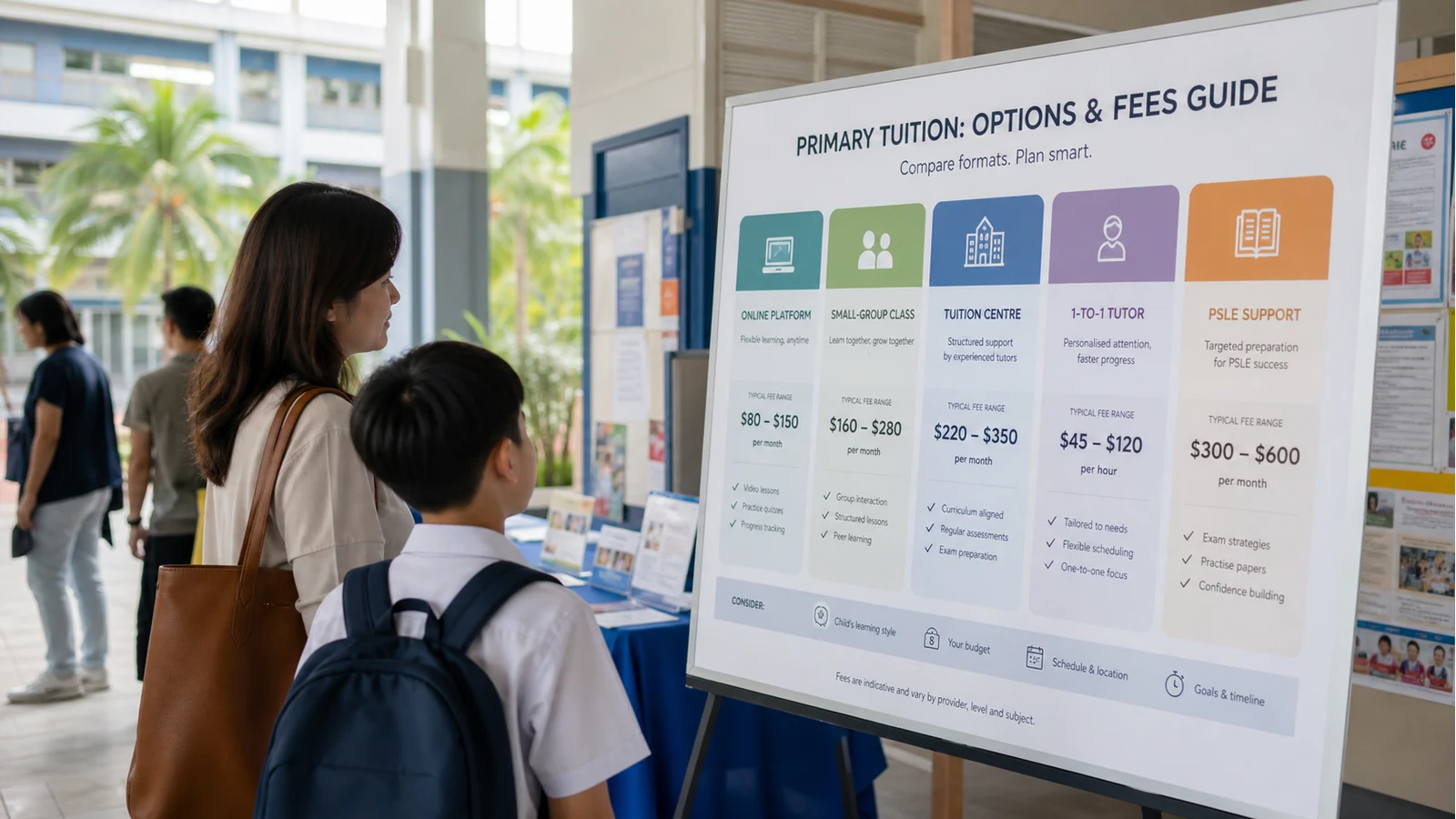
Primary tuition fees Singapore parents see in 2026 can vary from about $10-$20 a month for self-paced online platforms, to around $150-$400 a month for many group or centre-based classes, to roughly $25-$85 an hour for 1-to-1 home tuition. The right budget depends less on the cheapest listed fee and more on what your child needs right now: extra practice, a fixed routine, live teacher feedback, or targeted help with a weak topic.
That range can feel annoying because every option is described as "tuition". A tuition centre worksheet class, a small-group online lesson, and an ex-MOE 1-to-1 tutor are not selling the same kind of support.
If you're comparing online options now, use our best online tuition Singapore guide alongside this cost breakdown. If you already know you want a Math and Science programme with live teaching and practice built in, check Ottodot pricing or Check my child's fit to see whether it makes sense for your child.
Quick Answer
Compare tuition cost, class format, and fit before choosing a primary tuition option.
Recommended Next Guides and Practice
Key Takeaways
Primary tuition fees in Singapore are not one standard market rate. Format, tutor experience, level, subject, and class size change the fee quickly.
Hourly rates can be misleading. A cheaper hourly tutor may still cost more each month if lessons are longer or more frequent.
Self-paced online tools are usually the lowest-cost option, but they depend heavily on your child using them without much prompting.
1-to-1 tuition costs more because the child gets dedicated attention, but the fit still depends on the tutor's diagnosis, explanations, and follow-up.
For P5 and P6, parents should compare feedback quality and progress tracking, not only the fee.
Quick Answer: How Much Do Primary Tuition Fees Singapore Parents Pay?
For private primary tuition in Singapore, parents should expect a broad range. Based on current tuition-rate guides from TutorBee and The Singapore Syllabus, 1-to-1 primary home tuition commonly sits around $25-$85 an hour. The rate depends on whether the tutor is a student tutor, full-time tutor, current teacher, or ex-MOE teacher. Group classes and online programmes are often priced monthly instead, so compare the total monthly spend and what is actually included.
Tuition format | Typical cost pattern | Best for | Watch-out |
Self-paced online platform | About $10-$20/month | Children who need extra practice and can work independently | Little or no live teacher feedback |
Tuition centre or group class | Often around $150-$400/month per subject | Routine, worksheets, peer learning | Shared teacher attention and fixed pace |
Small-group online tuition | Often similar to live group tuition, depending on provider | Children who can participate online and benefit from live feedback | Needs good class design, not a basic video call |
1-to-1 home tuition | About $25-$85/hour for primary, depending on level and tutor tier | Deep gaps, urgent help, close correction | Higher monthly cost and tutor fit matters a lot |
Ex-MOE or specialist tutor | Premium end of the range | PSLE preparation or specific weak areas | Paying more does not automatically mean better progress |
Primary Tuition Prices
To make the ranges more concrete, we checked our Singapore primary tuition directory data, generated on 22 July 2026. Treat these as sample public prices, not a live ranking or full market average. Tuition providers change fees, bundles, GST treatment, and trial offers, so parents should always confirm on the provider's own site before signing up.
Provider | Format / category | Public fee found | What this tells parents |
88tuition | Self-paced online | Less than $15/month/subject, from public site copy captured in our directory data | The lowest-cost options usually give content and practice, not live teacher correction |
Ottodot | Small-group online Math and Science | $160/month on annual plan, upfront $1,920 | Live online teaching costs more than a self-paced library because teacher time and class practice are included |
Geniebook | Online/hybrid tuition platform | $372.50/subject/month, GST included | Some online platforms sit closer to premium tuition-centre pricing when live classes and progress systems are included |
Kumon | Centre-based enrichment | $170/month/subject | Monthly per-subject pricing can look simple, but parents should still ask about marking, levels, and pace |
Edufront | Centre-based tuition | $170-$300/month/subject | Group tuition fees vary by level, subject, and centre model |
Math Mavens | Primary Math specialist | From $360 before GST for 4 lessons | Specialist programmes can cost more when taught by experienced full-time teachers |
The Pique Lab | Primary Science / Math specialist | $80/lesson | Per-lesson pricing makes monthly cost depend on lesson frequency |
TinkerLab | Primary Science specialist | $70/lesson, with separate registration, deposit, and material fees listed | Add-on fees can change the real first-month cost |
MindFlex Home Tuition Agency | 1-to-1 home tuition agency | Primary 1-4: $25-$70/hour; Primary 5-6: $30-$80/hour by tutor tier | Tutor experience and level drive the hourly range for home tuition |
One more distinction matters: school fees and private tuition fees are separate things. The official MOE school fees page explains school fees for Singapore schools, but private tuition is an optional family expense on top of school.
Why Primary Tuition Fees Singapore Parents See Vary So Much
Tuition fees change because the child, the format, and the problem are different.
A Primary 2 child who needs more multiplication practice may not need a premium tutor. A Primary 6 child who keeps losing marks in Science open-ended questions probably needs a different kind of help. And a child who is bored by worksheets may need a format that gets them to participate first, before the teacher can correct anything.
Take Mei, a P4 student who understands lessons in school but forgets methods after a week. Her parents might not need 1-to-1 tuition yet. A lower-cost online practice platform, or a small-group class with weekly revision, could be enough.
Danish is different. He's in P6, can do routine Math questions, then freezes on multi-step problem sums. For him, the problem is more diagnostic. His tutor has to see where the thinking breaks, correct the method, and make him practise similar question types until the pattern sticks.
That is why two parents can both say "my child needs Math tuition" and end up with very different budgets.
Primary Tuition Fees By Format
Here are two recognisable reference companies in each tuition category. They are not ranked recommendations. Use them as market anchors when you compare price, class size, feedback, and what your child actually receives.
Format | Reference companies | What to compare |
Self-paced online platforms | Price, subject coverage, question practice, parent tracking | |
Small-group online tuition | Live feedback, class size, marking, between-class practice | |
Physical tuition centres | Monthly fees, centre location, worksheet load, parent updates | |
1-to-1 home tuition | Hourly rate, tutor experience, fit, replacement policy | |
Exam-year and PSLE support | Exam-year structure, teacher feedback, revision materials |
Self-paced online platforms
Self-paced platforms are usually the cheapest form of primary tuition. These can include video lessons, quizzes, worksheets, question banks, or game-style practice. Fees may sit around $10-$20 a month, though the exact price depends on the provider and subject coverage.
This works best when the child is self-motivated, or when a parent is willing to monitor usage. The risk is simple: low cost doesn't help if the child doesn't log in, rushes through questions, or repeats the same mistakes without correction.
For some families, this is still a smart first step. If your child has one weak topic, such as fractions or magnets, extra practice may be enough before committing to a larger monthly tuition budget.
Small-group online tuition
Small-group online tuition usually costs more than self-paced tools because there is a live teacher involved. Parents are paying for explanations, interaction, marked work, and some accountability.
The key question is whether the class is genuinely interactive. A good small-group online lesson should let the teacher see what students are doing, ask questions, correct mistakes, and keep children involved. A weak one can become a passive screen session, which is frustrating if you're paying live-class fees.
If you are still deciding between formats, read our guide on whether online tuition is suitable for primary school students and our comparison of online tuition vs physical tuition.
Physical tuition centres
Physical tuition centres often charge monthly fees by subject and level. Parents may like the routine: fixed lesson time, physical classroom, printed worksheets, and classmates around the child.
The trade-off is that attention is shared. In a larger class, your child may receive good exposure to questions but less personalised correction. This can still work well for children who already follow lessons and mainly need structure.
It may be less ideal if your child is quiet, hides confusion, or needs frequent prompting. In that case, ask how homework is marked, whether teachers give individual feedback, and how parents are told about progress.
1-to-1 home tuition
1-to-1 home tuition is usually the most flexible and one of the most expensive options. Current public rate guides commonly place primary-level 1-to-1 tuition from around $25 an hour for newer or part-time tutors to $85 an hour for more experienced or specialist tutors, especially at upper primary levels.
Parents often choose 1-to-1 tuition when the child has specific gaps, needs help before an exam, or struggles to ask questions in a group. It can be worth paying more when the tutor is good at diagnosis and changes the lesson around the child, instead of running through a fixed stack of worksheets.
But 1-to-1 is not automatically better. If a tutor simply goes through worksheets without explaining why the child made a mistake, the lesson can become expensive supervised homework.
Exam-year and PSLE support
PSLE tuition cost Singapore parents encounter can be higher because the stakes and urgency are higher. P5 and P6 students may need more targeted work in Math heuristics, Science answering technique, time management, or exam confidence.
At this stage, the better question is: "What will improve by the next review?" If the answer is vague, the fee is harder to justify.
For upper primary Math, you may want to compare the support in Ottodot's upper primary Math classes. For Science, especially if open-ended answers are costing marks, look at upper primary Science classes.
What Parents Should Compare Besides Price
Price matters. Once the fee is within your budget, the next question is fit.
Ask these before signing up:
What problem is this tuition solving?
Is my child missing concepts, practice, confidence, or exam technique?
How many students are in the class?
Does the teacher mark work and explain errors?
Are Math and Science both included, or priced separately?
Is there practice between lessons?
How will I know whether tuition is working after one month?
Here is a common parent trap. A parent sees a cheaper class at $180 a month and a more expensive programme at $240 a month. The cheaper class looks better until they realise it covers only one subject, has no feedback outside class, and requires another separate Science class. The higher fee may still be cheaper overall if it solves the actual problem.
The reverse can also happen. A parent pays for a premium tutor when the child only needed consistent practice. That is not "bad tuition", but it may be the wrong level of support for the problem.
When A Cheaper Tuition Option May Be Enough
A lower-cost option can be enough when your child:
Understands school lessons but needs repetition.
Is in lower primary and not facing urgent exam pressure.
Has one weak topic rather than broad confusion.
Can follow instructions independently.
Has a parent who can check whether practice is actually happening.
For example, if Ryan in P3 keeps forgetting multiplication facts, a $15 monthly practice tool might be a perfectly reasonable starting point. His parents can review after four weeks. If he's logging in, improving accuracy, and complaining less about sums, there may be no need to jump straight to 1-to-1 tuition.
This is where parents can save money: match the cost to the problem, then review honestly.
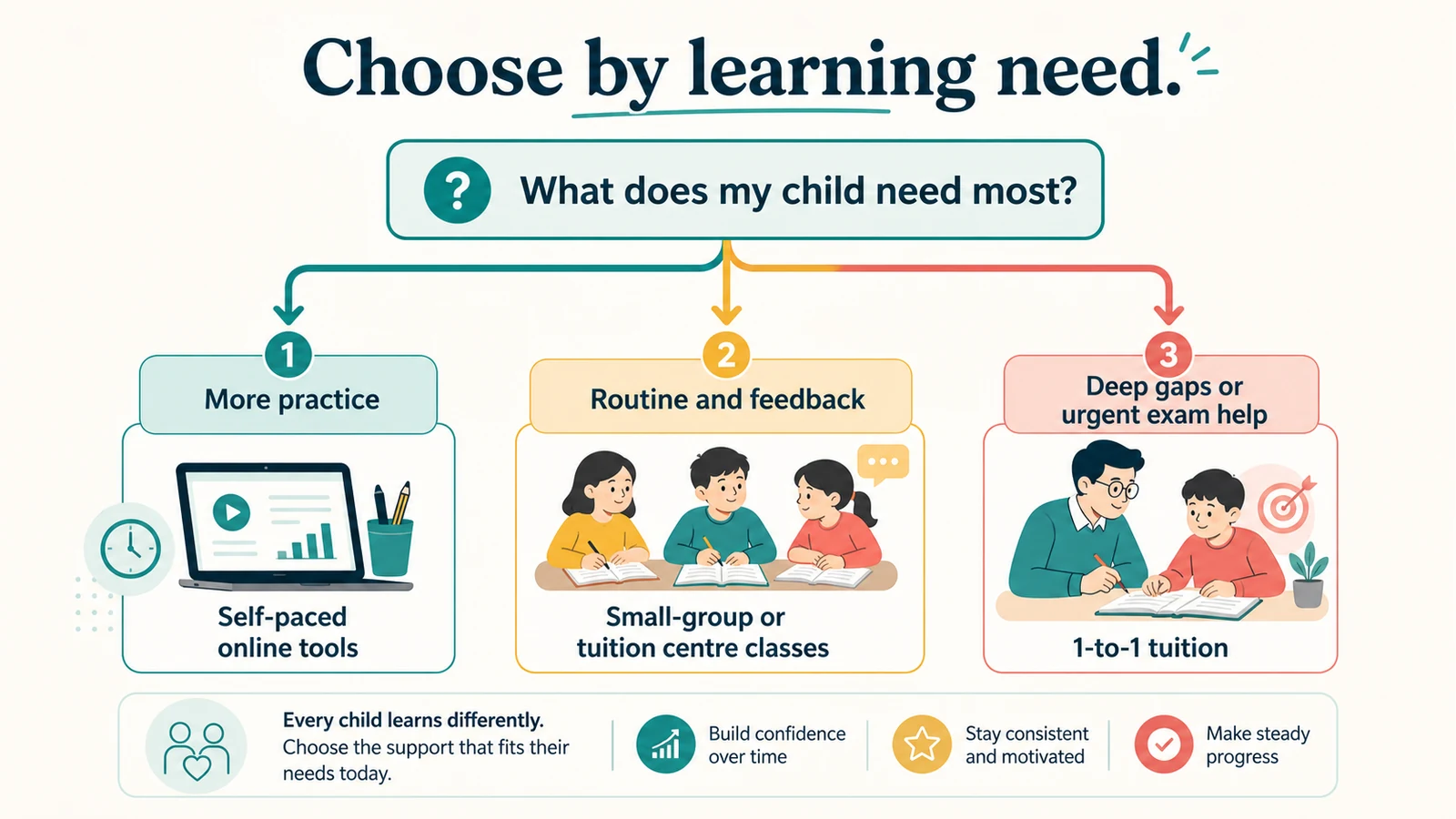
When Paying More May Make Sense
Paying more may make sense when your child needs live correction instead of more questions.
This is common when:
A P5 or P6 child has repeated conceptual gaps.
Math problem sums fall apart because the child cannot identify the right method.
Science answers lose marks because the child knows the concept but cannot phrase the answer.
The child avoids difficult questions and needs a teacher to keep them engaged.
Parents need clearer feedback because school results are dropping.
Nadia's parents tried worksheets for two months because her Science MCQ marks were fine. But her open-ended answers kept missing keywords and cause-effect links. At that point, teacher feedback may help more than another stack of practice papers.
The point is not that expensive tuition is always better. Some problems need a teacher who can see the mistake in real time.
Where Ottodot Fits
Ottodot sits in the live online tuition space for primary Math and Science. It is not a passive video library, and it is not 1-to-1 home tuition. The programme combines teacher-led online classes with game-based practice, so children get explanations, interaction, and repeated practice without it feeling like another worksheet pile.
That matters most for children who resist tuition, get distracted during passive lessons, or need more repetition than one weekly class can provide. If your child already enjoys independent worksheets, a lower-cost tool may be enough. If your child needs a dedicated tutor beside them for the whole lesson, 1-to-1 may be a better fit.
If you're comparing options, start with Ottodot pricing. If you're unsure whether your child fits online small-group learning, Check my child's fit and use it as a sanity check before committing more money.
You can also read our comparison of small-group online tuition vs 1-to-1 tuition if your shortlist is already down to those two formats. If attention is your main concern, our guide on online tuition for a distracted child will be more useful than another price table.
Parent Budget Checklist
Before you decide what to pay, work through this checklist:
Write down the exact problem: content gap, practice gap, confidence, exam technique, motivation, or accountability.
Compare monthly cost, not only hourly rate.
Check whether the fee is per subject or covers more than one subject.
Ask what happens between lessons.
Ask how work is marked.
Ask how parents receive progress updates.
Decide when you will review the spend, usually after four to eight weeks.
Stop or switch if the child is attending but nothing is changing.
This sounds obvious. It still prevents one of the most common tuition mistakes: keeping a class because it is familiar, not because it is working.
FAQ
How much is primary tuition in Singapore per month?
Primary tuition in Singapore can range from about $10-$20 a month for self-paced online tools, to around $150-$400 a month for many group classes, to several hundred dollars a month for weekly 1-to-1 tuition. The monthly cost depends on lesson length, frequency, subject, level, tutor experience, and format.
Is online tuition cheaper than physical tuition?
Online tuition can be cheaper, especially for self-paced platforms. Live online tuition may be closer to physical group tuition fees because parents are still paying for teacher time. The better comparison is whether the child gets feedback, practice, and accountability.
Is 1-to-1 tuition worth the higher fee?
1-to-1 tuition can be worth it when your child has specific gaps, avoids asking questions, or needs close correction. It may not be necessary if your child mainly needs routine practice and can keep up in a group.
Should P5 or P6 parents pay more for PSLE tuition?
Sometimes, yes. P5 and P6 children often need more targeted feedback, especially for Math problem sums and Science open-ended answers. But higher fees should come with clearer diagnosis and progress tracking, not another stack of worksheets.
How do I know if tuition is worth continuing?
Set a review point before you start. After one to two months, look for specific changes: better homework accuracy, fewer repeated mistakes, more willingness to try hard questions, clearer Science answers, or improved school quiz results. If nothing changes, ask the provider what they will adjust.
Final Thought
The best tuition budget is not the lowest fee you can find. It is the lowest fee that properly solves your child's current problem.
If your child needs practice, keep the plan simple and affordable. If your child needs diagnosis and live correction, expect to pay more and look closely at teacher quality. If your child needs participation before learning can happen, choose a format they will actually show up for.
For parents comparing primary tuition fees Singapore options now, the practical next step is to shortlist by problem first, then price. You can use Ottodot's pricing page for a live online Math and Science reference point, or Check my child's fit before deciding.