
Online Tuition vs Physical Tuition: Primary School
Online tuition vs physical tuition for primary school: compare focus, teacher support, travel time, recorded lessons, and best fit for your child in Singapore.
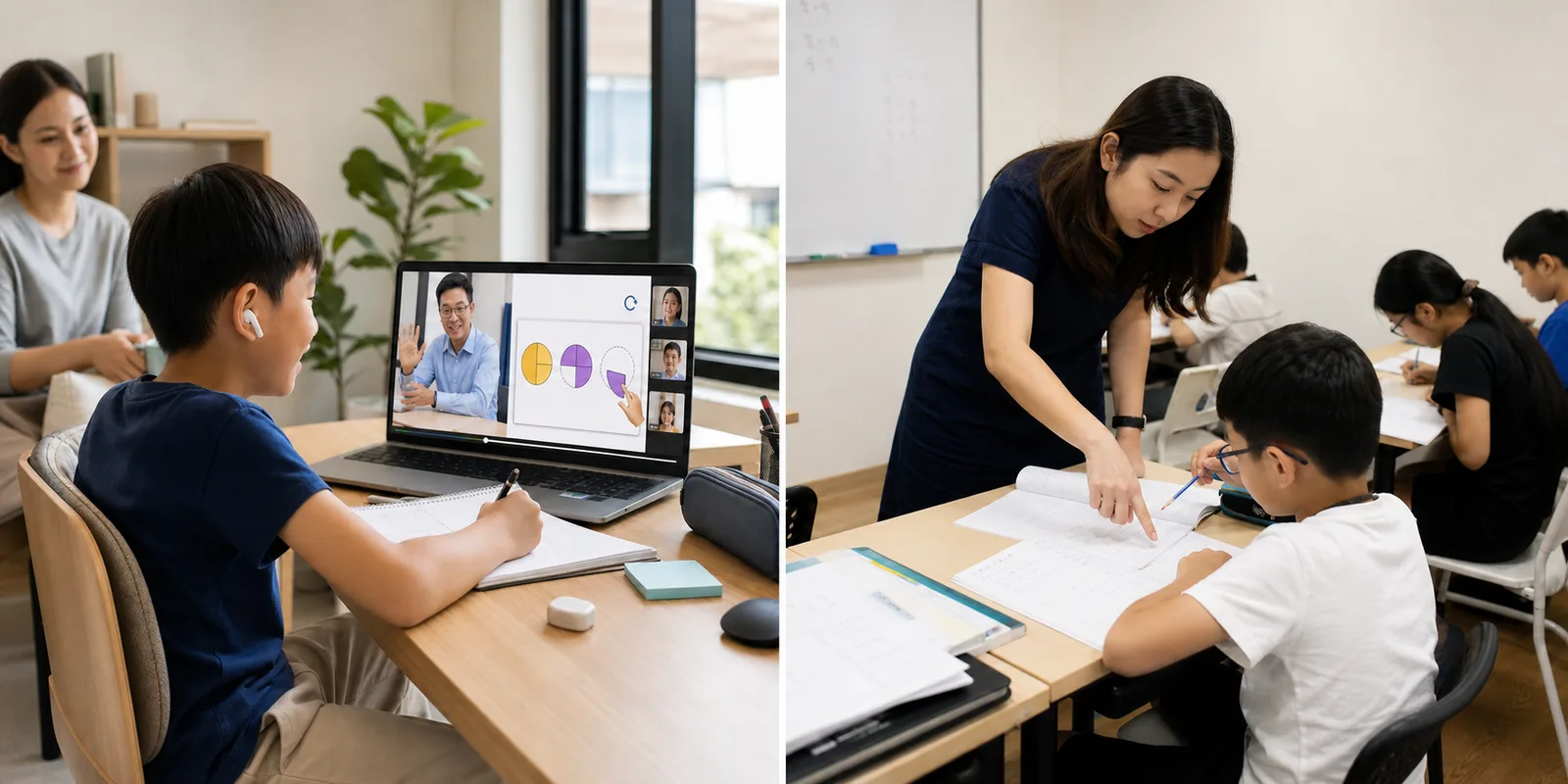
Online tuition vs physical tuition for primary school is one of those decisions where parents usually want a straight answer, but the honest answer is: it depends on your child. Online tuition can work very well when lessons are live, interactive, and easy to review after class. Physical tuition may work better when a child needs a separate study space or stronger in-person supervision.
If you are a Singapore parent choosing between online tuition, a tuition centre, home tuition, or a hybrid option, try not to start with the format. Start with your child. Do they need someone physically beside them? Do they answer better when they can type or click? Do they still have energy after travelling to class?
Last updated: 23 July 2026
This guide compares both formats for Primary 1 to Primary 6 students. It looks at what online does especially well, where physical tuition still has the edge, and what to watch for if you try an online class.
Key Takeaways
Online tuition is strongest when lessons are live, interactive, recorded, and built around real student responses.
Physical tuition is often better when a child needs an adult physically nearby, a separate learning space, or close handwritten correction.
For P1 to P3 children, parent setup support and simple routines matter more than the format itself.
For P4 to P6 children, online tuition can work well for MOE-aligned Math and Science concept practice, especially when digital tools make abstract ideas visible.
The best way to decide is to observe a trial class and check whether your child can explain one thing they learnt afterwards.
Online tuition vs physical tuition: quick comparison
Both online tuition and physical tuition can help primary school students. The difference often shows up in small moments: who notices when your child is lost, how quickly they get feedback, whether they actually practise, and what can be reviewed after class.
Factor | Online tuition | Physical tuition |
Travel time | No commute, easier weekday scheduling | Requires travel to a centre or waiting for a home tutor |
Learning environment | Home-based, needs a quiet setup | Separate classroom or tutor-at-home routine |
Teacher interaction | Strong when the lesson is live, responsive, and small-group | Easier for the teacher to read body language and redirect |
Child attention | Works well when there are response checks, games, polls, or activities | Helps children who need physical supervision |
Class resources | Digital whiteboards, screen sharing, recordings, simulations, games, and instant checks | Printed worksheets, handwritten correction, physical demonstration |
After-class diagnosis | Recordings and submitted responses can be reviewed by the teaching team | Depends mostly on what the teacher notices during the class |
Abstract concepts | Digital tools can make Math and Science ideas visible and interactive | Teacher can draw or explain, but the moment is harder to replay |
Best fit | Busy schedules, interactive learners, concept practice, location flexibility | Young children needing supervision, paper-heavy correction, separate study routine |
Take Priya, whose P4 son used to spend 45 minutes travelling to and from tuition every Wednesday. By the time he reached home, he was tired, hungry, and in no mood to finish school homework. Online tuition did not magically solve every learning gap, but it gave him back time and energy. More importantly, the class was not a video to sit through. He had to answer questions, move objects on screen, and explain his working.
That is the key difference. Online tuition works best when the class expects children to do something, not when a normal lecture is moved onto a screen.
Unsure whether online tuition suits your child? A trial class is the cleanest way to test attention, participation, and setup before choosing a longer plan. You can start the quiz and see how your child responds in an actual lesson.
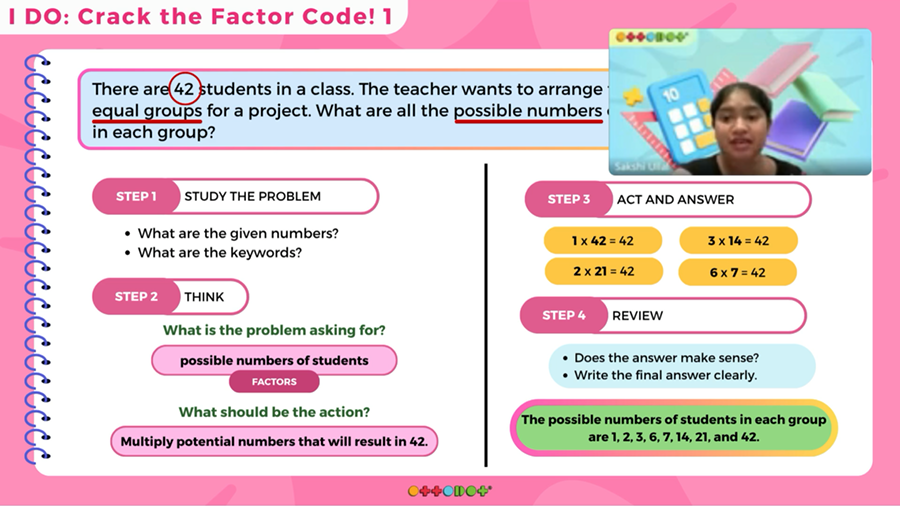
When online tuition works better for primary students
Online tuition is often described as "convenient". True, but that undersells it. A good online class can leave behind clues that are harder to capture in a physical room.
Recorded classes make after-class review possible
In a physical class, much of the lesson disappears once the class ends. The teacher may remember who was quiet, who answered wrongly, or which topic caused confusion. Still, that depends on what they noticed in the moment.
Online classes can create a better record of what happened. If classes are recorded, the lesson planning or teaching team can review:
whether students participated or stayed silent
which questions caused hesitation
what misconceptions appeared across the class
how the teacher prompted students
whether a child could explain the reasoning instead of giving only an answer
This does not replace a good teacher. It gives the team more to work with after class. If several P5 students make the same mistake in a Science open-ended question, the team can spot the pattern and adjust the next lesson without relying only on memory.
Digital tools can make abstract concepts visible
Primary Math and Science become harder when ideas stop being easy to see.
A P3 child may understand sharing a pizza into equal parts, but struggle when the same idea appears as a fraction diagram. A P5 child may memorise the water cycle, but freeze when asked to explain what happens when the air cools.
Online tuition can use digital tools to make these ideas more visible:
drag-and-drop fraction pieces
digital bar models that can be moved and reset
on-screen annotation for word problems
instant polls and quizzes
game-based tasks where the child must apply a concept to progress
That matters for MOE-aligned Math and Science. Children need to understand the idea before they can handle exam-style questions.
At Ottodot, our game-based online Math and Science classes use interactive activities so children practise rather than watch explanations passively. Some activities use Roblox-style environments, but the point is not the platform. It is that children have to answer, test, and apply the concept.
Online response tools can reveal quiet misunderstanding
Some children look attentive in class but are not really following. They nod. They say "yes". Then the worksheet comes out, and they cannot do the question alone.
Online tuition can help when the teacher uses response tools well. A child can answer through chat, polls, whiteboards, in-game actions, quizzes, or short verbal explanations.
This can help quieter children. In a physical group class, a shy child may avoid speaking up. Online, the same child may be more willing to type an answer or respond through a digital task. The teacher still has to use those tools well, but when they do, quiet misunderstanding becomes easier to catch.
When physical tuition may be better
Physical tuition still has real strengths, especially for primary school children who need more structure from the room and the adult in front of them.
Physical tuition may be the better starting point if your child:
cannot stay with an online task without an adult beside them
gets distracted by the home environment
keeps switching tabs or playing with device settings
needs physical presence to feel accountable
benefits from a separate "school-like" routine
needs intensive handwritten correction every week
is very young and still learning basic screen habits
For example, Marcus is in P2. He enjoys learning, but once he is at home, everything competes for his attention: toys, snacks, siblings, and the iPad itself. His parents tried online tuition twice. Both times, he needed someone beside him for almost every instruction. For Marcus, physical tuition may be the kinder starting point until he builds stronger routines.
That is not a failure. It is simply a better fit for now.
Physical tuition can also be useful when the main need is paper-heavy correction. If a P6 student has messy working, missing units, weak presentation, and many careless mistakes, an in-person tutor may find it easier to sit beside the child and check each step.
Lower primary vs upper primary: age changes the decision
The online tuition vs physical tuition decision can look very different for a P1 child and a P6 child. Age does not decide everything, but it changes the support your child may need.
P1 to P3: the routine matters most
Lower primary children can learn online, but the routine matters a lot.
At this age, parents may need to help with logging in, keeping the child in the right window, checking the microphone, and reminding the child to answer. This does not mean online tuition is unsuitable for P1 to P3 students. It means the first few sessions may feel a bit hands-on for parents too.
Online tuition works better for lower primary when instructions are simple, activities are short, and the teacher checks in often. Digital tools can also help younger children see ideas clearly. Equal parts in fractions, place value, and number bonds are easier to grasp when children can move, match, sort, or test something on screen. For P3 children, simple Science observations can work the same way.
Physical tuition may be better if your child still needs frequent adult redirection.
P4 to P6: online tuition becomes more practical
Upper primary students are usually more ready for online tuition. They can manage devices better, follow longer instructions, and explain their thinking more clearly.
For P4 to P6 students, online tuition can be especially useful when lessons include worked examples, active problem solving, topic revision, teacher feedback, timed practice, digital concept visualisation, and recorded lessons for review.
This matters for PSLE preparation too. Upper primary students need more than worksheets. They need to know why a method works, and what to change when they get stuck.
Physical tuition or 1-to-1 tuition may still be better for severe foundational gaps, exam anxiety, or situations where the child needs close supervision throughout the lesson.
Which format fits your child best?
Use this table as a starting point, then adjust it based on what you already know about your child.
Parent situation | Better starting point | Why |
My child focuses well at home and dislikes travelling | Online tuition | Removes commute and preserves energy |
My child gets distracted by devices | Physical tuition, or a carefully observed online trial | The child may need more structure first |
My child is shy in physical classes but will type answers | Online tuition | Digital responses can lower the barrier |
My child needs every written step checked | Physical or 1-to-1 tuition | Handwritten correction may be easier in person |
We live far from good tuition centres | Online tuition | Access matters |
My child is P1 or P2 and needs setup help | Either, but test carefully | Parent support and routine will decide fit |
My P5 or P6 child needs exam support | Depends on the weakness | Online can work for concepts and practice. Physical may help for close correction |
If your child is distracted specifically during online lessons, read our guide on why children lose focus while studying. Focus is partly about discipline, but task design and feedback matter too.
Common mistakes parents make when choosing tuition format
The biggest mistake is choosing based on convenience alone. A shorter commute helps, but it does not matter much if the child is passive for the whole lesson.
Another common mistake is assuming physical tuition automatically means better attention. A child can sit in a tuition centre and still hide at the back of the class. What matters is whether the teacher notices, asks, checks, and corrects.
The third mistake is judging online tuition after one messy setup experience. If the first lesson is mostly spent fixing audio, logging in, or learning where to click, judge the routine again after the setup is familiar. If the child still cannot participate after that, physical tuition may be a better fit.
What to check during an online trial class
A trial class should show you more than whether your child "liked it". Enjoyment matters, but fit matters more.
During an online trial, watch for these signs:
Did the teacher speak directly to your child?
Did your child answer, ask, type, click, move, or explain?
Was the lesson mostly watching, or did your child have to participate?
Could your child explain one thing after class?
Did the digital activity make the concept easier to see, test, or explain?
Was there evidence the teacher or team could review after class, such as submitted answers, in-class responses, or a recording?
After class, try one simple test: ask, "Can you teach me one thing you learnt?"
The answer does not need to be perfect. If your child can explain one idea, show one method, or describe one mistake they corrected, pay attention. That is a good sign.
Parent tips before you decide
First, compare the actual class experience, not the label. "Online" can mean a live small-group class, a worksheet sent over Zoom, or a self-paced video. These are very different.
Second, watch your child after the lesson, not only during it. If they are less tired, more willing to practise, or able to explain one thing clearly, that tells you something useful.
Third, give the format a fair test but not endless chances. If your child is still distracted after the routine is familiar and the teacher is actively engaging them, it may be time to try physical tuition or 1-to-1 support.
Is online tuition as effective as physical tuition?
Online tuition can be effective when it is live, interactive, and built around student participation. Research on synchronous online learning is encouraging, but parents should not treat it as a blanket promise.
For example, a 2026 meta-analysis of synchronous online learning reviewed 31 randomised controlled trials and found positive effects for cognitive and affective outcomes. A separate 2021 meta-analysis found a small significant effect in favour of synchronous online learning compared with asynchronous online learning for cognitive outcomes.
Read this evidence carefully. These studies are not the same as every primary tuition class in Singapore. They do not prove that any online class is automatically as good as any physical class.
A review of remote education interventions for primary school children also found that remote learning can support academic development, especially when approaches are synchronous and student-centred. At the same time, a Hong Kong study of 781 primary students found mixed perceptions of emergency online learning, with teacher-student interaction linked to better satisfaction and perceived effectiveness.
The practical takeaway is simple: online tuition is not effective because it is online. It is effective when the teacher interacts well, the child participates, and the lesson asks the child to think instead of watch.
How Ottodot approaches game-based online tuition
Ottodot runs live game-based online Primary Math classes for P1 to P6 students and Primary Science classes for P3 to P6 students. Lessons are aligned to the MOE syllabus and use interactive activities to help children practise concepts instead of watching explanations passively.
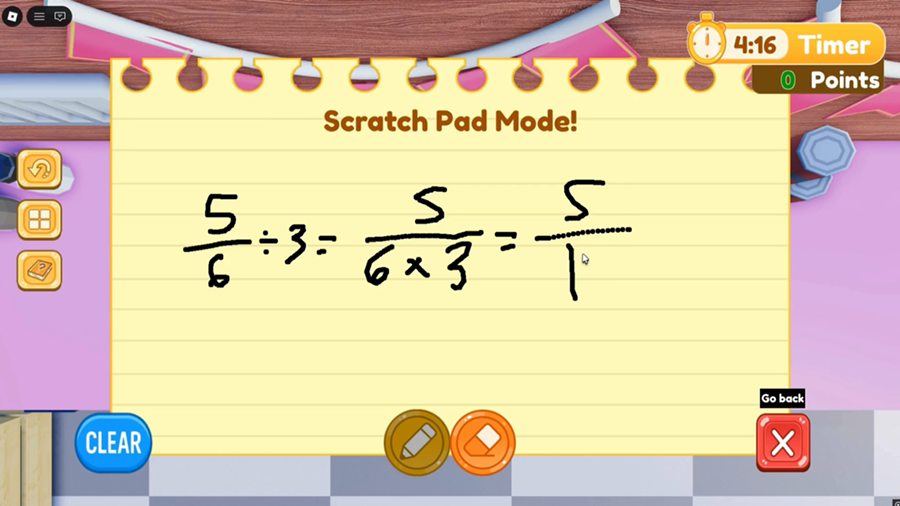
Some of those activities may use Roblox-style gameplay because it gives children a familiar, interactive space to solve problems. But Roblox is the example, not the whole promise. The promise is game-based learning with teacher guidance, concept practice, and feedback.
For Math, this can mean visualising fractions, bar models, number patterns, geometry, or problem sums through digital tasks. For Science, it can mean working through experiment scenarios, systems, cycles, and OEQ reasoning with teacher guidance.
The goal is not screen time for its own sake. The goal is practice, teacher feedback, and a clearer view of where the child is stuck.
Recordings and digital responses also help the teaching team review what happened after class. The lesson does not have to disappear the moment it ends.
If you are comparing formats first, you may also find our Best Online Tuition Singapore guide useful when you are ready to compare providers.
Want to test whether your child responds to this format? start the quiz and observe whether your child pays attention, joins in, and can explain what they learnt afterwards.
FAQ
Is online tuition better than physical tuition for primary school?
Online tuition may be better for primary school students who can follow an online routine, respond to a teacher through the screen, and benefit from interactive digital tools. Physical tuition may be better for children who need in-person supervision or a separate study environment.
Is online tuition suitable for P1 or P2 students?
Online tuition can suit P1 or P2 students if the class is interactive and parents can help with setup at first. If the child needs constant physical redirection, physical tuition may be a better starting point.
Is physical tuition better for distracted children?
Physical tuition may be better if the child is distracted by the device, home environment, or online routine. However, a well-designed online class with frequent response checks can still work for some distracted children.
Is online tuition cheaper than physical tuition in Singapore?
It depends on the format, tutor, class size, and provider. Online tuition may save travel time and sometimes fees, but parents should compare the full arrangement, not the headline price alone.
For a fuller cost comparison across formats, see our primary tuition fees Singapore guide before deciding whether online or physical tuition is the better value.
Should P5 or P6 students choose online or physical tuition before PSLE?
P5 and P6 students can do well with online tuition if they need concept revision, worked examples, and structured practice. Physical or 1-to-1 tuition may be better if the student needs close handwritten correction or urgent foundational repair.
Conclusion
Online tuition vs physical tuition for primary school should not be decided by trend, convenience, or fear of screens alone.
Choose online tuition if your child can participate actively, benefit from digital concept tools, and learn well with live teacher guidance. Choose physical tuition if your child needs stronger in-person supervision, a separate study routine, or close paper-based correction.
For many families, the best answer is to test fit before committing. Watch how your child responds in a real class. Do they answer? Do they practise? Can they explain one thing afterwards? That will tell you more than any generic comparison table.
If you would like to see how online Math and Science tuition can work for your child, start the quiz. Use it as an observation session: attention, participation, and understanding are the three signs to watch.