
P3 Whole Numbers: Understanding the Four Operations
Help your child with P3 whole numbers, addition, subtraction, multiplication and division through worked examples, checking habits and practical parent tips.
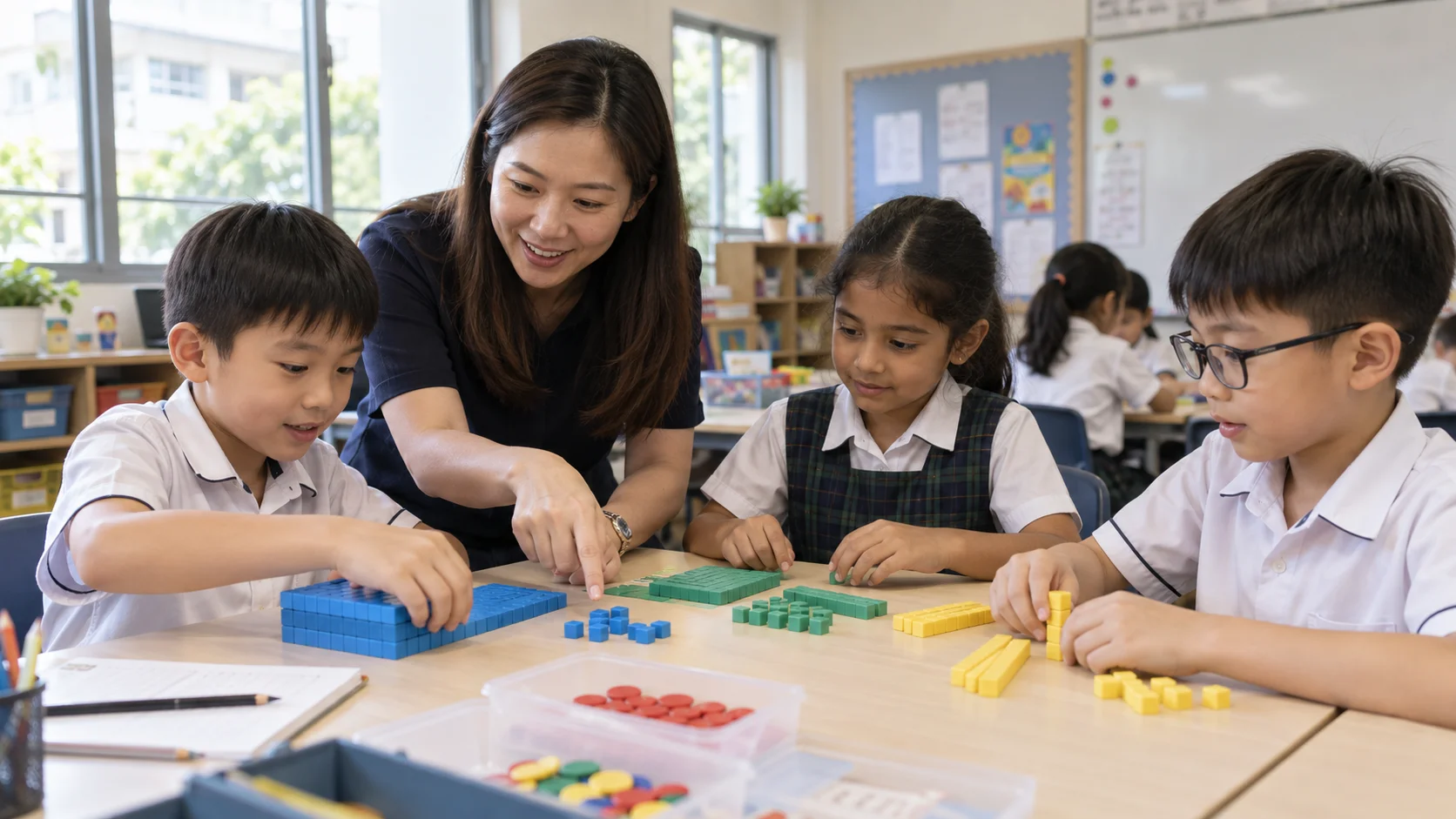
The P3 whole numbers topic combines numbers up to 10,000 with addition, subtraction, multiplication and division. This guide helps parents explain what the calculations mean, work through examples and spot where a child needs another explanation.
A child may know that 7 × 8 = 56 yet struggle to choose an operation in a story. Start with what is happening to the quantities, then write the calculation.
Key Takeaways
A digit's place determines its value: the 6 in 6,042 means 6,000.
Regrouping changes how a number is represented without changing its value.
Multiplication finds the total in equal groups; division can find group size or the number of groups.
A remainder must be smaller than the number you divide by.
Label intermediate answers so each calculation has a clear purpose.
What the P3 whole numbers topic covers
The MOE syllabus hosted by Lianhua Primary sets out four-digit addition and subtraction, tables of 6, 7, 8 and 9, and multiplication and division of up to three digits by one digit. Division includes remainders.
The Ang Mo Kio Primary P3 overview also lists word problems alongside these operations. A school may organise practice differently, so use your child's current work to choose a starting point.
Our P3 Maths overview connects these number skills with the other topics taught during the year.
Make place value visible before calculating
Write 6,042 in a place-value table:
Thousands | Hundreds | Tens | Ones |
6 | 0 | 4 | 2 |
This means 6,000 + 40 + 2. The zero holds the hundreds place. Without it, 642 names a different number.
To compare 6,042 and 6,402, start at the greatest place. Both have six thousands. At the hundreds place, zero hundreds is less than four hundreds, so 6,042 is smaller. Comparing the final digits first would miss the difference that decides the answer.
Number patterns use the same understanding. In 2,450, 2,550, 2,650, the increase is 100 each time. Ask your child to describe the change before filling in the next number, 2,750.
For mental addition, a child can split one number into tens and ones: 46 + 27 becomes 46 + 20, then another 7. For subtraction, 63 − 28 can become 63 − 20, then minus 8. These steps are small enough to explain aloud.
Connect tables to groups
If 7 × 8 is hard to recall, build it from a known fact. Five groups of eight make 40 and two more groups make 16. Together, seven groups make 56.
The same fact supports division: 56 shared equally among seven groups gives eight in each group. Alternatively, 56 arranged in groups of eight makes seven groups. The numbers are related, but the answer describes a different quantity in each story.
These multiplication and division facts also help children find equivalent fractions. Our P3 fractions guide connects the number changes to equal-sized parts.
Worked questions on P3 whole numbers
These are original practice questions with suggested solutions, not questions taken from a school assessment. Let your child attempt each one before reading the working.
Use a simple routine: understand the question, plan the steps, solve, then check. Ngee Ann Primary describes this four-stage approach alongside bar models. The fuller explanations below help parents teach the steps; a child's written answer can be shorter.
Example 1: Add, then subtract across zeros
A library has 2,786 books and receives 1,214 more. It then lends out 1,768 books. How many books remain in the library?
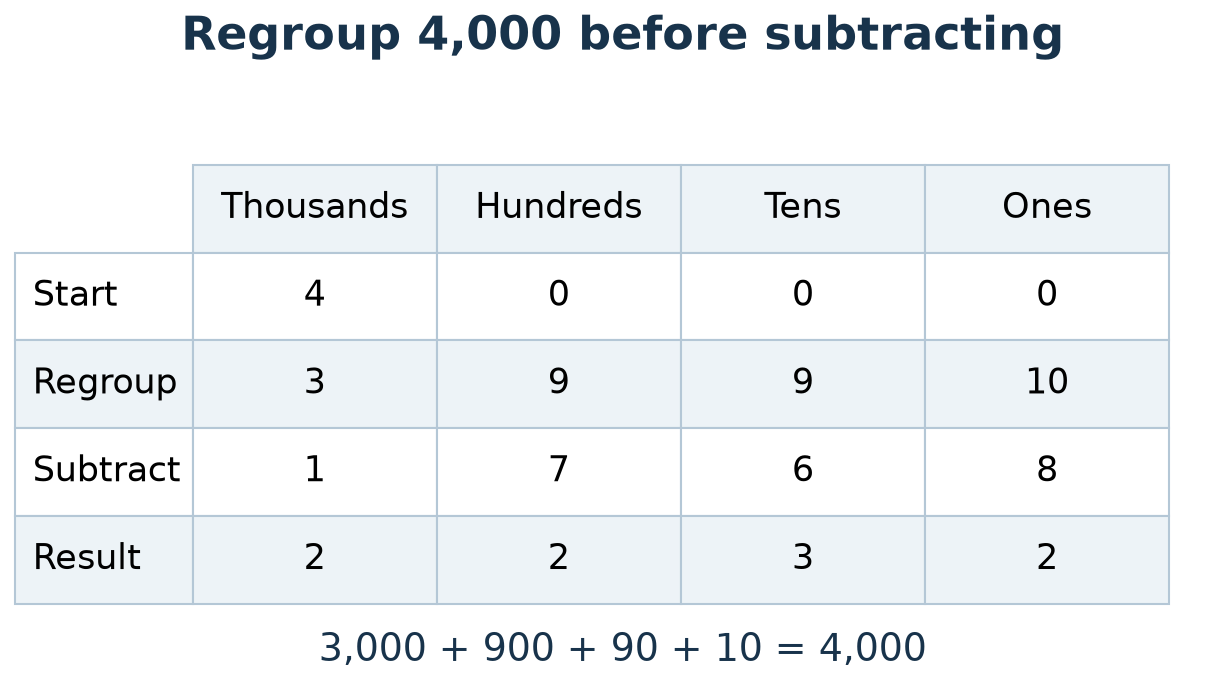
First find the number after the delivery:
2,786 + 1,214 = 4,000 books
In column addition, 6 + 4 makes 10 ones. Exchange those for one ten. Then 8 tens + 1 ten + the exchanged ten makes 10 tens. Continue regrouping into hundreds and thousands.
Next subtract the books lent out:
4,000 − 1,768 = 2,232 books
The zeros make this worth slowing down. Regroup 4,000 as 3 thousands, 9 hundreds, 9 tens and 10 ones. It is still 4,000, but now each column has enough to subtract.
Subtract to get 2 ones, 3 tens, 2 hundreds and 2 thousands.
Suggested answer: “2,232 books remain in the library.”
Check by adding the books remaining to the books lent out: 2,232 + 1,768 = 4,000. A child who gets the addition right but struggles with subtraction needs practice with regrouping across zeros, rather than repeating the whole problem.
Example 2: Multiply a three-digit number
There are 126 stickers in each packet. How many stickers are in seven packets?
There are seven equal groups of 126. Break each group into hundreds, tens and ones:
Part of 126 | Multiply by 7 |
100 | 700 |
20 | 140 |
6 | 42 |
Add the partial totals: 700 + 140 + 42 = 882.
Suggested answer: “There are 882 stickers in seven packets.”
In the column method, seven times six ones makes 42 ones: write two ones and regroup four tens. Seven times two tens, plus those four tens, makes 18 tens. Regroup again before completing the hundreds column.
Check using division: 882 ÷ 7 = 126, the number in each packet.
If your child writes the partial totals beside one another instead of adding them, return to the place-value table. The partial totals must be added because they describe parts of one total.
Example 3: Divide and interpret the remainder
A teacher puts 157 pencils into packets of six pencils each. How many full packets can she make, and how many pencils remain unpacked?
Find how many complete groups of six fit into 157.
Twenty groups use 120 pencils. That leaves 37. Another six groups use 36 pencils, leaving one.
157 ÷ 6 = 26 remainder 1
Suggested answer: “She can make 26 full packets, with one pencil remaining unpacked.”
Check the result: 26 × 6 = 156, and 156 + 1 = 157. The remainder is smaller than six, so another full packet cannot be made.
Pay attention to the requested quantity. If the question instead asked how many packets were needed to hold every pencil, allowing one partly filled packet, the answer would be 27. Here, it asks for full packets and unpacked pencils separately.
Example 4: Use a comparison before finding a total
Amir has 248 cards. Beth has 76 fewer cards than Amir. How many cards do they have altogether?
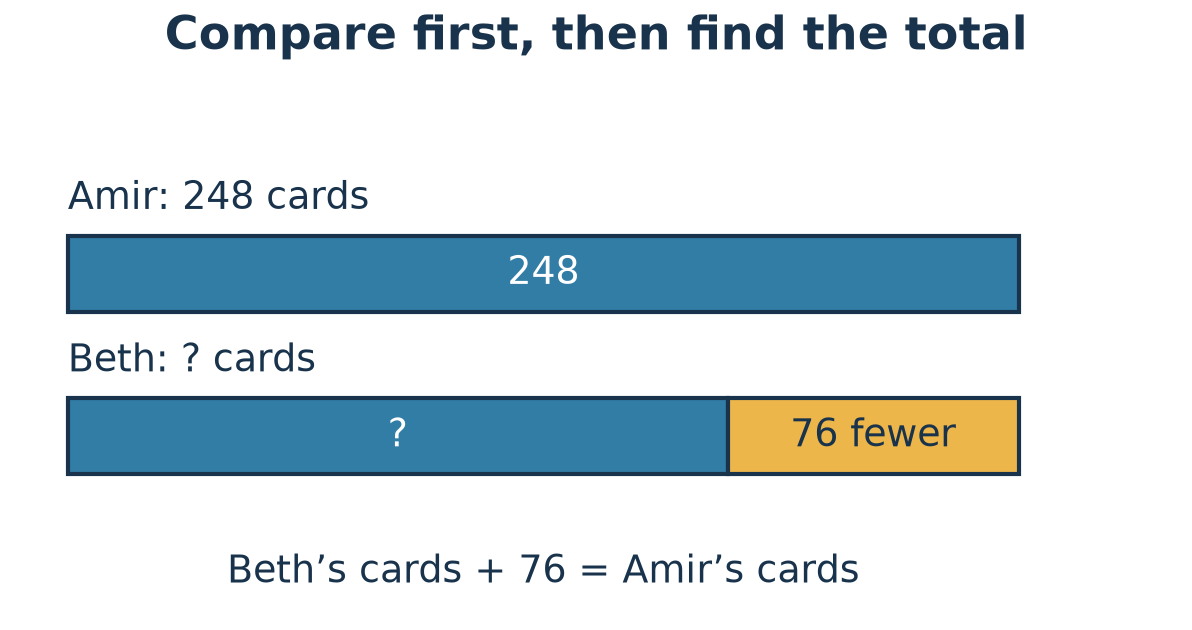
Draw a bar for Amir's 248 cards. Under it, draw Beth's shorter bar, with the difference marked 76. The missing quantity is Beth's number of cards.
Find that first:
248 − 76 = 172 cards
Now combine their cards:
248 + 172 = 420 cards
Suggested answer: “They have 420 cards altogether.”
The first answer is useful but does not yet answer the question. Label it “Beth's cards” so your child can see what still needs finding. Check both relationships: 172 + 76 = 248, and 420 − 248 = 172.
Common mistakes and how to respond
What appears in the working | What to revisit |
Digits slip into the wrong columns | Put ones under ones before calculating |
A regrouped ten disappears | Say what the small regrouping digit represents |
Division ends with a remainder equal to the divisor | Make one more complete group |
A correct first step becomes the final answer | Label the first result and reread the question |
“More” automatically triggers addition | Identify which quantity is larger and which is unknown |
For example, “Amir has 20 more cards than Beth” does not always mean add 20. If Amir's number is known and Beth's is missing, subtraction finds the smaller quantity. A comparison bar can show that relationship before any arithmetic starts.
Choosing an operation also matters in our money, time and measurement guide. The context changes, but the need to understand what each number represents stays the same.
Two ways to practise at home
Use counters for one division question in two ways. Share 24 counters equally among six cups, then arrange 24 counters in groups of six. Ask what the answer “4” describes each time: counters per cup in the first setup, groups in the second.
For written practice, choose one calculation and one short word problem. After each, ask your child to explain the first step and one check. An explanation such as “I subtracted because I knew the larger amount and the difference” tells you more than “because the question says fewer”.
If your child needs a prompt, return to the same type of question later with new numbers. Give them time to decide without repeating the prompt immediately.
Frequently asked questions
Should every word problem have a bar model?
No. Use a bar model when it helps show parts, a whole or a comparison. A simple equal-group question may be clear with a quick sketch and a number sentence.
Does a slow answer mean my child does not understand?
No. Listen to the reasoning. A child may understand the operation but still be building table recall or confidence with regrouping. Practise the specific step that takes time.
Should I teach algebra to make the questions faster?
For these P3 examples, arithmetic and visual models are sufficient. Help your child explain the quantities and connections before introducing unfamiliar notation.
How much working should my child show?
Show enough to make the method clear, especially intermediate quantities in a word problem. Follow the teacher's expectations for layout and labels; there is no need to turn every mental fact into a long written explanation.
How Ottodot supports number skills and word problems
Ottodot's Lower Primary Math classes combine teacher guidance, visual examples, game-based practice and homework. Those give children opportunities to practise both calculations and choosing what to do with them.
If your child can calculate when told the operation but gets stuck deciding the first step, Check my child's fit to explore suitable support.