
P3 Money, Time and Measurement: A Parent's Guide
Help your child solve P3 money, time and measurement questions using clear units, conversions and timelines, with worked examples and practical parent tips.

P3 money, time and measurement questions ask children to calculate with quantities that have units. This guide shows parents how to explain dollars and cents, convert measurements and use timelines for elapsed time.
Units can trip up a child whose arithmetic is otherwise correct. Writing 250 g instead of 2,050 g changes the amount, while treating an hour as 100 minutes changes the time. Keep each unit beside its number as you work.
Key Takeaways
One dollar contains 100 cents, but one hour contains 60 minutes.
Convert quantities to matching units before combining or comparing them.
A compound measurement uses two units, such as 2 kg 50 g.
A timeline can show the minutes before and after an hour changes.
Check both the numerical answer and the unit requested.
What P3 money, time and measurement includes
The MOE Primary Mathematics syllabus covers money addition and subtraction, measurement conversions, time in seconds, elapsed time and the 24-hour clock at P3.
The West Spring Primary P3 overview lists money, length, mass, volume and time across the school year. We have grouped them here because they share a useful habit: identify the unit before choosing the calculation.
Use our P3 Maths overview for the wider topic list. The explanations below use whole-number measurements and compound units, without needing decimal measurement conversions or speed calculations.
Know what each unit counts
A number alone does not tell the full story. Two litres and two millilitres are very different volumes, even though both start with “two”. Read the number and unit together.
Quantity | Relationship to remember |
Money | $1 = 100 cents |
Length | 1 km = 1,000 m; 1 m = 100 cm |
Mass | 1 kg = 1,000 g |
Liquid volume | 1 l = 1,000 ml |
Time | 1 h = 60 min; 1 min = 60 s |
For example, 2 m 8 cm means two metres and another eight centimetres. The metres account for 200 cm, so the total is 208 cm. Joining the digits to make 28 cm ignores what the units mean.
Converting to smaller units makes the count larger because each unit is smaller. The object does not grow. A 3 m ribbon and a 300 cm ribbon have the same length.
Money needs a similar distinction. $4.05 means four dollars and five cents; $4.50 means four dollars and fifty cents. Read the cents aloud if the zero is easy to overlook.
Clock time and duration answer different questions
“14:20” tells us when something happens using the 24-hour clock. “45 minutes” tells us how long something lasts. Ask which kind of answer the question needs.
For afternoon times from 1 p.m. to 11 p.m., add 12 to the hour when converting to the 24-hour clock. For example, 2:20 p.m. becomes 14:20. Noon is 12:00; midnight at the start of a day is 00:00.
Seconds describe shorter intervals. If a stopwatch shows that a task took 38 s, that is a duration. It does not name a time of day.
Reading the size of each interval matters on a measuring scale too. Our P3 bar graphs guide offers practice with labelled scales before children calculate with the values.
Worked questions with units and timelines
These are original practice questions with suggested solutions. Each explanation identifies the quantity, shows the working and ends with a check.
Example 1: Find a total cost and change
Lina buys a notebook for $3.85 and a pen for $2.40. She pays with $10. How much change does she receive?
First combine the two prices. Line up the decimal points so dollars and cents stay in their correct positions.
$3.85 + $2.40 = $6.25
The cents total 125 cents, which is one dollar and 25 cents. That extra dollar is included in the total cost.
Now subtract the cost from the amount paid:
$10.00 − $6.25 = $3.75
Suggested answer: “Lina receives $3.75 in change.”
Check by adding the change to the cost: $3.75 + $6.25 = $10.00. If your child writes $6.25 as the answer, the arithmetic may be correct but they have stopped at the cost instead of finding the change.
You can also count up: $6.25 to $7 is 75 cents, then $7 to $10 is $3. Together, the change is $3.75.
Example 2: Convert a length before subtracting
A ribbon is 2 m 35 cm long. Arun cuts off 80 cm. How many centimetres of ribbon remain?
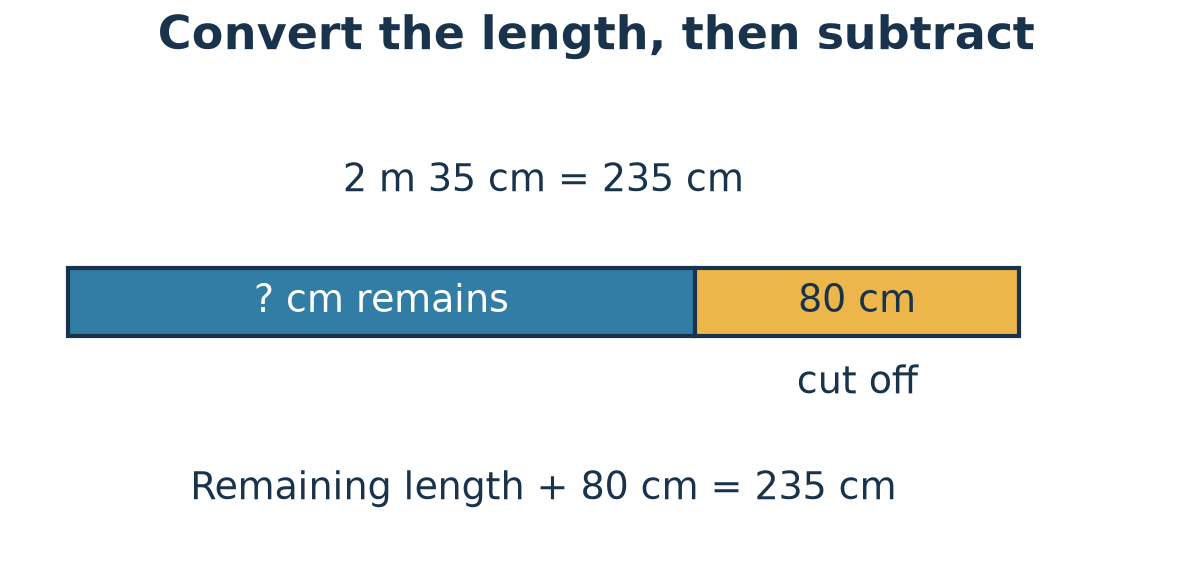
The answer is requested in centimetres. Convert the whole starting length into centimetres before subtracting.
2 m 35 cm = 200 cm + 35 cm = 235 cm
Then remove the length cut off:
235 − 80 = 155 cm
Suggested answer: “155 cm of ribbon remain.”
Check: 155 cm + 80 cm = 235 cm, the original length. You could express 155 cm as 1 m 55 cm, but the question specifically asks for centimetres.
The same conversion idea applies to kilometres and metres. For instance, 1 km 250 m is 1,250 m. Keep the conversion relationship visible rather than telling your child to “add zeros”, which does not explain the extra 250 m.
Example 3: Read compound mass and volume correctly
A bag has a mass of 2 kg 50 g. A bottle contains 1 l 250 ml of water. Express the bag's mass in grams and the water's volume in millilitres.
These are two separate conversions. Start with the mass:
2 kg = 2,000 g
2,000 g + 50 g = 2,050 g
Next convert the volume:
1 l = 1,000 ml
1,000 ml + 250 ml = 1,250 ml
Suggested answer: “The bag has a mass of 2,050 g. The water's volume is 1,250 ml.”
Check by converting back. Removing two groups of 1,000 g leaves 50 g; removing one group of 1,000 ml leaves 250 ml. Both match the information given.
Do not add 2,050 and 1,250 together. The numbers describe different kinds of quantity. A kilogram is a unit of mass; a litre is a unit of volume. This question gives no reason to combine them.
Example 4: Find duration across an hour
An activity starts at 14:35 and ends at 16:10 on the same day. How long does it last?
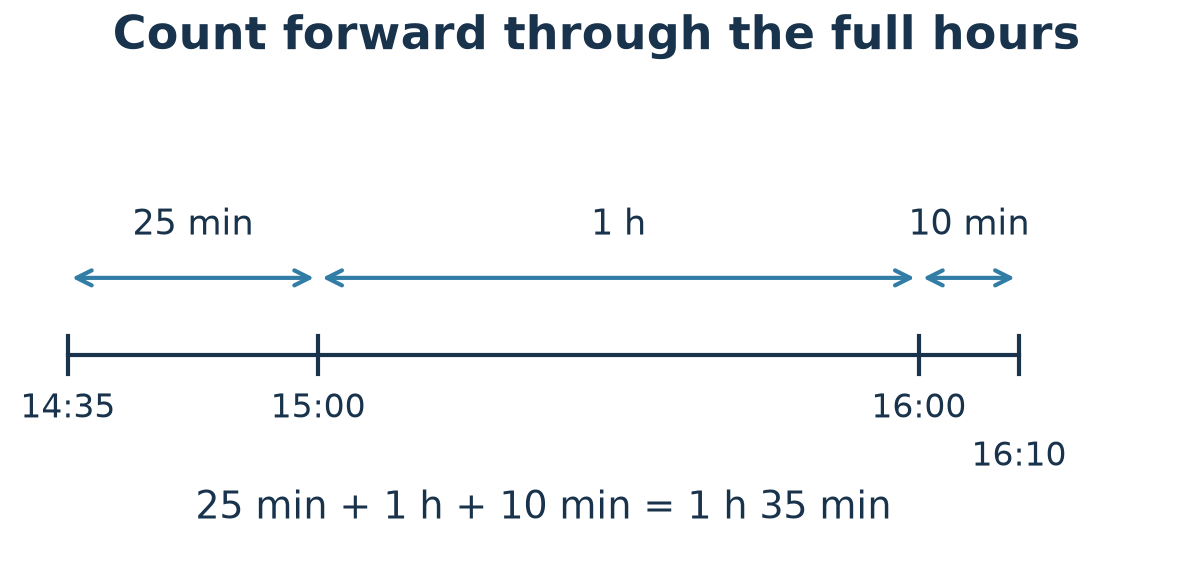
Use a timeline and split the journey at full hours:
From | To | Time passed |
14:35 | 15:00 | 25 min |
15:00 | 16:00 | 1 h |
16:00 | 16:10 | 10 min |
Combine the intervals: 25 min + 1 h + 10 min = 1 h 35 min.
Suggested answer: “The activity lasts 1 h 35 min.”
Check from the start: 14:35 plus one hour is 15:35. Adding 35 minutes gives 16:10, the stated finish.
The same timeline can run backwards. If the finish is 16:10 and the duration is 1 h 35 min, move back 10 minutes to 16:00, one hour to 15:00 and 25 minutes to 14:35. That finds the starting time.
Avoid subtracting 14.35 from 16.10 as though these were decimal amounts. Clock notation uses 60 minutes to an hour.
Common mistakes and useful checks
Mistake | What helps |
Writing 2 kg 50 g as 250 g | Convert the kilograms separately, then add 50 g |
Treating $3.05 as $3.50 | Read the cents aloud before calculating |
Adding quantities with different units | Rewrite both in the same suitable unit first |
Treating 1 h 30 min as 130 min | Replace the hour with 60 minutes |
Giving a time of day when duration is asked | Finish “It lasts for…” before writing the answer |
Ask your child to name what each intermediate answer measures. “235” is easy to lose track of; “235 cm, the ribbon before cutting” explains its role in the next step.
That habit also helps with the different units in our P3 geometry, area and perimeter guide. Length and area may involve the same numbers but describe different measurements.
Two everyday practice activities
Set up a small pretend shop with handwritten prices and coins or paper money. Give your child one purchase to total and an amount paid. Ask them to check that cost plus change returns to the amount paid. Keep multiplication of decimal prices out of this activity; addition and subtraction are enough.
For time, choose a familiar event with a known start and finish, such as reading from 7:40 p.m. to 8:05 p.m. Mark both times on paper and count forward to the next hour, then to the finish. The duration is 25 minutes.
Once that is comfortable, give the start and duration instead. Change the missing quantity while keeping the numbers manageable. Your child then has to read the question, rather than repeat the last operation automatically.
Frequently asked questions
Should every measurement be converted to the smallest unit?
Use a unit that makes the calculation clear and matches the question. Converting a mixed measurement into one smaller unit is useful for the examples here. Do not convert unrelated information unnecessarily.
Is money notation the same as a full decimals topic?
P3 includes adding and subtracting money in decimal notation. That does not mean every later decimal skill needs to be introduced alongside money. Keep the lesson tied to dollars and cents.
Does volume mean cubes and cuboids here?
This article covers liquid volume in litres and millilitres. Measuring the volume of solid shapes is a different topic and is not needed for these P3 examples.
Must my child use a timeline for every time question?
No. Use it when it helps, especially across an hour. The important point is that the chosen method handles 60 minutes per hour correctly and finds the requested quantity.
How Ottodot supports careful working
Ottodot's Lower Primary Math classes teach checking routines for units, labels and operations. Teacher-led examples are followed by game-based practice and homework.
If your child understands the story but loses track of units or the requested answer, Check my child's fit to explore suitable support.