
P3 Geometry: Angles, Lines, Area and Perimeter
Explore P3 geometry, area and perimeter with right angles, parallel lines and worked questions that help your child distinguish boundaries from inside space.

P3 geometry introduces angle comparisons and perpendicular and parallel lines. Alongside these ideas, children learn to distinguish the area inside a shape from the perimeter around its boundary.
This guide helps parents explain the diagrams and calculations. Before choosing an operation, ask your child to show what the question wants them to measure: an opening, a boundary or a surface.
Key Takeaways
A right angle stays a right angle when the diagram is rotated.
Perpendicular lines meet at a right angle; parallel lines remain the same distance apart and do not meet.
Perimeter measures the full boundary and uses length units such as cm.
Area measures the space inside and uses square units such as cm².
Trace a figure's boundary once to avoid missing or double-counting a side.
What P3 geometry and measurement covers
The MOE Primary Mathematics syllabus includes comparing angles with a right angle and drawing perpendicular and parallel lines. P3 area work covers rectangles and squares; perimeter also includes rectilinear figures.
The Ang Mo Kio Primary P3 overview lists angles, line relationships, and area and perimeter as topics within the year. They connect through diagrams, even though schools may teach them at different times.
This guide keeps angle comparisons at P3 level. It does not require measuring angles in degrees or using angle-sum rules. Nor does it require conversions between cm² and m². Our P3 Maths overview places these skills beside the other topics.
Look at the relationship, not the page orientation
An angle is formed by two straight arms meeting at a point. The size of the opening matters. Drawing longer arms does not make the angle larger if the opening stays the same.
Use the square corner of a card as a right-angle template. Place its corner at the angle's vertex and align one edge with one arm. Then compare the other arm with the card's second edge.
The angle may match the right angle, open less, or open more. Use the marked angle when a diagram identifies a particular opening; do not accidentally compare a different region around the vertex.
Perpendicular and parallel lines
Perpendicular lines meet at a right angle. They do not have to look like an upright “T” or “+”. Rotating the paper changes their position on the page, but their relationship stays the same.
Parallel straight lines stay the same distance apart and do not meet even if extended. Two short lines that have not yet met are not necessarily parallel: they may be heading towards each other.
For drawing perpendicular lines, draw a straight line with a ruler, then use a set square's right-angle corner to guide the second line. For parallel lines, a set square can slide along a fixed ruler to draw another line in the same direction. Follow the construction method your child's teacher uses.
Separate the edge from the space inside
Ask your child to trace a rectangle's outline with a finger. The length of that path is its perimeter. Now cover the interior with equal-sized square tiles. Count the square units to find the area.
Question asks for | What to do | Unit example |
Perimeter | Add all boundary lengths | cm |
Area | Count square units, or use rows and columns | cm² |
A rectangle with three rows of five unit squares has 15 square units of area. Multiplication shortens the counting: 3 × 5 = 15. It works because the squares fill the whole rectangle without gaps or overlaps.
Keep the unit attached to the idea. A centimetre measures length. A square centimetre is the area of a square whose sides are each one centimetre long.
Worked questions on P3 geometry
These are original practice questions with suggested solutions. Use sketches to make the relationships visible, and use given measurements rather than guessing from a drawing's apparent size.
Example 1: Identify line relationships after a rotation
A rectangular card is labelled A, B, C and D in order around its boundary. It is placed at a slant. Are AB and BC perpendicular? Are AB and CD parallel?
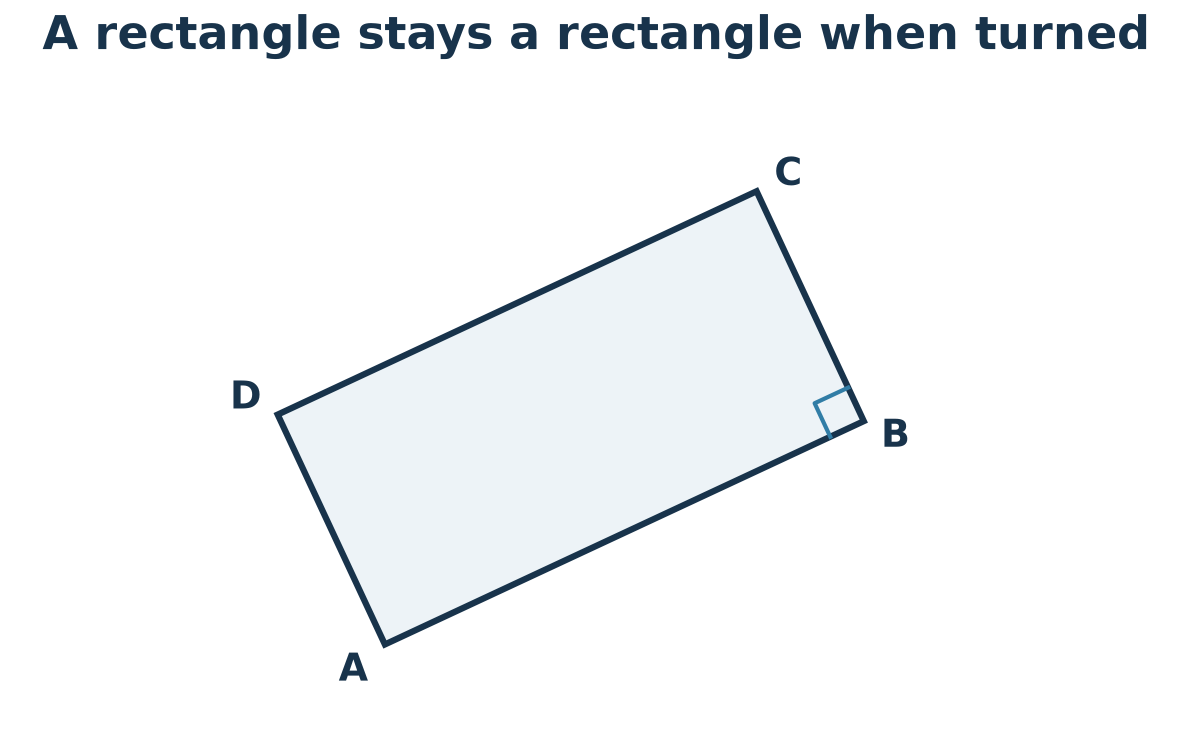
Sketch the labelled rectangle and keep the letters in order. AB and BC are adjacent sides meeting at corner B. A rectangle's corners are right angles, so those sides are perpendicular.
AB and CD are opposite sides of the rectangle. They run in the same direction and remain the same distance apart, so they are parallel.
Suggested answer: “AB and BC are perpendicular. AB and CD are parallel.”
Check by rotating the sketch to an upright position. None of the corners or sides has changed shape. If the answer changes only because the paper turns, revisit the line relationships.
The side names also matter. Point to each requested pair before answering so that a correct observation about one pair is not accidentally applied to another.
Example 2: Find both area and perimeter
A rectangle is 8 cm long and 3 cm wide. Find its area and perimeter.
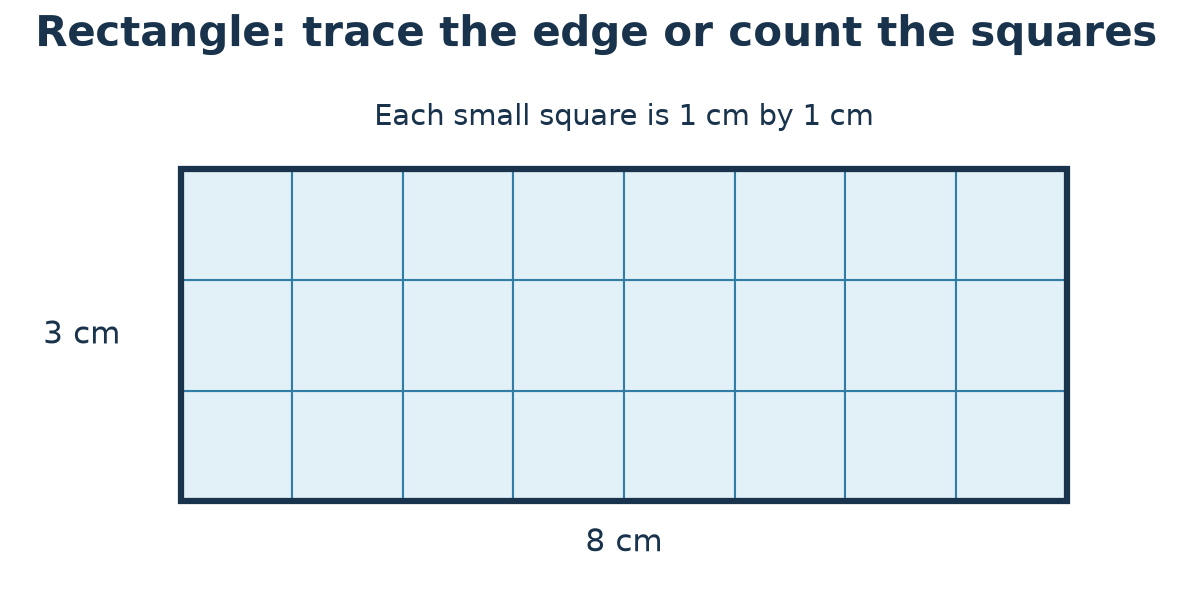
For area, imagine three rows of eight one-centimetre squares:
8 × 3 = 24 cm²
For perimeter, add the four boundary lengths. Opposite sides of the rectangle have equal lengths:
8 + 3 + 8 + 3 = 22 cm
Suggested answer: “The area is 24 cm² and the perimeter is 22 cm.”
Check the area by counting the imagined rows: 8 + 8 + 8 = 24 square centimetres. Check the perimeter by tracing each of the four sides once.
The answer “24 cm” would use a length unit for area. If your child forgets the square symbol, return to what is being counted: small squares covering the interior, not centimetres along an edge.
Example 3: Apply the same ideas to a square
A square tile has a side length of 5 cm. What are its area and perimeter?
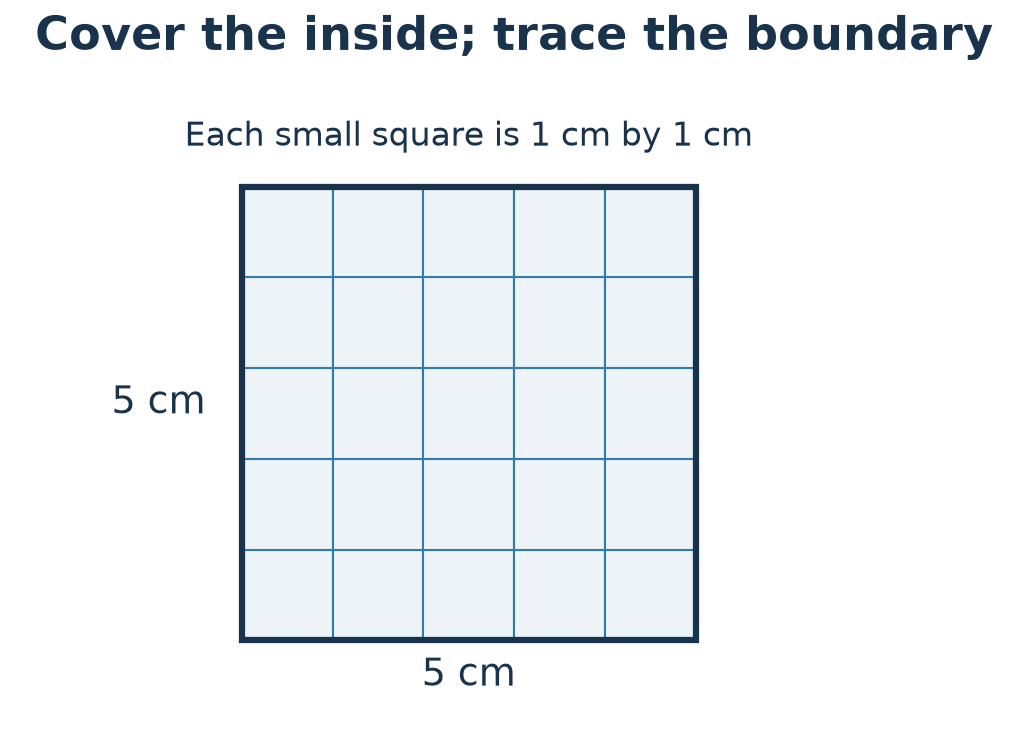
A square has four equal sides. Its perimeter is therefore:
5 + 5 + 5 + 5 = 20 cm
Its interior contains five rows of five one-centimetre squares:
5 × 5 = 25 cm²
Suggested answer: “The area is 25 cm² and the perimeter is 20 cm.”
Check which operation represents each measurement. Multiplying a side by four adds the four equal boundary lengths. Multiplying a side by itself counts the rows and columns inside.
The numerical answers 25 and 20 describe different kinds of measurement. Avoid saying the area is “bigger than the perimeter”: square centimetres and centimetres are different units, so that numerical comparison is not useful.
Example 4: Follow a rectilinear boundary
An L-shaped figure has six boundary sides. Starting at the top-left corner and moving clockwise, they measure 6 cm, 2 cm, 3 cm, 2 cm, 3 cm and 4 cm. Find its perimeter.
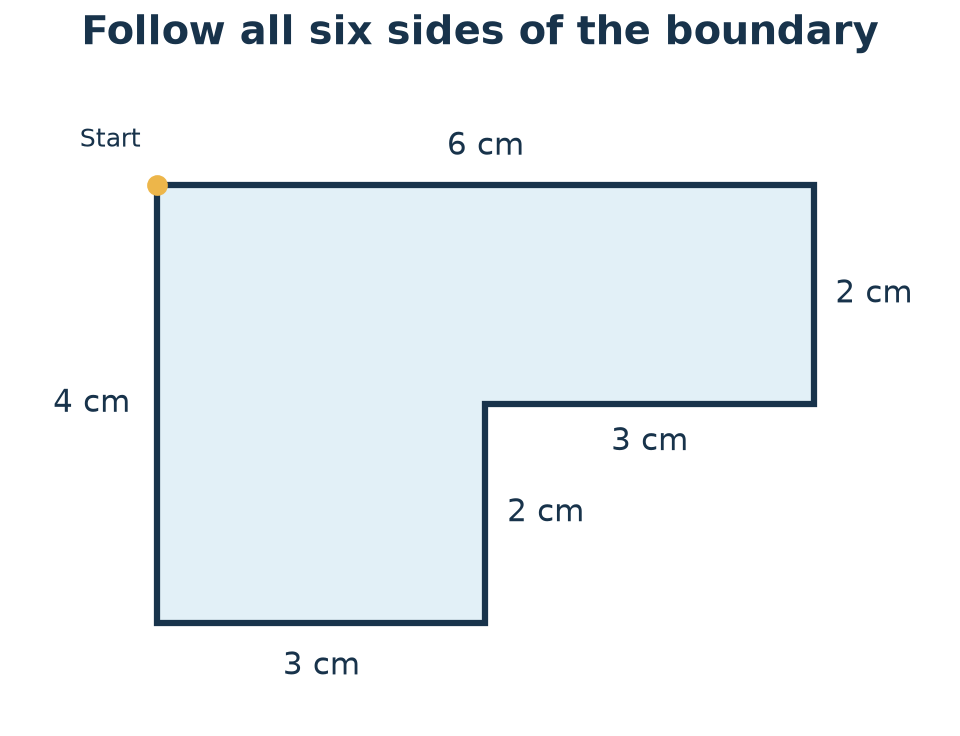
Sketch the figure by moving right 6 cm, down 2 cm, left 3 cm, down 2 cm, left 3 cm and up 4 cm. Those movements return to the starting point.
All six sides are on the outside boundary, including the two sides forming the inward corner. Add each length once:
6 + 2 + 3 + 2 + 3 + 4 = 20 cm
Suggested answer: “The perimeter is 20 cm.”
Check by tracing the full outline from the same starting point. Mark each side after counting it so that the inward step is not missed.
The rectangle perimeter formula cannot simply be applied to any irregular shape without considering its boundary. Here, adding the given sides directly makes the reasoning clear. There is no need to find the L-shape's area to answer this question.
Common mistakes and how to revisit them
Mistake | A useful prompt |
Treating a slanted right angle as a different angle | “What happens if we turn the paper?” |
Calling any two crossing lines perpendicular | “Does their opening match the right-angle template?” |
Finding area when perimeter is requested | “Are we covering the inside or tracing the edge?” |
Leaving out the inward step of an L-shape | “Can your finger complete the outline without passing that side?” |
Multiplying length by width for perimeter | “Where are all four boundary lengths in your working?” |
If your child chooses the right operation but makes a number mistake, practise the arithmetic separately. Our whole numbers guide explains the multiplication and addition used in these examples.
Two practical activities for home
Use a folded paper corner to test right angles around a book, a drawn rectangle and a rotated square. Then draw an angle with a smaller opening and one with a larger opening. Have your child compare them using the same template instead of judging by arm length.
On squared paper, draw a rectangle three squares long and two squares wide. Count the six interior squares. Then count the ten unit-length edges around the boundary. Colour the interior and trace the outline in different colours so the two measurements stay distinct.
Keep the square size consistent. If each small square is not one centimetre on a side, describe the results as square units and units. Do not label them cm² and cm unless the grid actually has those dimensions.
Frequently asked questions
Does P3 require a protractor?
The angle work in this guide compares angles with a right angle. Measuring and drawing angles in degrees is later learning. Use a right-angle template or the teacher's recommended tool for these comparisons.
Can a square still be a square when it looks like a diamond?
Yes. Turning a square does not change its side lengths or right angles. Describe the shape by its properties rather than its position on the page.
Must my child memorise area and perimeter formulas?
They need to use the relevant relationships, but understanding the boundary and the rows of squares helps those relationships make sense. Connect each short calculation to a drawing before relying on recall.
Are L-shaped figures beyond P3?
P3 includes perimeter of rectilinear figures. A question asking for the boundary length is different from a later composite-area question. The worked example here gives every boundary length and asks only for perimeter.
How Ottodot supports visual understanding
Ottodot's Lower Primary Math classes use visuals, worked examples and guided practice. Children also practise checking units and whether an answer makes sense.
Game-based practice and weekly homework give them further opportunities to apply the lesson.
If your child remembers a formula but struggles to match it to the diagram, Check my child's fit to explore suitable support.