
P3 Fractions: Equivalent Fractions and Worked Examples
Understand P3 fractions through equivalent fractions, comparisons and simple addition and subtraction, with worked examples and practical advice for parents.

P3 fractions work builds on equal parts through equivalent fractions, comparisons, and addition and subtraction of related fractions. This guide gives parents visual explanations and worked examples for when the symbols start to feel confusing.
If your child says one eighth is larger than one quarter because eight is larger than four, use two equal-sized paper strips. The size of each part becomes much easier to discuss when both wholes are visible.
Key Takeaways
Compare fractions using the same-sized whole.
Equivalent fractions describe the same amount using different-sized equal parts.
Change both numerator and denominator by the same multiplication or division to keep the value unchanged.
Related fractions have denominators where one is a multiple of the other, such as halves and quarters.
Before adding or subtracting, express both amounts in the same-sized parts.
What the P3 fractions topic includes
The MOE syllabus hosted by Lianhua Primary includes equivalent fractions, simplest form, and comparing and ordering fractions with given denominators up to 12. Addition and subtraction use two related fractions within one whole.
The Raffles Girls' Primary P3 overview places fractions across two terms. Follow your child's school sequence rather than assuming the entire topic has been taught after the first worksheet.
The examples here stay with proper fractions and answers no greater than one whole. They do not require mixed numbers, fraction multiplication or algebra. For the surrounding topics, see our P3 Maths overview.
Start with the whole and its equal parts
In 3/4, the denominator 4 tells us the whole is divided into four equal parts. The numerator 3 tells us that three of those parts are being considered.
The equal parts matter. Drawing four sections of noticeably different sizes and shading three does not reliably show three quarters. Use a rectangle divided into equal-width strips before moving to shapes that are harder to partition evenly.
The whole matters too. Half of a large sheet of paper can be larger than three quarters of a small sheet. When comparing fraction values visually, keep the whole the same size so your child is comparing the fractions rather than the paper sizes.
Why equivalent fractions work
Shade half a rectangle. Now divide each half into three equal smaller parts. The rectangle has six equal parts, and three are shaded. The shaded amount has not changed: 1/2 = 3/6.
Both numbers changed because every original part was split into three. Multiplying only the denominator would change the size of the parts without increasing the number counted.
Simplifying reverses that regrouping. In 3/6, join the six equal parts into two equal groups of three. One group is shaded, so the same amount is 1/2.
Our whole numbers and four operations guide can help if the multiplication and division facts behind these changes need practice.
Worked questions on P3 fractions
These are original practice questions with suggested solutions. Start by identifying the whole, choose equal-sized parts, calculate, then check against the picture. The explanation helps you teach the idea; your child need not copy every sentence into their working.
Example 1: Complete an equivalent fraction and simplify
Complete 2/3 = □/12. Then express 8/12 in its simplest form.
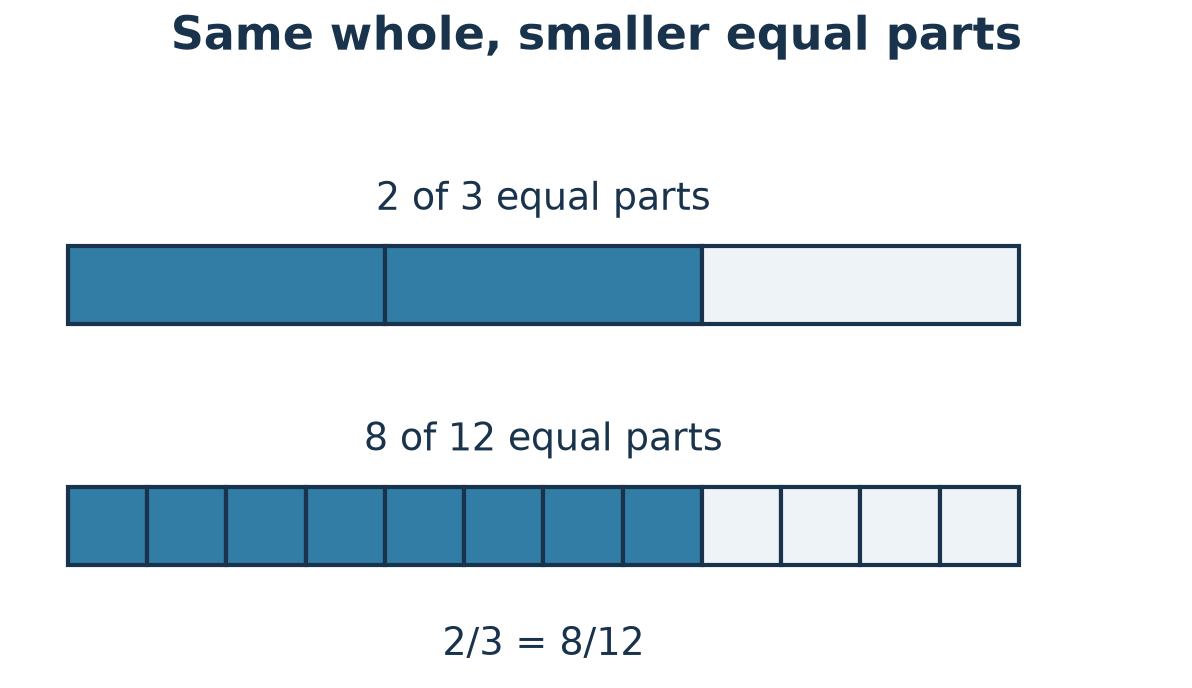
To change three equal parts into twelve, split each original part into four smaller parts. The denominator is multiplied by four, so the numerator must also be multiplied by four.
2 × 4 = 8, so 2/3 = 8/12.
For simplest form, divide both numbers in 8/12 by four:
8 ÷ 4 = 2 and 12 ÷ 4 = 3, so 8/12 = 2/3.
Suggested answer: “The missing numerator is 8. The simplest form of 8/12 is 2/3.”
Your child might divide both numbers by two first to get 4/6. That is a correct equivalent fraction, but it can still be simplified. Dividing both by two again gives 2/3.
Ask them to check the picture as well as the arithmetic. Two of three equal strips and eight of twelve equal strips should cover the same amount of an equal-sized rectangle.
Example 2: Compare and order fractions
Arrange 1/2, 2/3 and 3/4 from smallest to largest.
Use equal-sized wholes divided into twelve equal parts. Each original fraction can be expressed in twelfths:
Original fraction | Equivalent fraction |
1/2 | 6/12 |
2/3 | 8/12 |
3/4 | 9/12 |
Now all the parts are the same size. Six twelfths is less than eight twelfths, which is less than nine twelfths.
Suggested answer: “1/2, 2/3, 3/4.”
Twelve is useful because halves, thirds and quarters can all be divided into twelfths. There is no need to introduce formal lowest-common-multiple procedures to explain this example.
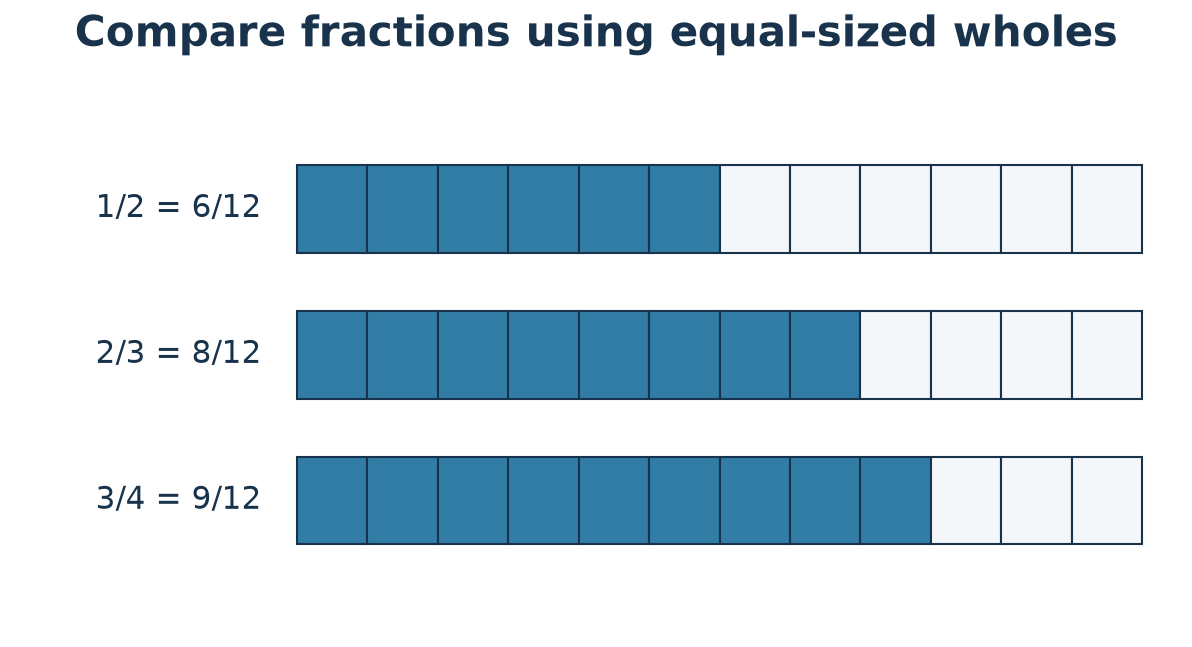
Check the order against the strips: six shaded twelfths cover less than eight, and eight cover less than nine.
Be careful about turning the result into a rule about denominators. The fractions increase here because of their values, not because 2, 3 and 4 increase. Comparing 1/2 and 1/4 gives the opposite pattern: the larger denominator describes smaller equal parts of the same whole.
Example 3: Add related fractions
Mei colours 1/2 of a strip blue and another 1/4 of the same strip yellow. The coloured sections do not overlap. What fraction of the strip is coloured?
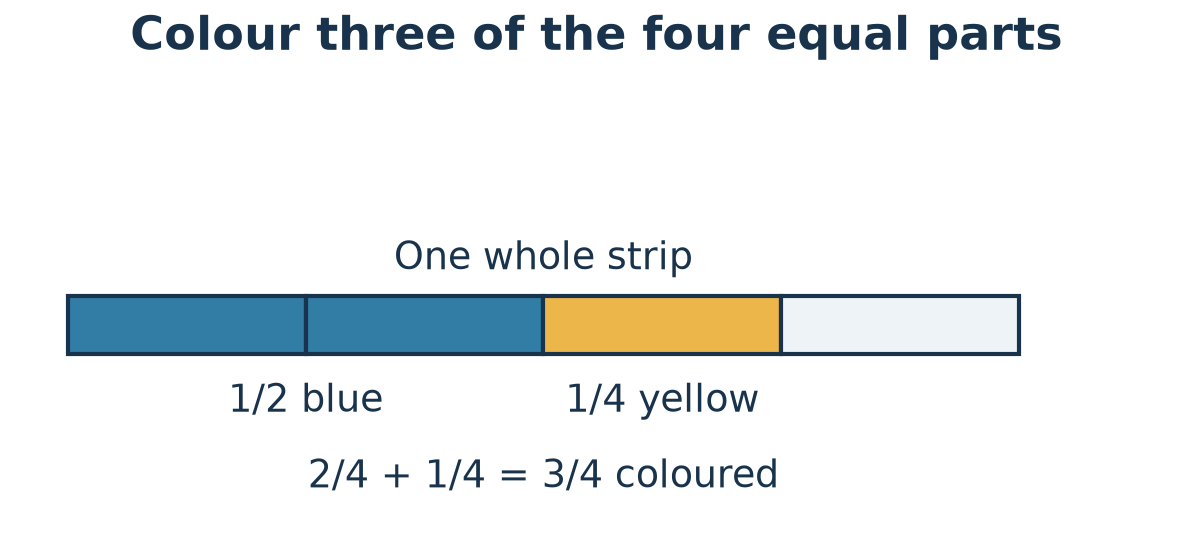
The amounts are halves and quarters. Split the half into two quarters so that both amounts use the same unit.
1/2 = 2/4
Then add the number of quarters:
2/4 + 1/4 = 3/4
Suggested answer: “3/4 of the strip is coloured.”
Check by counting the uncoloured part: one quarter remains, and 3/4 + 1/4 makes one whole strip.
The denominator stays four because the size of the parts has not changed. Two quarters and one quarter make three quarters.
If your child writes 2/6 by adding the top and bottom numbers, shade the original amounts on a four-part strip. Three of the four sections are coloured. That picture contradicts 2/6 and gives a reason to revisit the calculation.
Example 4: Subtract related fractions
A ribbon is 5/6 of a metre long. Sara cuts off 1/3 of a metre. How much ribbon remains?
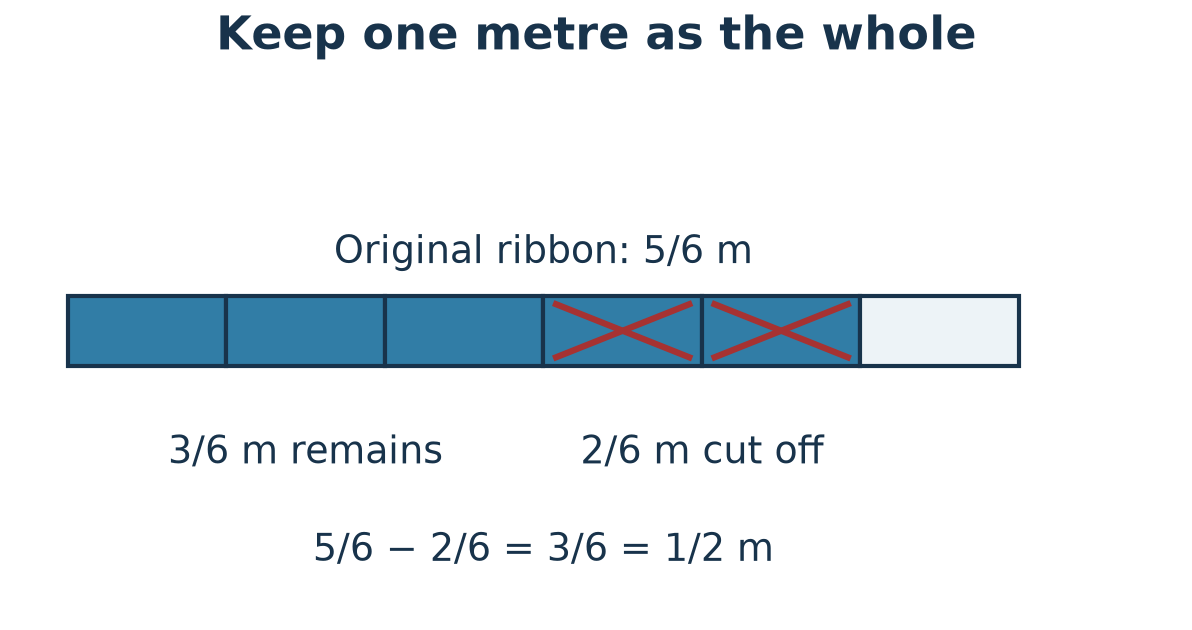
Both measurements refer to fractions of one metre. Change the thirds to sixths:
1/3 = 2/6
Subtract the amount cut off:
5/6 − 2/6 = 3/6 = 1/2
Suggested answer: “1/2 of a metre of ribbon remains.”
Check in sixths by adding the two removed sections back to the three remaining sections: 3/6 + 2/6 = 5/6. That restores the original length.
Draw one metre as six equal sections. Mark five as the original ribbon and cross out two of those five. The three remaining sixths occupy half of the one-metre whole.
Read the wording carefully. “1/3 of a metre” gives a length directly. It does not say “1/3 of the remaining ribbon”, which would describe a different problem. Keeping the named whole visible prevents that confusion.
Common mistakes and what they reveal
Mistake | A useful response |
Comparing only the denominators | Draw equal-sized wholes and inspect the part sizes |
Changing only one number when finding an equivalent fraction | Show that every original part is being split equally |
Adding denominators | Name the unit: quarters plus quarters still gives quarters |
Stopping at 4/6 when simplest form is requested | Check whether both numbers can still be divided equally |
Comparing shaded parts of different-sized drawings | Redraw the wholes at the same size |
A correct procedure with a shaky picture deserves attention. If your child gets 1/2 + 1/4 right but cannot show the result on a strip, ask them to draw it before increasing the difficulty.
Equally, a child who can draw the answer may need help connecting the picture to notation. Point to each part of the drawing as you write the matching numerator and denominator. Keep both representations beside each other for a few examples.
Two simple ways to practise at home
Make matching paper strips for halves, thirds, quarters, sixths and twelfths. Keep their total lengths equal. Place two thirds beside eight twelfths and ask your child to explain why the shaded lengths match.
You can also play a missing-number game: write 1/2 = □/8 and let your child use the strips before answering. The missing number is four. Then reverse the task with 3/6 = □/2, where the missing number is one.
For a short independent check, ask your child to solve 1/4 + 1/2 and 5/6 − 1/6. The answers are 3/4 and 2/3. In the second question, watch whether they simplify 4/6 without being reminded.
Choose one difficulty at a time. If equal parts are still unclear, stay with drawings. If the pictures make sense but the facts are slow, work on the relevant multiplication and division facts separately.
Frequently asked questions
What does “related fractions” mean?
Here it means one denominator is a multiple of the other. Thirds and sixths are related because each third can be split into two sixths. Halves and quarters are another example.
Must my child always use the smallest common denominator?
An appropriate common denominator lets your child compare equal-sized parts. For P3 practice, use manageable values and follow the teacher's approach. In a related-fraction sum such as 1/2 + 1/4, quarters are a natural choice.
Is 4/6 wrong if the answer is 2/3?
They have the same value. However, 4/6 is not in simplest form. If the question requests simplest form, your child needs the extra step to reach 2/3.
Should we practise improper fractions now?
Keep the focus of this P3 guide on the skills above and follow the school's progression. Mixed numbers and improper fractions belong to later learning; they are not needed for these examples.
How Ottodot supports fraction understanding
Ottodot's Lower Primary Math classes use visual explanations and guided practice before children work independently. Game-based practice and homework reinforce the ideas taught in class.
If your child remembers fraction rules but struggles to explain the parts, Check my child's fit to explore suitable support.