
P3 Materials and Their Properties: Uses and Fair Tests
Help your child choose materials in P3 Science using strength, flexibility, waterproofness and other properties, with worked answers and fair-test examples.

The P3 materials and their properties topic teaches children to connect what a material can do with the job an object needs to perform. They compare strength, flexibility, waterproofness, transparency and whether objects float or sink, then use evidence to explain a choice.
Naming “plastic” as a raincoat material is only part of an answer. The useful explanation connects a relevant property to keeping the wearer dry. This guide shows how to make that connection and how to read simple material tests.
Key Takeaways
An object is the thing being made; a material is what it is made from.
Strength concerns supporting a load without breaking. Flexibility concerns bending without breaking.
Choose properties that explain the object's intended use.
A fair comparison keeps other relevant conditions the same.
Results from a strength test do not also prove waterproofness or flexibility.
What P3 materials and their properties includes
The materials topic covers wood, metal, ceramic, rubber, glass, plastic and fabric. Children compare physical properties and relate those properties to uses. The school-hosted MOE syllabus sets out the five comparisons used in this guide.
Keep hardness in perspective. “Hard” can be a useful everyday description, but it should not replace strength in a question about the load a material supports. A surface that resists scratching is not necessarily difficult to break.
The teaching order depends on the school. Use our P3 Science overview to connect this topic with the rest of the year, rather than attaching a fixed term to every materials lesson.
Separate object, material, property and use
These four ideas often get mixed together. A window is an object. Glass is a possible material. Allowing most light to pass through is a property. Helping people see through the window is a use of that property.
Question | Example answer |
What is the object? | A window pane |
What is it made from? | Glass |
Which property matters here? | It allows most light to pass through |
Why does that help? | People can see through the window |
An object may contain several materials because its parts have different jobs. The handle of a tool and its working end do not necessarily need the same properties.
The reverse is also true: one material can be used in several objects. That does not mean the same property explains every use. Read the purpose in the question before choosing your reason.
The five property comparisons
The P3 ALP materials resource connects material choices with function. These plain-language meanings are a useful starting point.
Property | What children should consider |
Strength | How much load a sample can support without breaking |
Flexibility | Whether it can bend without breaking |
Waterproofness | Whether it absorbs water |
Transparency | Whether most, some or no light passes through |
Floating or sinking | Whether the tested object remains on or near the water surface or sinks |
P3 waterproofness is described in terms of not absorbing water. When explaining a product, connect that property to its intended function, rather than offering “it is waterproof” with no further explanation.
For transparency, describing how much light passes through is enough to explain many questions. Don't let unfamiliar labels get in the way of understanding the observation.
Treat the sample in the question as evidence. “Plastic” names a broad family: a thin plastic bag bends readily, while a thick plastic component may be rigid. Shape, thickness and construction can affect how an object behaves.
For the same reason, do not teach “all metal objects sink” as a rule. Use the observation or information supplied. Density calculations are not needed for the P3 comparison.
Metal objects also differ in whether they are attracted to a magnet. Our P3 magnets guide explains magnetic and non-magnetic materials, including why being metal does not automatically mean an object is magnetic.
Worked materials questions
The data below are invented for practice. These are original examples with suggested answers, not official assessment questions or measurements of commercial products.
Example 1: Choose two relevant properties
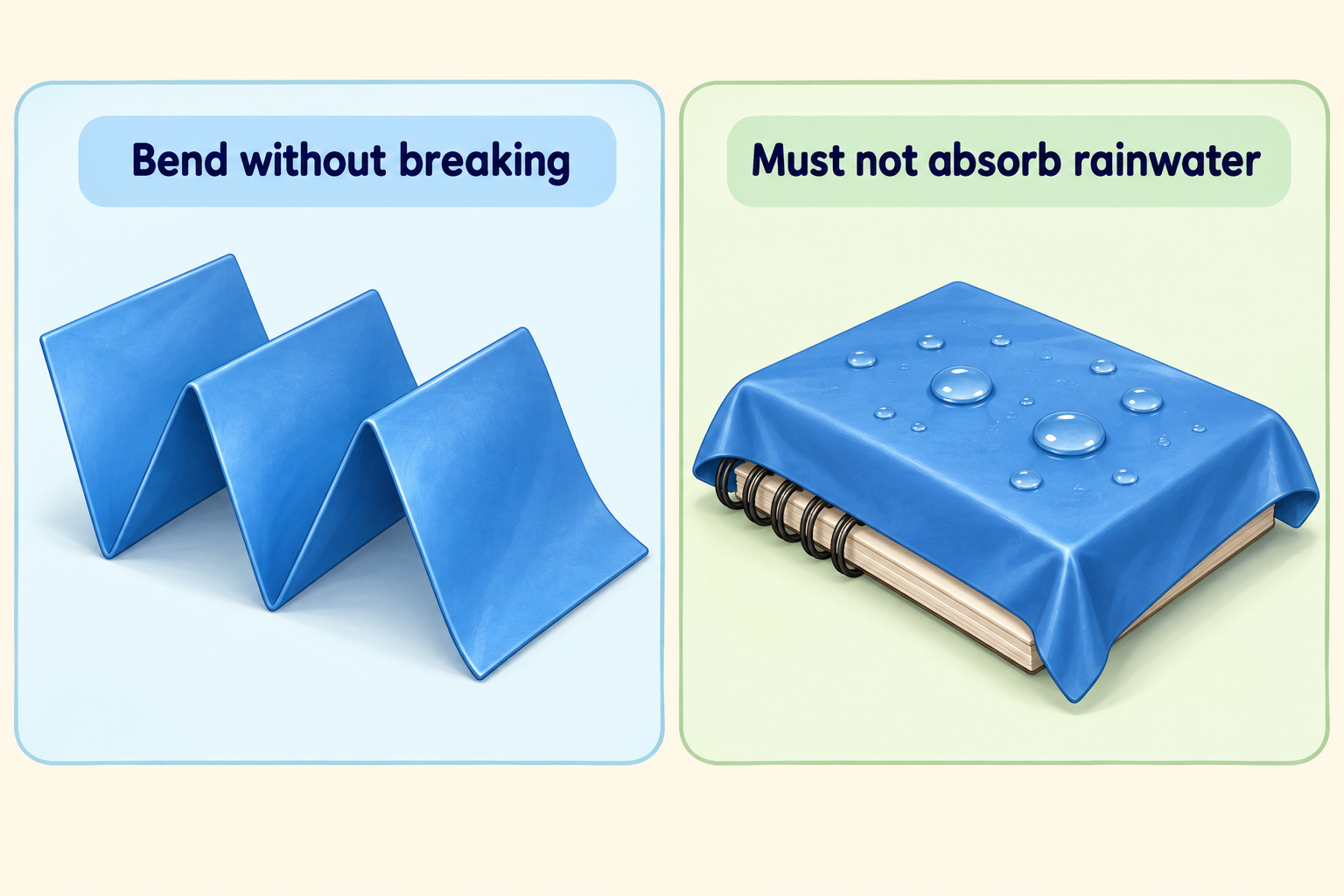
A designer needs a sheet for a foldable rain cover. It must bend without breaking and must not absorb rainwater. Which tested material should be chosen?
Sample | Bends without breaking | Absorbs water |
A | Yes | Yes |
B | No | No |
C | Yes | No |
The design has two requirements. A meets the bending requirement but absorbs water. B does not absorb water but fails the bending requirement. C meets both.
Suggested answer: “Choose C. It is flexible, so the cover can fold without breaking. It is waterproof, so it does not absorb rainwater.”
Do not add a claim that C is the strongest. No strength results are given. A complete answer can be short while still covering both stated requirements.
Example 2: Read a strength test
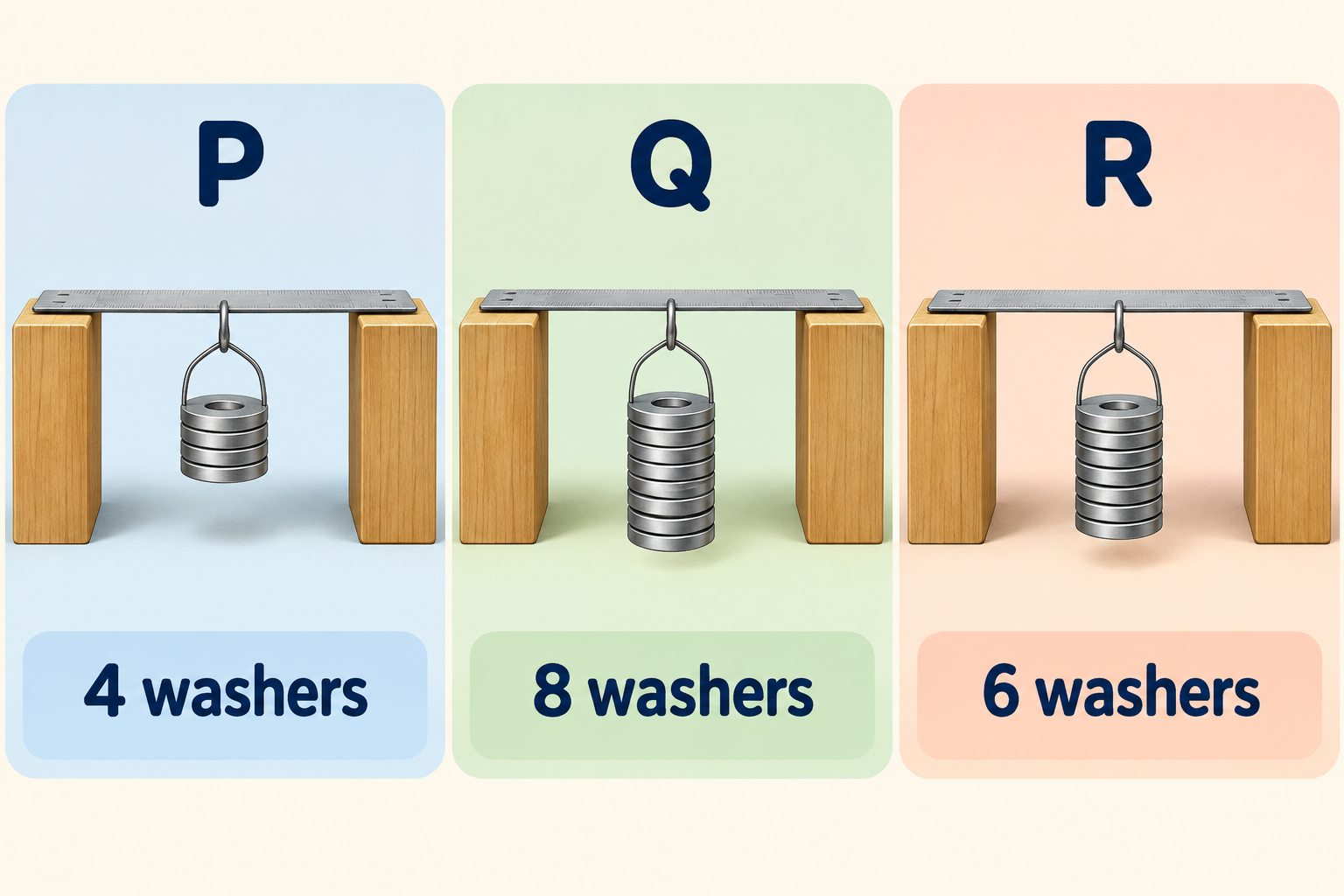
Equal-sized strips are tested using the same supports and loading method. Which sample is strongest in this test?
Sample | Greatest number of identical washers supported without breaking |
P | 4 |
Q | 8 |
R | 6 |
Compare the load supported. Because the washers are identical, more washers means a greater load.
Suggested answer: “Q is strongest in this test because it supports the greatest load without breaking: eight identical washers.”
If your child answers “Q is hardest”, point back to what was measured. The experiment tested load-bearing strength. It did not test whether the surface could be scratched or dented.
Example 3: Identify an unfair comparison
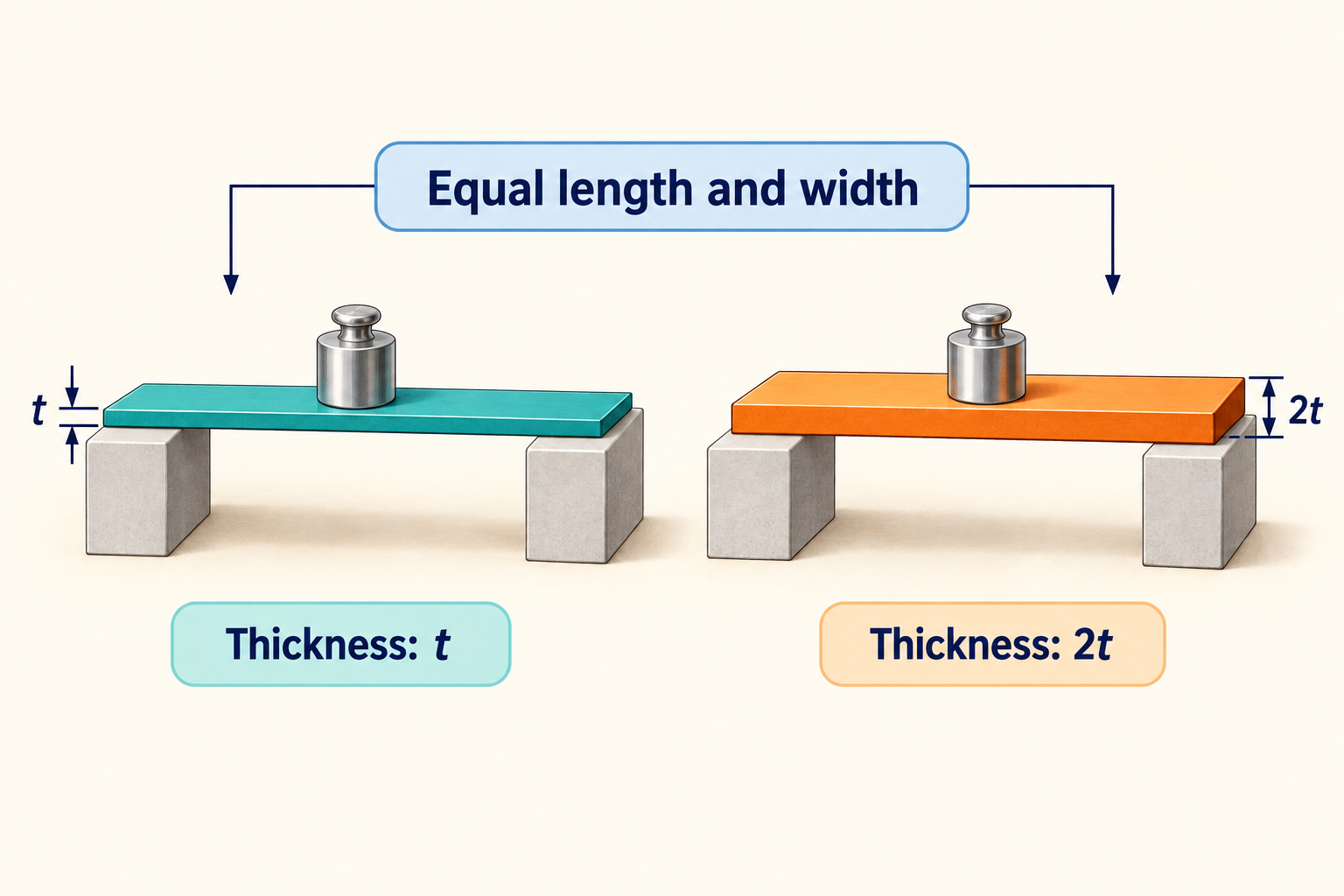
Two strips made from different materials are compared. They have equal length and width, but one is twice as thick. Both receive identical weights at the same position. Can a difference in the result be attributed only to material type?
The material and thickness both differ. Either could affect the result.
Suggested answer: “No. The strips also have different thicknesses. Use strips of the same thickness so the comparison tests material type more fairly.”
“Use the same weights” would not correct the problem because that condition is already controlled. Encourage your child to identify the actual difference in the setup.
Example 4: Reject an irrelevant property
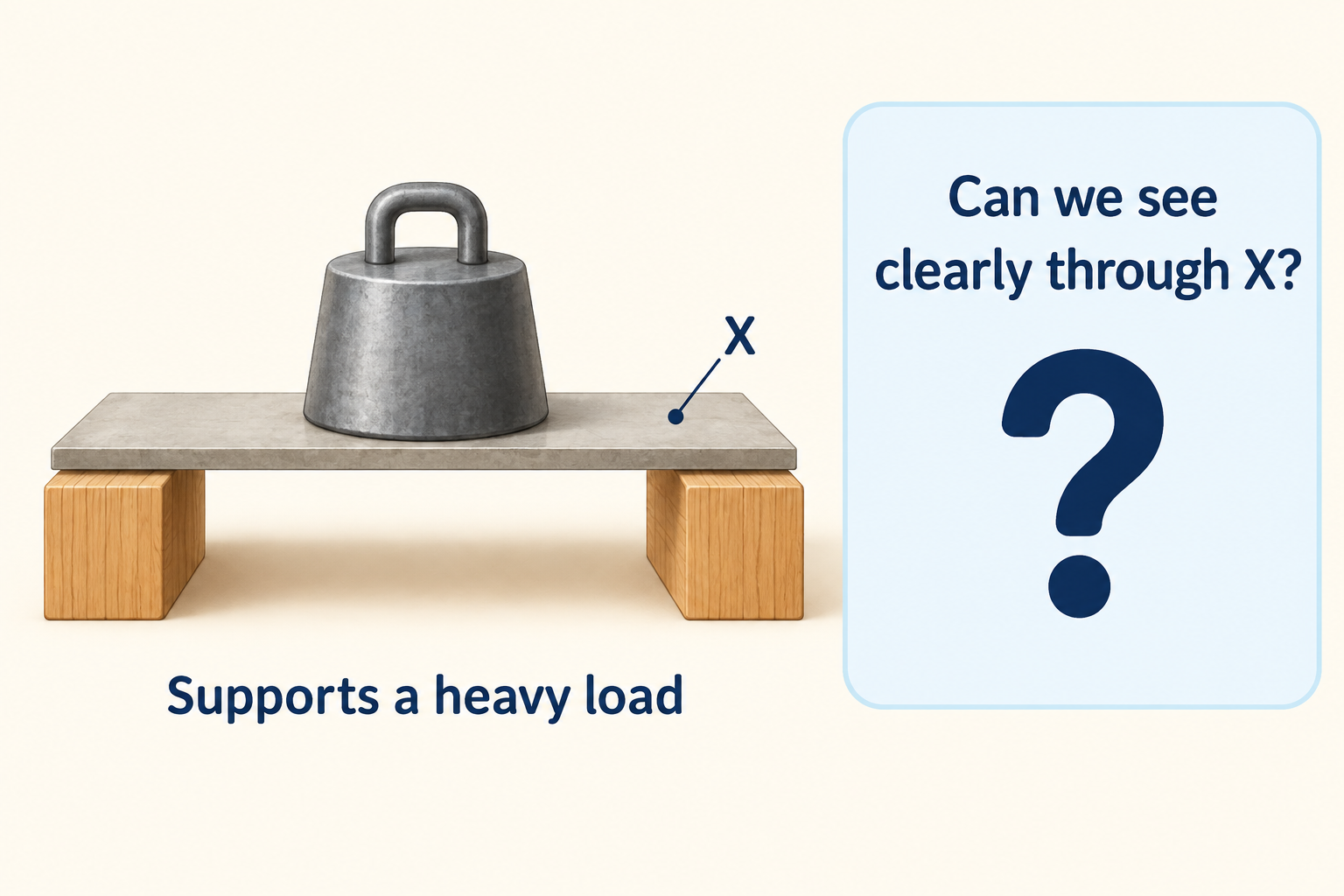
A screen must allow a person to see an object behind it clearly. A pupil chooses sample X because a test shows X can support a heavy load. Is this sufficient evidence?
Suggested answer: “No. The result shows strength, but the screen needs to allow enough light through for the object to be seen. A light-transmission test is needed.”
A statement can be true and still fail to answer the question. Ask your child: “How does this property help the screen do its job?” If they cannot make that link, return to the design requirement together.
How to plan a fair materials test
Before naming variables, have your child finish this sentence: “We want to find out whether changing ___ affects ___.” It gives the test a clear purpose.
For a strength comparison, change the material and measure the load supported. Keep dimensions, support spacing and loading position the same. Otherwise, a thicker strip or shorter unsupported span might affect the outcome.
For a water-absorption comparison, use equal-sized samples, the same amount of water and the same waiting time. Decide beforehand how absorption will be observed or measured. Looking only at water passing through holes would test something different from absorption by the material itself.
For a light comparison, keep the light source, distances and sample thickness consistent. Record what passes through rather than guessing from the material's colour.
Repeat a test when practical, especially if a result is unexpected. Repetition can help check consistency, but it cannot repair a setup in which several relevant conditions change at once.
A household design activity
Give your child a simple brief: “Design a cover for a notebook that needs to bend and resist water absorption.” Offer a few safe sample materials and ask them to predict which might work.
Ask for a reason before testing. Then compare the prediction with the observation. If a sample performs differently from expected, let your child revise the choice instead of treating the changed answer as a failure.
Finish with one sentence linking a result to the design. For example: “This sample absorbed water in our test, so it does not meet the water-absorption requirement.” That sentence is more useful than “This one is bad.”
The aim is to practise making a supported choice. A simple home activity does not need to establish a universal rule about every material of that type.
Frequently asked questions
Is flexibility the same as stretching?
No. Flexibility concerns bending without breaking. Stretching changes length. Use an example of bending in a flexibility answer rather than assuming the two words are interchangeable.
Does a stronger material always make a better object?
No. Suitability depends on the purpose. A material might support a large load but fail another requirement, such as allowing light through or bending when needed.
Should my child learn density formulas?
Not for this P3 topic. Focus on comparing observations and choosing properties relevant to uses. Our Science topics by level guide explains how the subject develops later.
Why does “because it is suitable” need more explanation?
It repeats the conclusion without giving the reason. Name the property and explain how it helps the object do its job.
How Ottodot helps with OEQs
In Ottodot's Lower Primary Science classes, teachers model how to read a property table, select evidence and connect it to a use. Children practise using words such as “flexible” and “supports a greater load” accurately.
CER means Claim, Evidence and Reasoning. In a materials answer, the claim names the sample, the evidence comes from the test, and the reasoning connects the property to the object's purpose.
Ottodot's Materials OEQ game provides simulation-based open-ended practice. Guided prompts support initial attempts before children try less scaffolded questions. Teacher feedback and marked weekly homework help catch repeated issues, such as naming a property without explaining its relevance.
If your child knows the vocabulary but struggles to justify a choice, Check my child's fit to explore support with applying it.