
P3 Life Cycles of Plants and Animals: Stages Explained
Understand P3 life cycles of plants and animals with clear stage comparisons, worked questions, common mistakes and a simple observation activity for home.
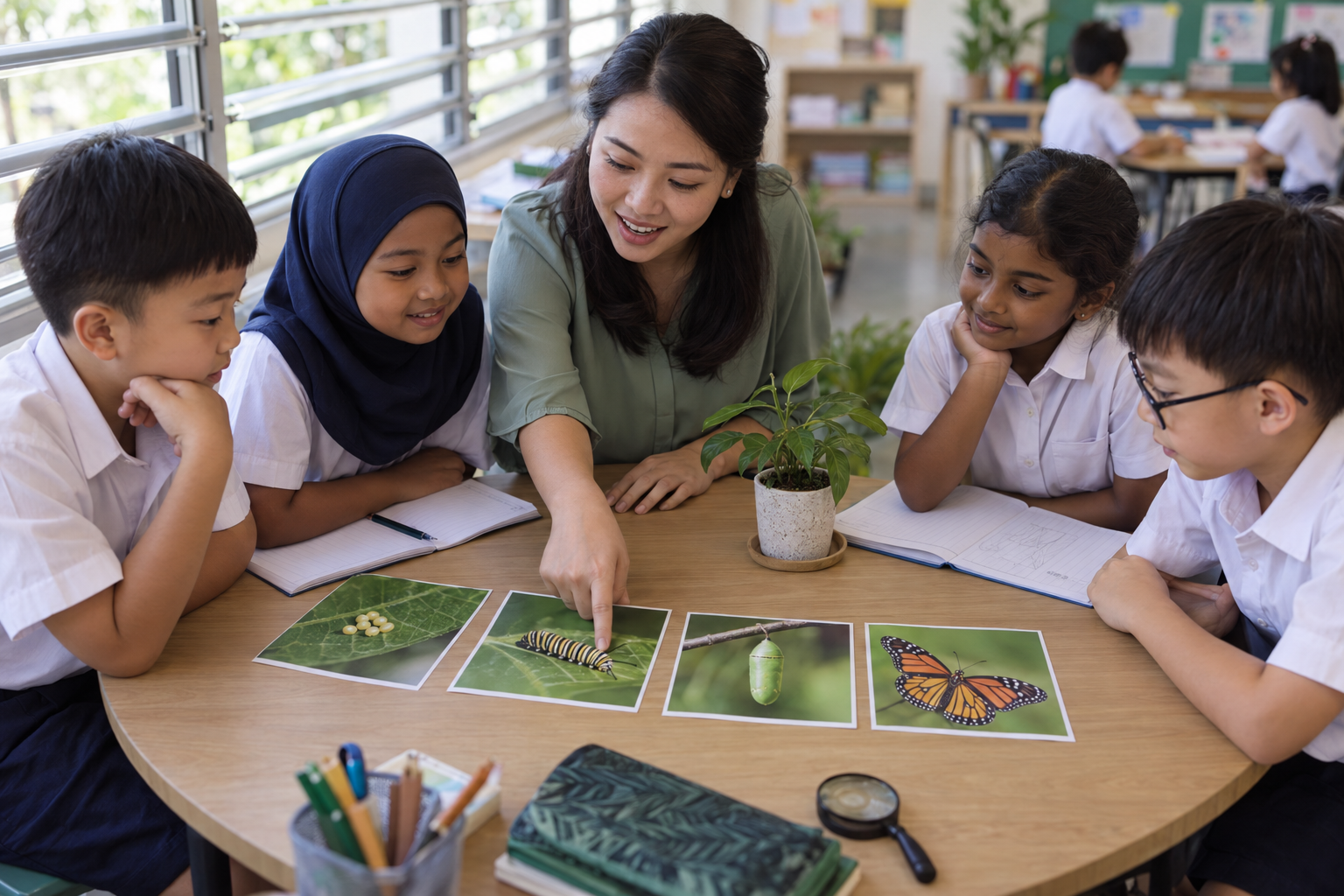
The P3 life cycles topic explores how plants and animals develop through recognisable stages and produce the next generation. Children learn to order stages, compare different cycles and explain changes using pictures or observations.
Knowing the words “egg, larva, pupa, adult” is a start. The next step is understanding what those labels tell us, including why a grasshopper's cycle should not have a pupa added to it.
Key Takeaways
A flowering plant's P3 sequence is seed, young plant and adult plant.
Butterflies have four main stages: egg, larva, pupa and adult.
Grasshoppers have egg, nymph and adult stages, with no pupa.
The arrow back to eggs or seeds represents the next generation.
Comparing cycles means stating a similarity or difference about both organisms.
What children learn in P3 life cycles
The MOE Primary Science syllabus places life cycles in P3. Plant learning centres on observing stages; detailed reproductive processes are studied later. Your child does not need to turn a P3 answer into a detailed explanation of pollination or fertilisation.
Schools may introduce the topic at different times. Follow your school's sequence and use our P3 Science overview for the broader picture.
It helps to separate three tasks: naming a stage, putting stages in order, and comparing two cycles. A child may manage the first two but still need support with comparison questions.
The life cycle of a flowering plant
For the P3 model, use:
Seed → young plant → adult plant → seeds of the next generation
A seed can develop into a young plant. As the plant grows and matures, it reaches the adult stage and can reproduce. The cycle continues through new seeds and new plants.
A sequence of photographs may show several changes within the young-plant stage. Those photographs do not automatically create extra major stages. Read the labels and the question before counting.
Suppose a diary contains a seed photograph, two photographs of the growing young plant and one of the adult. There are four photographs, but the diary still shows the three broad stages above.
What should a child observe?
Useful observations are specific: the first root has appeared, a shoot is visible, or more leaves can be seen. “It changed” gives less information than describing the visible change.
Keep observation separate from explanation. If the diary only shows photographs, it cannot establish every reason why one plant developed differently from another. Your child should not invent differences in watering or light that the question does not provide.
Comparing animal life cycles
The table below gives familiar classroom sequences. Follow the stage labels supplied in a particular question, especially when a diagram shows smaller changes within a broad stage.
Animal | Main sequence used for comparison |
Butterfly | Egg → larva (caterpillar) → pupa → adult |
Beetle | Egg → larva → pupa → adult |
Mosquito | Egg → larva → pupa → adult |
Grasshopper | Egg → nymph → adult |
Cockroach | Egg → nymph → adult |
Chicken | Egg → chick → adult chicken |
Frog | Egg → tadpole → adult frog in a simplified grouping |
The Admiralty P3 resources include three-stage and four-stage animal comparisons. The point is to notice the actual stages, rather than assume all animals develop in the same way.
Complete and incomplete metamorphosis
For insects, complete metamorphosis describes development through egg, larva, pupa and adult. Incomplete metamorphosis describes egg, nymph and adult, without a pupal stage. These terms help explain the difference; the stage sequence should remain your child's starting point. National Park Service teaching resource
A nymph commonly resembles its adult form, although it has not developed all adult features. A butterfly larva looks very different from an adult butterfly. Neither “young” nor “small” is enough to decide whether a stage is a larva or a nymph.
Do not label a chicken's three-stage sequence “incomplete metamorphosis”. The insect comparison does not apply to every animal with three labels in a school diagram. Frogs also change form, but their young are tadpoles, not nymphs.
For a local example, NParks' butterfly guide describes the butterfly's four stages. Caterpillars and adult butterflies can look and feed differently while belonging to the same species at different stages.
Worked questions on P3 life cycles
These are original practice questions with suggested explanations, not official school questions or marking schemes.
Example 1: Find the missing stage
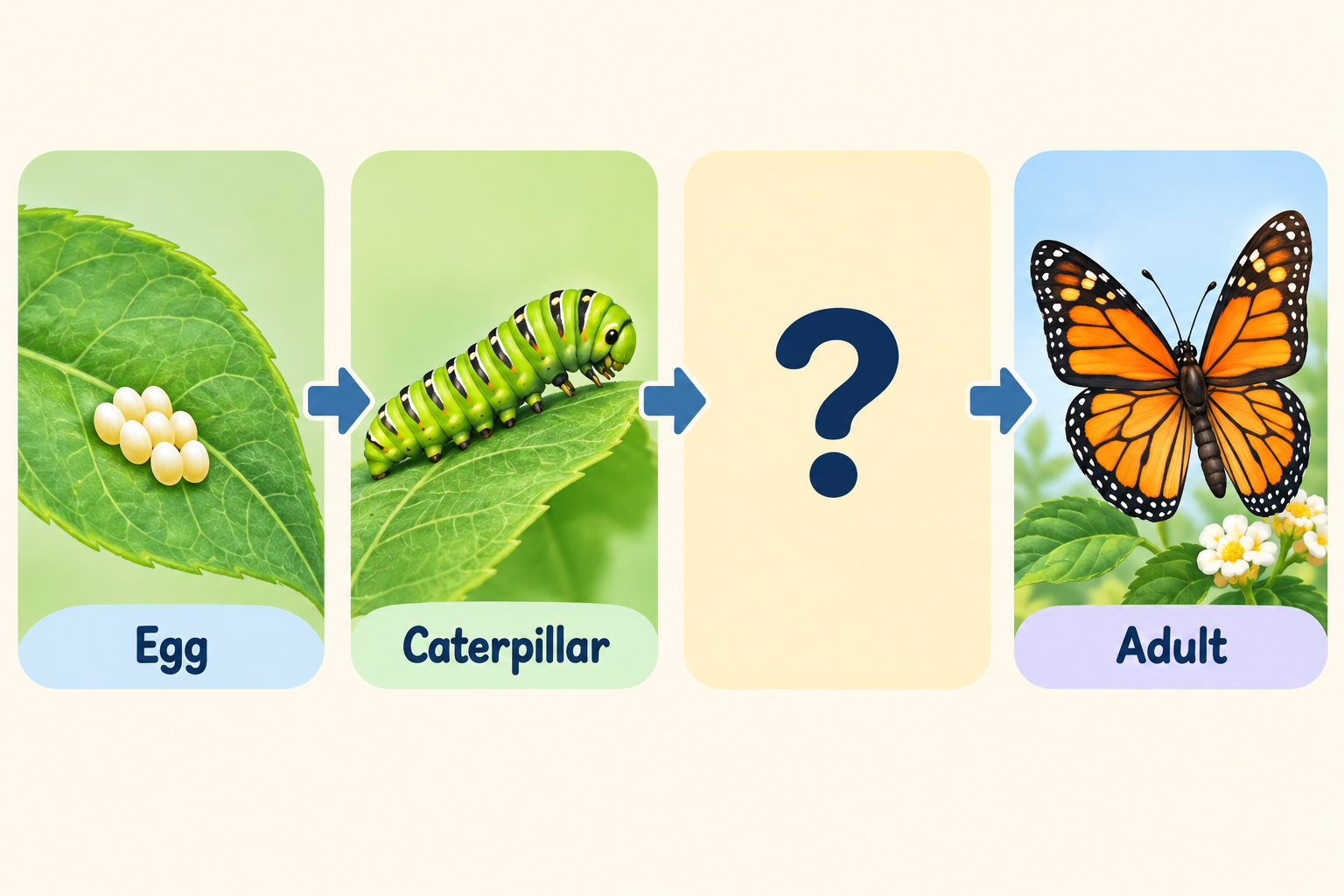
A diagram shows a butterfly's egg, caterpillar and adult stages, in order. Which stage is missing between the caterpillar and adult?
The word “caterpillar” names the butterfly's larva. The missing stage is the pupa.
Suggested answer: “The pupal stage is missing. The caterpillar develops into a pupa before the adult butterfly emerges.”
If your child writes “cocoon”, bring them back to the stage name. Pupa is the stage being tested. A cocoon is a covering made by some insects, not a replacement name for every pupal stage.
Example 2: Give a proper comparison
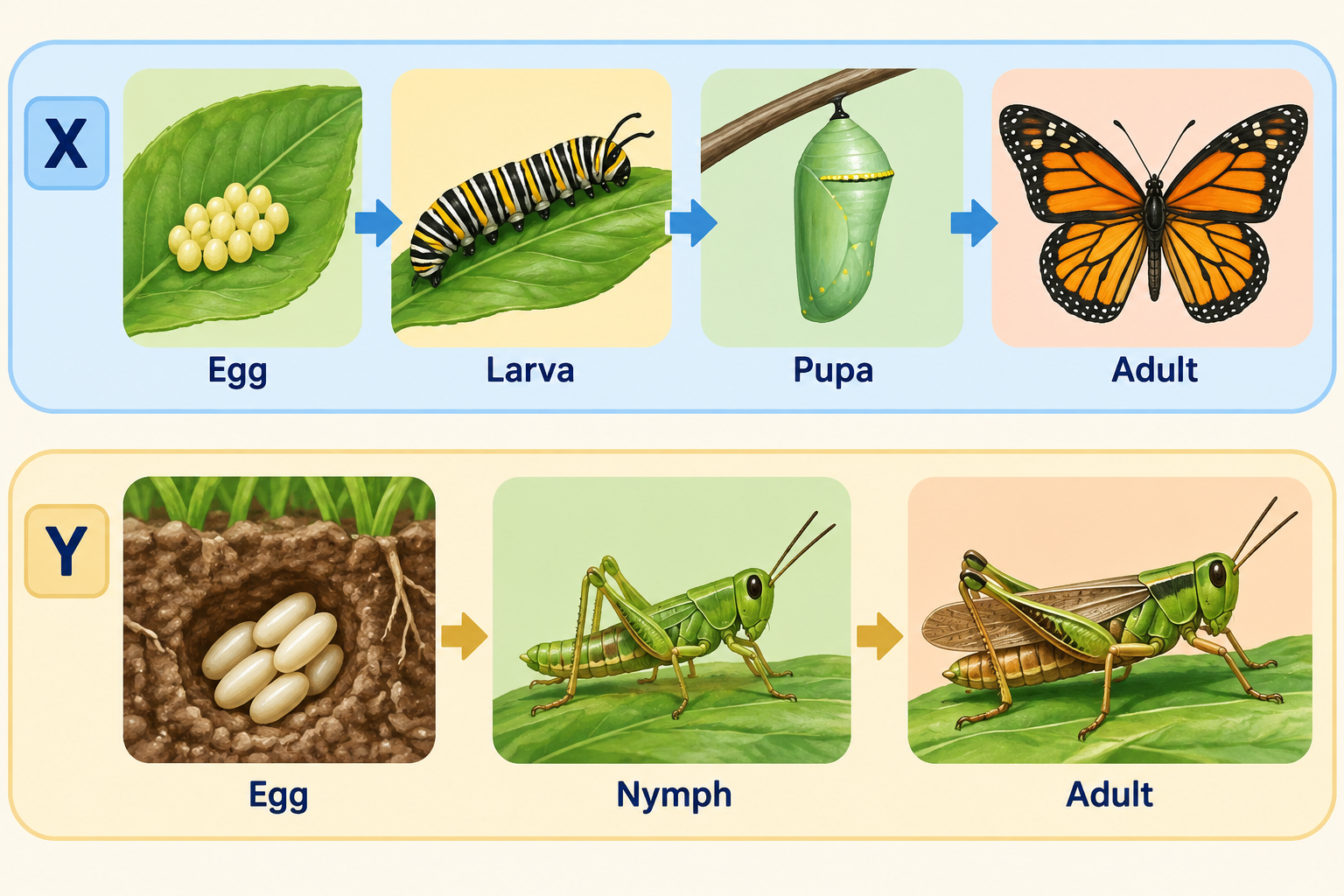
Animal X has egg, larva, pupa and adult stages. Animal Y has egg, nymph and adult stages. State one similarity and one difference.
Choose features that the information actually shows.
Suggested answer: “Both animals have an egg stage. X has a pupal stage, whereas Y does not.”
“X has four stages” describes X but leaves the comparison unfinished. A complete alternative would be: “X has four stages, while Y has three.”
For the similarity, avoid adding an unsupported statement about what the animals eat or where they live. Those details are not given.
Example 3: Count stages, not photographs
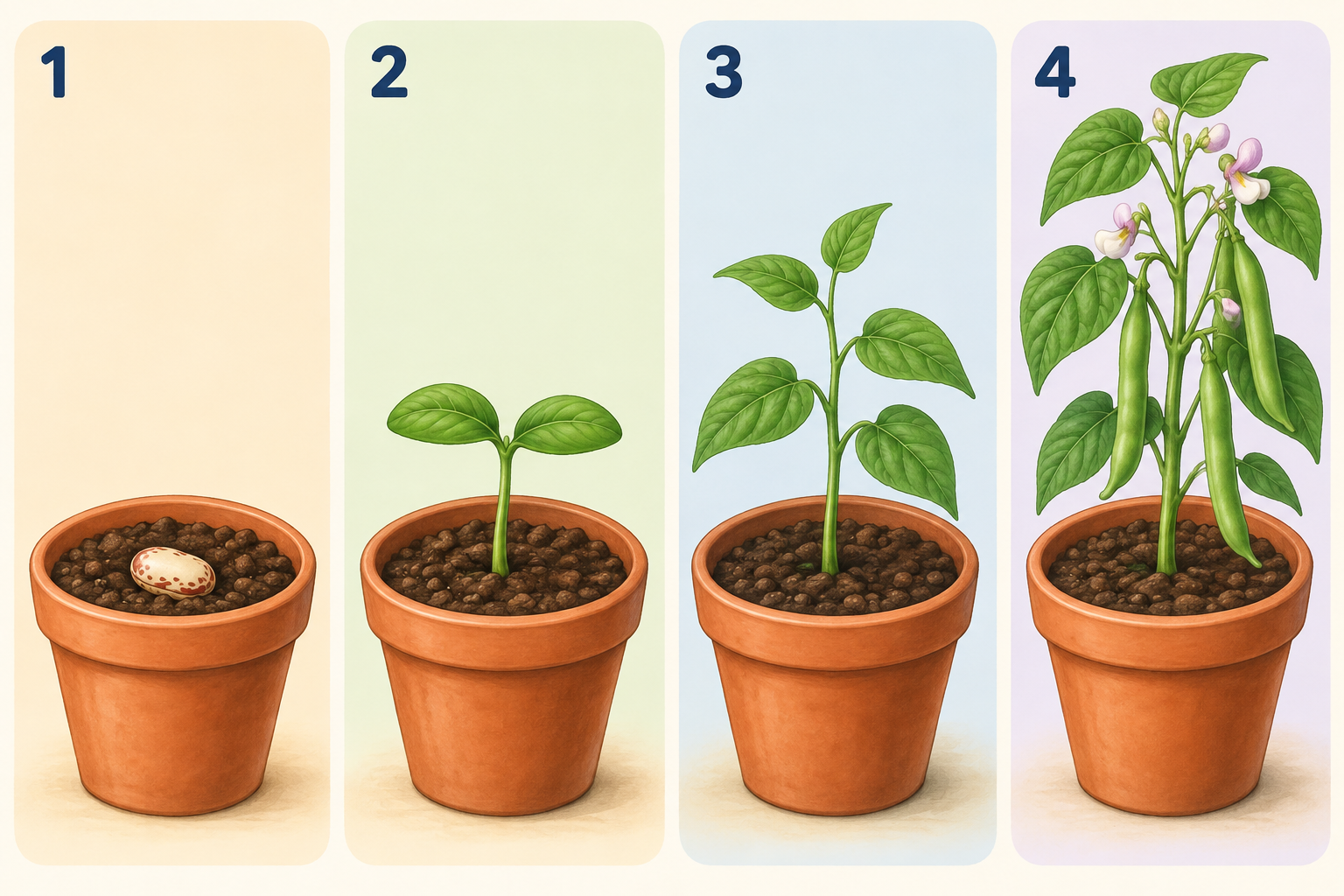
A plant diary shows a seed, a young plant with two leaves, the same young plant with more leaves, and an adult plant. A pupil says it has four major stages because there are four photographs. Explain the mistake.
Two photographs record changes within the same broad stage.
Suggested answer: “The two young-plant photographs show the same major stage. The diary shows seed, young plant and adult plant stages.”
Ask your child to label each photograph before counting. This gives them a way to check their answer without guessing which picture to ignore.
Example 4: Explain the return arrow
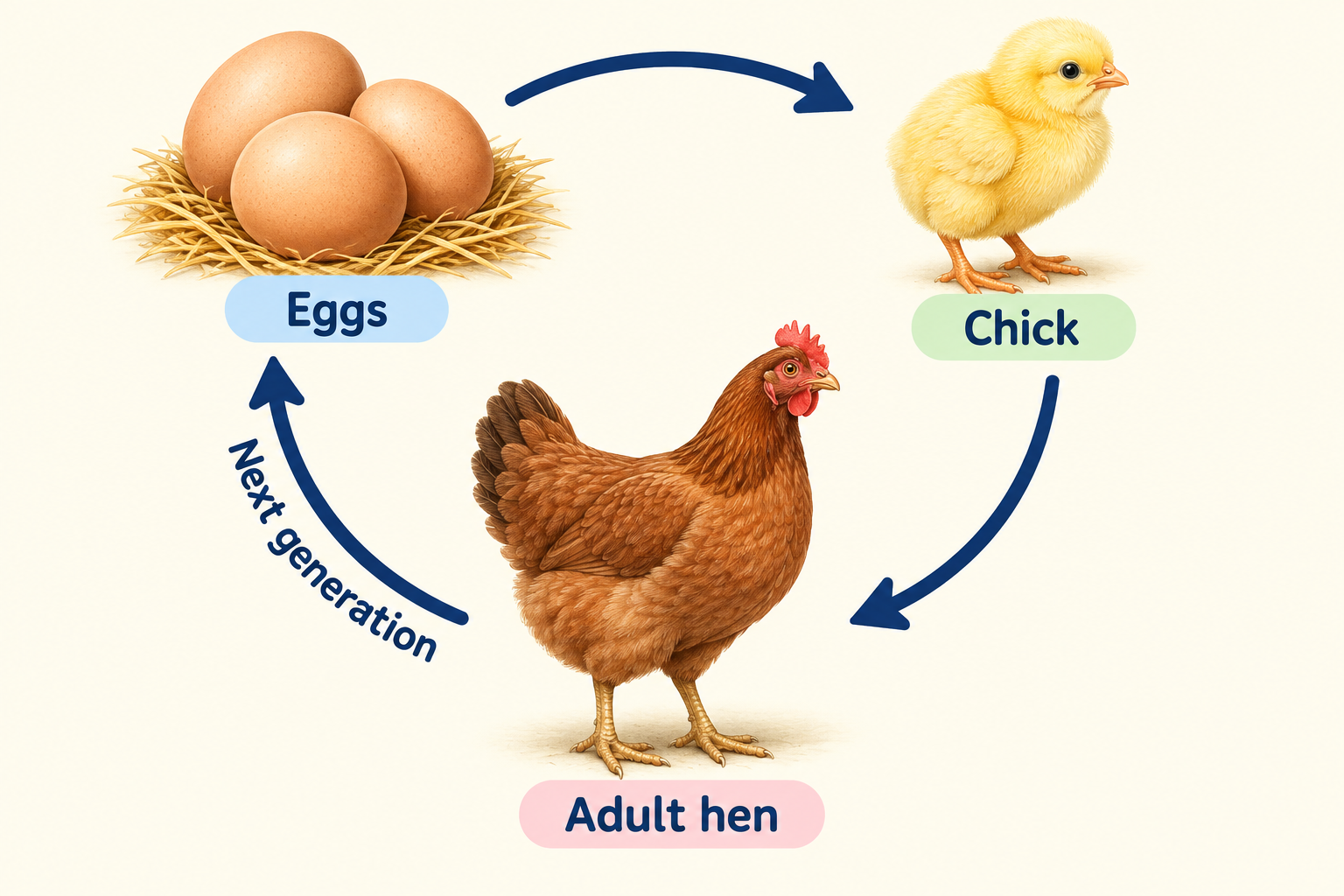
A cycle diagram has an arrow from an adult chicken to eggs. Does this mean the adult changes back into an egg?
Suggested answer: “No. An adult female chicken lays eggs. These can develop into the next generation; the adult does not turn back into an egg.”
A cycle repeats across generations. Ask your child to point to where the next generation begins. This also helps when a plant diagram returns from an adult to new seeds.
Mistakes to catch during revision
Start by asking your child to tell you which organism a diagram represents. A memorised butterfly sequence can get inserted into a question about another animal if they rush past the title.
Then check the arrows. They show sequence, so a missing-stage answer must fit between the stages on either side. Have your child read the whole sequence aloud after filling the gap.
Avoid fixed claims such as “all eggs hatch after three days”. Development times depend on the organism and conditions. If a question provides dates, calculate from those dates instead of using a remembered number.
Finally, a stage that looks still is not necessarily non-living. A photograph alone may not reveal the changes taking place. Our P3 living and non-living things guide explains why movement alone is insufficient evidence and how to classify organisms using their characteristics.
Keep a plant observation diary
Grow a suitable seed with an adult's help and record its development with dated drawings or photographs. Write one observation beside each entry. A short note such as “two leaves are visible” is enough.
After several entries, ask your child to arrange them in order and explain the evidence used. Then choose two entries and describe one visible difference.
This is an observation activity, not automatically a fair test. If you later compare growing conditions, decide what will change and what will stay the same. Do not change several conditions and then attribute the result to only one.
An adult plant photograph can help complete the discussion if your seed has not matured. There is no need to pretend a short home activity has captured the whole cycle.
Frequently asked questions
Are life cycles a P3 or P4 topic?
They are P3 in the current syllabus. Older resources may use a different level label. Our Science topics by level guide helps separate early life-cycle work from later reproduction topics.
Does every insect have a pupa?
No. Grasshoppers and cockroaches develop through a nymph stage without a pupa. Compare the actual sequence rather than using one insect as a rule for all insects.
Should my child learn detailed germination conditions now?
For a P3 guide, focus on observing a seed develop and identifying stages. Detailed germination and reproduction processes belong to later learning; follow any additional guidance from the child's teacher.
How Ottodot helps with OEQs
In Lower Primary Science classes, a teacher can model how to read stage labels and build a comparison using both organisms. Words such as “larva”, “nymph” and “pupa” become useful because the child connects them with evidence.
Ottodot uses CER, or Claim, Evidence and Reasoning, to support explanations. A child states the answer, points to the relevant stage or observation, and explains the link. This does not require three separate paragraphs for a short question.
OEQ practice includes simulations or scenarios with prompts, followed by less guided attempts. Teacher-marked weekly homework and class feedback help identify whether the difficulty is stage knowledge, diagram reading or expressing a comparison.
If your child remembers the sequence but struggles when a diagram changes, Check my child's fit to explore support with applying the concept.