
P2 Whole Numbers: Place Value, Addition and Subtraction
Explain P2 addition and subtraction with place-value charts, four worked examples and clear steps for regrouping across zero, plus practical parent tips.
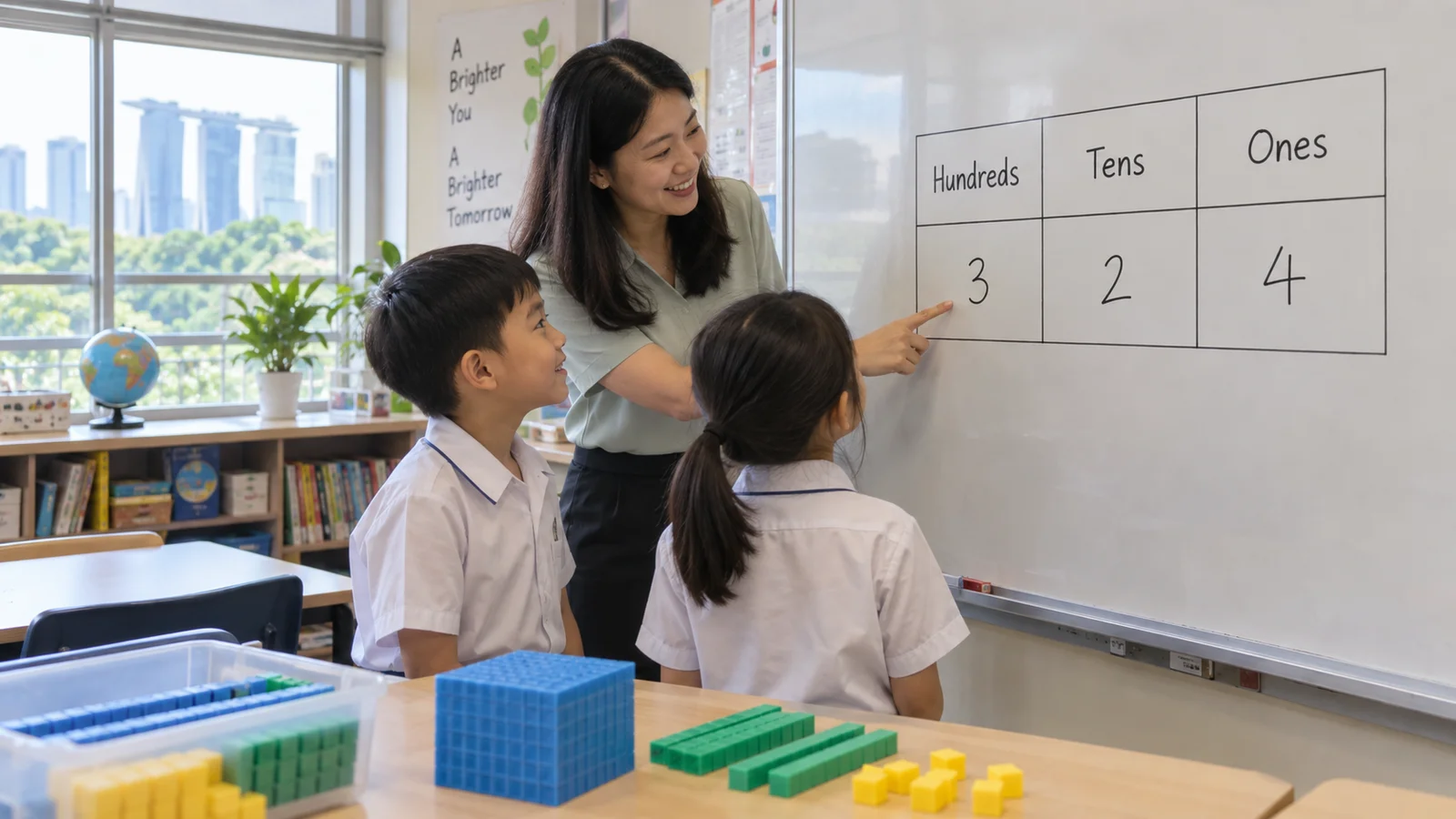
P2 addition and subtraction work builds on understanding hundreds, tens and ones. This guide shows parents how to explain three-digit calculations, including subtraction across zero, through four worked examples.
If your child can recite a calculation rule but cannot explain a crossed-out digit, return to the quantity it represents. Exchanging one hundred for ten tens changes the way we show a number. It does not change its value.
Key Takeaways
A digit's place tells us its value.
Line up hundreds, tens and ones before calculating.
Exchange quantities without changing the total.
Read a word problem to find the unknown before choosing an operation.
Use the inverse operation to check a completed calculation.
What P2 addition and subtraction includes
The MOE Primary Mathematics syllabus includes whole numbers to 1,000, place value, number patterns, odd and even numbers, and three-digit addition and subtraction. Our Primary 2 Maths overview puts these skills alongside the other topics for the year.
A useful starting point is the relationship between adjacent places: ten ones make one ten, and ten tens make one hundred. Paper cards labelled 100, 10 and 1 can represent these amounts. Make their values clear, because the cards themselves are all similar in size.
Ask your child to show 243 as two hundreds, four tens and three ones. Then exchange one ten for ten ones. The new display has two hundreds, three tens and thirteen ones. Both displays represent 243. This small action explains the regrouping that later appears in written subtraction.
Comparing, ordering and spotting patterns
Compare hundreds first, then tens, then ones. For 368 and 386, the hundreds match. Six tens are fewer than eight tens, so 368 is smaller. The ones do not overturn that comparison.
For a number pattern, check the change between neighbouring terms rather than guessing from the last digit. In 215, 225, 235, 245, each step adds ten. The ones stay the same because the change is in the tens.
Even numbers can be arranged in pairs with nothing left over. Odd numbers leave one unpaired. The ones digit tells us which applies: 0, 2, 4, 6 and 8 indicate an even number. Although 306 has an odd hundreds digit, its six ones can pair up and its full tens and hundreds can too.
Four worked examples with checking prompts
These original questions move from representing a number to calculating and interpreting a word problem. Let your child attempt one step before you supply the next. The explanation below is fuller than the working a child needs to write.
Example 1: Explain the zero in 406
Write 406 in hundreds, tens and ones. What is the value of the digit 4?
Read the number from its largest place. The 4 is in the hundreds place, the 0 is in the tens place and the 6 is in the ones place.
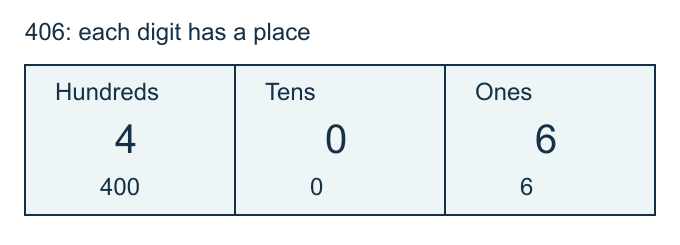
406 = 400 + 0 + 6
Answer: 406 has 4 hundreds, 0 tens and 6 ones. The value of the digit 4 is 400.
The zero keeps the tens place. Removing it gives 46, which is a different number. Say “four hundred and six” while pointing to the corresponding places.
Check: Combine 400 and 6. The result is 406. Ask, “Would four tens and six ones still make this number?” Your child should see that this makes only 46.
Example 2: Add with two exchanges
Find 268 + 157.
Write one number below the other, with matching place values in each column. Start with the ones so that any new ten can join the tens column.
Eight ones plus seven ones make fifteen ones. Exchange ten of them for one ten. Write 5 in the ones column and record the extra ten above the tens.
Six tens plus five tens plus the extra ten make twelve tens. Exchange ten tens for one hundred. Write 2 in the tens column and record the new hundred.
Two hundreds plus one hundred plus the extra hundred make four hundreds.
268 + 157 = 425
Answer: 425.
Check: Subtract 157 from 425 to recover 268. A quick size check also helps: 268 + 100 is already 368, so an answer of 325 would be too small.
When your child writes a small 1 above a column, ask what it means. Above the tens column it means one ten; above the hundreds column it means one hundred. Naming the quantity keeps the written method connected to the number.
Example 3: Subtract across zero
Find 402 − 176.
The ones calculation needs more than the two ones available. There are no tens to exchange directly, so first exchange one of the four hundreds for ten tens.
Now 402 is represented by 3 hundreds, 10 tens and 2 ones. Exchange one of those ten tens for ten ones. The representation becomes 3 hundreds, 9 tens and 12 ones.
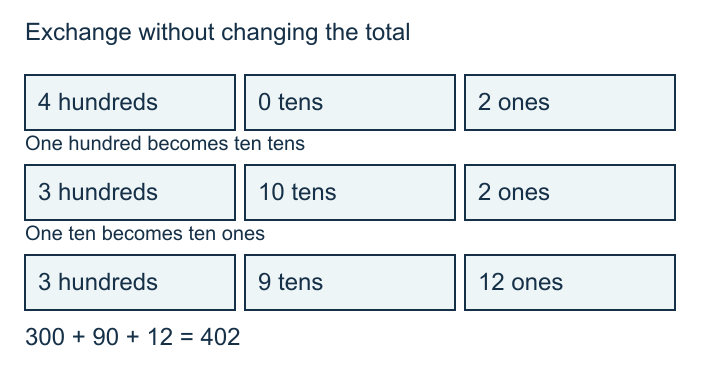
Subtract by place value:
Ones: 12 − 6 = 6.
Tens: 9 − 7 = 2.
Hundreds: 3 − 1 = 2.
402 − 176 = 226
Answer: 226.
Check: 226 + 176 = 402. You can also check the exchanged starting amount: 300 + 90 + 12 = 402.
Pause before the subtraction if your child records ten tens and twelve ones together. One ten was used to create those additional ones, leaving nine tens. Moving a labelled card physically can make that change easier to follow.
Example 4: Find a smaller collection
Amir has 145 stickers. Mei has 38 fewer stickers than Amir. How many stickers does Mei have?
We know Amir's amount and the difference between the collections. Mei's amount is unknown, and it must be smaller than 145.
Imagine two bars starting at the same point. Amir's bar represents 145. Mei's shorter bar stops 38 before Amir's bar ends. Removing that difference from 145 leaves Mei's collection.
145 − 38 = 107
One mental route is to subtract 40, then put back 2 because 38 is two less than 40: 145 − 40 = 105, then 105 + 2 = 107. The usual written method is equally suitable.
Answer: Mei has 107 stickers.
Check: 107 + 38 = 145, so Mei has exactly 38 fewer than Amir. An answer above 145 would contradict the story.
Avoid teaching a word-to-operation rule on its own. If the question gave Mei's amount and asked for Amir's, the same relationship would require addition. Identify which collection is missing first.
Common mistakes and useful fixes
Lining numbers up by their left edges
In 145 − 38, 38 has three tens and eight ones. Its 3 belongs under the 4, and its 8 under the 5. Use a place-value chart until alignment becomes familiar. Squared paper can help your child keep one digit in each column.
Subtracting the smaller digit from the larger
A child might see 2 − 6 and write 4 because 6 − 2 feels possible. Return to the whole calculation. We are taking 176 away from 402, so the order stays fixed. Exchange a ten to get enough ones rather than reversing that part of the subtraction.
Crossing out digits without tracking their value
Ask your child to read the full representation after each exchange. “Three hundreds, nine tens and twelve ones” offers a check that a string of crossed-out digits may hide. Once the exchanges make sense, the shorter notation is useful.
A short place-value activity at home
Make a small bank of paper hundreds, tens and ones. Write 302 on a card and ask your child to build it. Then ask them to pay 18 from that amount. They will need an exchange from hundreds to tens, followed by tens to ones.
Ask them to explain what stayed the same during each exchange. After paying 18, the remaining amount is 284. Count the remaining cards to check it, then record 302 − 18 = 284. Keep the physical action and the written calculation beside each other.
On another day, use number cards for a quick pattern task: 284, 294, 304. Ask what changes at each step and why the hundreds digit eventually changes. Short conversations about one example can reveal more than a long page of repeated sums.
Frequently asked questions
Should my child always use column working?
No. Mental methods are useful when the numbers suit them. Written columns help organise calculations with several place values. Ask your child to explain their chosen method and check the answer, rather than insisting that every sum looks identical.
What if my child understands objects but struggles on paper?
Keep the objects beside the written method for a while. After each exchange, point to the changed digits and describe the matching action. Reduce the physical support when your child can explain the step without moving the cards.
Does a zero mean there is nothing in the number?
It means there are none of that particular place-value unit in the standard representation. In 406, there are zero tens, but there are still four hundreds and six ones. The zero also holds the tens position.
What should we practise after addition and subtraction?
Work on explaining calculations before adding speed. The P2 multiplication and division guide connects repeated addition to equal groups. For another way of representing quantities, try the P2 fractions guide, where equal parts have to be identified carefully.
Support when exchanges keep causing confusion
If your child follows a worked solution but loses track of the values independently, they may benefit from a teacher making each exchange visible. Ottodot's Lower Primary Math classes combine teacher explanations with Roblox-based practice. The teacher introduces the maths, and practice gives children opportunities to apply it.
For help finding support suited to your child's current number skills, Check my child’s fit.