
P2 Fractions: Equal Parts, Comparing and Calculating
Explain P2 fractions using equal parts of a whole, matching strips and four worked examples for reading, comparing, adding and subtracting like fractions.

Work on P2 fractions begins with equal parts of a whole. Children learn to name those parts, compare unit and like fractions, and add or subtract like fractions within one whole. This guide gives parents four worked examples and simple ways to make the quantities visible.
Before asking your child to read a fraction, check the picture together. Counting three shaded pieces is not enough if the pieces have different sizes.
Key Takeaways
A fraction picture must divide the whole into equal parts.
The denominator tells us how many equal parts make the whole.
The numerator tells us how many of those parts we are describing.
Use equal-sized wholes when comparing shaded amounts.
When adding or subtracting like fractions, the size of each part stays the same.
What the P2 fractions topic includes
The MOE Primary Mathematics syllabus includes comparing unit fractions and like fractions, and adding and subtracting like fractions within one whole, with denominators no greater than 12. The examples here use fractions of a whole, such as a strip of paper.
Our Primary 2 Maths overview connects this topic to the rest of the year. This guide stays with whole shapes and strips. Children do not need a lesson on mixed numbers or formal fraction-of-a-set calculations to use these examples.
Read the fraction through its picture
In 3/8, the denominator 8 says the whole has been divided into eight equal parts. The numerator 3 says we are describing three of those parts. Read it as “three eighths”.
Ask your child to point to one eighth before identifying three eighths. If they cannot locate one equal part, the fraction name may be a memorised label rather than a description of the picture.
The whole matters too. Half of a large sheet and half of a small sheet are both halves, but they do not have the same area. When using strips to compare fraction values, start with strips of the same length and width. That keeps the comparison focused on the fractions.
Why equal parts come first
Imagine a rectangle divided into three pieces, with one piece taking half the rectangle and two smaller pieces filling the other half. Shading the large piece does not show one third, even though one of three pieces is shaded. The three pieces are not equal.
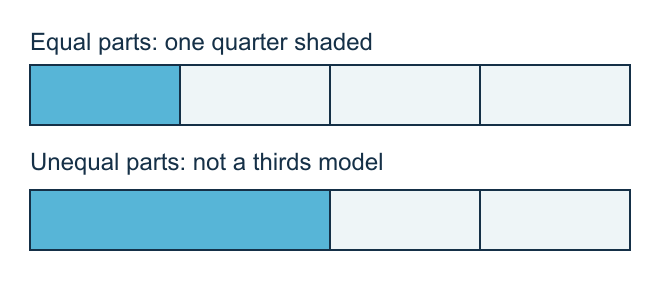
Let your child explain what is wrong with an unequal example. Saying “the pieces must be equal” is more useful than learning that every shaded piece can automatically be counted as the numerator.
Four original worked examples
Keep a pencil or finger beside the diagram as you read each example. The explanations show the reasoning a parent can discuss; the final number sentence is the shorter working a child may write.
Example 1: Name the shaded fraction
A strip is divided into 8 equal parts. Three parts are shaded. What fraction of the strip is shaded?
First count all the equal parts, including the unshaded ones. There are eight, so each part is one eighth of the strip.
Three of those eighths are shaded. The fraction is therefore 3/8.
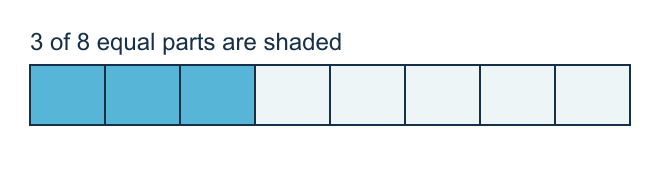
Answer: 3/8, or three eighths, of the strip is shaded.
Check: Count three shaded parts and five unshaded parts. Together they make all eight equal parts. The denominator is eight, not five: five counts only the unshaded pieces.
If your child writes 8/3, ask them to finish two sentences: “The whole has ___ equal parts” and “___ parts are shaded.” Match the first answer to the denominator and the second to the numerator.
Example 2: Compare one third and one sixth
Which is greater, 1/3 or 1/6?
Use two identical strips. Divide one into three equal parts and the other into six equal parts. Shade one part in each strip.
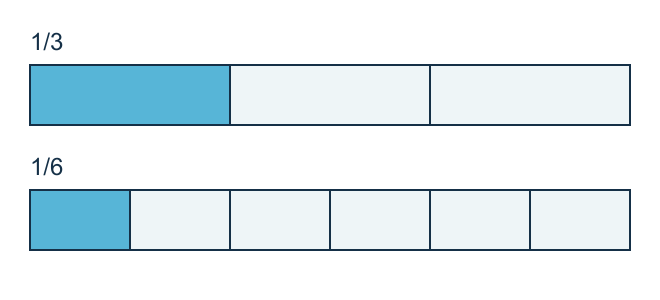
When the same whole is divided into more equal parts, each part becomes smaller. One of three equal parts is larger than one of six equal parts.
1/3 > 1/6
Answer: 1/3 is greater than 1/6.
Check: Align the strips at the left edge. The one-third shading reaches farther across the same-sized whole. Both fractions describe one part, so compare the size of that part.
A larger denominator does not mean a larger unit fraction. Avoid explaining this only as a rule about “the bottom number”. The strips show why the relationship works.
Example 3: Add like fractions
A paper strip has 7 equal sections. Two sections are blue and another 3 sections are yellow. What fraction of the strip is coloured?
The blue and yellow sections are different sections of the same strip. We are combining two sevenths and three sevenths.
2/7 + 3/7 = 5/7
Answer: 5/7 of the strip is coloured.
Check: There are five coloured sections and two uncoloured sections. Together they make the original seven equal sections.
The denominator stays seven because each section is still a seventh. We have coloured more sections, but we have not divided the strip into fourteen parts. Saying “two sevenths plus three sevenths makes five sevenths” helps keep the unit in the calculation.
This example stays within one whole. The answer describes five of the strip's seven sections, so it must be less than a complete strip.
Example 4: Subtract like fractions
Seven ninths of a strip is shaded in pencil. The shading is erased from two ninths of the whole strip. What fraction remains shaded?
Picture a strip with nine equal sections and seven shaded. Remove the shading from two of those seven sections. Five sections remain shaded.
7/9 − 2/9 = 5/9
Answer: 5/9 of the strip remains shaded.
Check: Add the erased amount back to the remaining shading: 5/9 + 2/9 = 7/9. This matches the starting amount.
The strip still has nine equal sections after erasing. Only the number of shaded sections changes, so the denominator remains nine. We are erasing shading, not removing pieces of the whole.
Comparing like fractions
Like fractions have the same denominator. On identical strips divided into eighths, 5/8 is greater than 3/8 because five eighths covers more equal parts than three eighths.
The reasoning is different from comparing 1/3 and 1/6. For unit fractions, we compared the size of one part. For like fractions, the part size is the same, so we compare how many parts are counted.
Ask your child to say which situation they are looking at before choosing an answer. “These are both eighths” is a useful starting point. If they count the numerators without checking the denominators, they may later apply a familiar method to an unsuitable pair.
Common mistakes and useful fixes
Counting every piece as though it were equal
A roughly drawn picture can create confusion. Use a ruler or a prepared strip when the example depends on equal lengths. Ask your child to inspect the partitions before naming a fraction. If the parts are unequal, redraw the model rather than forcing a fraction label onto it.
Adding or subtracting the denominators
For 2/7 + 3/7, writing 5/14 changes the kind of part being counted. Point to a single section and ask whether it has become smaller. It is still a seventh. The number of coloured sevenths changes from two to five, while the partition stays fixed.
Comparing shading on different-sized wholes
One third of a long strip may cover more paper than one half of a short strip. That picture compares physical amounts from different wholes. Replace them with matching strips before using the shading to compare the fractions themselves.
A fraction-strip activity at home
Draw a rectangle 14 cm long and divide it into seven sections of 2 cm each. This measured setup is for the parent; the learning task is recognising equal parts. Let your child check that the sections match before adding any colour.
Ask them to colour two sections, then another three. Have them say “five sevenths” and write 2/7 + 3/7 = 5/7. Next, cross out the colour on one section and discuss why four sevenths remains coloured. Keep the outline intact so the whole is still visible.
On a different sheet, draw two identical rectangles with eight equal sections each. Shade three sections on one and five on the other. Ask which fraction is greater and why. Your child can point to the additional two shaded eighths without needing a longer written explanation.
For practice with whole-number quantities between fraction sessions, the P2 addition and subtraction guide offers place-value examples. The P2 multiplication and division guide uses equal groups of separate objects; keep that representation distinct from partitioning a single whole here.
Frequently asked questions
Does the denominator count only the unshaded parts?
No. It counts all the equal parts in one whole. In the first example, three shaded parts and five unshaded parts make eight parts altogether, so the denominator is eight.
Why is one sixth smaller than one third?
The same-sized whole has been split into more equal parts. Each sixth is therefore smaller than each third. Use matching paper strips and shade one part of each so your child can see the difference.
Should I teach fraction simplification with these questions?
It is not needed for these examples. Focus on equal parts, correct fraction names, the required comparisons and like-fraction calculations. Follow your child's current school materials before introducing additional procedures.
Can we use food instead of paper strips?
Yes, if the portions are equal and the whole is clear. Paper strips are often easier for precise comparisons because matching wholes and partitions can be drawn consistently. Uneven slices can distract from the fraction relationship you want to explain.
Support for understanding the parts
If your child can repeat a fraction rule but cannot explain the picture, return to equal parts before adding more calculations. Ottodot's Lower Primary Math classes combine teacher explanations with Roblox-based practice, so the maths is taught before children apply it in practice.
To explore support for your child's understanding of fractions, Check my child’s fit.