
P2 Multiplication and Division: Tables and Word Problems
Help your child connect P2 multiplication and division through equal groups, times tables and four worked word problems, with checking prompts for parents.
P2 multiplication and division work connects equal groups with the 2, 3, 4, 5 and 10 times tables. This guide helps parents explain what a calculation means, choose an operation in a word problem and check the answer through four worked examples.
Knowing that 4 × 5 = 20 is useful. Knowing whether 4 describes the number of bags or the number of marbles in each bag makes that fact useful in a story.
Key Takeaways
Multiplication describes equal groups.
Division can find the size of each share or the number of groups.
Related multiplication facts can check division answers.
Count what the answer represents, not only the objects in the picture.
In a two-step problem, describe the first answer before using it again.
What P2 multiplication and division includes
The MOE Primary Mathematics syllabus includes the 2, 3, 4, 5 and 10 multiplication tables and related division. Children build on the equal-group and sharing ideas introduced in P1. Multiplication is therefore not an entirely new P2 concept.
Our Primary 2 Maths overview shows how this number work sits beside other P2 topics. If counting equal groups is still difficult, use counters before focusing on recalling facts quickly.
Label both parts of a multiplication story
For four groups of five, count 5, 10, 15, 20. The repeated addition is 5 + 5 + 5 + 5 = 20, and the multiplication sentence is 4 × 5 = 20. Here we write the number of groups first.
A rectangular array makes the quantities visible. Four rows with five counters in each row have twenty counters. Turn the array and you see five rows with four in each. The total stays twenty, although the labels in the original story still matter.
When your child writes a different factor order, ask them to explain it before correcting their work. Follow the notation used in their class, and keep the meaning of the groups explicit.
Sharing and grouping ask different questions
Sharing starts with a total and a known number of recipients. For example, sharing twenty counters among five children asks how many each child receives.
Grouping starts with a total and a known group size. Putting eighteen pencils into groups of three asks how many groups can be made. Both situations use division, but the answer has a different meaning. Saying the answer with its unit helps children notice that difference.
Four original worked examples
Use counters or quick circles while discussing these examples. A neat drawing is less important than equal groups that your child can count and explain.
Example 1: Find the total in equal packets
There are 4 packets of stickers. Each packet contains 6 stickers. How many stickers are there altogether?
We know the number of packets and the number in each packet. All four packets have the same amount, so we can multiply.
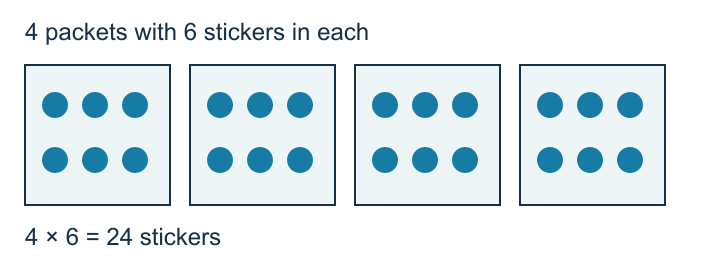
Count the packet totals: 6, 12, 18, 24. The repeated addition is 6 + 6 + 6 + 6 = 24.
4 × 6 = 24
Answer: There are 24 stickers altogether.
Check: Divide the total among the four packets: 24 ÷ 4 = 6 stickers in each. That matches the question.
This fact can also be read from the 4 times table: six fours make twenty-four. Using the matching array connects the two factor orders without requiring a new table as a separate learning target.
Example 2: Share equally among five children
Five children share 20 counters equally. How many counters does each child receive?
Draw five spaces to represent the children. Deal one counter into each space, then continue dealing one at a time. Stop when all twenty counters have been shared.
Each child has four counters. The total was known, and the question asked for the amount in each share.
20 ÷ 5 = 4
Answer: Each child receives 4 counters.
Check: Five children receiving four counters each use 5 × 4 = 20 counters. Check that there are no counters left and that every share is equal.
A child might stop as soon as one space has four counters. Ask them to check the other spaces too. Equal sharing means every child receives the same amount; reaching the correct total alone is not sufficient.
Example 3: Make groups of three
There are 18 pencils. Put 3 pencils in each group. How many groups can be made?
This time the question tells us the size of each group. Circle three pencils, then another three, until all eighteen have been grouped.
The groups use 3, 6, 9, 12, 15 and then 18 pencils. That makes six groups.
18 ÷ 3 = 6
Answer: 6 groups can be made.
Check: Six groups of three pencils contain 6 × 3 = 18 pencils.
Compare this with the previous question. In Example 2, we found counters per child. Here, we found the number of groups. The calculation's result needs the right label. “Six pencils in each group” would contradict the instruction to put three in each group.
Example 4: Find a total, then subtract
Lena has 4 bags of marbles. Each bag contains 5 marbles. She gives away 6 marbles. How many marbles does she have left?
We cannot subtract six from the number of bags because the six refers to marbles. First find how many marbles Lena has altogether.
4 × 5 = 20 marbles
She then gives away six of those twenty marbles.
20 − 6 = 14 marbles
Answer: Lena has 14 marbles left.
Check: Put the six given-away marbles back: 14 + 6 = 20. Twenty also matches the original four bags of five.
Ask your child to finish the sentence “The first answer, twenty, means…” before moving on. If they can say “the marbles before she gave any away”, they have connected the two steps. This example is a practice progression, not a claim that every school teaches two-step questions in the same order.
A manageable times-table practice plan
Begin with a small number of facts that your child can show, then revisit them in different forms. There is no need to race through all five tables in one sitting.
Table | A concrete starting point | A useful connection |
2 | Count pairs of counters. | Each new group adds two. |
10 | Make groups of ten sticks. | The totals increase by ten. |
5 | Count five fingers on each hand. | Two groups of five make ten. |
3 | Make groups of three buttons. | Build an unfamiliar fact from a known nearby fact. |
4 | Make rows of four counters. | Double a group of two to make a group of four. |
For example, if 5 × 3 = 15 is secure, one more group of three gives 6 × 3 = 18. Let your child explain what changed. This builds a route to an answer when recall is not immediate.
Include related division facts in the same practice. After showing 4 × 5 = 20, ask how many are in each of four equal shares, then how many groups of five can be made from twenty. Keep the objects available until your child can picture the relationships.
Common mistakes and useful fixes
Adding the two numbers in every story
For four bags of five, 4 + 5 counts neither the bags' contents nor a meaningful total. Draw four empty bag outlines and put five counters in each. Ask what is repeated. If group quantities are unclear, return to the P2 addition and subtraction guide and practise adding the equal amounts.
Treating unequal groups as multiplication
Three plates holding two, four and five biscuits do not show three equal groups. Count or add their individual amounts. Before multiplying, ask whether every group has the same number. Equal-sized outlines do not guarantee equal contents.
Remembering an answer but losing its meaning
A child may calculate 18 ÷ 3 = 6 accurately, then say there are six pencils per group. Have them point to the six groups they made. Write “6 groups” beside the calculation so the answer describes the question.
A home activity using cups and counters
Place fifteen counters on a table with three cups. First ask your child to share them equally among the cups. There will be five in each cup. Empty the cups and ask them to make groups of five. There will be three groups.
Write 15 ÷ 3 = 5 and 15 ÷ 5 = 3 beside the two arrangements. Ask which number describes the group size each time. You are changing the question while keeping the total fixed.
Finish by letting your child make a short story for one arrangement. A story about bags, plates or teams is enough. If the story and picture disagree, adjust them together rather than treating the activity as a timed test.
Frequently asked questions
Does my child need to learn the 6 times table for the first example?
The example can use the related 4 times-table fact, 6 × 4 = 24, or repeated addition. P2 table work centres on 2, 3, 4, 5 and 10. A factor of six in a question does not automatically mean a separate 6 times-table lesson is required.
Should we stop using counters once tables begin?
No. Counters are useful when a fact or word problem lacks meaning. Gradually move from objects to pictures and then to number sentences as your child becomes comfortable explaining the groups.
How can I tell whether to multiply or divide?
Ask what is missing. If the number of equal groups and the amount in each are known, multiply to find the total. If the total is known and either group size or group count is missing, division can find it.
Is slow recall always a sign of poor understanding?
No. A child may understand the groups but need longer to recall a fact. Listen to the explanation. Practise a few related facts regularly, while keeping meaning and accurate answers ahead of speed.
Help with turning a story into a calculation
If your child knows the tables but struggles to decide what a word problem asks, more table drills may miss the difficulty. Ottodot's Lower Primary Math classes combine teacher explanations with Roblox-based practice, giving children opportunities to apply the maths after it is taught.
To explore support for your child's next step with equal groups and word problems, Check my child’s fit.