
P2 Shapes: Patterns and 3D Objects
Explore P2 shapes through patterns and 3D objects. Use four worked examples to explain repeating rules, cubes, cuboids, cones, cylinders and spheres clearly.
P2 shapes work helps children describe patterns and recognise solid objects such as cubes, cuboids, cones, cylinders and spheres. This parent guide uses four worked examples to show what to look at, how to explain an answer and how to check it.
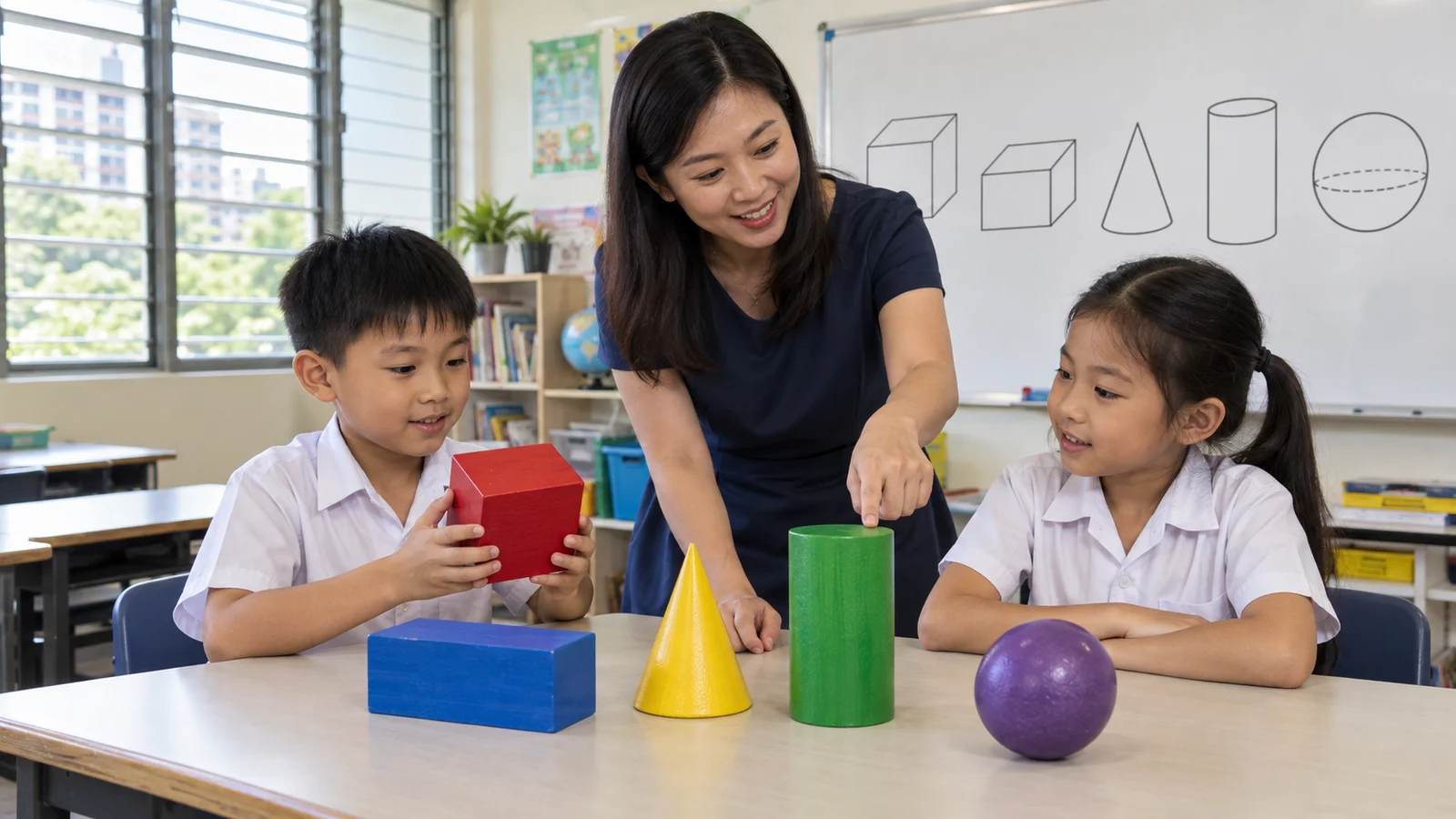
A child may recognise a familiar cereal box but hesitate when a cuboid is drawn at a different angle. Handling an object and turning it slowly can make the connection between the solid and its picture much clearer.
Key Takeaways
Describe the rule before continuing a shape pattern.
A pattern can change colour, shape, size or direction.
Turning a solid changes the view, not the solid's name.
A circle is flat; a sphere is a three-dimensional shape.
Use several features together when sorting objects.
What the P2 shapes topic covers
The MOE Primary Mathematics syllabus includes shape patterns and identifying, describing and classifying basic solids at Primary 2. The examples here stay with those ideas. They don't need angle measurements, nets or volume formulae.
Our Primary 2 Maths overview connects this work with the rest of the year's maths. Shape questions need careful looking and language, even when no calculation is involved.
Look for the part of a pattern that repeats
Ask your child to point to each item and describe it. “Circle, triangle, circle, triangle” may be enough for a simple pattern. If the colours also matter, include them: “red circle, blue triangle”.
Then ask which group repeats. Marking the smallest repeating group helps the child see why the next item belongs. Continue the rule through every item already shown, rather than checking only the last two.
Some questions change size. Others change the way a shape points, called its orientation. Before looking for a complicated rule, compare the items and name exactly what stays the same and what changes.
A short sequence can sometimes fit more than one rule. In school-style repeating-pattern questions, use the intended simple repeat supported by the displayed items. If a child proposes a different rule, ask them to apply it consistently and explain it; guessing a different next shape without a rule is not the same thing.
Connect flat shapes with solid objects carefully
A drawing lives on a flat page, but it can represent a solid. An illustration of a box may show three faces at once so that we can imagine its depth. The drawn sloping lines do not mean that the box itself has become a different shape.
Solid | Useful features to notice | Familiar approximation |
Cube | Six square faces of the same size | A plain wooden cube |
Cuboid | Six rectangular faces; dimensions need not all match | A rectangular cereal box |
Cone | A circular base and a curved surface meeting at a point | A plain party hat's overall form |
Cylinder | Two matching circular ends and a curved surface | A straight-sided food tin |
Sphere | A curved surface all around, without flat faces | A ball |
Real objects may have seams, lids or rounded edges. Treat them as models that resemble mathematical solids, rather than insisting every household object is an exact example.
When discussing flat faces, be consistent with the language your child's teacher uses. A curved surface is different from a flat face. Rolling alone is not enough to identify a shape, because more than one kind of solid can roll.
Four worked examples
Example 1: Continue a shape-and-colour pattern
The pattern is red circle, blue triangle, red circle, blue triangle, red circle, blue triangle. What are the next two items?
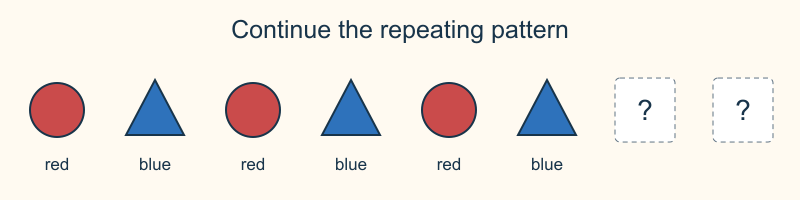
Understand and plan: Read both the shape and its colour. The repeating group contains two items: a red circle followed by a blue triangle.
After the final blue triangle, begin the group again.
Answer: A red circle, then a blue triangle.
Check: Read the whole extended sequence in pairs. Each pair should have the same order and colours. A blue circle would preserve neither the full shape-and-colour rule nor the first item in the repeat.
If your child says only “circle, triangle”, ask for the colours as well. Their idea may be right, but the complete answer should describe everything the question makes relevant.
Example 2: Notice a change in direction
Four equal-sized green triangles point up, right, up and right. Continue this repeating pattern with two more triangles.
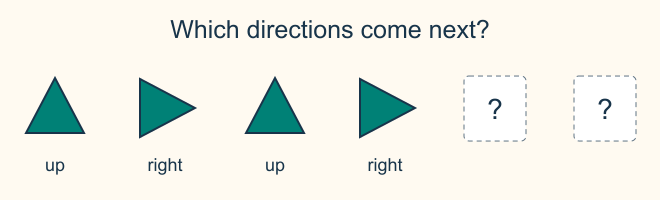
Understand and plan: The triangles keep their colour and size. Their direction alternates between up and right.
You can turn a paper triangle to match each item before drawing the answer. Watch which way the point faces, rather than changing its colour or making it smaller.
Answer: Draw a triangle pointing up, then one pointing right.
Check: The first, third and fifth triangles should point up. The second, fourth and sixth should point right. Looking at those positions gives another way to check the repeat.
Your child doesn't need to describe the turn in degrees. The task is to continue an orientation pattern.
Example 3: Sort objects by their solid shapes
A table holds a plain wooden cube, a rectangular cereal box, a straight-sided food tin, a party hat with a circular base and a ball. Which solid does each object most closely resemble?
Understand and plan: Look at the overall form. Ignore pictures on the packaging and small details such as the tin's rim.
Suggested answer:
Wooden cube: cube.
Cereal box: cuboid.
Food tin: cylinder.
Party hat: cone.
Ball: sphere.
Check: Give a feature for each choice. The tin has two matching circular ends. The hat narrows to a point. The ball curves all around. The cube has matching square faces, while the cereal box's dimensions are not all the same.
In mathematics, a cube is also a special cuboid. If a task offers both labels and asks for the most specific name, use “cube” for the wooden cube. Avoid teaching that these two categories have no relationship.
Example 4: Tell a circle from a sphere
Maya says, “My ball is a circle because its outline looks round.” What shape does the whole ball resemble, and how can you explain the difference?
Understand and plan: Maya has noticed the outline in one view. The question asks about the whole object.
Place a circular paper cut-out beside a ball. The cut-out models a flat shape. The ball has depth and a curved surface all around.
Suggested answer: The whole ball resembles a sphere. A circle is a flat shape, while a sphere is a solid shape.
Check: Turn the ball and look at it from another direction. It still has a three-dimensional form. Tracing around its widest outline would make a circle on paper, but that outline does not describe the whole solid.
This distinction also helps with cylinders: a cylinder can have a circular end without the whole object being called a circle.
Common mistakes and useful prompts
Naming only one changing feature. A child may correctly identify the next shape but use the wrong colour. Ask them to read the repeating group aloud before drawing.
Changing the object when the view changes. Turn a familiar box while keeping it in the child's hands. Ask what has actually changed. Some faces become hidden, but the same box is still there.
Using one feature as the whole test. “It rolls” can fit a sphere, cylinder or cone in different ways. Ask whether the object has flat ends, a point or a curved surface all around.
Calling every box a cube. Compare a plain cube with an elongated rectangular box. Let the child handle both and discuss the face shapes and lengths they can see.
Try a short sorting activity at home
If recognising flat shapes is still difficult, revisit our P1 shapes guide before adding solid objects.
Choose four or five safe objects with clear shapes. Ask your child to sort them and explain a choice. Accept everyday words first, then supply the mathematical name: “You noticed two round ends. This object resembles a cylinder.”
For patterns, draw a repeating strip and hide one item in the middle. Ask the child to find what belongs there and explain how the items on both sides help. For example, in red circle, blue triangle, blank, blue triangle, the missing item is a red circle under the alternating rule.
You can also swap roles. Let your child set a pattern for you and deliberately make one mistake. Ask them to show where your answer stops following their rule. You will be able to follow the rule only if their explanation is clear.
Frequently asked questions
Does turning a square make it a different shape?
No. Its orientation changes, but its sides and corners do not. Use the same cut-out and turn it so the child can track the unchanged object.
Must my child memorise every face, edge and vertex count?
Begin with recognising and describing the solids covered at school. Follow the teacher's expected vocabulary and tasks rather than adding a long list of counts before the objects make sense.
Is every round object a sphere?
No. A cylinder has circular ends, and a cone has a circular base. Look at the whole shape, including its flat and curved surfaces.
What if my child gives a different pattern rule?
Ask them to test it against every displayed item. A consistent alternative deserves discussion, although a worksheet may be asking for a particular simple repeating rule.
Support careful looking and clear explanations
When your child names a shape incorrectly, ask what they noticed before correcting them. Their answer may reveal that they looked only at an outline or counted visible faces as though hidden faces did not exist.
Ottodot's Lower Primary Math classes use teacher-led explanations, worked examples and Roblox-based practice. If your child needs help connecting a picture with the maths it represents, Check my child’s fit.