
P1 Shapes: Recognising and Building 2D Figures
Help your child recognise P1 shapes in different positions, compare half and quarter circles, build a circle and copy a house on a grid with worked examples.
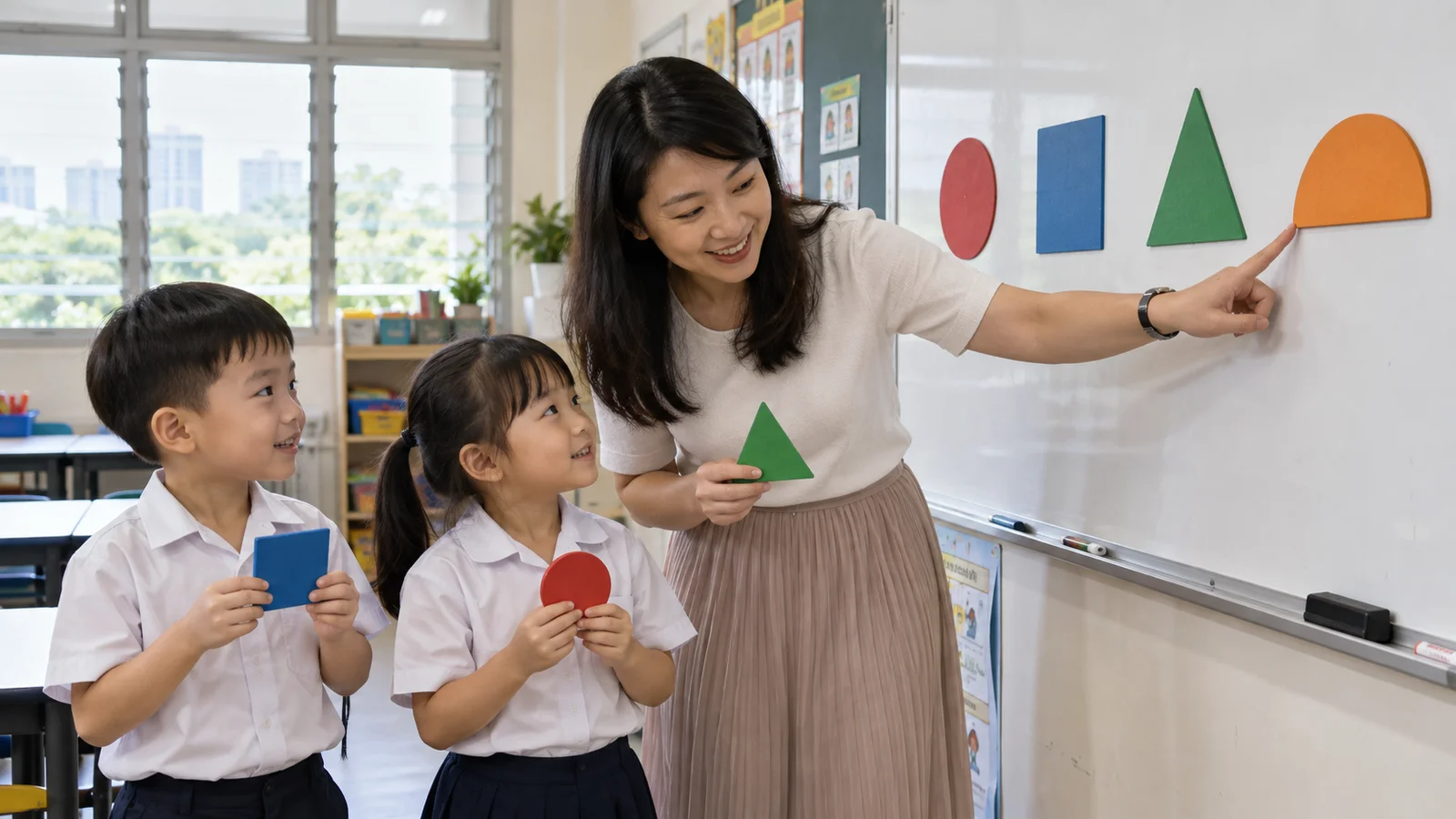
P1 shapes work helps children recognise flat figures, describe what they see and combine shapes to make new pictures. A square stays a square when it is turned, and two matching half circles can be joined to make a whole circle.
This guide gives parents four worked examples, including a simple grid-copying task. The focus is on looking closely, using shape names and checking a drawing against its source.
Key Takeaways
Turning a shape changes its position, not its name.
Look at the whole outline instead of relying on a familiar picture.
A half circle comes from two equal parts of a circle; a quarter circle comes from four.
Shapes can be joined without gaps or overlaps to build a larger figure.
When copying on a grid, count spaces and use matching starting points.
What P1 shapes work includes
The MOE Primary Mathematics syllabus includes recognising basic 2D shapes, making figures from shapes and copying figures on grids. Half circles and quarter circles are part of the P1 work covered here.
Our Primary 1 Maths overview connects this with number work and measurement. These examples concern flat shapes. Naming three-dimensional solids is covered at P2.
Describe what you can see
Start with a circle, triangle, square and rectangle cut from card. Ask your child to trace each outline. A circle has a curved boundary. A triangle has three straight sides. A square has four equal straight sides and four square corners.
A rectangle also has four square corners; its opposite sides are equal in length. Classroom shape cards often show a long rectangle beside a square. Avoid saying that every rectangle must look long, or that a square stops being a square when turned.
There is no need to introduce angle measurements to explain these examples. A child can compare a square corner with the corner of a sheet of paper. Keep the explanation tied to features they can see and check.
Change one feature at a time
Turn the same card before introducing a new shape. If you change the colour, size and position at once, it is harder to tell which feature has confused your child.
Next, show a large and small triangle. Both have three straight sides even though their sizes differ. Try triangles that point sideways as well as upwards. A shape name should not depend on the point facing the top of the page.
Colour can help children find a shape in a busy picture, but it does not define the shape. A blue triangle and a yellow triangle are still triangles.
Four worked examples
Example 1: Name a turned square
Question: What is the blue shape in the picture?
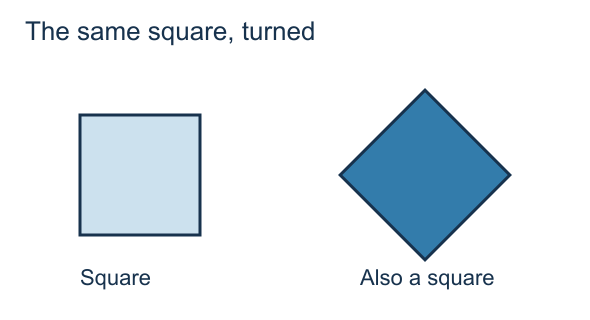
Working: Trace the blue outline. It has four equal straight sides and four square corners. It is the same square as the one beside it, turned around its centre.
Answer: The blue shape is a square.
Check: Turn the page or rotate a matching square card. Its sides and corners do not change as it moves.
A child may call the shape a “diamond” because that is a familiar description of its position. For this question, guide them back to the mathematical name, square. Do not teach that every diamond-looking outline must be a square: the equal sides and square corners matter.
Ask your child to draw a small mark on one corner of a square card and then turn it. Following that corner helps them see movement without imagining that a new shape has appeared.
Example 2: Compare half and quarter circles
Question: Shape A is a half circle. Shape B is a quarter circle. How can you tell them apart? Both come from circles of the same size.
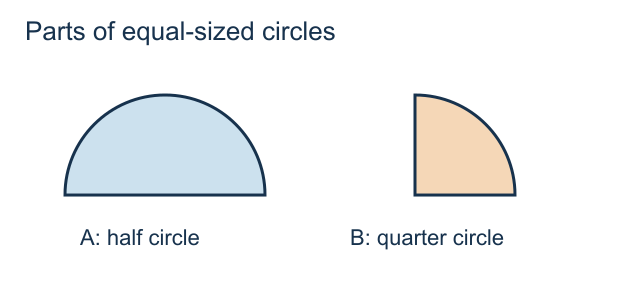
Working: A half circle is one of two equal pieces made by cutting a circle through its centre. It has one straight edge and a curved edge.
A quarter circle is one of four equal pieces. In this picture, it has two straight edges meeting at a square corner and a curved edge.
Answer: A is half of the circle, and B is a quarter of the same-sized circle.
Check: Two matching copies of A would complete a circle. Four matching copies of B would complete a circle of the same size.
The equal-sized starting circles matter. A quarter of a very large circle could be larger than half of a small circle. For this comparison, use matching paper circles so your child is comparing parts of the same-sized whole.
Example 3: Build a whole circle
Question: What shape can you make by joining two matching half circles along their straight edges?
Working: Place one half circle above the other. Match the straight edges exactly, with the curved edges facing outwards. There should be no gap and no overlap.
Answer: The two matching half circles make one circle.
Check: Trace the outside boundary. It should be one continuous circular outline. The straight edges are now inside the figure where the pieces meet.
If the pieces overlap, the outside shape may not form the intended circle. If one half circle is larger, the straight edges will not match. Before correcting the placement, check that the two pieces were cut from equal-sized circles.
Let your child move the pieces themselves. Watching an adult assemble the shape is different from deciding which edges should meet. Once the circle is complete, separate it again and ask where the two half circles went.
Example 4: Copy a house on a grid
Question: Copy the house onto a blank grid of the same size. Which two shapes make the house?
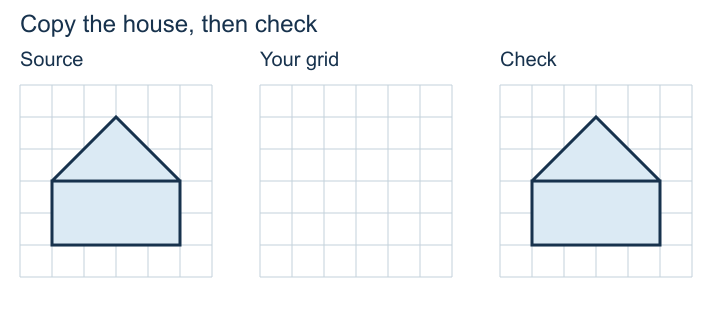
Working: Start at the bottom-left corner of the rectangle. Count four grid spaces across for its base and two spaces up for its height. Draw the rectangle on the blank grid in the matching position.
The roof's base is the top of that rectangle. Its tip is above the midpoint, two grid spaces higher. Mark the tip and join it to the two top corners of the rectangle.
Answer: The house is made from a rectangle and a triangle. The copy should match the source's position and outline.
Check: Compare the base widths, rectangle heights and roof-tip positions. Count spaces between grid lines rather than counting the lines themselves.
Cover the completed copy while your child tries the blank grid. Uncover it only to check. A correct house shape in a different position may show good shape recognition but still need work on matching locations.
Common mistakes and gentle corrections
If shape names change whenever a card turns, keep using the same physical card. Ask, “Did any side disappear?” and “Did any corner change?” Let the child turn it back to check rather than relying on your answer.
If half and quarter circles are confused, rebuild the whole. Two matching half-circle pieces complete it; four matching quarter-circle pieces complete it. Avoid introducing written fraction calculations when the immediate task is recognising the shapes.
When copying on grids, a child may count five lines as five spaces. Touch the gaps between the lines as you count. Drawing a short one-space segment first can make the unit clear.
Another mistake is adding attractive details that are not in the source. A door and windows are welcome in a free drawing, but a copying question asks for the given figure. Let your child decorate a separate house after checking the copy.
Build a shape picture at home
Cut several circles, triangles, squares, rectangles, half circles and quarter circles from coloured paper. Invite your child to build a picture without glue first. They might make a boat, face or house. Ask them to name the pieces they chose and show where two edges meet.
Take one piece away and ask what changed. Could another shape fill the gap? The aim is to discuss the fit, not to find one correct picture. When your child is happy with the arrangement, glue it down and label a few of its parts together.
For a short follow-up, sort the unused pieces by shape and count each group. The same collection can support a simple activity from our P1 picture graphs guide. Keep the sorting rule clear: colour and shape are different ways to group the pieces.
Frequently asked questions
Is a turned square called a diamond?
“Diamond” is often used informally for its appearance. If the shape has the properties of a square, square remains its mathematical name after rotation.
Do triangles all need to look the same?
No. They can differ in size, orientation and side lengths. Each must have three straight sides forming a closed outline. Show varied examples so your child does not memorise one picture.
Should my child calculate angles?
No angle calculation is needed for these P1 examples. Looking at straight sides, curves and square corners gives enough information for the tasks in this guide.
What if drawing is harder than naming?
Separate the two tasks. Let your child point to or build the shape first, then practise copying a short part of the outline. Grid spaces provide useful guides for placement.
Support with looking beyond a familiar picture
If your child names shapes confidently until they are turned or combined, vary their position while discussing the same visible features. Ottodot's Lower Primary Math classes combine teacher-led explanation with Roblox-based practice.
To explore whether that approach suits your child, Check my child’s fit.