
P2 Money, Time and Measurement: Worked Examples
Practise P2 money, time and measurement with worked examples on dollars and cents, clocks, hours and minutes, length, mass and litres, plus checking tips.

P2 money, time and measurement questions ask children to connect numbers with units. This guide shows parents how to explain dollars and cents, clock readings, hours and minutes, and everyday measurements through four worked examples.
Start by asking “What are we measuring?” A child who reads every number correctly can still compare the wrong units or treat a clock like a base-ten number.
Key Takeaways
$3.40 means three dollars and forty cents.
One hour contains 60 minutes, so 1 h 25 min is 85 min.
Read the minute hand and the hour hand together.
Choose a unit that fits the quantity being measured.
Compare amounts in the same unit before deciding which is greater.
What P2 money, time and measurement includes
The MOE Primary Mathematics syllabus includes money notation and conversion to cents, minute-level clock reading, hour/minute conversions and everyday measurement. This article groups those topics for parents; schools may teach them in a different order.
Our Primary 2 Maths overview places these skills alongside number work and fractions. Here, the focus is on what each number means and how to check its unit.
Start with the quantity, then read the number
Money: keep the cents places visible
Write a dollars-and-cents amount as two labelled parts before joining it into money notation. Three dollars and forty cents becomes $3.40. Three dollars and four cents becomes $3.04. The zero tells us which amount of cents we have.
Use play coins to build both amounts. If your child says the two prices are the same, ask them to show forty cents and then four cents. The difference is easier to see when the quantities are on the table.
Money notation is an early encounter with a decimal point. You can explain it in this familiar setting without launching into a general lesson on decimal arithmetic.
Time: a clock has a different grouping rule
A clock groups minutes in sixties. Moving from 59 minutes to the next minute changes the hour. This is why 1 h 25 min cannot be written as 125 min.
When reading an analogue clock, the short hand moves gradually between hour numbers. At 9:17, it has already moved past 9 but has not reached 10. The long hand gives the minutes past the hour.
Measurement: name what the instrument measures
Length tells us how long something is. Mass tells us how heavy it is, using units such as grams or kilograms. Liquid volume tells us how much liquid is present, using litres in these examples.
Ask for a sensible unit before asking for a numerical estimate. A corridor might be measured in metres. A small packet of biscuits might have its mass labelled in grams. Both answers need a number as well as a unit when an actual measurement is reported.
Four worked examples
Example 1: Read and compare money amounts
A notebook costs $3.40. A folder costs $3.04. Write both prices in cents. Which costs more, and by how much?
Understand and plan: Both prices contain three dollars. Convert each whole amount to cents so the comparison uses one unit.
Price | Dollar part in cents | Extra cents | Total |
$3.40 | 300c | 40c | 340c |
$3.04 | 300c | 4c | 304c |
Working:
340 − 304 = 36
Answer: The notebook costs more. It costs 36 cents more than the folder.
Check: 304c + 36c = 340c. Also check the conversion backwards: 340c consists of three groups of 100 cents and another 40 cents, which is $3.40.
If your child reads $3.04 as “three dollars forty”, return to the labelled table. A child can name every digit correctly and still miss what the amount means.
Example 2: Read a clock and convert a duration
(a) The clock below shows the start of a morning activity. What time is it? (b) A different activity lasts 1 h 25 min. How many minutes is that?
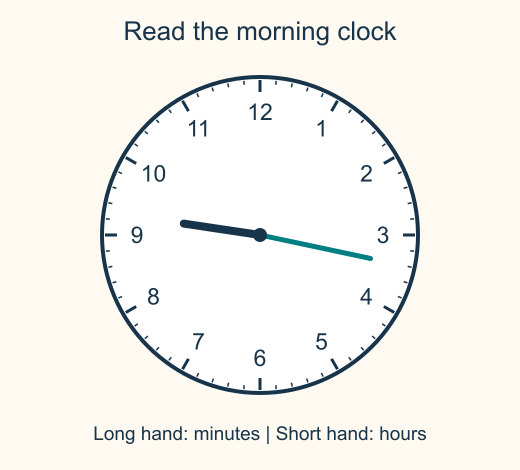
Understand and plan: Part (a) asks for a time of day. Part (b) asks how long an activity lasts. They are separate questions.
For part (a), the long hand has passed the 15-minute mark and moved another two minute marks. The short hand lies between 9 and 10.
Answer to (a): 9:17 am.
For part (b), exchange one hour for 60 minutes, then add the remaining 25 minutes.
60 + 25 = 85
Answer to (b): 85 minutes.
Check: Separate 85 minutes into 60 minutes and 25 minutes again. That restores 1 h 25 min. The clock's hour hand also agrees with a time after nine and before ten.
Don't write “9.17 hours” for the clock reading. A time of day and a duration have different meanings.
Example 3: Choose units and compare masses
Choose a sensible unit for a corridor's length, a large bag of rice's mass and a small packet of biscuits' mass. Then compare two packets labelled 250 g and 180 g. How much heavier is the first packet?
Understand and plan: The first part is about choosing units, so no exact measurements are needed. In the second part, both masses are already in grams.
Suggested units: Metres for the corridor, kilograms for the large rice bag and grams for the small biscuit packet.
These are sensible everyday choices. An object does not have one exclusive unit forever, but some units make its measurement easier to report.
Working:
250 − 180 = 70
Answer: The first packet is 70 g heavier.
Check: 180 g + 70 g = 250 g. The answer describes a difference in mass, so it needs g, not cm or litres.
A larger-looking packet isn't necessarily heavier. Use the given measurements rather than the size of the package in a picture.
Example 4: Compare liquid volumes
Container A holds 2 litres of water. Container B holds 5 litres. How much more water does B hold than A?
Understand and plan: Both quantities describe water currently in the containers, and both use litres. Find the difference between them.
5 − 2 = 3
Answer: Container B holds 3 litres more water than container A.
Check: Two litres plus three litres makes five litres. If one-litre bottles were used to show the amounts, A would need two bottles and B would need five. The three additional bottles show the difference.
Don't infer liquid volume from container height alone. A short, wide container can hold more water than a tall, narrow one. A question needs measurements or a clearly marked scale to support an exact answer.
Common mistakes and how to revisit them
Dropping a zero in money notation. Ask the child to read the cents as a complete amount. Forty cents and four cents should sound different before anything is written.
Treating one hour as 100 minutes. Put 60 minute counters into a group labelled “1 hour”. Add the remaining minutes outside that group, then count the total.
Reading only the short clock hand. Use it to establish the hour, then read the minute marks. Check both hands together before saying the complete time.
Giving a bare number. Ask “70 what?” after the mass example. Naming the unit is part of explaining the answer, not an optional decoration at the end.
Short practice at home
Set up two pretend price tags, such as $2.50 and $2.05. Ask your child to build each amount with play money and explain which costs more. Use only two prices at first, so your child can concentrate on comparing them.
For time, show a clock reading to the nearest minute and ask your child to point to the evidence for each part of their answer. Then use a separate card for a duration such as 1 h 10 min. Its answer is 70 min. Keeping clock readings and durations on separate cards helps distinguish the two ideas.
If subtraction itself is the sticking point, our P2 addition and subtraction guide explains the exchanges with place-value pictures.
For measurement, choose three household objects and ask which quantity could be measured. A bottle has a height and can contain liquid; those are different measurements with different units.
Frequently asked questions
Should my child calculate directly with decimal money amounts?
For these examples, converting to cents makes the quantities clear. Use the method taught at school and keep the value of each part visible.
Does P2 time mean reading only five-minute intervals?
P2 work includes reading to the minute. Five-minute marks remain helpful landmarks; children then count the smaller minute intervals between them.
Should we practise complicated unit conversions?
Start with the unit work assigned at school. This guide concentrates on appropriate units, given measurements and hour/minute or money conversions, without adding later-level compound measurement procedures.
What if my child knows the calculation but chooses the wrong unit?
Ask them to name the quantity before calculating. “We are finding a difference in mass” gives the unit a purpose and often reveals where the confusion began.
Help your child connect the number to its meaning
If your child can subtract 250 − 180 but struggles when grams or cents appear, spend time representing the quantities. More arithmetic questions alone may not explain what the numbers refer to.
Ottodot's Lower Primary Math classes combine teacher-led explanations and worked examples with Roblox-based practice. Parents looking for support with using number skills in everyday problems can Check my child’s fit.