
P1 Number Bonds, Addition and Subtraction: Worked Examples
Explain P1 number bonds, addition and subtraction with four worked examples, tens and ones, checking prompts and practical maths activities to try at home.
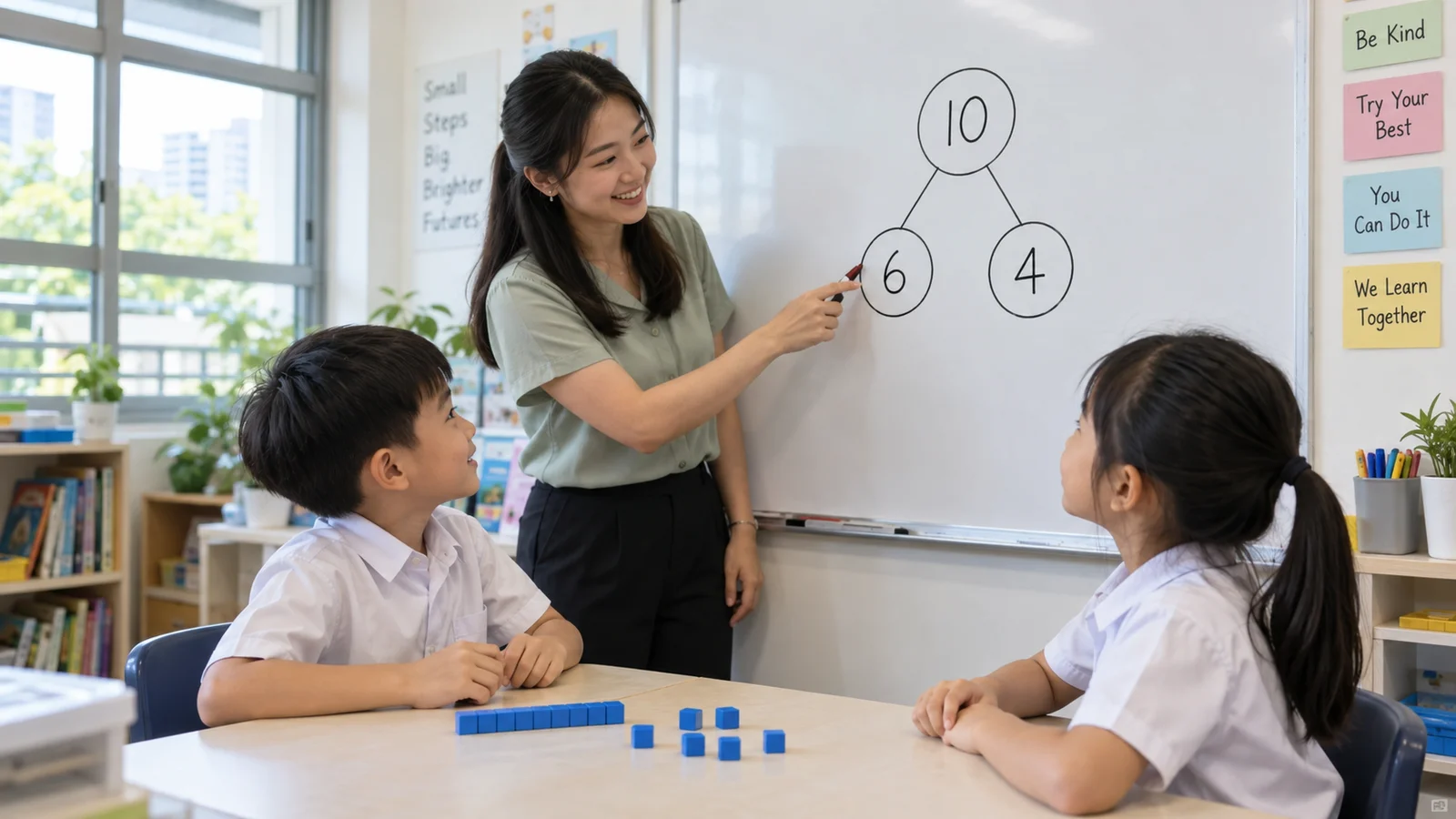
P1 number bonds show how a whole number can be split into parts. They help children add, subtract and explain their answers instead of counting everything from one each time.
This guide gives parents four worked examples, from splitting 14 to subtracting across a ten. If your child can count objects but gets stuck on written calculations, start by making the numbers visible with counters or bundles of ten.
Key Takeaways
A number bond links a whole to its parts.
Ten ones can be exchanged for one ten without changing the total.
Making ten can make an addition easier to see.
A comparison asks for the difference between quantities.
Check subtraction by adding the answer back to the amount taken away.
What P1 number bonds and number work cover
The MOE Primary Mathematics syllabus includes numbers to 100, place value, number bonds, addition and subtraction at Primary 1. The examples here focus on understanding quantities and choosing an operation.
For the wider picture, our Primary 1 Maths overview connects number work with shapes, measurement and graphs. Schools may organise the year's topics differently, so follow your child's current lesson when choosing which example to practise.
Start with tens and ones
In 34, the digit 3 represents three tens, or 30. The digit 4 represents four ones. Swap the digits and 43 represents a different amount. A place-value chart helps show why the position matters.
Bundle ten craft sticks together and leave four loose to make 14. Your child can count the bundle as ten and then count on: eleven, twelve, thirteen, fourteen. The bundle is one object physically, but it represents ten sticks.
Number order also deserves practice. Ask which comes before 40 and which comes after it. In the pattern 21, 23, 25, each number increases by two, so 27 comes next. Let your child describe the change before filling a blank.
Ordinal words describe position: first, second and third. They do not tell us how many objects there are altogether. Line up five toys and ask for the second toy from the left, then the second from the right. Naming the starting side keeps the question clear.
Four worked examples
Use the explanations below as parent prompts. Your child does not need to copy every sentence. A short number sentence, a useful drawing and an answer with the right meaning are enough for these practice questions.
Example 1: Split 14 into tens and ones
Question: Complete a number bond for 14 when one part is 10. What is the other part?
Working: Put out 14 counters. Move ten into a group and leave the rest beside it. There are four counters outside the group.
The whole is 14. Its two parts are 10 and 4:
10 + 4 = 14
Answer: The missing part is 4.
Check: Put the two groups together and count 14. We have rearranged the counters, not added or removed any.
Other number bonds for 14 are possible, such as 7 and 7. Here, the question fixes one part at 10, so only 4 completes that bond. If your child writes another pair, acknowledge that it totals 14 and point back to the given part.
Example 2: Add by making ten
Question: What is 8 + 7?
Working: Start with eight counters. Eight needs two more to make ten. Split the seven counters into 2 and 5, then move two beside the eight.
8 + 2 = 10
10 + 5 = 15
Answer: 8 + 7 = 15.
Check: Count all the counters, or subtract eight from 15 to get seven. Both original amounts must still be present.
Watch for adding all seven after making ten. The two moved counters came from the seven, so only five remain. Ask, “Which counters have we already used?” before asking for another calculation.
Counting on from eight is also a valid way to solve this question. Making ten is useful because it builds a reusable relationship, but it should not become a rule your child follows without understanding the split.
Example 3: Subtract by exchanging a ten
Question: What is 52 − 18?
Working: Show 52 as five tens and two ones. We need to remove eight ones, but only two loose ones are available. Exchange one ten for ten ones.
Now 52 is represented by four tens and twelve ones. The total has stayed the same: 40 + 12 = 52.
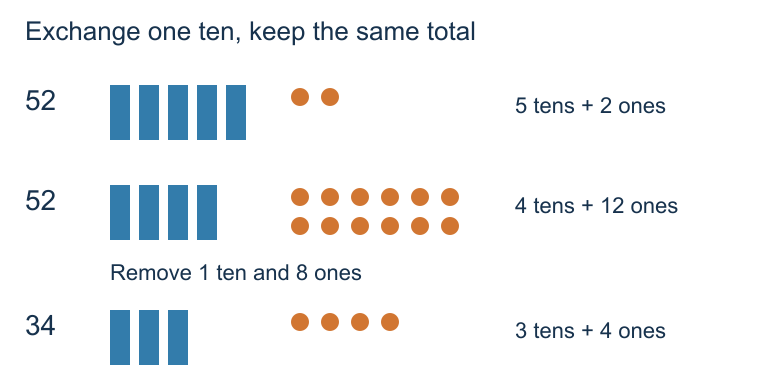
Remove eight ones from twelve ones: 12 − 8 = 4.
Remove one ten from four tens: 4 tens − 1 ten = 3 tens.
Answer: 52 − 18 = 34.
Check: Add back the amount removed: 34 + 18 = 52. The answer is also smaller than 52, as we would expect after taking away a positive amount.
The exchange matters more than the crossing-out marks in a written method. If your child says there are still five tens after gaining ten ones, rebuild 52 with sticks and physically open one bundle. That bundle cannot remain in the tens column as well.
Example 4: Find how many more
Question: Aisha has 23 stickers. Ben has 16 stickers. How many more stickers does Aisha have than Ben?
Working: We are comparing two collections. Match 16 of Aisha's stickers with Ben's 16 stickers. The unmatched stickers are the extra amount.
23 − 16 = 7
Answer: Aisha has 7 more stickers than Ben.
Check: Ben's 16 stickers plus seven more makes Aisha's 23: 16 + 7 = 23.
The word “more” does not automatically mean add. Adding 23 and 16 would find the two collections altogether. Ask your child to show which quantity is missing: a combined total or the gap between the collections.
This comparison also appears in our P1 picture graphs guide, where children compare quantities shown by pictures.
Common mistakes and helpful prompts
If your child confuses the whole with a part, draw one large loop around all the counters and two smaller groups inside. Ask, “Which number counts everything?” Return to the bond only after those quantities are clear.
A child may subtract the smaller digit from the larger digit in each column, turning 52 − 18 into 46. This ignores the meaning of the numbers. Rebuild the exchange and keep the starting amount visible. We are removing 18 from 52, not choosing a new subtraction separately for each digit.
Another mistake is losing the unit in a word problem. An answer of seven could mean stickers, children or groups. Encourage a short answer sentence. It is a check on what the calculation found, not extra writing for its own sake.
Avoid correcting everything at once. If the number model is right but the final addition is wrong, work on that addition. If the arithmetic is right but answers a different question, return to the story.
Short practice at home
Make a “whole and parts” game with ten counters. Hide some under a cup and leave the rest visible. If three are visible, ask how many are hidden. Reveal the cup to check. Change the whole to 12 or 14 when your child can explain the first version comfortably.
For place value, build 36 using three bundles of ten and six loose sticks. Ask your child to make 37, then 47. Discuss which place changed each time. Next, exchange one bundle so that 36 becomes two tens and sixteen ones. Count together to confirm that the amount did not change.
Finish with one comparison: place 12 counters in one row and nine in another, aligned from the same starting point. There are three more in the first row. Cover the unmatched counters and ask your child to predict how many will remain when uncovered.
Frequently asked questions
Should my child stop using fingers?
Not simply because they are in P1. Fingers can support early counting. Add counters, ten-frames and number bonds so your child has ways to see relationships as well as count one at a time.
Is there only one correct number bond?
No. A whole can have several pairs of parts. A question with one given part narrows the answer. For 14 with a part of ten, the missing part must be four.
Must every word problem have a bar model?
No. Use a bar model when it clarifies the relationship. Small collections, a drawing or a number sentence may be clearer for a child still learning what the quantities mean.
What if my child can explain but writes slowly?
Let them explain with objects first, then record one matching number sentence. Separate the number idea from the effort of writing a long explanation. Follow the presentation your child's teacher is teaching.
Support with the step that feels difficult
If your child can count but loses track when exchanging a ten, the useful next step is a clear demonstration followed by supported practice. Ottodot's Lower Primary Math classes combine teacher-led explanations with Roblox-based practice.
To explore whether that format suits your child, Check my child’s fit.