
P1 Multiplication and Division: Groups and Sharing
Help your child understand P1 multiplication and division through equal groups, sharing and four worked examples, with pictures and simple home practice.
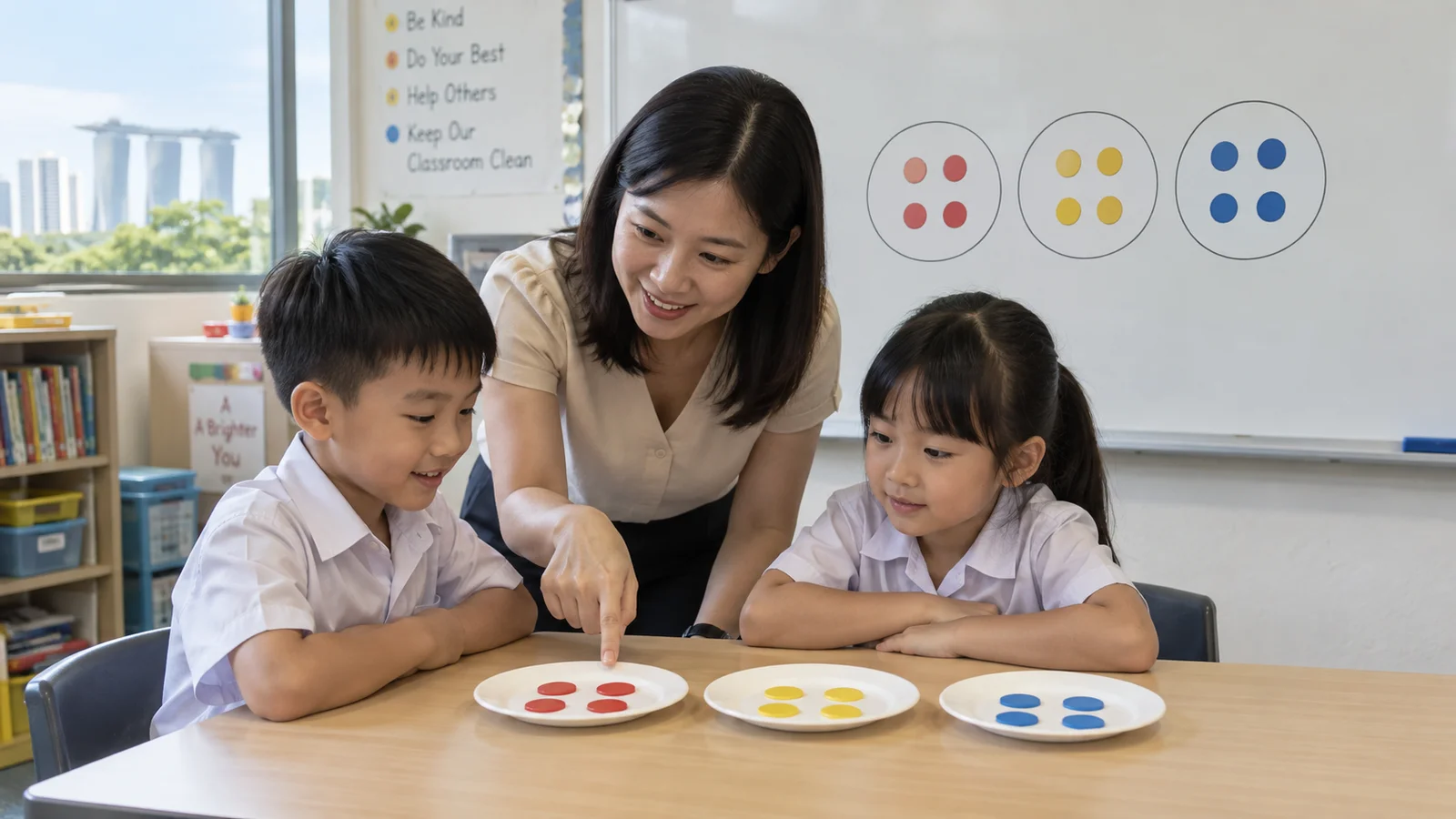
P1 multiplication and division begin with equal groups, sharing and grouping objects. Before asking your child to remember a number sentence, help them see how many groups there are and how many objects belong in each group.
The four worked examples below use plates, bags and counters. They separate two division questions that can sound similar: “How many does each person get?” and “How many groups can we make?”
Key Takeaways
Multiplication can describe equal groups of objects.
Keep the number of groups separate from the number in each group.
Sharing starts with a known number of recipients or groups.
Grouping starts with a known size for each group.
A division answer needs a clear meaning, such as counters each or groups.
What P1 multiplication and division include
The MOE Primary Mathematics syllabus includes multiplication within 40 and division through sharing and grouping within 20 at P1. Multiplication does not begin only in P2. Later work builds on the meaning established here.
Our Primary 1 Maths overview shows how these ideas fit with the year's other topics. For this guide, all groups are equal and the division examples have no objects left over.
What makes a group equal?
Place two counters on each of three paper plates. The groups are equal because each plate has two counters. The plates do not need to be the same colour, but the number of counters on each must be the same.
Now move one counter from the first plate to the second. There are still six counters altogether, but the groups are no longer equal. One has one, another has three, and the last has two. That arrangement cannot be described as three groups of two.
The total stays six even though the arrangement changes. A correct total alone does not show that a child understands equal groups.
Read a multiplication sentence with words
In this guide, 3 × 4 describes three groups of four. Say those words while pointing to the groups. Follow your child's teacher's notation when recording schoolwork, and keep the picture and spoken meaning clear.
Repeated addition connects the new idea with familiar number work: 4 + 4 + 4 = 12. If combining small numbers is still difficult, revisit the making-ten examples in our P1 number bonds guide.
Children do not need to draw every counter forever. The pictures give meaning to the number sentences so that shorter working makes sense later.
Four worked examples
Example 1: Three plates of berries
Question: There are 3 plates. Each plate has 4 berries. How many berries are there altogether?
Working: Draw three plates first. Put four dots inside each plate. Touch each plate as you say, “One group of four, two groups of four, three groups of four.”
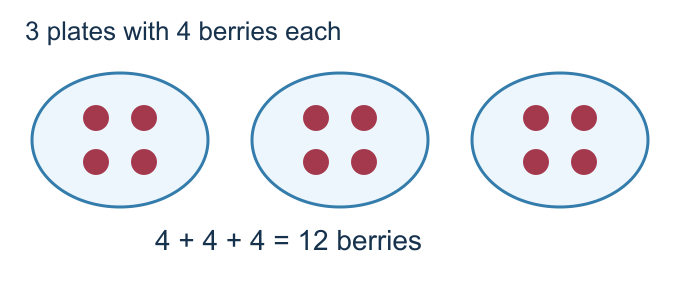
Add the equal groups:
4 + 4 + 4 = 12
We can record the same arrangement as 3 × 4 = 12.
Answer: There are 12 berries altogether.
Check: Count all the berry dots. There should be twelve, and each of the three plates should still have four.
An answer of seven often comes from adding the two numbers in the question: 3 + 4. Ask your child what the three counts and what the four counts. Three plates and four berries per plate are different quantities; the picture shows how they are related.
Example 2: Five bags of counters
Question: There are 5 bags with 6 counters in each bag. How many counters are there altogether?
Working: Make five circles to stand for the bags. Draw six dots in each. Six appears five times in the repeated addition:
6 + 6 + 6 + 6 + 6 = 30
The running totals are 6, 12, 18, 24 and 30. Each total includes one more bag.
5 × 6 = 30
Answer: There are 30 counters altogether.
Check: Pair two bags to make twelve counters and another two bags to make twelve. The last bag has six. Then 12 + 12 + 6 = 30.
This is an equal-groups example within 40. It is not a demand to memorise the entire six-times table before your child understands the bags. If they lose track of the repeated addition, place a tick beside each bag as it is counted.
Example 3: Share twelve among three children
Question: Share 12 counters equally among 3 children. How many counters does each child get?
Working: Set out three mats, one for each child. Give one counter to every mat, then repeat. Keep going until all twelve counters have been shared.
After four rounds, each mat has four counters. There are no counters left in the starting pile.
12 ÷ 3 = 4
Answer: Each child gets 4 counters.
Check: The three shares are equal and 4 + 4 + 4 = 12. We have used every counter exactly once.
The question tells us the number of children. We find the number each receives. If your child makes four piles of three, the total is correct but the arrangement does not yet answer this story. Point to the three mats and ask who would receive the fourth pile.
Example 4: Make groups of five
Question: Put 15 counters into groups of 5. How many groups can you make?
Working: Take five counters from the pile and place them inside one loop. Make another group of five, then a third group of five. No counters remain.
15 ÷ 5 = 3
Answer: You can make 3 groups.
Check: Three groups of five contain 15 counters: 5 + 5 + 5 = 15.
This time the group size is given. We find the number of groups. The answer is three groups, not three counters in each group. Ask your child to circle each finished group and count the circles.
Compare this with sharing 15 counters among five children. That would give each child three counters. The same calculation can describe both situations, but the answer refers to something different.
Common mistakes and what to do next
Unequal groups are easy to miss when a child is focused on getting the total right. Before calculating, ask them to count the objects in each group separately. If the numbers differ, the picture needs fixing first.
A second mistake is counting groups when asked for objects, or objects when asked for groups. Say a complete answer together: “There are three groups.” Then point to the things the word “three” counts. This is more useful than repeating “read carefully” without showing what to look for.
For sharing, a child may hand out a large pile to one recipient and leave too little for the rest. Returning to one counter per person per round makes equal sharing visible. Later, they can distribute larger equal amounts at a time.
If the multiplication symbol causes confusion, keep the spoken description and repeated addition beside it. Removing the symbols briefly can help you check whether the difficulty is the idea or the notation.
Practise with a small collection
Use twelve buttons or counters and three cups. First ask your child to share the counters equally among the cups. Each cup gets four. Empty the cups, then ask them to make groups of four. There will be three groups.
Ask what was known at the start of each task. In the first, you fixed the number of cups. In the second, you fixed the number in each group. Let your child explain with gestures if the words are not ready yet.
For another short task, draw two bags with five counters in each. Ask for the total, then add a third identical bag. Your child can add one more group of five to the earlier total of ten, giving fifteen. They do not have to restart from one.
Stop after a few arrangements and ask your child to invent a matching story. “Three plates with two biscuits each” shows a different kind of understanding from reciting a calculation alone.
Frequently asked questions
Is division part of P1 Maths?
Yes. Sharing and grouping within 20 appear in the P1 syllabus. Use small collections to explain the action before expecting confident written division sentences.
Should I teach times tables first?
Begin with equal groups and connect them to repeated addition. Remembered facts become more useful when your child can explain what the numbers represent. Follow the table practice set by their teacher.
Does every division question mean sharing?
No. Some questions ask how many groups of a given size can be made. In sharing, the number of groups is known; in grouping, the size of each group is known.
What if my child counts every counter?
That is a sensible starting point. After counting, ask them to count in groups and compare the totals. Repeated exposure to equal groups gives them a reason to use shorter methods.
Help with turning a story into groups
If your child can count but mixes up “groups” and “in each group”, focus on drawing the story before calculating. Ottodot's Lower Primary Math classes pair teacher explanations with Roblox-based practice.
For a next step suited to your child's learning needs, Check my child’s fit.