
P1 Money, Time and Length: Everyday Maths Examples
Practise P1 money, time and length with worked examples for counting coins, reading clocks, half-hour durations and measuring accurately in centimetres.

P1 money, time and length questions ask children to connect numbers with units. A child needs to know whether 20 means cents, minutes or centimetres before deciding how to read or calculate an answer.
This guide explains four everyday examples: counting coins, reading an analogue clock, finding a half-hour later and measuring a ribbon. Each includes a check you can try with your child.
Key Takeaways
Count the value of coins, not only the number of coins.
The minute hand and hour hand have different jobs.
Each step between neighbouring clock numbers represents five minutes for the minute hand.
Half an hour is 30 minutes.
Measure from the ruler's zero mark, which may be inside its physical edge.
What P1 money, time and length cover
The MOE Primary Mathematics syllabus includes counting cents to $1 and dollars to $100, measuring in centimetres, reading clocks at five-minute intervals, using am and pm, and working with hour and half-hour durations at P1.
The Primary 1 Maths overview connects these everyday skills with the rest of the year's Maths. This guide keeps money examples in cents or whole dollars; it does not require a general lesson on decimal calculation.
Give the unit a meaning
Ask your child to finish the sentence “This number tells us how many…”. For coins, the answer may be cents. For a ruler, it is centimetres. On a clock, the numbers need more care because the two hands use the face differently.
Keep tools nearby. Actual coins or clearly labelled paper coins let a child sort by value. A teaching clock lets them move both hands together. A ruler shows that length is made of equal spaces, not a count of the printed labels.
Choose one of these topics for a short practice session. Choose the one that matches the current homework, and come back to the others when there is a natural opportunity.
Money: count values rather than objects
A 50-cent coin has a greater value than a 10-cent coin, although each is one coin. Five 10-cent coins have the same total value as one 50-cent coin. Arrange the smaller coins in a row so your child can count 10, 20, 30, 40, 50.
For whole dollars, a $10 note and a $5 note make $15. Write $10 + $5 = $15 and read the unit aloud. A dollar sign belongs before the number. When working in cents, write 90c or 90 cents consistently.
If adding the values is the difficult part, use the splitting ideas in our P1 number bonds guide. Keep the money labels attached so the calculation still answers the original question.
Example 1: Count three coins
Question: Mei has a 50-cent coin and two 20-cent coins. How much money does she have?
Working: Read the value on each coin. There are three coins, but their values are 50 cents, 20 cents and 20 cents.
50c + 20c = 70c
70c + 20c = 90c
Answer: Mei has 90 cents.
Check: Count the two 20-cent coins first. They make 40 cents. Then 50c + 40c = 90c. The two methods agree.
If your child answers three cents, ask them to read the labels rather than count the pieces. If they answer 70 cents, touch each coin as it is included; one 20-cent coin may have been missed.
Time: read both hands
The longer hand shows minutes. When it moves from 12 to 1, five minutes have passed. At 2, it shows ten minutes past; at 3, fifteen minutes past. Continue counting in fives around the face.
The shorter hand shows the hour and moves gradually as time passes. At 7:25, it is between 7 and 8, rather than pointing exactly at 7. Ask which hour the hand has already passed.
An analogue clock face alone does not show whether it is morning or evening. The story supplies that information. Use am for a morning time such as breakfast at 7:25 am, and pm for an afternoon time such as 3:00 pm.
Example 2: Read 7:25 am
Question: The clock shows the time Mei eats breakfast in the morning. What time is it?
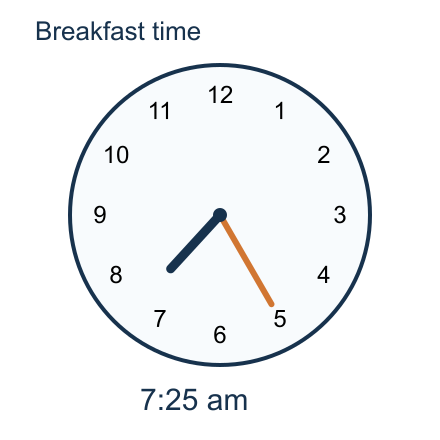
Working: The short hand is past 7 and has not reached 8. The hour is seven. The long hand points to 5. Count five-minute steps from 12: 5, 10, 15, 20, 25.
Answer: It is 7:25 am.
Check: Twenty-five minutes is five minutes before half past seven. The minute hand is one numbered step before 6, where half past would be shown. The hour hand is still between 7 and 8.
Do not read the long hand's 5 as five minutes. The printed clock numbers name hours; for minute reading, each numbered step represents five minutes.
Example 3: Find half an hour later
Question: A drawing activity starts at 3:00 pm and lasts half an hour. What time does it end?
Working: Half an hour is 30 minutes. Start with the minute hand at 12 and move it halfway around the clock to 6. The hour hand moves halfway from 3 towards 4.
3:00 pm + 30 minutes = 3:30 pm
Answer: The activity ends at 3:30 pm.
Check: Two half-hours make one hour. Another half-hour after 3:30 pm would bring us to 4:00 pm. Our first move should therefore stop halfway between 3:00 pm and 4:00 pm.
A duration tells us how long something lasts. A clock time tells us when something happens. “Half an hour” answers a different question from “3:30 pm”, even though they belong to the same story.
Length: line up with zero
A centimetre is the length of one interval between neighbouring whole-centimetre marks on a ruler. Between 0 and 1 is one centimetre. Counting the labels 0 and 1 as two marks would not give the length of that space.
Place a straight object alongside the ruler. Keep its edge parallel to the scale and look straight down at the endpoint. A ruler tilted away from the object makes the endpoint harder to read accurately.
Example 4: Measure and draw eight centimetres
Question: A ribbon starts at 0 on the ruler and ends at 8. How long is it? Draw a line of the same length.
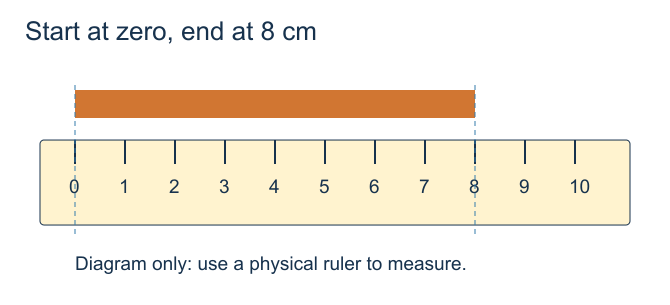
Working: The ribbon spans eight one-centimetre spaces from 0 to 8.
Answer: The ribbon is 8 cm long.
To draw a matching line, make a small mark at 0 and another at 8 on the ruler. Hold the ruler steady and join the marks along its straight edge. Label the line 8 cm.
Check: Place the zero mark at the start of the drawn line again. Its other end should reach 8. Do not start at the physical edge of the ruler if that edge comes before the zero mark.
The image explains alignment; it is not a ruler to measure from your screen. Its displayed size can change across devices. Use a physical ruler for the drawing task.
Common mistakes and useful fixes
When money answers mix dollars and cents, ask your child to say the unit after each amount. Keep a cents-only question separate from a dollars-only question while the labels become familiar.
If clock hands are reversed, compare their lengths before reading either one. Then ask the hour question and minute question separately. There is no need to guess the whole time at once.
For rulers, watch the start as carefully as the end. A child can read the endpoint correctly while starting the object before zero. Move the object back to zero and let them see why alignment changes the reading.
Small activities at home
Make a paper shop with prices of 30c, 50c and 70c. Use labelled paper coins and ask for two different ways to make 50c. Five 10-cent coins and a 20c + 20c + 10c combination both work. Count every combination to check it.
At a whole hour, ask what the clock will show half an hour later. Move a teaching clock together, keeping both hands moving correctly. For length, draw a 6 cm line and let your child check it with a ruler. Then swap roles and check a line they draw.
Frequently asked questions
Is P1 time limited to o'clock and half past?
No. The syllabus also includes telling time at five-minute intervals. Whole hours and half-hours are useful starting points, but they are not the complete P1 scope.
Must my child use decimal money notation here?
These examples can be solved in cents or whole dollars. Keep the meaning of the coins clear before adding a new notation task. Follow the notation used in the current school lesson.
Why does the hour hand move between numbers?
It moves as the hour passes. At half past three, it is halfway from 3 to 4. Keeping it fixed on 3 would give an inaccurate model of the clock.
Can we measure with a printed ruler?
Only if its scale has been printed accurately. Page resizing can change it. A physical ruler is a simpler choice when your child is learning to measure and check centimetres.
Support with reading before calculating
If your child can add but misreads coins, hands or ruler marks, practise identifying the quantity first. Ottodot's Lower Primary Math classes combine teacher explanations with Roblox-based practice.
To explore whether this learning format suits your child, Check my child’s fit.