
Are Roblox Math Games Actually Educational? What Singapore Primary School Parents Need to Know
Your child has logged another two hours on Roblox. The screen glows, characters dash around, and your child is entirely absorbed. Your first instinct might be to call time, but a second thought surfaces: what if this is not the problem you think it is? Singapore parents are raising the first generation of children for whom a video game platform feels as natural as a textbook. Roblox has over 88 million daily active users globally, with a large proportion of those players under 13 years old....
Your child has logged another two hours on Roblox. The screen glows, characters dash around, and your child is entirely absorbed. Your first instinct might be to call time, but a second thought surfaces: what if this is not the problem you think it is?
Singapore parents are raising the first generation of children for whom a video game platform feels as natural as a textbook. Roblox has over 88 million daily active users globally, with a large proportion of those players under 13 years old.
The question worth asking is not whether children will spend time on this platform, but whether that time can count for something. The research on game-based learning, what separates structured educational play from casual play, and how the MOE syllabus fits inside a Roblox game are all addressed below.
The Research on Game-Based Learning
Before looking at any specific product, the research is worth examining on its own.
A 2012 study published in the Mathematics Education Research Journal found that students spent 93% of class time on task during game-based learning sessions, compared with 72% during conventional instruction. That is not a marginal improvement. For parents who have watched their child drift off during a tuition worksheet, the gap between 72% and 93% represents the difference between passive exposure and active engagement.
Separately, 74% of teachers surveyed reported that digital game-based learning improves their students' mathematical outcomes. A national survey on teaching with digital games, published by the Joan Ganz Cooney Center, found that game-based learning produced better conceptual understanding and student participation compared with conventional instruction.
Roblox itself operates an Education platform designed specifically for structured learning. The resources on that platform are described by Roblox as "standards-aligned experiences" built in consultation with curriculum experts, not informal content created by game developers.
None of this means every Roblox game is educational. The research supports the method, not the platform indiscriminately. What matters is how the game is used, and by whom.
What Makes a Roblox Math Game Actually Educational?
The Difference Between Playing and Structured Game-Based Learning
A child playing Roblox on a Saturday afternoon is making free choices about where to spend in-game currency, how to navigate a world, and which missions to attempt. Some spatial and logical thinking happens incidentally. That is not game-based learning.
Structured game-based learning places specific curriculum objectives inside game mechanics so that a student cannot progress without applying the targeted skill. The game is the method of instruction, not a reward after instruction is complete. The distinction is important because it explains why two children can spend the same number of hours on Roblox and emerge with very different academic outcomes.
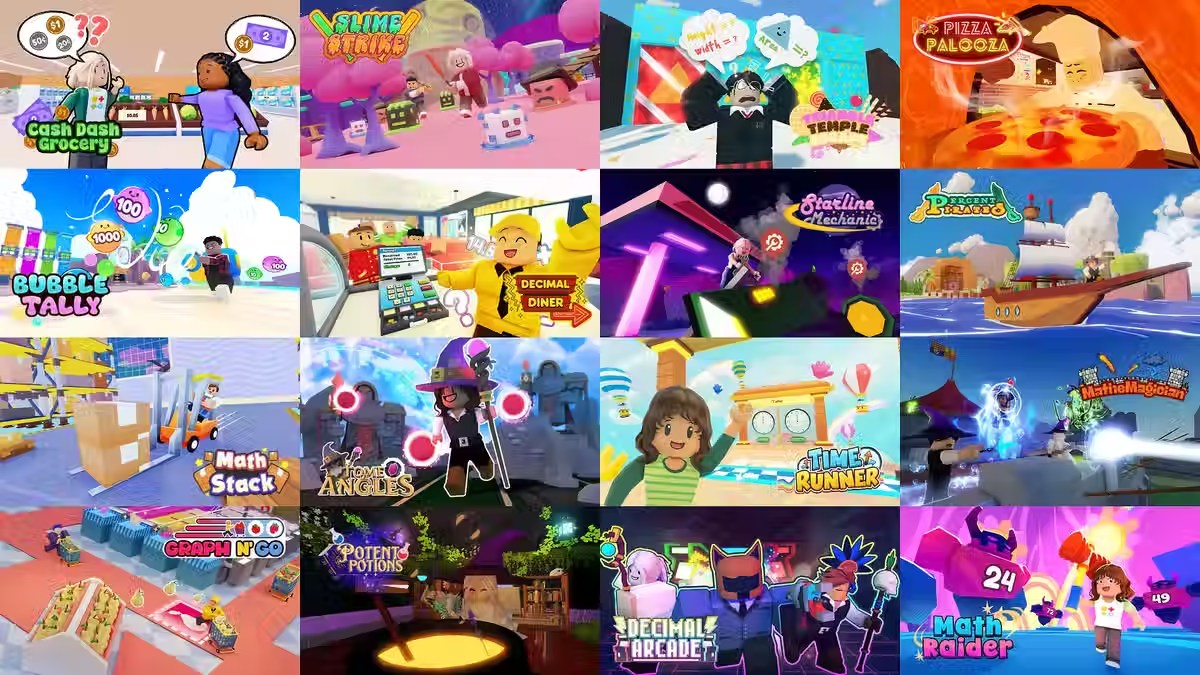
Ottodot builds its classes and games around this distinction deliberately. The games are not chosen from a library of educational titles; they are built in-house, with MOE syllabus objectives mapped to specific gameplay mechanics. Completing a level requires applying a concept, not just clicking faster.
How Singapore's MOE Syllabus Fits Inside a Roblox Game
This is the question most parents actually need answered, because it is the place where scepticism is most legitimate. Saying "Roblox teaches math" is a claim. Showing exactly which MOE topics appear in which game mechanic is evidence.
Here is how specific Primary school topics from the MOE syllabus appear inside Ottodot's Roblox games.

Bar graphs (P3 Math): In Graph and Go, students must correctly read bar graphs to complete delivery missions inside the game. A customer order requires interpreting the correct bar height, reading the scale accurately, and calculating differences between categories. If the student misreads the scale or confuses the axis labels, the mission fails. The game forces the same analytical steps that appear in P3 exam questions: identifying the range, calculating totals, and interpreting differences.
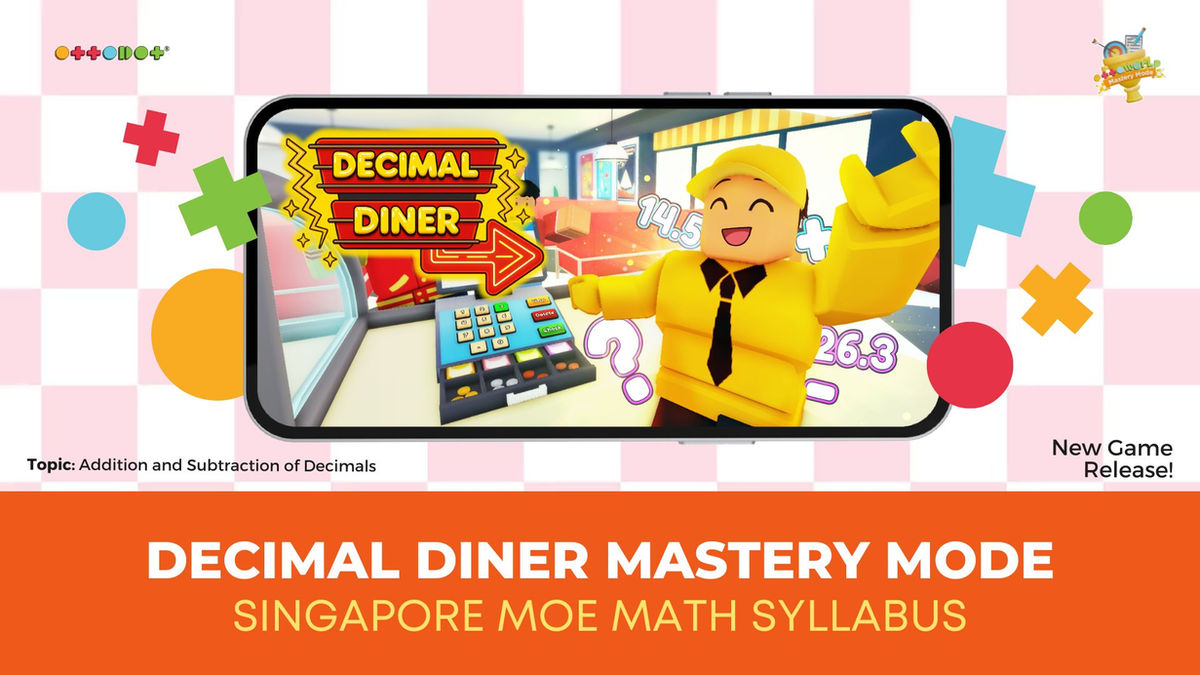
Decimal operations (P4 Math): In Decimal Diner, students play the role of a cashier. Customer orders require addition of decimal amounts, and giving correct change requires subtraction with decimal alignment. The game creates time pressure, which builds mental arithmetic fluency, but more importantly it embeds the "Golden Rule of Alignment" that P4 students must master: decimal points must be perfectly stacked before adding or subtracting. A calculation error in the game produces a wrong order and a departing customer, which is the kind of immediate, concrete consequence that reinforces the rule.

Fractions (P2 and P4 Math): Fraction Action builds fraction identification and comparison into gameplay decisions. For younger students learning fractions as equal parts of a whole, the game presents visual scenarios where the student must match a fraction to the correct shaded shape. For older students, the scenarios require comparing and ordering fractions, mirroring the P4 syllabus emphasis on equivalent fractions and mixed numbers.

Geometry and angles (P5 Math): In Triangle Temple Escape, students need to escape the temple ruins by applying their knowledge in finding the area of a triangle. The game reinforces the 180-degree angle sum rule and the properties of isosceles triangles, both of which appear in P5 and PSLE exam questions. Students learn to chain properties logically, which is precisely what the MOE heuristic approach to geometry requires.

Time (P1 and P2 Math): Time Runner incorporates foundational number skills into an obstacle course for students. These games help P1 and P2 students practice reading time on analog clocks and converting seconds, minutes, and hours.

Heuristics and problem-solving (P4 to P6): Math Kaboom presents multi-step problems where students must choose and apply the correct heuristic approach: working backwards, drawing a diagram, or using guess and check. These are the same heuristics examined in PSLE Math. The game structure means students encounter multiple question types in a single session, which builds the pattern recognition that heuristics training requires.
These are not incidental learning experiences. Each game was designed so that the MOE topic is the entry requirement, not a side effect of play.
How Ottodot's Roblox Math Classes Work
Live Classes Inside Roblox: What a Session Looks Like
When a student attends an Ottodot class, they log into Roblox and join a private, teacher-controlled server. They are not on the public Roblox platform. They are in a dedicated learning environment that happens to use Roblox as its classroom.
The teacher leads the session live. The class follows the "I Do, We Do, You Do" structure: the teacher models a concept, the class works through examples together, and then students apply the concept independently inside a game challenge. A typical session runs 45 to 60 minutes and covers one focused MOE topic, starting with a pre-quiz to establish a baseline and ending with a post-assessment to confirm what has been retained.
Real-time feedback is built into the structure. The teacher observes which students are struggling with a particular mechanic, pauses play to address common misconceptions, and then resumes. This is teaching, with Roblox as the medium. For more detail on what a session involves, see how Ottodot's Roblox classes work.
The homework that follows each class is a tiered digital quiz: Tier 1 tests basic concept recognition, Tier 2 tests calculation accuracy, and Tier 3 requires multi-step application similar to PSLE-style word problems. Students who complete homework earn Tickets redeemable for Robux, which provides motivation without undermining the academic purpose.
Interactive Resources on the Resource Hub
Between live classes, students can access hundreds of Math and Science resources on Ottodot's resource hub. These are organised by subject, level (P1 to P6), and resource type: PDF worksheets, interactive quizzes, and Roblox-based games.
The 64 Math resources cover every MOE topic from P1 number bonds through to P6 ratio and percentage. The 105-plus Science resources cover the full P3 to P6 Science syllabus, including systems, cycles, diversity, and interactions. Every resource on the hub is mapped to a specific MOE syllabus objective.
No other primary school tuition provider in Singapore offers anything comparable. Browse free, no sign-up needed — though some resources are members-only.
Who Is Ottodot For? P1 to P6, Ages 7 to 12
Ottodot's online Math classes cover Primary 1 through Primary 6. Science classes run from Primary 3 to Primary 6, which aligns with the MOE syllabus introduction of Science at P3. Ottodot also offers Science classes covering the full upper primary Science syllabus.
The content is levelled by school year, not by a general difficulty setting. P1 and P2 content stays within the lower primary scope. P5 and P6 content includes PSLE-specific heuristics and the structured approaches that the examination tests. A P3 student and a P6 student are not doing the same content inside the same game; they are playing at the level appropriate to their MOE syllabus year.
Answering Parent Concerns Directly
"Is This Just Playing Games?"
The MOE syllabus is the foundation of every Ottodot class. The games are how the content is delivered, not what replaces it. The game mechanic is designed so the student fails if they apply the wrong mathematical procedure.
The distinction between Ottodot and unstructured Roblox play is the same distinction between a PE lesson and recess. Both happen outdoors. Both involve movement. Only one is structured to achieve a specific developmental objective.
"Is Roblox Safe for My Child?"
This is a reasonable concern and it deserves a direct answer. Ottodot classes take place on private, teacher-controlled Roblox servers. Students do not have access to the public Roblox platform during a class session. They cannot be contacted by strangers.
The only communication that takes place is between students and the teacher, within a supervised, closed environment. Sessions are time-limited and structured, like any class period. Roblox itself provides parental controls that allow parents to restrict chat, limit screen time, and control which experiences their child can access. Ottodot's closed server adds a further layer above the platform's own controls.
For parents who are newly setting up Roblox for their child, Ottodot's team helps with the setup process before the first session.
"Will This Prepare My Child for PSLE Math?"
The heuristics tested in PSLE Math are present in every upper primary Ottodot class. Working backwards, guess and check, drawing a diagram, assuming a value, and the before-and-after model are all taught explicitly and then practised inside game scenarios that require their application.
The bar model is embedded into inventory and comparison mechanics across multiple games, so students practise visual-spatial reasoning in the same way they would on a worksheet, but within a context that maintains their attention. A student who has spent several months practising bar model thinking inside a game will recognise bar model problems in an exam paper, because the underlying structure is identical.
Children who disengage from worksheets often engage with the same mathematical content when it is delivered through gameplay. The method changes; the MOE syllabus content does not.
"How Is This Different from Just Letting My Child Play Roblox?"
There is a teacher. There is a curriculum. There are specific MOE learning objectives for each session. There is a pre-assessment and a post-assessment to confirm what the student has learned. There is levelled homework that progresses from concept recognition to PSLE-style application.
When a child plays Roblox without a class, none of those elements are present. The game is entertainment. When a child plays Roblox in an Ottodot class, the game is the classroom. The teacher designed the experience to produce a specific learning outcome. That outcome is assessed within the same session.
Ottodot vs. Conventional Tuition: A Practical Comparison
Factor | Conventional Tuition | Ottodot Roblox Classes |
Engagement | Variable; dependent on child's willingness to sit and focus | High; children are motivated to progress in the game |
MOE alignment | Yes, for established providers | Yes; all content built to MOE P1–P6 syllabus |
Live teacher | Yes | Yes; teacher leads every session in real time |
Heuristics training | Taught through worksheets and model answers | Taught through game scenarios requiring heuristic application |
Bar model practice | Worksheet-based; static | Embedded in inventory and comparison game mechanics |
Screen time | Zero in-class screen time | Structured, time-limited; Roblox is the classroom |
Child enjoyment | Mixed; many children resist worksheets | Generally high; children choose to play Roblox voluntarily |
PSLE readiness | Yes; all upper primary providers target PSLE | Yes; upper primary content explicitly targets PSLE heuristics and question types |
Practice between classes | Homework worksheets | Hundreds of interactive games accessible at any time |
Entry point | Typically three-month enrolment minimum | Single trial class; no prior commitment |
For children who engage readily with worksheets, conventional tuition works. For children who resist homework, become disengaged in class, or need a different entry point into the material, Ottodot delivers the same MOE content through a medium their child already chooses to use.
Try a Roblox Math Class
The quickest way to find out whether Ottodot works for your child is to attend a class.
A start the quiz involves no further commitment. The session follows the same structure as a regular Ottodot class: your child logs into Roblox, joins Ottodot's private server, meets the teacher, completes a pre-quiz, works through a live MOE-aligned lesson using game mechanics, and finishes with a post-assessment. Parents are welcome to observe.
Before booking, there is no barrier to exploring Ottodot's resources. The resource hub is free to access and contains games across every P1 to P6 Math and Science topic. Your child can try Graph and Go, Decimal Diner, or Fraction Action before setting foot in a class.
To view subscription options after the trial, see Ottodot's plans and pricing.
Frequently Asked Questions
Is Roblox actually educational for primary school children?
Roblox can be educational when it is used as a structured instructional medium rather than as unstructured free play. The research on game-based learning consistently shows higher engagement rates and improved outcomes in mathematics when gameplay is tied to specific curriculum objectives. The critical factor is whether the game has been designed to require the application of a specific skill, and whether a qualified teacher is guiding the session. On its own, Roblox is a games platform. Inside an Ottodot class, it is the classroom.
Is Ottodot suitable for all levels from P1 to P6?
Math classes run from P1 to P6. Science classes run from P3 to P6, which is when MOE introduces Science in the primary school syllabus. Content at each level is matched to that year's MOE syllabus scope. A P1 student learns number bonds and simple addition within game mechanics designed for that level. A P6 student works through PSLE heuristics, ratio problems, and multi-step percentage questions inside game scenarios designed for upper primary difficulty.
View our Lower Primary Math Programme here
View our Upper Primary Math Programme here
What This Means for Your Child
Screen time and academic progress do not have to be in tension. The platform your child already chooses to use can, with the right structure behind it, deliver the MOE syllabus in a format that holds their attention through an entire 45-minute session.
Ottodot is Singapore's only primary school tuition provider using Roblox as its classroom. Its games are purpose-built for the MOE syllabus, its teachers are qualified and present in every session, and its resource hub gives students hundreds of games to practise between classes. The trial class requires no further commitment.
If your child spends time on Roblox regardless, the question is whether that time can also serve their education. start the quiz and find out.