
Math games for primary school kids that follow the MOE spiral curriculum
Most parents notice the same thing around Primary 3: the math that felt manageable suddenly feels hard. Fractions arrive. Word problems get longer. Multiplication tables need to be sharp. And homework, which used to take 20 minutes, now takes an hour, with tears. This isn't a sudden jump. It's the MOE spiral curriculum doing exactly what it was designed to do. Ottodot's math games are built around the same spiral. Every game your child plays maps to the exact MOE topic they're covering in...
Most parents notice the same thing around Primary 3: the math that felt manageable suddenly feels hard. Fractions arrive. Word problems get longer. Multiplication tables need to be sharp. And homework, which used to take 20 minutes, now takes an hour, with tears.
This isn't a sudden jump. It's the MOE spiral curriculum doing exactly what it was designed to do.
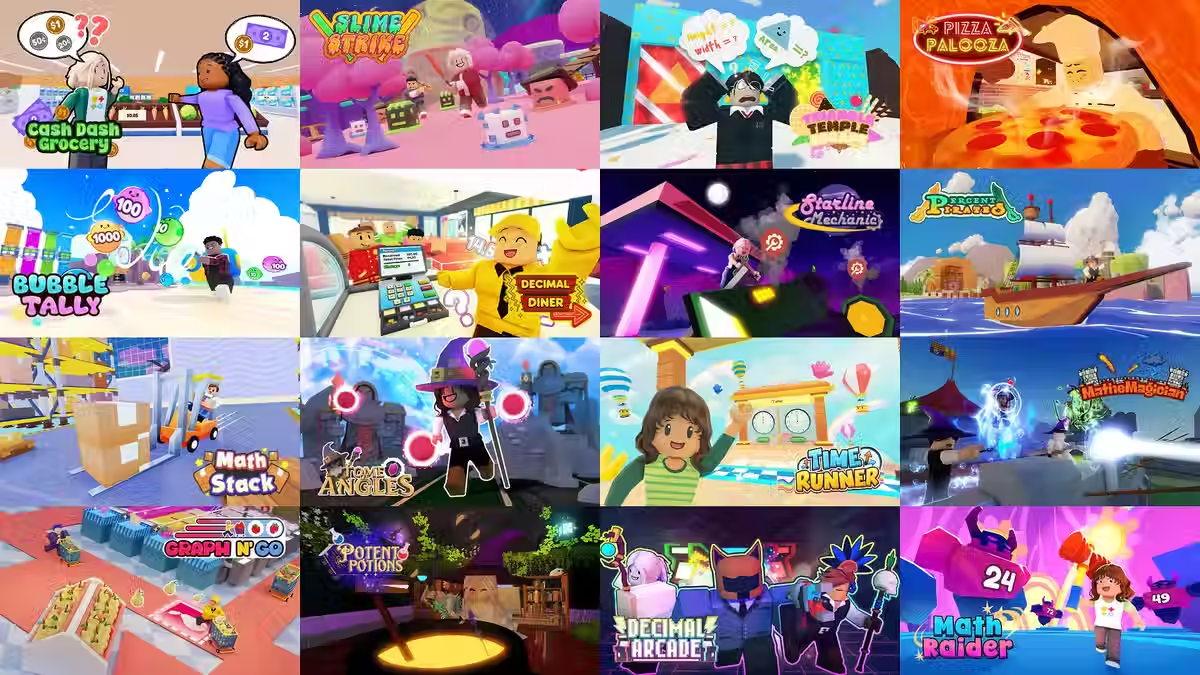
Ottodot's math games are built around the same spiral. Every game your child plays maps to the exact MOE topic they're covering in school -- the right concept, at the right level, in the right order.
Join 1,000+ students learning primary school math through Roblox gameplay.
What is the MOE spiral approach, and why does it matter?
Singapore's primary math curriculum is built on a principle called the spiral curriculum. Rather than teaching a topic once and moving on, MOE introduces concepts early and revisits them at every level, each time going deeper.
The MOE's 2021 Primary Mathematics Syllabus describes the curriculum as designed so "concepts and skills in each content strand are revisited and built upon at each level to achieve greater depth and understanding."
Here is how that plays out across six years of primary school:
P1: Numbers to 100, basic addition and subtraction (foundation level)
P2: Multiplication tables (2, 3, 4, 5, 10), halves, thirds, quarters -- revisits numbers, addition, subtraction
P3: Multiplication tables (6-9), equivalent fractions, area and perimeter -- revisits fractions, multiplication, basic operations
P4: Mixed numbers, decimals (to 3 decimal places), angles, pie charts -- revisits fractions, multiplication tables, measurement
P5: Fractions (four operations, unlike denominators), percentage, rate, area of triangle -- revisits decimals, measurement, problem-solving
P6: Ratio, algebra, circles, percentage increase/decrease -- revisits all prior strands, PSLE preparation
A child who doesn't firmly grasp P3 fractions will struggle with P4 mixed numbers, then again with P5 fraction operations, then again with P6 ratio problems. Each gap compounds.
One-shot revision doesn't fix this. The spiral demands consistent practice at every level, for every concept, over time.
How Ottodot's math games follow the spiral
Ottodot's game library is built level by level, following the same progression MOE uses. Each game targets a specific concept at a specific primary level, so when your child plays, they're reinforcing what their teacher covered in class that week. This isn't coincidence -- Ottodot's curriculum was built by experienced MOE teachers.
P1: numbers to 100
In Crystal Blasters, children shoot crystals and defeat enemies using numbers up to 100. The game requires number recognition, ordering, and comparison -- the same thinking the P1 syllabus is building.
P2: multiplication tables and money
Math Stack has children construct equations step by step to solve word problems, which is exactly what P2 teachers are working on. Separate money minigames (converting dollars and cents, counting to 1,000) give children a second pass at material from class.
P3: fractions, multiplication tables extended, word problems
P3 is where the workload jumps. Multiplication tables at P2 cover 2, 3, 4, 5, and 10. At P3, the 6, 7, 8, and 9 times tables are added. Fractions come in properly. Area and perimeter are introduced. Three games cover this level:
Math Kaboom has children demolish buildings by solving multiplication and division problems step by step
Math Raider puts multiplication table practice inside a fast-paced action game
Fraction Action has children build fractions from pizza slices and serve customers - concrete and visual, before the concept becomes purely abstract on paper
P4: decimals and mixed numbers
In Decimal Diner, children serve restaurant customers using decimal addition and subtraction. A three-decimal-place problem becomes a task with a clear purpose. That's the MOE's own Concrete-Pictorial-Abstract (CPA) approach built into gameplay rather than described in a textbook.
P5: fractions across all four operations, percentage, rate
P5 is where many children hit the wall. Fractions now require all four operations across unlike denominators. Percentage and rate appear for the first time. P5 games on the resource hub help build the fluency children need before fraction operations can click into place.
P6: PSLE preparation
At P6, everything converges. Ratio, algebra, and circles arrive. Every strand from P1 through P5 is needed at once for PSLE problem-solving. Ottodot's P6 classes and games work on this integration: heuristics, multi-step word problems, and the kind of reasoning the PSLE actually tests.
Why kids fall behind isn't what parents think
Children who struggle at PSLE rarely lack ability. More often, the spiral fell behind somewhere around P3 or P4, and nobody caught it in time.
Every unmastered concept becomes a gap at the next level. P3 equivalent fractions not fully there? P4 mixed numbers will be harder. P4 harder? P5 fraction operations will be harder still. By P6, the problem is three or four levels deep.
The other problem is motivation. Worksheets and traditional tuition struggle to hold a primary school child's attention for long. Homework resistance isn't a character flaw -- it's a predictable response to repetitive, low-engagement practice. Most parents know this already.
Ottodot uses Roblox because children already choose to be there. When the practice happens inside a game they'd play anyway, the resistance largely goes away.
"Before Ottodot, we wondered why so many kids dread homework and find learning a chore. We discovered that we can make learning as fun as video games." -- Wong Le Yi, Ottodot co-founder, PEAK Magazine
What parents notice after a few weeks
"My P4 son used to take forever to do his math homework. After two months with Ottodot, he actually asks to do his math games. His SA1 results improved by 15 marks." -- Parent of a P4 student, Singapore
"I was sceptical about learning through games. But the games are genuinely teaching the MOE syllabus. My daughter came home and explained decimals to me using the restaurant game. I couldn't believe it." -- Parent of a P4 student, Singapore
Parents report children asking to practise math instead of avoiding it, better multiplication table fluency, fewer meltdowns over word problems, and less resistance to tuition overall.
How it works
Try a trial class first -- one session with a live Ottodot teacher. Your child plays, learns, and you see the format before committing to anything.
From there, students join live online classes (P1-P6 for Math, P3-P6 for Science), taught by experienced MOE teachers inside Roblox. Between sessions, the resource hub is open anytime -- hundreds of interactive math and science games mapped to every MOE topic. Free to browse; some resources are members-only.
No new app to install. Roblox is free to download, and most primary school children have already used it.
How Ottodot compares
Delivery: Roblox gameplay + live classes (vs classroom worksheets or video call slides)
MOE alignment: Every game mapped to syllabus
Practice between classes: Hundreds of interactive games (vs worksheets or recorded videos)
Child engagement: High -- Roblox is where they play
AI science support: Free AI open-ended question (OEQ) tutor included
Schedule: Flexible online (vs fixed physical location or fixed schedule)
Minister Edwin Tong has cited Ottodot as an example of genuinely innovative primary school education. Not a standard tuition class with Roblox as decoration, but a curriculum built from the ground up around how children actually want to spend their time.
Read more about Ottodot's approach
Ready to try?
The spiral doesn't wait. Every term, concepts compound. The children who stay on top of it are the ones with consistent, well-matched practice at each level.
One class. No long-term commitment until you've seen how your child responds.
Ottodot is a Singapore-founded online tuition programme teaching MOE-aligned Math and Science through Roblox gameplay. Serving students in Singapore and Hong Kong, P1-P6.
MOE spiral curriculum reference: MOE 2021 Primary Mathematics Syllabus | TIMSS 2015 Singapore Mathematics Curriculum Overview